Why we love old movie locations — especially the Iverson Movie Ranch

For an introduction to this blog and to the growing interest in historic filming locations such as the Iverson Movie Ranch — the most widely filmed outdoor location in movie and TV history — please read the site's introductory post, found here.
• Your feedback is appreciated — please leave comments on any of the posts.
• To find specific rock features or look up movie titles, TV shows, actors and production people, see the "LABELS" section — the long alphabetical listing on the right side of the page, below.
• To join the MAILING LIST, send me an email at iversonfilmranch@aol.com and let me know you'd like to sign up.
• I've also begun a YouTube channel for Iverson Movie Ranch clips and other movie location videos, which you can get to by clicking here.
• Readers can email the webmaster at iversonfilmranch@aol.com
.

Showing posts with label Adventures of Kit Carson. Show all posts

Thursday, December 17, 2009

Classic Rock: The Cul de Sac Crew

"The Golden Stallion" (1949): Scene filmed in what is now a cul de sac

The above shot is taken from the Roy Rogers movie "The Golden Stallion," in which the plot revolves around Roy's beloved horse Trigger being accused of killing a guy. 

Along with a really sweet woodie, the shot showcases the Cul de Sac Crew, a rock feature on the former Upper Iverson Movie Ranch in Chatsworth, Calif. The tall triangular rock noted here is the feature's defining "character."

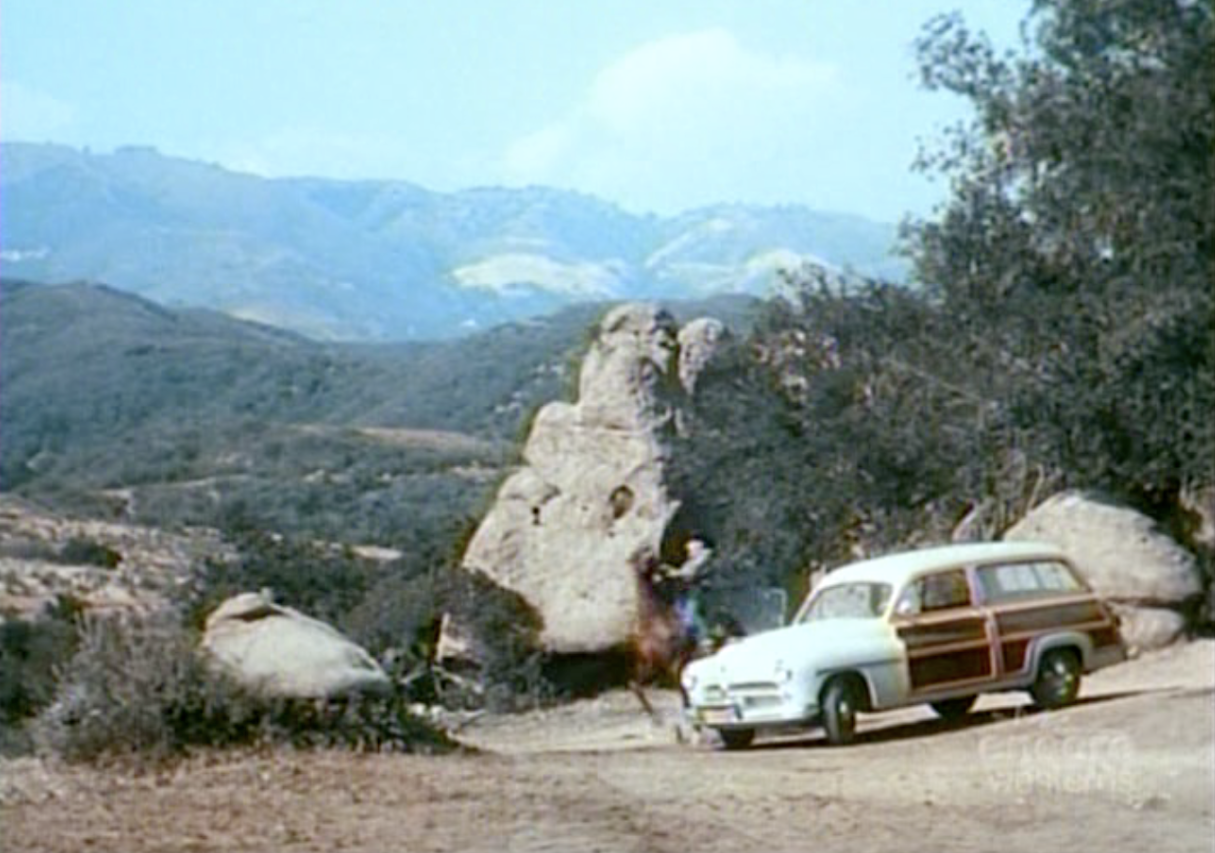
"The Adventures of Kit Carson": episode "The Baron of Black Springs"

This shot comes from the TV show "The Adventures of Kit Carson," which aired from 1951-1955. The shot isn't the greatest picture quality, but the photo shows more of the Cul de Sac Crew, at top right. The episode "The Baron of Black Springs" premiered Aug. 9, 1952, early in the second season of "Kit Carson."

Here's a look at the Cul de Sac Crew today, taken from about the same angle, from the middle of the cul de sac.

These days the rock feature is situated at the end of a cul de sac — hence the name. It currently "lives" among the large estates that occupy most of what was once the Upper Iverson. 

Another view of the Cul de Sac Crew in recent times. That's poison oak at its most virulent in the bottom left corner, with some of the leaves having turned red.

The Cul de Sac Crew, circa the 1930s

We get a good look at the Cul de Sac Crew in an old photo believed to be from the 1930s, around when the Iverson family purchased what would become the Upper Iverson.

This post is part of a series on "Classic Rocks" — sandstone giants located on the former Iverson Movie Ranch in Chatsworth, Calif., that became a part of not only America's physical landscape but also its cultural heritage, through featured roles in old movies, cliffhanger serials and early TV shows. Other entries in the series can be seen by clicking here.

Monday, November 23, 2009

Flipping the shot in "Adventures of Kit Carson"

One of the tricks used to save money in the old movies and TV shows was flipping shots, apparently to get what looked like different footage but was in fact just the same footage mounted in reverse. In other words, left is right and right is left, like a mirror image. Here's an example from the TV show "Adventures of Kit Carson."

This shot is from about five minutes into the episode "Border Corsairs," which premiered Jan. 12, 1952. Kit, played by Bill Williams, is on the left and his sidekick El Toro, played by Don Diamond, is on the right. But this shot is in fact flipped.

Around the 10-minute mark of the same episode, this shot appears. The riders are now on opposite sides of each other. But if you look closely, you'll see that it's not just the riders who have switched sides — everything is reversed from the earlier shot. In the second shot, everything is correctly oriented. One of the better giveaways is that the curved white marking along the nose of Kit Carson's horse curves to the left in the first shot and to the right in the second.

The main feature in the background is Oat Mountain, the light-colored series of hills along the top of the shot. Another way to tell the shots are reversed is by looking at the dark triangle shape just above the riders — the Triangle Brand, as I call it, stamped on Oat Mountain. We know from seeing the orientation of the Triangle Brand in modern times — it's formed by a grove of trees on the side of the hill, and can still be easily spotted today — that this is the correct orientation for the shot.

Click here for another example of flipping the shot, from "The Roy Rogers Show."