Why we love old movie locations — especially the Iverson Movie Ranch

For an introduction to this blog and to the growing interest in historic filming locations such as the Iverson Movie Ranch — the most widely filmed outdoor location in movie and TV history — please read the site's introductory post, found here.
• Your feedback is appreciated — please leave comments on any of the posts.
• To find specific rock features or look up movie titles, TV shows, actors and production people, see the "LABELS" section — the long alphabetical listing on the right side of the page, below.
• To join the MAILING LIST, send me an email at iversonfilmranch@aol.com and let me know you'd like to sign up.
• I've also begun a YouTube channel for Iverson Movie Ranch clips and other movie location videos, which you can get to by clicking here.
• Readers can email the webmaster at iversonfilmranch@aol.com
.

Showing posts with label intruder rocks. Show all posts

Sunday, December 16, 2018

Gems from the Bison Archives: Bob Hope visits Lone Ranger Rock, Tom Mix gets vertical ... and I'll have a Norma Shearer on the rocks

Promo still for "Never Say Die," 1939 (Bison Archives)

Here's a fun shot that surfaced recently from Marc Wanamaker's Bison Archives, an indispensable resource for historical Hollywood photos. Marc has been a big supporter of my research and of the Iverson Movie Ranch Blog.

The photo was taken during filming in the Iverson Gorge in late 1938 for Paramount's 1939 comedy "Never Say Die." The scene finds Bob Hope reluctantly taking part in a duel under the watchful eye of Lone Ranger Rock.

A lobby card for the movie contains a photo taken in almost the same spot, and again Lone Ranger Rock appears in the background. But with the top of the rock cut off here, it would have been hard to ID from just this shot.

A screen shot from the movie provides a wider view of the scene, with the action taking place on the plateau above the Lower Gorge. The rock towers of the Garden of the Gods loom in the background.

Almost unnoticed at the edge of the frame, Lone Ranger Rock continues to oversee the action.

For the shoot, the production team installed a small fence at the edge of the plateau.

Bob Hope in "Never Say Die"

Bob Hope stands near the fence in this shot from the movie. You may recognize the rocks and hills in the background, which are located southwest of the Iverson Ranch, below Santa Susana Pass Road.

The producers also created some "movie magic" in post-production, blending footage of the Iverson Gorge with a painted background featuring wild trees and huge snow-covered mountains.

They went just a little crazy with the special effects, but it's a fun use of the Iverson rocks.

Promo still for "Dick Turpin" (Fox Film Corp., 1925)

Another intriguing shot that recently surfaced from the Bison Archives is this promo still for the 1925 silent movie "Dick Turpin," starring Tom Mix. It's a historical adventure in which Mix plays an English highwayman.

It's easy to miss Tom Mix, who's dwarfed by the unusual rock features as he appears to climb a large vertical crack in one of the rocks. I was initially unable to identify this scene as being shot on the Iverson Ranch.

The designation at the bottom includes the reference "Bly 34," pinpointing the photo as a promo still for the movie "Dick Turpin." The "Bly" part refers to the movie's director, John G. Blystone.

The "Dick Turpin" promo shot in the photo's proper orientation

Somehow it occurred to me to rotate the photo to get a fresh perspective, and suddenly it made sense. The photo had been rotated 90 degrees for the promo still, but this is its correct orientation.

The Sphinx, in the Iverson Movie Ranch's Garden of the Gods

It turns out Mix is "climbing" — or crawling, to be more accurate — along a horizontal crack in the heavily filmed Iverson rock feature known as the Sphinx.

Mix was photographed along the northwest corner of the sandstone behemoth. He was up pretty high, presumably having been placed there through the use of a ladder or scaffolding.

One thing you almost can't help noticing in the promo still is this upside-down "tree," which doesn't belong there and is probably a fake that the "Dick Turpin" team installed.

"Ben-Hur: A Tale of the Christ" (MGM, 1925)

We can see in this screen shot from the silent "Ben-Hur," released the same year as "Dick Turpin," that no such nature-defying tree actually existed in that spot.

The two shots from 1925 also showcase an optical illusion I've always found fascinating. The "Ben-Hur" shot appears to contain a "mystery circle."

When one visits that corner of the Sphinx today, it is difficult to discern whether the "mystery circle" remains in place — especially from ground level.

Drone shot taken in 2017

But in fact, the illusion remains intact, as this drone shot taken by Dennis Cohee in 2017 illustrates. When we're able to view the rock from an elevated position, the circle appears.

Even with that dumb tree in the way, the "Dick Turpin" photo is the missing link that brings clarity to the mystery. The photo reveals that the "circle" is formed by a combination of a more or less circular hunk of rock along with a fortuitously positioned hole to its immediate left.

"Ben-Hur": The illusion of the perfect circle

The angle seen in "Ben-Hur" tightens up the illusion by making it almost perfectly circular.

Tom Mix and Kathleen Myers in "Dick Turpin" — not exactly an Iverson movie

It should be noted that the movie "Dick Turpin," at least in its surviving form, does not contain the Sphinx shot, nor does it include anything readily identified as Iverson. It may be that only the promo still was shot at the ranch.

This is the same corner of the Sphinx we spotlighted in a recent post about an "intruder rock" that fell sometime after the filming era. Please click here if you haven't seen that post — or just want to refresh your memory.

As luck would have it, the "Dick Turpin" photo pinpoints where the intruder rock was situated before it fell. The photo provides the best look by far that I've seen of the rock when it was still perched up high.

When the rock fell, it failed to dislodge a small rock feature that had been sitting directly in front of it. This small rock can be identified both in the 1925 photo and in recent shots.

The intruder rock area in 2018

Given the intruder rock's rounded shape, it may have been inevitable that it would roll off, whether it was prompted by an earthquake or just got sick of being stuck there. Maybe a bug moved and that was all it took.

Regardless of how it got there, the restless rock has settled in nicely, and the area appears to be stable now.

Promo still for "Excuse Me" (MGM, 1925): Nyoka Cliff in the background

Still another gem from the Bison Archives is this promo still for the silent comedy "Excuse Me," starring Norma Shearer and Conrad Nagel. Watching the young couple embrace are actors William V. Mong and Edith Yorke.

The photo is taken looking east from the Garden of the Gods toward Nyoka Cliff. Thanks to this photo we can add Norma Shearer's name to the list of huge stars of Hollywood's Golden Age who worked on the Iverson Ranch.

Norma Shearer in "He Who Gets Slapped" (MGM, 1924)

One of MGM's top stars of the late silent era and into the 1940s, Shearer made her mark playing sexually liberated women — one of the first major actresses to do so.

Shearer shows off her Oscar in 1930

Nominated six times for Academy Awards for her leading roles, Norma won her only Oscar in 1930 for MGM's "The Divorcee." She was nominated twice that year, including one for MGM's "Their Own Desire." 

"Upstage" (MGM, 1926): Norma reaches new heights

Like most teenage girls, Norma had her "massive beehive" phase. I grew up in the East Valley and had a big sister, so this is nothing new to me.

Norma dazzles in her new hat in "The Tower of Lies" (MGM, 1925)

She also could rock a funny hat if the producers insisted.

Norma Shearer on the rocks ... sounds like it would make a fine cocktail

Speaking of rocking, Norma wasn't just another pretty face in the rocks. While she was at Iverson for "Excuse Me," she got out there and got her hands dirty shooting the film's rocky climactic action sequence.

It's a hard movie to find, and as it turns out, Norma's rocks are hard to find too. I've already been out to Iverson on an "Excuse Me" hunt, and was reminded that these things are never as easy as they should be.

This one should be a slam-dunk: Just line up the rocks above Nyoka Cliff. Well, excuse ME! I got close, I'm sure, but no cigar ... and no sign of the rock that once had a moment with Norma's ... um ... photo shoot.

The "other woman" in the movie is played by French actress Renee Adoree. That's Adoree draped over Nagel this time, in position to make her move while Nagel and Shearer squabble.

"The Michigan Kid" (1928): Conrad Nagel and Renee Adoree

Adoree and Nagel apparently hit it off. They went on to work together in five movies, including making the jump to Universal for the 1928 melodrama "The Michigan Kid."

"The Cossacks" (MGM, 1928): Renee Adoree and Ernest Torrence

Adoree also tangled with the feared contrabass balalaika in "The Cossacks," another silent movie filmed on the Iverson Ranch. From the looks of that thing, we may be lucky the movie was silent!

"Heaven on Earth" (1927): Renee Adoree on mandolin, with Conrad Nagel

But Adoree apparently did have some musical chops. They found a more "size appropriate" instrument for her, something in the mandolin family, in MGM's "Heaven on Earth."

"The Pagan" (MGM, 1929): Adoree with Ramon Novarro

The diminutive Adoree was downsized all the way to a ukulele for "The Pagan."

Adoree in a photo shoot for "The Cossacks"

Born in Lille, France, Adoree was the daughter of circus performers and got an early start in showbiz. As a youngster she toured Russia — where herds of wild balalaikas reportedly still roamed free at the time.

"The Big Parade" (1925): Adoree reminds John Gilbert what he's fighting for

Adoree, whose stage name means "adored," was apparently a good kisser. She practiced on John Gilbert in "The Big Parade," considered by many historians to be one of the best films of the silent era.

"Forbidden Hours" (MGM, 1928)

She later got to show off her skills for Ramon Novarro.

"Exchange of Wives" (1925): Renee Adoree and Creighton Hale

Adoree even wound up in bed with a snoozy Creighton Hale, in the provocatively titled "Exchange of Wives." This was years before the Hays Code forced Hollywood to pretend it didn't know about the birds and the bees.

"Back to God's Country" (Universal, 1927)

Renee's "adorableness" may have got her in trouble during filming on "Back to God's Country." In a juicy rumor right out of "Hollywood Babylon," she was accused of an illicit affair with director Lynn Reynolds.

Renee Adoree at home by the fireplace, circa 1927

As the story goes, Reynolds' wife, actress Kathleen O'Connor, got vocal about the alleged affair during a dinner with cast and crew, prompting Reynolds to ruin the party, first by hitting O'Connor and then by killing himself.

Renee Adoree — publicity still for "Rose-Marie" (1928)

Life wasn't all that kind to Adoree either. She lived to be just 35, dying of tuberculosis on Oct. 5, 1933.

Thursday, July 26, 2018

The Iverson Movie Ranch's mighty Sphinx welcomes an unexpected visitor

The Sphinx, located in the Garden of the Gods (viewed from the southeast)

Many fans of the Iverson Movie Ranch are familiar with the Sphinx, one of the former movie location ranch's most famous and most widely filmed rocks.

Promo still for "Bullet Code" (1940): The Sphinx, seen from the northeast

The Sphinx's name appears to be derived from its profile as seen from the north or northeast.

The western end of the rock has a "face" that bears a resemblance to Egypt's famed Great Sphinx of Giza. 

The Great Sphinx of Giza, in Egypt

Egypt's Sphinx has a few extra centuries of recorded history behind it, but the Iverson Movie Ranch's Sphinx has the advantage of still having its nose.

Egypt's Great Sphinx — front view

The front view of the Great Sphinx is a more familiar angle. But from this angle the ancient landmark loses its resemblance to Iverson's Sphinx.

"Tarzan's Savage Fury" (1952) (promo still from the Jerry England Collection)

The Iverson Movie Ranch's Sphinx strikes an especially "Sphinx-like" pose as it looms in the background of a promotional photo for "Tarzan's Savage Fury," starring Lex Barker and Dorothy Hart.

The Sphinx — at least that's what we're calling it these days

The Sphinx has had a number of other names. As recently as 10 years ago the rock was still widely known as Eagle Beak — a bit of mislabeling that has been attributed to confusion with the "real" Eagle Beak Rock.

The "real" Eagle Beak Rock — on the Upper Iverson

The real Eagle Beak Rock was a common feature in the background of chase scenes filmed on the Upper Iverson. Today it provides a backdrop for the mansions that now occupy that part of the former movie ranch.

"Calamity Jane and the Texan" (1950): Eagle Beak Rock, at top left, presides over a chase

Here's just one example of what Eagle Beak Rock looked like as it towered over hundreds of chase scenes. Readers should be able to match up the rock as it appears "then and now" in the above two photos.

"Overland Trails" (Monogram, 1948): Responsible for one of the "Indian Heads"?

For part of the filming era, the Sphinx was known as "Indian Head" — one of at least four or five rocks on the Iverson Ranch to be called that. The name appears to have originated in the movie "Overland Trails."

"Overland Trails": The rock pinpoints a hidden waterhole and mine

I've only been able to find a very low-res version of the movie, but when the boys ride up on the rock seen above (which we know as the Sphinx), Johnny Mack Brown says: "Hey Dusty, look — look at that rock. Doesn't that look like an Indian head to you?" And Dusty, played by Raymond Hatton, answers: "Well it sure does!"

The Sphinx, identified as "Indian Head Rock" in Leon Smith's movie location books 

That's probably why some researchers started identifying the Sphinx as "Indian Head," as author Leon Smith does in his movie location books.

Lone Ranger Rock — once known by another name

Many of the major rocks at Iverson have multiple names — and the most common of those names is "Indian Head." Even the ranch's most famous rock, Lone Ranger Rock, used to be called "Indian Head." That was long before Clayton Moore came along on Silver and established the rock's new identity.

The Sphinx: Intrigue at the west end

Getting back to the Sphinx, each corner of the rock has its own movie history and its own stories to tell, but I'd like to call attention to the rock's complicated and rarely talked about bottom half at its western end.

"The Lone Ranger" TV series: "War Horse" episode (1949)

I was watching some early episodes of "The Lone Ranger" when I noticed what appears to be the entrance to a cave. A few days later I found myself on the Iverson Ranch searching for the cave.

The "War Horse" episode premiered on Oct. 20, 1949, back in the earliest days of television as a mainstream medium. These early episodes of "The Lone Ranger" were filmed heavily on the Iverson Ranch. They also occupy an important place in TV history, with "The Lone Ranger" being one of the medium's first hit shows.

The same location on a visit to the Iverson Ranch in 2018

Based on the context in the TV episode I had a good idea where to look for the cave, and as it turned out, it was pretty easy to find. Of course, when we find these sites in the real world, they rarely look the same as they did in the movies and on TV, and this location is no exception.

As usual, it's the little details that make the match. This shot identifies some of the common reference points between the photo I took on my recent visit, seen here, and the "Lone Ranger" screen shot, seen below.

Here are the same reference points in the "Lone Ranger" screen shot.

Should we be talking about the "elephant in the room"?

Have you spotted the "elephant in the room" yet? There's one big, glaring difference between the site as it appeared in "The Lone Ranger" and the site as it appears today.

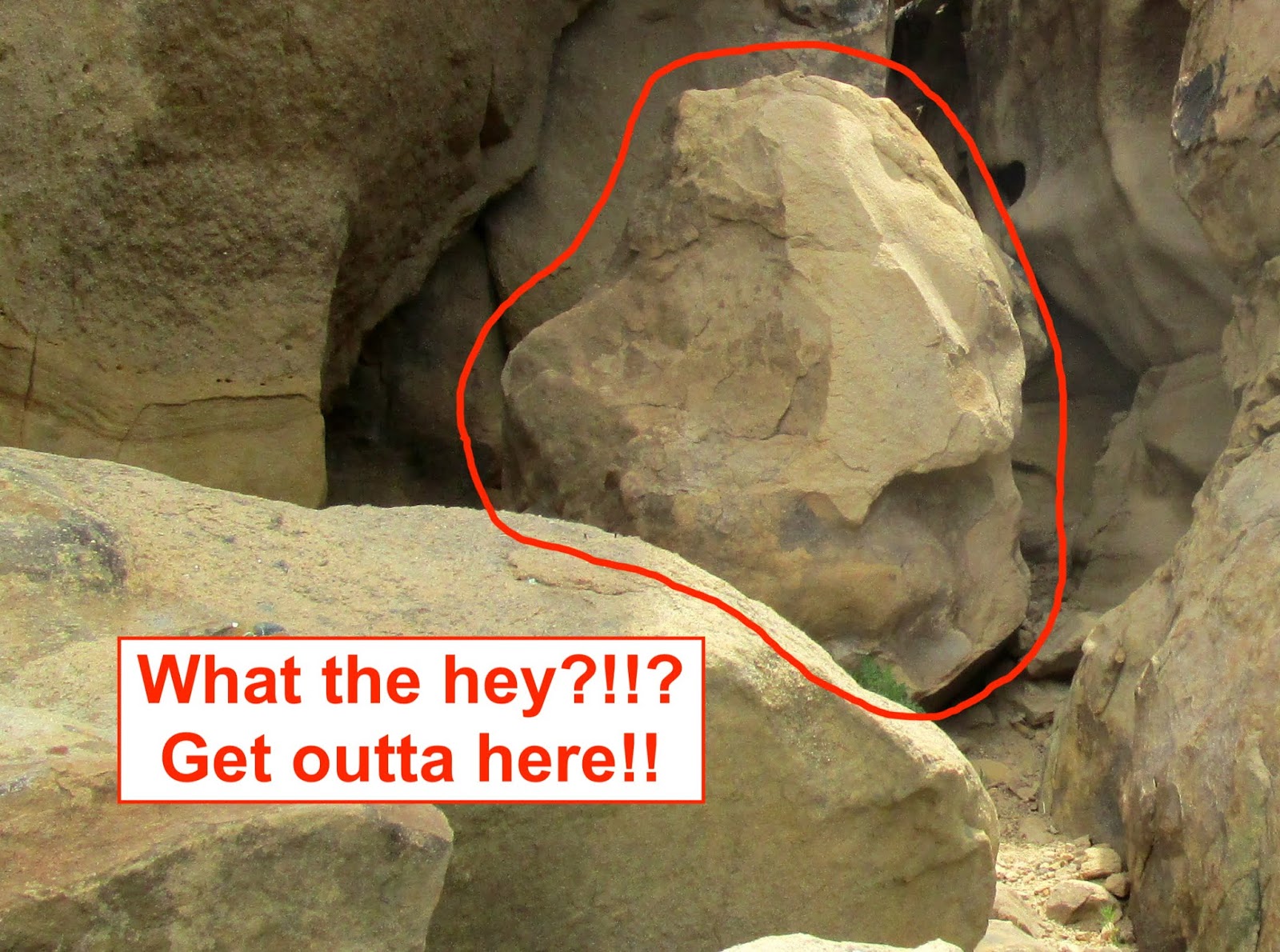
Intruder alert! What the heck is that thing doing in there?

The glaring difference is a big rock that wasn't there back in 1949. This monster is one of the best examples I've seen lately of what I call an "intruder rock."

Intruder rocks we have known and loved: The "Love Me Tender" filming area at Bell Ranch

My initial reaction whenever intruder rocks show up is typically along the lines of: "Get outta there — you're ruining the shot!" But the truth is intruder rocks often add something to the story. If nothing else, they demonstrate that rocks don't necessarily have to sit still all the time.

Photo from the "Love Me Tender" expedition to Bell Ranch in 2015

These intruders provided a fun twist back in 2015 when we went "Off the Beaten Path" to Bell Ranch to track down an Elvis Presley filming location from his first movie, "Love Me Tender." You can click here to read the full report.

As for the Sphinx intruder, a look at that corner of the Sphinx provides clues to where it may have come from.

Considering how gravity works, we know the intruder rock must have come from somewhere up above. And directly above the rock's present position we find evidence of rock movement.

Just above the intruder we can see some new rock surface — an indication that something did break off from here. We also find a distinctive curved edge to the new surface area.

The curved edge up above appears to match an edge on the intruder rock. The evidence strongly suggests that we have identified the spot where the intruder rock was hanging around before it broke away.

Factor in that the intruder rock is positioned RIGHT BELOW the target area of the "mother rock," and we have a mountain of evidence supporting the proposed point of origin.

Damage from the Northridge Earthquake (Jan. 17, 1994)
 
The intruder most likely snapped off during one of the region's two big earthquakes of modern times — either the Sylmar/San Fernando Quake in 1971 or the Northridge Quake in 1994.

"The New Adventures of Spin and Marty" (1957): The western edge of Sphinx

Delving further into the rock's origins, I tracked down this shot from the "Spin and Marty" TV serial that aired in 1957. Here we see that corner of the Sphinx as it appeared before the rock took the plunge.

The area where the fresh rock surface is visible today is located roughly here in the "Spin and Marty" shot.

As I studied the available "then" and "now" shots, I became increasingly focused on the rock noted here.

The west end of Sphinx on a recent visit

It's hard to duplicate the angle seen in "Spin and Marty" when visiting the site today, in part because the lower sections are now blocked by foliage. But this recent shot offers a reasonable approximation.

Notice the rocks marked "A," "B" and "C" in the recent photo.

The same rocks are indicated here in the "Spin and Marty" shot.

The possible intruder rock is positioned in the space between rocks A, B and C.

The intruder rock appears to be missing from the recent shot.

I'm reluctant to say this analysis "proves" that we've correctly identified the intruder rock, because just when we think we have rocks figured out, they can surprise us. But I have a feeling we've found our culprit.

It seems as though these two surfaces may have originally been attached. The rock would have twisted as it fell, and what was previously the rectangular front "face" of the rock is now hidden in back.

Back side of the intruder rock (2018)

Taking a look at the back side of the rock, yeah, I can believe this was the part that formed the rectangular "face" of the rock as it appeared in "Spin and Marty." Again, nothing conclusive here, but it seems to work.

Seeing the intruder rock in its contemporary setting, I can't help thinking the rock has settled in nicely. If nothing else, it's appealingly framed by the rocks around it.

It's almost as though the rock finally arrived home — the place where it wanted to be all along. And its journey provided hours of diversion for some among us who already spend way too much time thinking about rocks.

"Dick Turpin" (1925): Promo still helps clear up the mystery of the intruder rock

Update: About six months after this item was originally posted, this promo still for the 1925 Tom Mix movie "Dick Turpin" surfaced, adding clarity to the intruder rock's origins. Click here for the full update.