Why we love old movie locations — especially the Iverson Movie Ranch

For an introduction to this blog and to the growing interest in historic filming locations such as the Iverson Movie Ranch — the most widely filmed outdoor location in movie and TV history — please read the site's introductory post, found here.
• Your feedback is appreciated — please leave comments on any of the posts.
• To find specific rock features or look up movie titles, TV shows, actors and production people, see the "LABELS" section — the long alphabetical listing on the right side of the page, below.
• To join the MAILING LIST, send me an email at iversonfilmranch@aol.com and let me know you'd like to sign up.
• I've also begun a YouTube channel for Iverson Movie Ranch clips and other movie location videos, which you can get to by clicking here.
• Readers can email the webmaster at iversonfilmranch@aol.com
.

Showing posts with label obituary. Show all posts

Saturday, January 6, 2018

Remembering Bill Sasser, movie history pioneer, prolific video documentarian, Iverson Movie Ranch enthusiast

Bill Sasser

I recently received the sad news that my friend Bill Sasser, an accomplished film historian and a longtime fan of the Iverson Movie Ranch, has died.

Bill Sasser on the Iverson Ranch in 2009 

Bill was one of the first major location researchers I got to know back when I was getting started on my own full dive into movie history about 10 years ago. Even though we lived on opposite coasts, we kept in touch and collaborated when we could, connecting over our shared obsession with the Iverson Ranch.

"Iverson Summit," 2009: Bill Sasser, left, and Jerry England on the Nyoka Summit

Bill traveled to California almost every year from his home in Virginia, specifically to visit movie sites. His annual Iverson visit presented an opportunity for some heavyweight movie historians to gather — and gave me, as an upstart Iverson researcher, a chance to tag along and learn from the masters.


"Iverson Movie Ranch - Then and Now" — a 7-minute Bill Sasser YouTube video from 2008

Bill captured much of his research on video, including constantly expanding his famous "Iverson DVD" over the years. The last time I received the latest updated version from Bill, it ran more than three hours.


"Callaway at Iverson's" (Posted by Bill Sasser in 2010)

Bill posted one of my favorite Iverson Movie Ranch clips, from the 1951 MGM movie "Callaway Went Thataway." The clip pays tribute both to the cliches of the cowboy movie and to Iverson's widely filmed rock features.


"Gold Raiders Rock"

Bill put together a quick "then and now" focusing on the Upper Iverson feature known as Gold Raiders Rock, posted in 2011. I believe it was Bill who came up with the rock's name.


"Iversons Rock"

Most of this clip comes from the 1937 Shirley Temple movie "Wee Willie Winkie," and the clip includes a "then and now" on the Pirate Ship.


"Gun Belt"

Footage posted by Bill from the 1953 Western "Gun Belt" showcases the rocktabulous South Rim of the Upper Iverson, including location aficionado favorites Wrench Rock, Turtle Rock, the Molar, Ambush Rock and Ambush Pass — plus a few seconds at the end of something that looks to me like the Conejo Valley.


"Desert Gold"

Here's some eerily silent footage of a shootout in the 1936 Buster Crabbe Western "Desert Gold," spotlighting a bunch of familiar Lower Iverson features along with nearby Stoney Point.


"Tornado Arch"

This one's just a rough cut with three clips on a formation I usually hear referred to as "Tornado's Cave," which remains in place today in the Iverson Gorge. Bill posted this back in 2011.


"Stacked Rock & Center Rock"

This clip features the old Western town set on the Lower Iverson, including Pond Rock and, at the very end, a quick look at Center Rock.


"Law of the Canyon" (1947)

In this YouTube clip, Bill highlights the weird two-tone fake mine near the Grove Cabin.


"Relay Station" ("The Plunderers," 1948)

Just one more video from Bill — this one has color footage from "The Plunderers" showing a lot of the Saddlehorn Relay Station with some fake rocks sprinkled in.

Bill has more videos of the Iverson Movie Ranch and other filming locations posted on his YouTube account, which you can go to by clicking here, and a few items on his Google+ page, which is found here.

Bill Sasser, left, with Williamsburg Film Festival Lifetime Achievement recipient Grady Franklin, 2010

Back home in Virginia, Bill poured much of his energy over the years into the Williamsburg Film Festival, and was one of the prime movers behind the event's success.

But my own fondest memories of Bill are about seeing him among the rocks at Iverson, where he will be sadly missed. Keep on a-rockin', Bill!

Wednesday, July 9, 2014

We knew and loved him as Dickie Jones — a B-Western child star and early TV Western pioneer; Richard Percy Jones, the voice of "Pinocchio," is dead at 87

Dick Jones as Buffalo Bill Jr.

With great sadness I must report the death of a man who was a fixture on the Iverson Movie Ranch during his acting career. Dick Jones made an impact as a child actor in B-Westerns, as a young man in the early days of television, and — as if that weren't enough — as the voice of the beloved Disney character "Pinocchio" in the 1940 animated movie.

12-year-old actor Dickie Jones reading the title role for "Pinocchio" in 1939

Richard Percy Jones — or as he was known early in his career, Dickie Jones — died Monday, July 7, 2014, at 87. He was one of the last of an era, a veteran who acted in the B-Westerns in their heyday in the 1930s and 1940s ... precious few of whom are still around.

 Dick Jones, at right, on the South Rim of the Upper Iverson Movie Ranch in "Wagon Team" (1952)

As a young man transitioning from his career as a child actor, Jones was taken under the wing of Gene Autry, appearing with the cowboy star in a series of Autry's Westerns in the late 1940s and early 1950s, when Jones was in his early 20s — "The Strawberry Roan" (1948), "Sons of New Mexico" (1949), "Wagon Team" (1952), "The Old West" (1952) and "Last of the Pony Riders" (1953).

Dick Jones on the Upper Iverson in the TV series "The Range Rider" (1953)

Autry was savvy enough to recognize the increasing importance of the new medium of television, and as Autry moved to the small screen with his own show, he brought Jones along for the ride. Autry groomed Jones with a string of appearances on "The Gene Autry Show" from 1950-1954. At the same time, he put Jones in a meaty role as the sidekick to B-Western veteran Jock Mahoney on the "Range Rider" TV series, produced by Autry's Flying A Pictures.

Dick Jones, right, and Jock Mahoney in "The Range Rider," 
with Iverson's Center Rock in the background (1953)

Jones played the teenage sidekick to the "much older" Mahoney (born Jacques O'Mahoney and billed as Jack Mahoney on the show), even though Jones was 26 by the time "The Range Rider" wrapped its three-year run in syndication in 1953 — and even though the ever-youthful Jones was only eight years younger than the veteran actor Mahoney.

"Buffalo Bill, Jr." (1955) — Dick Jones, right, appears to be getting the worst of it 
in a fight with a bad guy on Iverson's Western street

When the timing seemed right, Autry gave Jones his own show: "Buffalo Bill, Jr.," another Flying A Pictures production. The show featured a who's who of B-Western veterans in guest roles: Lee Van Cleef, Slim Pickens, Glenn Strange, Denver Pyle, William Fawcett, Kirk Alyn, Jack Ingram, John Doucette and Lane Bradford, to name a few. Jones, who was an accomplished stuntman as well as a natural horseman, put those skills to good use on the series, which had a 42-episode run in syndication, from 1955-1956.

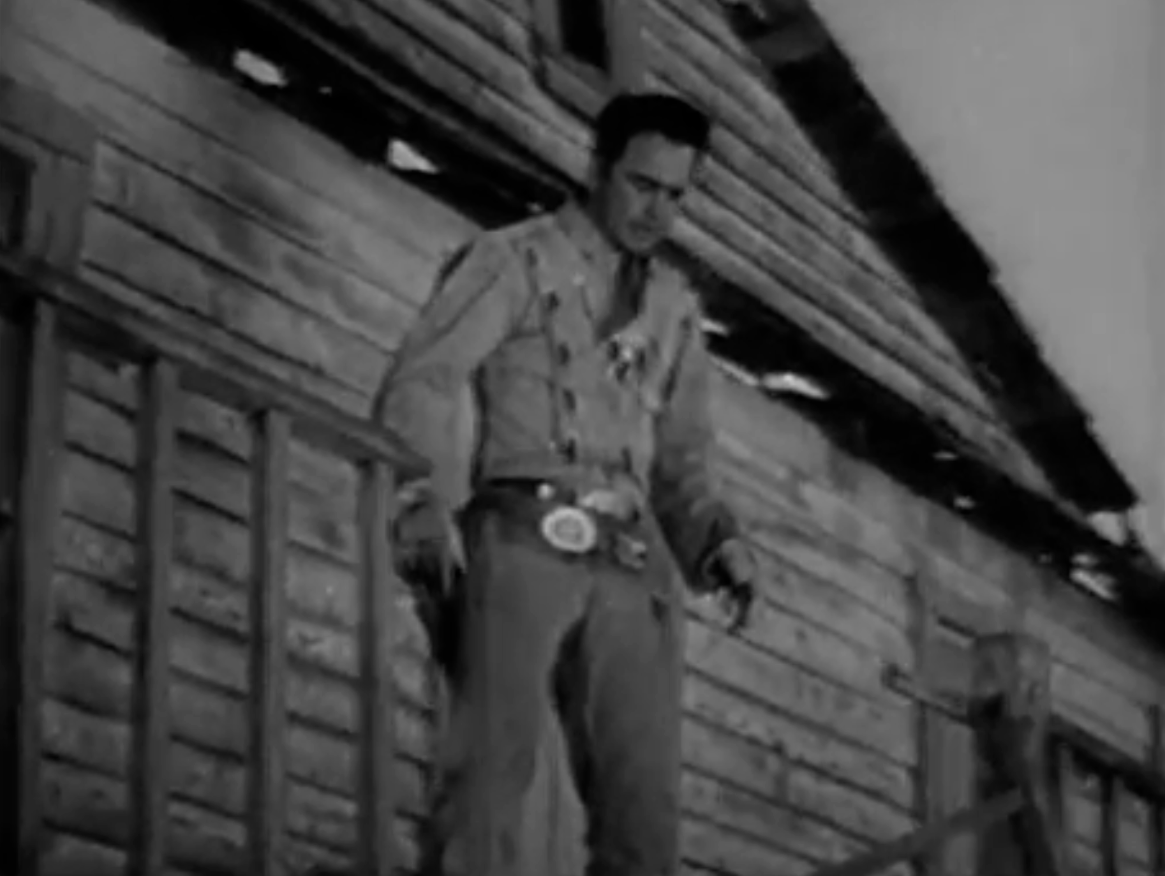
Dick Jones, as Buffalo Bill Jr., has turned the tables on the bad guy, who wound up
crashing through the second-story railing off the hotel building in Iverson Village

By now Jones was "all grown up" and had lost the "Dickie" credit of his childhood, being billed as Dick Jones. But even though he was only 29 when "Buffalo Bill, Jr." ended its run, his career tapered off quickly after that and he appeared only sporadically on TV and in films over the next decade. His final credit was a supporting role in the Rod Cameron Western "Requiem for a Gunfighter" in 1965.

Richard Percy Jones — aka Dickie Jones (1927-2014)

Jones retired from acting after "Requiem" and reportedly went into real estate and banking. A popular figure for decades at Western movie fan events — and by all accounts a super-nice guy — he was honored in 1989 with the Golden Boot Award, given to the greats of the Western genre for their contribution to depictions of the West on TV and in film.


In yet another honor for his highly honored career, Jones was named a Disney Legend in 2000.

Tuesday, May 27, 2014

A film pioneer dies — was he the last of the singing cowboys?

Herb Jeffries

I am sorry to report the death of a man who was one of precious few remaining icons from the era of the singing cowboy: Herb Jeffries, who was known as Hollywood's first black singing cowboy — and who may well have been the last singing cowboy. Jeffries died of heart failure Sunday, May 25, 2014, at 100 years of age at West Hills Hospital in the San Fernando Valley.


Jeffries' name appears with different spellings throughout his film career, including on this poster for "The Bronze Buckaroo (1939), one of his signature films. He spelled his last name "Jeffries" even though it often appears as "Jeffrey" or "Jeffreys" on posters and in film credits.


"Harlem on the Prairie" (1937)

I know of only one movie that Jeffries filmed on the Iverson Movie Ranch — his 1937 Western "Harlem on the Prairie." The above scene from the movie is filmed in the ranch's Garden of the Gods.

Herb Jeffries on the cover of Jet Magazine in 1952

Jeffries has been called the towering figure in the integration of pop culture in the 20th century, and has been widely credited for making a conscious decision to become the first black singing cowboy rather than pass as white — something his mixed ethnic background and light skin would have enabled him to do. His widow, Savannah Jeffries, is quoted as saying earlier this week: "Herb's motto was there's only one race — the human race."

Herb Jeffries, left, with Duke Ellington (partially visible over 
Jeffries' shoulder) and bassist Jimmy Blanton in 1941

Jeffries was a singer in the Duke Ellington Orchestra in the early 1940s, scoring a big hit in 1941 with "Flamingo," which became his signature song.

Jeffries starred in a series of all-black B-Westerns in the 1930s, earning the nickname "The Bronze Buckaroo" after his lead role in the 1939 Western of that title, directed by Richard Kahn and released by Hollywood Productions. He usually appeared as cowboy hero Bob Blake, and rode a horse named Stardusk — with his Westerns also often featuring the vocal group the Four Tones.

He appeared as a singing cowboy in the 1938 featurette "Rhythm Rodeo," even though his name didn't make it onto the movie's poster. The poster includes racial references that many of us may find offensive today, but I believe it's important to portray history as accurately as possible, so I've included it above.


Herb Jeffries sings "Flamingo" with the Duke Ellington Orchestra in 1941 

Jeffries participated in at least one gathering at the Iverson Movie Ranch, well after the site's filming era, in 1999, when he took part in a fund raiser held at Iverson for fellow singing cowboy Eddie Dean, who was in failing health at the time and died about a month later.

"Last Stagecoach West" (1957)

In effect, Jeffries died in the background of the singing cowboy genre's most important outdoor filming location, the Iverson Movie Ranch, as portions of what is now West Hills can be seen in the distance in movie scenes shot in Iverson's Upper Gorge — including the above example from the Jim Davis B-Western "Last Stagecoach West." (Jeffries did not appear in the movie, having wrapped up his career in Westerns by the end of the 1930s.)


The links below will take you to Amazon.com listings for a number of Herb Jeffries' films and recordings:

Wednesday, February 12, 2014

Shirley Temple dies — and she probably never knew she had a rock named after her

Shirley Temple, 1928-2014

I was sorry to hear the news this week of the death of Shirley Temple Black at age 85. She was a unique talent and had an enormous impact not just on movie fans of the 1930s, but on American culture. She also earned a special place in Iverson Movie Ranch history, starring in one of the most important Iverson productions, "Wee Willie Winkie," released in 1937.

Shirley Temple was the biggest movie star in the world in the mid-1930s, even though she was still just a little kid. When she appeared in the John Ford epic "Wee Willie Winkie," along with established Hollywood stars including Victor McLaglen and Cesar Romero, Shirley — who was 8 years old during filming of the movie — was top-billed. And McLaglen was already an Oscar winner for his lead role in "The Informer" in 1935.

Shirley Temple, as young Priscilla Williams — Wee Willie Winkie — with Cesar Romero, as the warrior 
Khoda Khan, in a promotional still for John Ford's "Wee Willie Winkie." The photo, shot on the 
Iverson Movie Ranch, comes from the collection of film historian Jerry England.

As she always did, Shirley stole the show in "Wee Willie Winkie," a war movie about the British colonial period in India. Shirley's character charmed her way into the hearts of soldiers on both sides of the conflict, while the young actress chewed up the scenery across two elaborate sets built for the movie on the Iverson Movie Ranch — widely considered to be the most extensive construction ever done for a movie at Iverson.

In a battle sequence from the film, Shirley stopped to survey the situation from atop a particular rock, seen above. The scene takes place in the Iverson Gorge, among buildings that were part of the set built as India freedom fighter Khoda Khan's mountain stronghold. I've blogged about this scene before — and you can click here to read that earlier post. Shirley's scene on this rock led to the rock being referred to — by me, initially, but to some extent by other location researchers as well — as Shirley Temple Rock.

Here's a wider view of Shirley Temple Rock from "Wee Willie Winkie," with 8-year-old Shirley scampering down from the rock feature.

The rock has turned up in other productions as well, which helped pinpoint its location. Here's an appearance by Shirley Temple Rock many years after the "Wee Willie Winkie" filming, in an episode of the TV show "The Virginian" called "Run Quiet," which first aired Nov. 13, 1963. Shirley Temple Rock is the shade-covered rock feature occupying the lower left corner of the frame. This shot also includes a number of other significant features of the Iverson Gorge — I'll post an annotated version of the photo below to point those out.

Here you can get an idea of the various rock features seen in the shot above this one, from "The Virginian." The hill in the background, across much of the top of the frame, is Cactus Hill, located to the north of Iverson Gorge. Most of the rock features seen in this shot remain in place today — but Shirley Temple Rock was not as fortunate. Sadly, the rock did not survive the development of the former Iverson Movie Ranch, being demolished to make way for condos.

Here's another appearance by Shirley Temple Rock, in the 1938 Bob Steele B-Western "Thunder in the Desert." The picture quality isn't the greatest, but you may be able to make out the rock at the left, below the shooter's outstretched arm. The background is filled by the rock feature known as The Wall, and a portion of Potato Rock, on top of The Wall, can be seen. I'll point out these features in the next shot.

This is the same shot as above, from "Thunder in the Desert," with key rock features highlighted. Unfortunately, all of the rocks seen here — including Shirley Temple Rock — were destroyed to make way for the Cal West Townhomes.

Shirley Temple on the set of the India outpost, built at Sheep Flats on the Iverson Movie Ranch,
in a scene from "Wee Willie Winkie." 

Other key scenes in "Wee Willie Winkie" took place on Iverson's Sheep Flats, where a massive set, usually called the India outpost or the India fort, was built. A small portion of this set can be seen in the shot above. By coincidence, my previous blog entry, published about a week before Shirley Temple's death, also featured Shirley Temple, "Wee Willie Winkie" and the India fort. You can go to that entry by clicking here, or you should be able to find it below this post. Additional posts about "Wee Willie Winkie" may be found here.

Shirley Temple Black

I would be shocked if I found out Shirley Temple Black ever heard of Shirley Temple Rock, or knew she had a rock named in her honor — a rock she scampered up as a child, with that scampering preserved for future generations thanks to the magic of celluloid. The rock name is a modest honor, to be sure — nothing formal, just a tribute to an actress and a little girl who won over the hearts of millions.

Tuesday, April 9, 2013

Disney legend Annette Funicello dies; looking back on a memorable appearance by the Mouseketeer and beach bunny at the Iverson Movie Ranch

Annette Funicello, 1942-2013

I was sorry to learn today that Annette Funicello had died. The actress known for being a Mouseketeer in the '50s and a beach bunny in a string of 1960s bikini movies — "Beach Blanket Bingo," "How to Stuff a Wild Bikini" and others — died this morning at 70 of complications from multiple sclerosis.

Annette Funicello in her Mouseketeer days

Being a Disney regular she didn't work much at the Iverson Movie Ranch, as Disney had its own Golden Oak Ranch in Placeritas Canyon, out in the Newhall area. But Funicello did make it to Iverson at least once, for an episode of the Disney miniseries "The Nine Lives of Elfego Baca."

Annette Funicello, right, as Chiquita Bernal in
"Elfego Baca, Attorney at Law" — shot on the Upper Iverson

The  episode, "Elfego Baca, Attorney at Law," aired Feb. 6, 1959, as part of the "Disneyland" TV series — also known as "Walt Disney Presents" or "Walt Disney's Wonderful World of Color," among various other names over the span of its many decades on television. As it turns out, Funicello's Iverson shoot for "Elfego Baca" produced an important sighting: an adobe on the Upper Iverson, which I have never seen anywhere else.

The above shot offers one of the best looks at the front of the Elfego Baca Adobe. It was a full building, completed on all four sides, rather than a "front," and the set included a small outbuilding and a sheep corral. The actor seen in this shot (and also seen in the one above it) is Edward Colmans, who plays Funicello's father in the show — the character who's to blame for naming his two daughters Lolita and Chiquita.

Annette Funicello, right, with Robert Loggia and Gloria Castillo
in "Elfego Baca, Attorney at Law"

In the above shot and a few others in this post, the familiar hills to the west of Iverson can be seen, pinpointing the location as the Upper Iverson.

Here's an overview of the Elfego Baca Adobe set, which included a corral full of sheep. This view of the set, seen from the northeast, shows the back of the house.

Robert Loggia as Elfego Baca

In the above shot, Robert Loggia, playing the title role of real-life Western attorney and gunman Elfego Baca, arrives at the adobe complex, with some important marker rocks visible in the background. Most of those rocks remain in place today on the site of the former Upper Iverson, although the area is now occupied by a gated community of large estates. The rocks — sometimes referred to as the "Rocks Across the Way," in reference to their relatively remote location on the North Rim of the Upper Iverson — are helpful in further narrowing down the location of the adobe, which was just south of this cluster of rocks.

Lolita and Chiquita peek out from the adobe as actors Edward Colmans, left, Robert Loggia and James Drury, at the center of the shot, talk things out.

This shot looking west offers another view of those distinctive background hills above Chatsworth.

Here's a look at those same background hills in more recent times, along with some of the estates that now occupy the former Upper Iverson.

Annette Funicello and frequent co-star Frankie Avalon in the beach movie days

Known for her physical assets and her beach outfits as much as for her acting — OK, let's be honest: known MORE for her physical assets than for her acting — Funicello wore "bikinis" that these days even Granny would consider too modest.