Why we love old movie locations — especially the Iverson Movie Ranch

For an introduction to this blog and to the growing interest in historic filming locations such as the Iverson Movie Ranch — the most widely filmed outdoor location in movie and TV history — please read the site's introductory post, found here.
• Your feedback is appreciated — please leave comments on any of the posts.
• To find specific rock features or look up movie titles, TV shows, actors and production people, see the "LABELS" section — the long alphabetical listing on the right side of the page, below.
• To join the MAILING LIST, send me an email at iversonfilmranch@aol.com and let me know you'd like to sign up.
• I've also begun a YouTube channel for Iverson Movie Ranch clips and other movie location videos, which you can get to by clicking here.
• Readers can email the webmaster at iversonfilmranch@aol.com
.

Showing posts with label Fighting Seabees. Show all posts

Saturday, December 24, 2016

The Year in Review: Top 10 Iverson Movie Ranch finds of 2016

"Code of the Secret Service" (1939): Iverson Gorge

Here's a Top 10 list counting down the best Iverson Movie Ranch discoveries of the past year ...


No. 10

Joe Iverson's incredible old tractor


Joe Iverson rides one of the greatest tractors ever

Joe Iverson, who ran all or part of the Iverson Movie Ranch for 60-plus years, had a lot of cool toys, and his vintage grader/crawler was one of the coolest.

Click here to see the original post about Joe's tractor, from July 2016.

No. 9

The Roy Rogers rock on top of Cactus Hill


"The Roy Rogers Show" (1952)

An episode of "The Roy Rogers Show" features an unusual rock, which was recently spotted at the east end of Cactus Hill — despite having changed its appearance over the years. The site also has a few things to say about the history of filming in that area.

Click here to see the original post about Roy's encounter with the rock on Cactus Hill, published in August 2016.

No. 8

The former location of the Hangman's Tree


The Hangman's Tree on the Lower Iverson (from "An Ambush of Ghosts")

While the Hangman's Tree itself did not survive, we were able to determine the exact location where it once stood — and we did find the nearby Hangman's Tree Rock.

• Click here to see the original post about the Hangman's Tree, published in October 2016.

No. 7

Where Jesus walked in Silverland 


"The Living Bible" (1952) — Jesus comes to the Iverson Movie Ranch

Jesus and two Lone Rangers — the original, from the 1930s Republic serials, and the more famous one from the 1950s TV series — all made their way to Silverland on the Lower Iverson. But the biggest Silverland find of 2016 may have been the discovery of an important saucer-shaped movie rock.

Saucer, left, and Mushroom Rock in "The Man From Colorado" (1948)

We took a "long, strange trip through Silverland" early in the year and were able to unlock a number of its mysteries by decoding clues contained in its few surviving rocks. One of the biggest surprises was the discovery that the widely filmed rock "Saucer" can still be found.

• Click here to revisit the adventures of Jesus and two Lone Rangers among the fascinating rocks of Silverland — along with the discovery that the Saucer has survived — from April 2016.

No. 6

An amazing Iverson Movie Ranch sequence in "Montana Moon," the first singing cowboy movie 


Johnny Mack Brown in "Montana Moon" (1930)

The era of talking in movies had just begun, and when "Montana Moon" came out in 1930, it launched the era of the singing cowboy. The movie includes a great sequence filmed along the western edge of Garden of the Gods overlooking Santa Susana Pass Road — not to mention one of the best buttressing shots ever filmed at Iverson.

• Click here to see the original post about the remarkable Iverson Movie Ranch sequence in "Montana Moon," from October 2016.

No. 5

Joe Iverson's butterfly collection, hunting trophies and other prize possessions are captured on film


Kelly Sullivan in "Death by Dialogue" (1988), with a few of Joe's butterflies

Joe Iverson's museum is on display in the movie "Death by Dialogue." The trophy room alone elevates this low-budget thriller into a unique artifact of movie history.

• Click here to see the original post about "Death by Dialogue" and Joe's vast collections, from June 2016.

No. 4

The "Muffin" rock behind the Grove Cabin has popped its muffin


"Bells of Rosarita" (1945): giant muffin-shaped rock behind cabin

A muffin-shaped rock once stood directly behind the little building known as the Grove Cabin. The rock is still there but it no longer looks like a muffin — and we found out why.

• Click here to see the original post about what became of the giant muffin, from earlier this month — December 2016.

No. 3

The "kill rock" from the Hopalong Cassidy movie "Mystery Man"


"Mystery Man" (1944): Hoppy's gun casts a shadow on the Kill Rock

The Kill Rock in the Hopalong Cassidy movie "Mystery Man" took multiple expeditions to find, encompassing both Lone Pine and the Iverson Ranch. Between me and Don Kelsen, we eventually found the thing hiding in plain sight.

• Click here to see the original post about the "Mystery Man" Kill Rock, from September 2016.

No. 2

A film shoot inside Karl and Augusta Iverson's house in 1935 


"The Outlaw Deputy" (1935) — the view from the Iversons' house on the hill

Film historian Tinsley E. Yarbrough spotted this scene filmed inside the home of Iverson Movie Ranch founders Karl and Augusta Iverson in the Western "The Outlaw Deputy." It may be the only time anyone filmed in the house on the hill.

 • Click here to see the original post about the 1935 shoot inside Karl and Augusta's house, from October 2016.

No. 1

The "grassy knoll" — a mystery from "Little Big Horn" that took 65 years to solve


"Little Big Horn" (1951): Sheb Wooley's sad fate on the grassy knoll

The location where Sheb Wooley's character met his grisly demise in the classic Western "Little Big Horn" has long perplexed movie historians — but a couple of us put our heads together early this year and, thanks to the sharp eye of veteran location researcher Eddie Henn, we finally solved the mystery.

• Click here to see the original post about the discovery of the "grassy knoll" of "Little Big Horn" infamy, from February 2016.


Here are a few finds from the past year that didn't quite make it into the Top 10 — click on the text to be linked to the original blog items ...

• The rediscovery of an old movie road on the north side of Cactus Hill

• Promo stills from the John Wayne movie "The Fighting Seabees" with surprising details hidden way in the background

• The crack where the Japanese sniper was stationed in "The Fighting Seabees"

• Some overlooked rock survivors found in the Iverson Gorge


To catch up on additional discoveries on the Iverson Movie Ranch in recent years, here are links to past "Year in Review" posts ...

Top Iverson Movie Ranch finds of 2015


• Click here to review the major discoveries of 2015, when an Elvis Presley filming location, a fake cave house from the silent era, Burgess Meredith's "Siedry-Bert" inscription, a wonderland of old movie footholds and the location of the Chinese Bridge from the 1926 movie "Tell It to the Marines" all made the list.

Top Iverson Movie Ranch finds of 2014


• Click here for a look back at 2014, a year in which Bear Tree, the Hobbit House, the remains of Freddie Frog, the Charles Bronson Hanging Tree and Tom Mix's bootholes from the 1935 Mascot serial "The Miracle Rider" were among the year's biggest discoveries.

Thursday, August 11, 2016

Promo shots surface from the John Wayne World War II movie "The Fighting Seabees" ... and we go deep!

Promo still for "The Fighting Seabees" (1944) — Garden of the Gods in background

I recently rounded up a nice batch of promotional stills from the John Wayne movie "The Fighting Seabees," showing the production filming on the Iverson Movie Ranch.

Iverson's rocky Upper Gorge, with Cactus Hill in the background

Most of the rocks seen in this shot can still be found on the site of the former Lower Iverson, just off Redmesa Road in Chatsworth, Calif.

The spot where the fuel tank stood is now filled with condos

The World War II movie is right near the top of just about any list of Iverson productions — one of the most important movies to shoot at Iverson, and one that's loaded with great Iverson content.

The Seabees work on the airstrip on the Iverson Ranch

"The Fighting Seabees" came out in January 1944, and the production occupied much of the Iverson Movie Ranch — both the Upper Iverson and the Lower Iverson — for several weeks in late 1943.

An inferno in the Iverson Gorge, on the Lower Iverson

The producers of "Fighting Seabees" set a number of fires and blew up plenty of explosives during the location shoot — something I blogged about last year.

Let's take a closer look at the portion of the photo highlighted here in red. Also note that you can click on any of these photos to see additional details in a larger view.

Closeup of a portion of the previous photo

The closeup reveals a number of details hidden in the background. In this zoomed-in version of the photo, you may be able to spot a windmill toward the left.

I believe this windmill is part of the Iverson family's farm operation. It is rare for it to appear in movies, and I don't know that it turns up in "The Fighting Seabees" — only that it did make it into this promo shot.

A few other items in the closeup from the promo shot are also interesting. The palm tree is fake, one of many brought in to turn the Iverson Ranch into a Pacific island for "The Fighting Seabees."

This section of the photo also caught my attention. Seen here are an old car and a large tank, along with a piece of equipment that I first thought might be a plow, again part of the farming operation.

Zooming in further on the photo, however, it becomes evident that a person can be seen near the equipment — and he (or she) appears to be wearing a fire suit. Also, the old car looks like a 1938 or 1939 Ford delivery van.

Given that the photo is taken during a massive fire sequence, it makes sense that the equipment seen in the shot might be a part of either the fire-making operation or safety efforts. However, I'm only speculating.

I still think the piece of equipment in front of the tank looks like a plow. Either way, it's surprising what sometimes turns up on a close examination of these old promo shots.


For more about "The Fighting Seabees," please click here to see my detailed post from last year. If you'd like to see the movie for yourself, you can click on the link below to go to Amazon.com to buy the DVD.


This DVD set is a John Wayne double feature that also includes the movie "Wake of the Red Witch." It's the same DVD I have, and the picture quality on "The Fighting Seabees" is really nice. ("Wake of the Red Witch" is not filmed on the Iverson Ranch.)

Friday, January 29, 2016

How Roy Rogers solved the mystery of the Japanese sniper in John Wayne's "Fighting Seabees"

"The Fighting Seabees" (1944)

One photo I didn't put up when I blogged last summer about the John Wayne World War II movie "The Fighting Seabees" was this shot of a Japanese soldier using a diagonal crack in a rock as a sniper's perch.

"The Roy Rogers Show" (1952)

I didn't post the shot because I couldn't figure out where it was taken. But with some help from Roy Rogers, the mystery is now solved. Roy peers through the same crack in an early episode of "The Roy Rogers Show" called "The Train Robbery," filmed in 1951 and first aired Feb. 3, 1952.

Sniper's crack, on a recent visit to the Lower Iverson

Thanks to the context in the "Roy Rogers" episode, I was able to determine that the crack is part of a heavily filmed movie rock that I call Hangdog. The tricky thing about both the "Fighting Seabees" shot and the "Roy Rogers" shot above is that they feature the rarely seen "back side" of the rock.

"The Train Robbery" ("The Roy Rogers Show")

This is what the sniper's crack area looks like from the much more heavily filmed "front side" of the rock — its west side. In the "Roy Rogers" episode, Roy climbs on top of Hangdog to get a drop on the bad guys.

A portion of the crack is visible near the legs of the two bad guys. The section of Hangdog shown in this shot is just a fraction of the massive rock feature.

The rock, including the sniper's crack, remains intact today on the Lower Iverson Ranch. This recent photo of Hangdog shows the same section of the rock seen in the "Roy Rogers" shot.

The sniper's crack area is located at the north end of the rock.

This is what the rest of Hangdog looks like in modern times. The photo shows the west-facing side of the rock.

Hangdog today is on private property, and access is difficult. The rock is positioned near the southeast corner of the Cal West Townhomes, separated from the condo community by a brick wall.

Friday, July 24, 2015

Perils Tower — a fake rock that made its presence felt in the movies of the early 1940s

"Perils of Nyoka" (Republic serial, 1942)

I've had a request for more information about Perils Tower since I first mentioned the fake rock formation in a recent post about the John Wayne movie "The Fighting Seabees."

The name "Perils Tower" comes from the fake rock's appearance in the Republic serial "Perils of Nyoka," probably the feature's most high-profile screen role. The 1942 production filmed much of its outdoor action on the Iverson Movie Ranch, including an extensive shoot in the Iverson Gorge.

Other than its unusual shape, with a large, overhanging cube perched on top of a smaller rectangular "trunk," Perils Tower looks realistic and is typically seen standing around among the legitimate rock features of the Upper Gorge, acting like it belongs there.

Another shot from "Perils of Nyoka" offers a view of Perils Tower from a slightly different angle. Appearing again at the right of the screen is The Wall, and from this angle we can see Potato Rock sitting on top of it.

I've identified a few of the key features in this version of the shot. In this shot and the photos above this one the camera is aimed more or less toward the south.

Turning the camera around and shooting toward the north this time, another shot from "Perils of Nyoka" takes us in even closer to Perils Tower. The large rectangular shape at the top center of the frame is part of the "trunk." 

From this angle a portion of the Devil's Doorway Cluster is visible at the right.


I've spotted the fake rock tower in just a handful of movies and serials, almost all of them released from 1940-1944. The tower appears repeatedly in "The Fighting Seabees."

Additional shots of Perils Tower in "The Fighting Seabees" can be found in this recent post focused on the extensive Iverson shoot for the John Wayne World War II movie.

"Fugitive Valley" (Monogram, 1941)

In a scene from the Range Busters B-Western "Fugitive Valley," Perils Tower provides cover to some of the cowboys involved in a big shootout in the Gorge. It's unclear whether any or all of the smaller rocks that form the "foot" of the tower are real, but my hunch is that they are — possibly with a few fakes in the mix.

Crown Rock, a portion of which remains in place today as part of the Cal West Townhomes complex, can be seen in the top left corner of the "Fugitive Valley" shot.

"Perils of Nyoka"

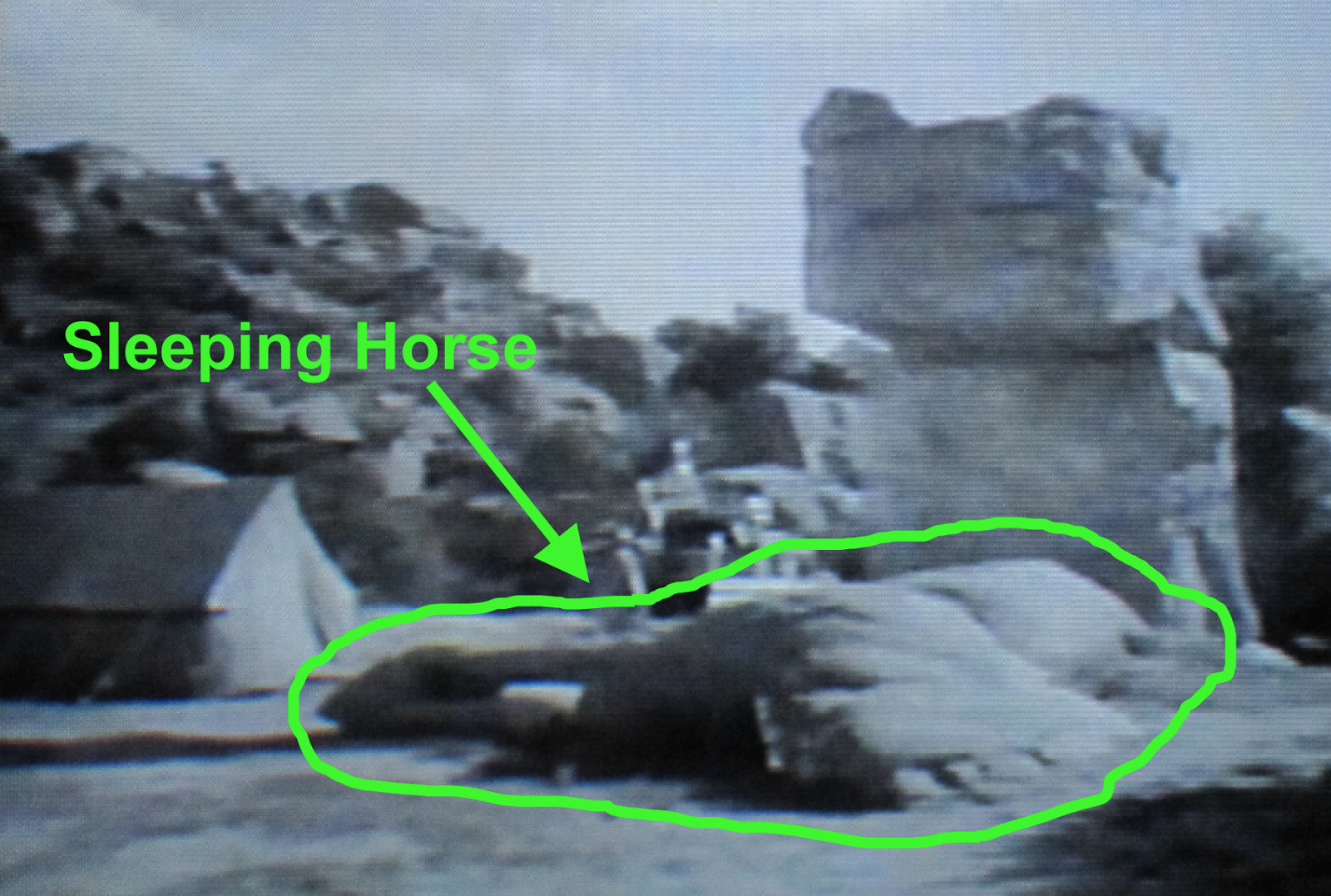
Perils Tower was one of the defining features of the Iverson Gorge during its brief lifespan, standing tall in the midst of more durable movie rocks such as The Wall, Crown Rock, Devil's Doorway and Three Ages Rock. From this angle part of Nyoka Cliff is visible in the background.

The tower as seen here appears to be situated in its usual spot in the Upper Gorge. However, it's possible the fake tower was mobile and may have been moved around from time to time within a limited range.

Just for fun, I'm calling this the Sleeping Horse, although I'm sure it's just an accident of shadows and light. You may or may not see what I'm talking about.

"The Denver Kid" (Republic, 1948)

In a few instances recycled clips shot during the period when Perils Tower was standing in the Gorge — from about 1940-1944 — turn up as rear-projection footage in later productions. This appearance in the Rocky Lane movie "The Denver Kid," released in 1948, is an example.
This version of the shot points out Perils Tower as part of the rear-projection footage. This sequence would have been filmed in the studio using footage filmed at Iverson a few years earlier.

"Thundering Caravans" (Republic, 1952)

Another example of rear projection — possibly using the same recycled footage — turns up in another Rocky Lane movie from Republic, "Thundering Caravans," released in 1952. In this shot Perils Tower appears at far right.

Nyoka Cliff is also seen in the "Thundering Caravans" shot. Republic seems to have made the most use of Perils Tower, although my earliest sightings of it so far have been in Monogram's 1941 release "Fugitive Valley," as noted higher up in this post, and in the backgrounds of some PRC B-Westerns going back to 1940.

"Billy the Kid Wanted" (PRC, 1941)

Here's one of those PRC movies I'm talking about. PRC made a lot of use of the Gorge Cabin for its Billy the Kid series in the early 1940s, and Perils Tower popped up a few times in the background — although you have to know what you're looking for to find it.

I've noted Gorge Cabin here, along with Perils Tower, which is much harder to spot. Gorge Cabin was quite a bit older than Perils Tower, dating back to the mid-1930s, but the two manmade features ended their run in the Iverson Gorge around the same time, in about 1944.

The shot from "Billy the Kid Wanted" contains a number of Upper Gorge rock features, and I wanted to be sure to point out a few of the important ones while we're in the neighborhood.

Promo still for unknown Columbia production of the early 1940s

Columbia also had its encounters with Perils Tower. This promotional still from the early 1940s, focused on Gorge Cabin at the center of the frame, includes a number of familiar features of the Iverson Gorge, with Perils Tower making an appearance toward the left of the frame. The rocky hill in the background is Cactus Hill.

Perils Tower is highlighted here, along with some of the other features found in the promo shot. Both the presence of Perils Tower and the look of the cabin help determine that the shot is from the early 1940s.