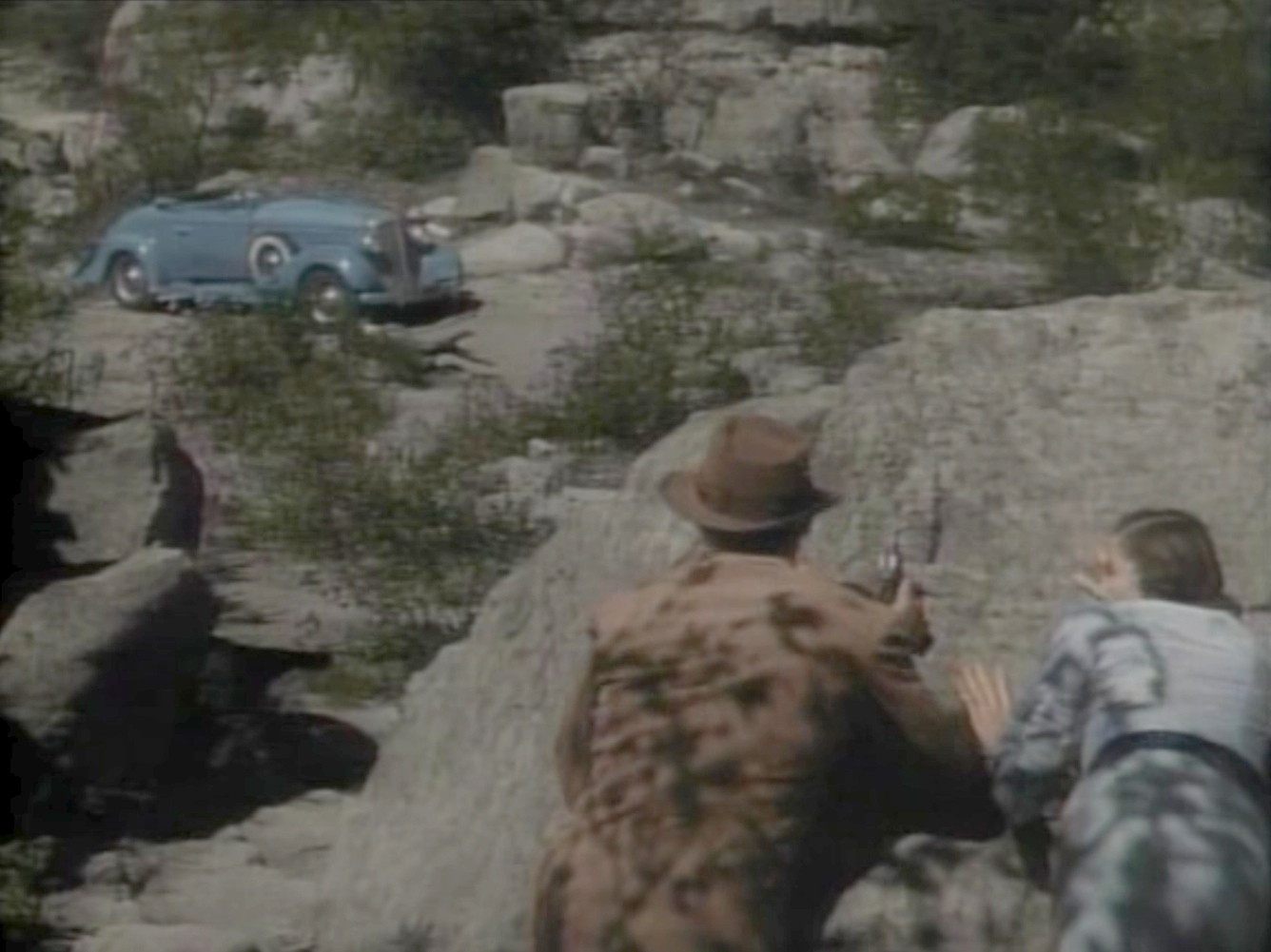
"The Fighting Legion" (1930) — Lone Pine, Calif.
I recently discovered the work of film historian and documentary photographer Jerry Condit, whose re-creations of movie location shots elevate the concept of the "then and now" photo to an art form.

Lone Pine, Calif. — photographed in 2009 by Jerry Condit
The above example of Jerry's work showcases one of his favorite filming locations, the Alabama Hills in Lone Pine, Calif. His photo re-creates the shot from "The Fighting Legion" so closely it's hard to tell them apart, as even the shadows are virtually identical. The main difference between the two photos is the presence of horses and riders in the movie shot, which also brings out the imposing scale of the rocky landscape. The two shots are taken almost 80 years apart.


"Old Yeller" (1957) — Garden of the Gods
Did you cry over "Old Yeller"? Who didn't! In a certain age bracket it's the most remembered childhood movie for a lot of us kids. Parts of the Disney tearjerker were shot at the Iverson Movie Ranch, including the above scene in which Yeller runs through Iverson's Garden of the Gods. I love the way this shot projects how formidable those rock formations are.

The same location photographed in 2014 by Jerry Condit
Still formidable — and pretty much unchanged — more than a half-century later.

"Man in the Saddle" (1951)
Here's a shot taken in almost the same spot as the "Old Yeller" shot, but this one is from the Columbia Western "Man in the Saddle." The all-star cast in the above shot includes, from left, Randolph Scott, Ellen Drew and Guinn "Big Boy" Williams. The guy with his back to the camera is Cameron Mitchell.

This is a recent shot of the site where the "Man in the Saddle" campfire scene took place, again in Garden of the Gods on the former Iverson Movie Ranch. The rock in the top left corner with the prominent crack is Mitchum Rock, named after the Robert Mitchum film noir "The Big Steal," in which Mitchum and Jane Greer take shelter behind the rock during a shootout. You can read more about Mitchum Rock and "The Big Steal" by clicking here.

"Saga of the Viking Women" (1957)
The original title of this movie, produced and directed by Roger Corman, is considerably longer: "The Saga of the Viking Women and Their Voyage to the Waters of the Great Sea Serpent." The title has been shortened in a variety of ways in connection with various releases of the movie, but under any title, the movie is strongly recommended both for its terrific Iverson location shots and because it's a fun movie.


"Bonanza" episode "The Dowry" (first aired April 29, 1962)
The Iverson Movie Ranch poses more than its share of challenges when it comes to re-creating movie and TV shots. The place has changed a lot since the filming days, and whether it's a condo or an overgrown bush in the way — or a rock or tree that's simply not there anymore — it's often impossible to get the same angle. For the above "Bonanza" scene, filmed on the South Rim of the Upper Iverson, duplicating the angle would have required a scaffold — or at least a good ladder.

The Slates as they appear today, in a 2014 photo by Jerry Condit
But the site is easily identified, even from a slightly lower angle. Looking at this recent photo I sometimes think I still see that rutted road running straight through the middle of the shot, between the two major rock formations.


Bell Location Ranch, in the hills west of Chatsworth
The shoot for the above lobby card for the 1957 Columbia B-Western "Sierra Stranger" took place at Bell Ranch, west of Chatsworth and south of Santa Susana Pass Road off Box Canyon — a few miles southwest of the Iverson Movie Ranch.


The same location in 2014
Jerry Condit took this photo on a recent trip to Bell Ranch. You can probably see right away that it's all the exact same rocks seen in the promo shot, along with the same road in the foreground.

"Cripple Creek" (1952) — the Upper Iverson Movie Ranch
The above promo still for the Columbia B-Western "Cripple Creek" comes from the collection of location researcher and Western movie expert Jerry England. The scene is shot on the South Rim of the Upper Iverson, where a water feature was brought into play especially for this production. I've blogged before about this water feature, which I call the Reflecting Pool. You can see a brief video of this sequence — which included a waterfall — and read more about the Reflecting Pool, by clicking here. That blog post also includes another clip from "Cripple Creek."

The same site in 2014, photographed by Jerry Condit
Other than the absence of the water feature, the "Cripple Creek" site remains virtually unchanged, as seen in Jerry Condit's recent photo. Inspired in large part by these "then and now" shots, I was able to nail down a few details about the Reflecting Pool — notably that it had an "extended version" that brought it closer to Wrench Rock, as seen in "Cripple Creek." I previously spotted this extended Reflecting Pool in an episode of the "Annie Oakley" TV show from 1956, as seen in this earlier blog entry, but the "Cripple Creek" sequence adds perspective on the Reflecting Pool, the extended Reflecting Pool and the waterfall.
Above are some links to Amazon.com, where you can find DVD, Blu-ray and streaming versions of a number of the productions featured in this post. I can personally recommend the Roger Corman double feature 'Viking Women and the Sea Serpent" and "Teenage Caveman," with both movies having filmed at Iverson and "Teenage Caveman" featuring the Reflecting Pool. It's the same DVD set I used for my shot of the Viking whipping scene that appears in this post. Also note that the "Bonanza" Season 3 set includes the episode "The Dowry," which is featured above.