Why we love old movie locations — especially the Iverson Movie Ranch

For an introduction to this blog and to the growing interest in historic filming locations such as the Iverson Movie Ranch — the most widely filmed outdoor location in movie and TV history — please read the site's introductory post, found here.
• Your feedback is appreciated — please leave comments on any of the posts.
• To find specific rock features or look up movie titles, TV shows, actors and production people, see the "LABELS" section — the long alphabetical listing on the right side of the page, below.
• To join the MAILING LIST, send me an email at iversonfilmranch@aol.com and let me know you'd like to sign up.
• I've also begun a YouTube channel for Iverson Movie Ranch clips and other movie location videos, which you can get to by clicking here.
• Readers can email the webmaster at iversonfilmranch@aol.com
.

Showing posts with label Manta Ray's Garden. Show all posts

Tuesday, September 7, 2010

Have you seen this rock?


"Perils of Nyoka" (1942): "Kinda Like Doglips"

This shot from the Republic serial "Perils of Nyoka," filmed by master Iverson cinematographer Reggie Lanning, shows a rock I call Kinda Like Doglips because it is reminiscent of, well, Doglips — a familiar rock on the Lower Iverson, near Lone Ranger Rock.

"Hannah Lee: An American Primitive" (1953): The real Doglips

Early in my research, I operated for a while under the misconception that Doglips, seen here, and the then-unnamed rock at the top were the same rock. Once I came to terms with reality — that they were two different rocks with a few strongly imitative characteristics — the new rock name "Kinda Like Doglips" sprang up.
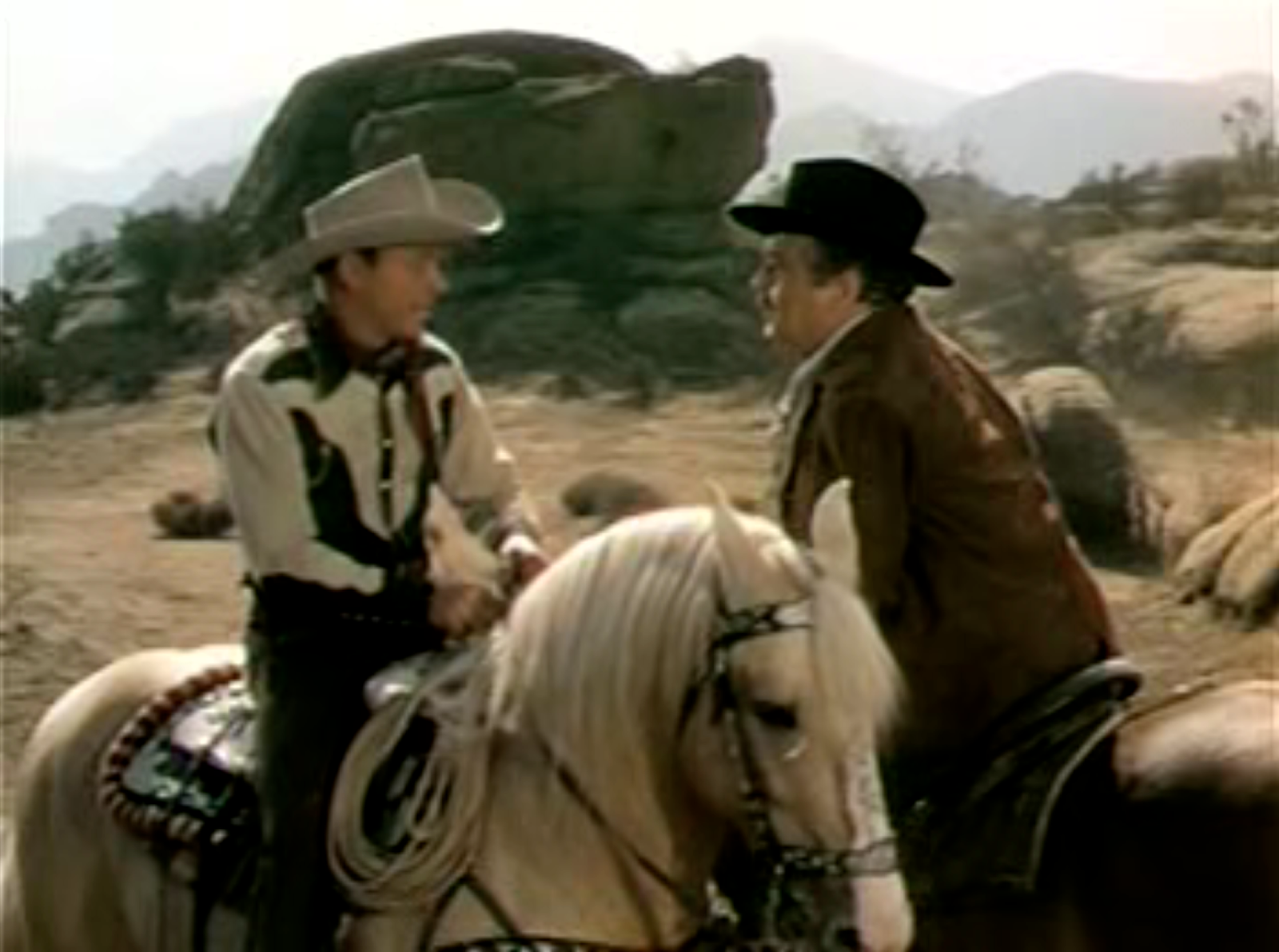
"Son of Paleface" (1952): Kinda Like Doglips

I never found Kinda Like Doglips, and initially I didn't know whether it was at Iverson or somewhere else. Eventually I narrowed it down — yes, it would have once stood at Iverson, in an area known as Silverland (not to be confused with Silvertown, which was the name of the Western town at Corriganville).

"White Squaw" (1956): Kinda Like Doglips in background

Sadly, Kinda Like Doglips doesn't exist anymore. It was destroyed years ago to make room for a concrete basin that still remains on the site. I'm unclear on just what the function of the basin was, but I've heard a rumor that the project in that area was a failed attempt to build a sewage facility.

Bird's-eye view: former Silverland area in bottom right corner

The concrete basin, and the former site of Silverland, is adjacent to the southwest corner of the Indian Hills Mobile Home Village Some of the mobile home village's famous movie rocks are also seen here — the ones surrounding the swimming pool in particular were widely filmed.

"From Here to Texas" (1958): Silverland

Silverland was a beautiful section of Iverson in the filming era, and it showed up quite a bit in the movies. These days the place is fenced off and can't easily be accessed, besides which not much remains of the landmark rocks from the filming days — Kinda Like Doglips (not seen here) and most of its neighbors were destroyed.


Here's a shot of Doglips in recent times. Not the best photo, but maybe you get the idea. Again, Doglips and Kinda Like Doglips are not the same rock.

 Here's another look at Doglips as it appears today.

Saturday, April 17, 2010

Tricks of light and imagination: The Llama ... and why you'll never get to see it in real life


Here's a photo that never fails to amuse me. It's a grainy, low-res screen shot from the "Lone Ranger" movie (shot in 1949 for the TV series, edited into a feature film in 1952). Now, you may not see the same thing I see, but I can't help but see a nearly perfect side view of a llama's head and neck. It's just to the left of the rider, hovering above the smooth white rock at the far left.

Here's a detail shot of the Llama.

Silver, the Lone Ranger's horse, rehabbing in Silverland in the movie "The Lone Ranger," filmed in 1949. 
Directly above the horse is Silver Rock, also known as the Manta Ray.

That smooth white rock, by the way, is a feature I called the Manta Ray early in my research, and later came to call Silver Rock in honor of the Lone Ranger's horse, Silver. I originally called this area the Manta Ray's Garden, before learning that it had already been called Silverland for some time, in recognition of the fact that it is the area where the Lone Ranger nursed a wounded Silver back to health in the movie and TV series.

This empty concrete basin is what occupies Silverland today.

As much as I've always wanted to get a look at that "llama" in real life, the sad reality is that most of the rocks in the above screen shots have been destroyed, giving way to a mysterious project that was once described to me (accurately or not) as an attempt at a sewage facility that was built as part of the adjacent mobile home park and apparently never worked out. These days an empty concrete reservoir occupies the location.