Why we love old movie locations — especially the Iverson Movie Ranch

For an introduction to this blog and to the growing interest in historic filming locations such as the Iverson Movie Ranch — the most widely filmed outdoor location in movie and TV history — please read the site's introductory post, found here.
• Your feedback is appreciated — please leave comments on any of the posts.
• To find specific rock features or look up movie titles, TV shows, actors and production people, see the "LABELS" section — the long alphabetical listing on the right side of the page, below.
• To join the MAILING LIST, send me an email at iversonfilmranch@aol.com and let me know you'd like to sign up.
• I've also begun a YouTube channel for Iverson Movie Ranch clips and other movie location videos, which you can get to by clicking here.
• Readers can email the webmaster at iversonfilmranch@aol.com
.

Showing posts with label Joe Iverson. Show all posts

Sunday, May 27, 2018

What's up with all those 1930s movies about Colonial India
— and why were so many of them filmed in the Iverson Gorge?

"The Lives of a Bengal Lancer" (Paramount, 1935)

Back in the 1930s Hollywood became obsessed with big productions about the British occupation of India. Gary Cooper helped get the ball rolling with "The Lives of a Bengal Lancer," filmed largely on the Iverson Ranch.

The "Mogala" set, built atop the Iverson Gorge in 1934 for "The Lives of a Bengal Lancer"
(promo still from the Jerry England collection)

The movie was filmed in 1934 and released on Jan. 11, 1935. A sprawling set was built at the north end of the Iverson Gorge to depict "Mogala," the mountain stronghold of rebel leader Mohammed Khan.

Gary Cooper mans the big gun at "Mogala" — really the Iverson Gorge in Chatsworth, Calif.

The Mogala set was the focal point for much of the action in the movie, with Cooper, Franchot Tone, Richard Cromwell, Colin Tapley and the film's other key players seeing action in Chatsworth during the shoot.

The same promo shot was featured in a lobby card for "The Lives of a Bengal Lancer," but the marketing department saw fit to flip the photo horizontally.

"The Lives of a Bengal Lancer": On location in Lone Pine, Calif.

Even though the Mogala set stood on the Iverson Ranch in Chatsworth, some of the outdoor footage in "The Lives of a Bengal Lancer" was filmed about 200 miles to the north, in Lone Pine, Calif.

The Lone Pine footage, too, fell prey to some horizontal flipping when it came time to put together lobby cards.

In another bit of movie magic, when Mogala is introduced in "The Lives of a Bengal Lancer," Khan's stronghold in the Khyber appears to be located somewhere that looks a lot like Lone Pine.

Matte painting representing Mogala, set in Lone Pine

A fake version of Mogala, anchored by the familiar tall white tower — similar to the "real" Mogala in the Iverson Gorge, but not an exact duplicate — is seen against a backdrop of Lone Pine landmarks.

While the shot is composed primarily of actual Lone Pine features, including Lone Pine Peak, the Mogala set itself is added using special effects — presumably a matte painting. No actual Mogala set was built in Lone Pine.

The "Mogala" location in Lone Pine, in 2018

Lone Pine location expert Don Kelsen was able to find the exact location that was used for the Lone Pine "Mogala" shot. Until I saw Don's photo, I assumed that at least the rocks at the bottom of the movie frame were painted — they're almost too good a match for the rocks that frame the actual Mogala set at Iverson.

The gate to the Mogala set in the Iverson Gorge

Here's a look at the gate to Mogala — the "real" gate, built in the Iverson Gorge, spanning a channel between two rock walls that bear a resemblance to the rocks seen in the foreground of the Lone Pine photo.

Zoomed-in view of the fake gate in the matte painting

Even though the gate in the matte painting is darker, it appears to be an attempt to replicate the Iverson gate: The designs on the doors are similar, and both gates span the gap between two rock walls.

Similar set built two years later for "Wee Willie Winkie" (20th Century-Fox, 1937)

Adding to the intrigue, the Mogala set looks a lot like another mountain stronghold — the set built in 1937 for "Wee Willie Winkie," director John Ford's contribution to Hollywood's Colonial India mania of the Thirties.

"Wee Willie Winkie": Cesar Romero and Shirley Temple talk peace in the Iverson Gorge

The "Wee Willie Winkie" set in the Iverson Gorge — one of two major sets built on the Iverson Ranch for the movie — is where Shirley Temple tried to convince Cesar Romero's Khoda Khan that peace is better than war.

Khoda Khan's mountain stronghold in "Wee Willie Winkie"

The mountain stronghold sets for "Wee Willie Winkie" and "Lives of a Bengal Lancer" have plenty of similarities: They were built in almost exactly the same place, both sets feature tapered cylindrical towers ... and both served as home base to rebel leaders named "Khan."

"The Charge of the Light Brigade" (Warner Bros., 1936)

The same flurry of Colonial India movies from the major studios that produced "The Lives of a Bengal Lancer" and "Wee Willie Winkie" also yielded Errol Flynn's "Charge of the Light Brigade."

"The Charge of the Light Brigade": Three Ages Rock in the Iverson Gorge
(Promo still from the Jerry England collection)

Like "The Lives of a Bengal Lancer" before it, and "Wee Willie Winkie" after it, "The Charge of the Light Brigade" also filmed in the Iverson Gorge. However, no major set was built at the site for the movie.

Promo still for "The Charge of the Light Brigade": Fort built on Lasky Mesa

Instead, "The Charge of the Light Brigade" featured an impressive fort built a few miles to the south of Iverson, on Lasky Mesa. This important filming area has been preserved as public land and is accessible at the west end of Victory Boulevard in the San Fernando Valley.

"The Lives of a Bengal Lancer": Camels in the Gorge

A fun sidenote to the Colonial India movies of the 1930s involves the camels that began showing up on the Iverson Movie Ranch in connection with the often desert-themed productions.

Joe Iverson rides a camel on the "Lives of a Bengal Lancer" set in late 1934

Sometime after the first camels began arriving for "Bengal Lancer," the adventurous Joe Iverson — the man who ran the movie ranch for more than 50 years — seized on the opportunity to take one out for a spin.

Joe and his dog on the set of "The Lives of a Bengal Lancer" in 1934

Joe also tried out some of the accommodations of "Bengal Lancer's" impressive Mogala set. The set's construction helped usher in a fruitful period for the Iverson Ranch that would see important productions including "Wee Willie Winkie," "Stagecoach" and "Fighting Seabees" build major sets on the ranch during the next decade.

Here's a wider view of that part of the "Bengal Lancer" Mogala set, taken with the camera looking north. You should be able to spot the doorway where Joe and his dog were sitting in the previous photo.

The main rock formations that provided the foundation for that part of the set remain in place today, among the Cal West Townhomes off Redmesa Road in Chatsworth, Calif.

Recent Google aerial showing the same rocks in their current environment

This Google bird's-eye view indicates where those rocks are situated today. If you plan to visit the site, keep in mind that the condos are in a private residential area.

"The Lives of a Bengal Lancer": Mogala's main tower

A screen shot from the movie provides a good look at the Mogala set's main tower. One of the best ways to tell apart the sets for "Bengal Lancer" and "Wee Willie Winkie" is simply that the "Lancer" buildings are much whiter.

Wide shot of the Mogala set looking south, from the movie

SPOILER ALERT!! In case you're planning to watch "The Lives of a Bengal Lancer" sometime soon, you may want to stop reading here because I'm about to give away an important plot point.

Promo still showing battle scene from "Bengal Lancer," with Mogala partially destroyed

That beautiful white tower we've been seeing from "Lives of a Bengal Lancer" ends up getting blown up in the movie. I want to believe they blew it up in real life and filmed it for the movie, even though I know it's not true.

By the time this shot was taken, the tower was nowhere to be found. But as realistic as the smoking ruins may be, the actual destruction of the tower shown in the movie is done with a model.

It's OK — it's just a model

Here's what it looks like when they blow up the tower. They "kind of" re-created the look of the background rocks, but they can't fool location aficionados from the future who have harnessed the power of freeze-frame.

While "Lives of a Bengal Lancer" helped jump-start a productive period for the Iverson Movie Ranch, it would be "Wee Willie Winkie" a couple of years later that would put Iverson over the top as an "A-list" location.

"Wee Willie Winkie": The mountain stronghold in the Iverson Gorge

The "Wee Willie Winkie" mountain stronghold deserves its own deep dive, which is coming up soon. I've been putting the finishing touches on a post about it, and am hoping it blows everyone's minds as much as it has mine.


The links above will take you to DVD versions of the movies discussed above, which can be ordered from Amazon.com. All of the Colonial India movies contain Iverson Movie Ranch footage. There's also a link to a Gary Cooper set that includes both "Bengal Lancer" and "Peter Ibbetson," another movie filmed on the Iverson Ranch.

Friday, November 25, 2016

Joe Iverson's "Garden of Stacked Rocks" on the Lower Iverson Movie Ranch

Joe Iverson builds a road through the Gorge, circa early 1930s

Joe Iverson, who ran all or part of the Iverson Movie Ranch for more than 60 years, was known to take it upon himself to "fine-tune" the ranch's rocky landscape.

"The Miracle Rider" (1935): Freddie Frog in foreground

One of Iverson's favorite techniques for changing the look of the place was to cement one rock on top of another — creating a "stacked rock" formation.

Freddie Frog, an early Iverson Ranch "stacked rock"

The earliest known example of a manmade stacked rock at Iverson is a feature I call Freddie Frog, which was in place as early as 1926.

Promo still for "Tell It to the Marines" (1926)

While it's relatively small and would be easy to miss in this early promo still, a careful examination of the shot reveals that Freddie Frog had already been created in 1926.

Remnants of Freddie Frog as found today

We know Freddie Frog was a manmade formation because remnants of the rock, including the cement that once held it in place, can be found today at the site.

I blogged about Freddie Frog back in February 2014, including getting into the nitty gritty about chunks of cement that remain from the formation's movie days.

"Range Beyond the Blue" (PRC, 1947)

This shot from the Eddie Dean movie "Range Beyond the Blue" shows Freddie at its most "frog-like." For more of the Freddie Frog story, please click here to read my blog post from 2014.

"Gold Raiders" (1951): Gold Raiders Rock appears at left

The Iverson Ranch was sprinkled with these "stacked rocks" throughout its filming era, and many of the stacks found their way into movies and TV shows. One of the best-known of the Iverson rock stacks is Gold Raiders Rock, seen above in the movie role that gives the rock its name.

"Ghost Town Renegades" (1947): Al "Fuzzy" St. John
rides past the future Gold Raiders Rock

Gold Raiders Rock, as it would later come to be known, also appeared in productions before it became a stacked rock. This is what it looked like before it had the smaller rock cemented on top of it.

Gold Raiders Rock today (photo by Jerry Condit)

A number of the original Iverson Movie Ranch stacked rocks have survived and can still be found on the former movie ranch. This is what Gold Raiders Rock looks like today.

"Five Guns West" (1955): "The Head" makes a rare appearance

An unusual stacked rock can be found near the west end of Cactus Hill. "The Head," as I call it, was rarely filmed, but did show its, um, head, in Roger Corman's terrific Western "Five Guns West."

The Head in modern times

The Head has survived and can still be found today next to the trail the riders used in "Five Guns West."

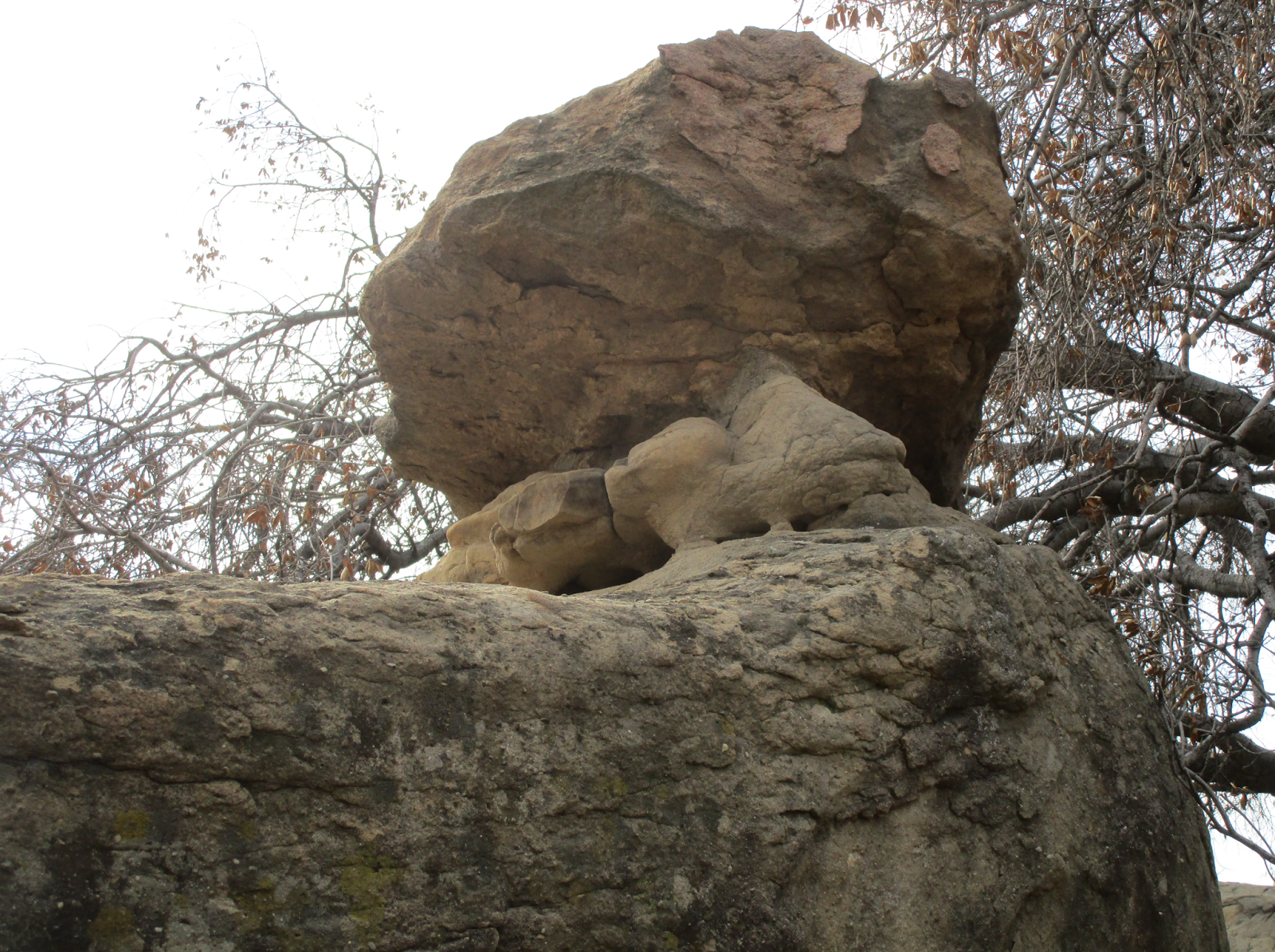
A closeup reveals the cement work that was done to hold the "head" in place.

A small bird rests on "The Head" as dusk approaches 

The Head may have had a limited film career, but it continues to make itself useful to the local wildlife.

Joe Iverson's "Garden of Stacked Rocks" in 2016

Joe Iverson outdid himself in one particular section of the former movie ranch, creating what amounts to a "garden of stacked rocks."

Contained within a small area are three distinct stacked-rock formations. The "garden" is located in a rarely explored private section of the former Lower Iverson, near Flat Rock and what remains of the Iverson Ranch Eucalyptus Grove.

For research purposes, I refer to the three stacked-rock formations as Grove Stacks A, B and C. The most familiar of the three is the triple stack identified here as "A."

"The Life and Legend of Wyatt Earp" (1960)

Grove Stack A is easy to spot in this scene from the "Wyatt Earp" TV series. The shot comes from an episode called "John Clum, Fighting Editor," which premiered April 12, 1960.

The key features of the "Wyatt Earp" shot are identified here. The camera is shooting northeast toward the nearby Eucalyptus Grove.

The same area is seen in this shot from a recent expedition to the site. A few new trees are in place, but the rock features are immediately recognizable.

"Escort West" (United Artists, 1959)

Another view of Grove Stack A, this time with the camera shooting south, appears in the Victor Mature movie "Escort West." The stacked formation can be seen at the left of the frame.

Grove Stack B in 2016

Grove Stack B, which is tucked in between Grove Stacks A and C, is the least frequently filmed of the three formations in Joe's "Garden of Stacked Rocks."

"The Roy Rogers Show" episode "Ghost Town Gold" (premiered May 25, 1952)

This rare shot from "The Roy Rogers Show" comes from one of the few scenes where it's possible to identify Grove Stack B in a production.

A portion of Grove Stack B appears at the far right in the "Roy Rogers Show" screen shot.

In fact, all three of Joe's Grove-area creations can be identified in the "Roy Rogers" shot, including a little bit of Grove Stack C hiding behind Grove Stack B.

"Hannah Lee: An American Primitive" (1953)

We get a better look at Grove Stack C in the John Ireland Western "Hannah Lee: An American Primitive."

The "Hannah Lee" shot also shows the stacked formation's proximity to Flat Rock.

"The Roy Rogers Show" episode "End of the Trail" (premiered Jan. 27, 1957)

Grove Stack C shares the screen with Roy Rogers in an episode from the final season of "The Roy Rogers Show."

Grove Stack C as it appears now, at left, and in "The Roy Rogers Show"

Here's a side-by-side comparison of the rock's profile in the "Roy Rogers" episode and in recent times.

Grove Stack C shows off its duck-shaped body in this modern-day photo.

A closeup of Grove Stack C shows the area where the "head" attaches to the body.

Zooming in further, we get a look at the cement work that helps hold the head in place.

Grove Stack B

Grove Stack B, too, is put together with the help of cement.

This closeup of Grove Stack B provides a look at some of the cement work holding the rock together.

Grove Stack A

As a classic "triple stack," Grove Stack A would have necessarily been slathered in cement.

Cement is used not only to fasten the head of Grove Stack A to the middle section, but also to hold the middle section in place atop the feature's large base rock.

Here's a closer look at the cement holding the head in place on Grove Stack A.

The finished product: Grove Stack A, in "Cole Younger, Gunfighter" (1958)

Joe Iverson's handiwork, Grove Stack A, can be seen in the lower right corner of this shot from the Allied Artists Western "Cole Younger, Gunfighter."

Joe Iverson's "Garden of Stacked Rocks" in 2016

Today the "Garden of Stacked Rocks" stands as a cement and sandstone testament to a man who knew a lot about rocks, earned his living from them — and even on occasion made his own.