Why we love old movie locations — especially the Iverson Movie Ranch

For an introduction to this blog and to the growing interest in historic filming locations such as the Iverson Movie Ranch — the most widely filmed outdoor location in movie and TV history — please read the site's introductory post, found here.
• Your feedback is appreciated — please leave comments on any of the posts.
• To find specific rock features or look up movie titles, TV shows, actors and production people, see the "LABELS" section — the long alphabetical listing on the right side of the page, below.
• To join the MAILING LIST, send me an email at iversonfilmranch@aol.com and let me know you'd like to sign up.
• I've also begun a YouTube channel for Iverson Movie Ranch clips and other movie location videos, which you can get to by clicking here.
• Readers can email the webmaster at iversonfilmranch@aol.com
.

Showing posts with label PRC. Show all posts

Saturday, December 4, 2010

The Iverson Church wasn't originally a church

Update (April 12, 2014): I've done a more recent, updated version of this post, which you can read by clicking here. The older version below remains pretty much as I originally published it, and contains some information that didn't make it into the newer post. But in my opinion, if you had to pick one or the other as the place to start ... I'd go to the newer post. (Again, click here to go to the newer post.)

Film location researcher Bill Sasser tipped me off about a 1947 movie called The Millerson Case, part of a series of Crime Doctor movies from Larry Darmour Productions starring Warner Baxter, originally distributed to theaters by Columbia. The series is usually set in the big city, and so it rarely ventures into rustic Iverson territory. But in this installment the lead character goes on a hunting trip and finds himself in a small country town called Brook Falls — played by Iverson's Western street, sometimes called El Paso Street or Iverson Village.


Among a number of important finds in this movie is probably the first film appearance of what would become the Iverson Church. Tracking the release dates of movies in which the church appears — and there are only a few of them, all released from 1947 to 1949 — I've become convinced that the church was built specifically for The Millerson Case, which came out in May 1947, a couple of months before its next known film appearance — in the Hopalong Cassidy feature The Marauders — and a few months before the church would make the first of what are probably its most commonly seen appearances these days, in a string of PRC-produced B-Westerns starring Eddie Dean and Lash LaRue.


The most surprising twist in the story of the church is that when it was first built, it wasn't a church. It was a schoolhouse. It was subsequently modified to make it look like a church — with arched tops added to the two front windows and a taller turret, complete with arched window, replacing the bell tower, transforming it into a steeple. Above is a slightly askew shot from one of the late 1947 to early 1949 B-Westerns from PRC or its spinoff, Western Adventure, showing the church as a church. The tall rock to the left of the steeple, also visible in the top photo, is known as Church Rock, obviously because of its proximity to the church.


Location expert Tinsley Yarbrough offers what seems to be the most plausible explanation for the transformation of the schoolhouse into a church: It was probably undertaken by United Artists for The Marauders, where the building again plays a major role, this time as a church. Since I first published this post I had a chance to see The Marauders, and I can confirm that the movie is set almost entirely in and around the church. I agree with Tinsley that in all likelihood the producers of that Hopalong Cassidy movie were the ones who transformed the schoolhouse into a church — and it retained that identity for the remainder of its short life.


My original theory was that PRC had something to do with the construction of the church, but PRC was notoriously low-budget, and now that the Crime Doctor and Hoppy movies have surfaced with their more meaningful use of the building, that theory can be put to rest. I find it interesting too that once PRC begins shooting in the area — and the company was there a lot from 1947-1949, with Eddie and Lash — the church is always there, in the background, but it's never brought to the foreground or incorporated into the story.


Here's another shot of the schoolhouse in The Millerson Case, giving a better look at the original turret or bell tower. The schoolhouse plays a central role in the plot of the movie — as headquarters for treating an outbreak of typhoid fever. The building is featured far more in The Millerson Case and The Marauders than in any other movie I've seen.


Here's one more view of the schoolhouse in The Millerson Case, with a portion of Iverson Village also seen. The building on the right can easily be matched with the second photo, after the schoolhouse down at the end of town became the church down at the end of town. Note that horse-drawn carts and more modern vehicles such as the stylish coupe in the top photo coexist in the small country town depicted in The Millerson Case.

Monday, October 4, 2010

Hidden Valley Cabin on the Upper Iverson Movie Ranch


"Prairie Outlaws" (1948)

This screen shot from the old Eddie Dean B-Western "Prairie Outlaws" features a cabin that appeared on the South Rim of the Upper Iverson starting in about 1944. The cabin is usually called "Hidden Valley Cabin," and has been alternately referred to simply as "Stone Cabin."

The distinctive rock towering above the cabin, which helps pinpoint the structure's location, has been called Stone Cabin Rock. In this version of the "Prairie Outlaws" screen shot, Stone Cabin Rock is identified, as is the ubiquitous background feature Oat Mountain — along with Hidden Valley Cabin, or Stone Cabin, in the foreground.

"Cheyenne Takes Over" (1947)

This shot from the Lash LaRue B-Western "Cheyenne Takes Over" gives a good look at the porch of the cabin. The term "Stone Cabin" is a reference to its appearance, not its construction. Being a movie cabin, it would have been built as inexpensively as possible. The outer surface was made to look like stones, but was presumably made up of some kind of facing material — in other words, "movie magic."

Stone Cabin Rock and a portion of the old Upper Iverson in recent times

The cabin is long gone, and this shot of Stone Cabin Rock and its surroundings from a recent visit shows some of the mansions that now occupy much of what used to be the Upper Iverson Movie Ranch. The rock's name, Stone Cabin Rock, commemorates that the distinctive feature clearly marks the spot where the cabin previously stood.

Also visible in these photos, in the distance, is Oat Mountain, and in the recent shot, as noted above, microwave towers and related gear can be seen at top right. (You may want to click on the photo to enlarge it to get a better look.) Back in the Cold War years of the 1950s and 1960s a Nike missile base, part of the national defense system, was situated where the microwave towers now stand. I believe the small rectangular white building visible in the smaller blue box on the left was a part of the missile base.

I've blogged about the Nike base before, in an entry I wrote about the Cold War movie "Panic in Year Zero," which you can read by clicking here. That post includes a shot of the missile base that snuck into the background of the movie, which was released in 1962 at the peak of the nuclear scare.

"Prairie Outlaws," made by Producers Releasing Corp., has an interesting backstory. It was an edited version of a movie the company made two years earlier, "Wild West," with additional footage shot for the new movie even though the new movie wound up being shorter than the original.

The earlier production, "Wild West," was out of character for a notoriously cheap B-movie studio such as PRC: It was in color, for one thing, and at 73 minutes, longer than typical B-movie fare. It also had two cowboy stars instead of the usual one, featuring both Eddie Dean and Lash LaRue. And it had a dual love story AND a story about a heroic young boy.


When PRC reinvented the movie two years later as "Prairie Outlaws," the company was clearly targeting the Saturday matinee market, especially young boys. Much of the "mushy stuff" was cut out, but the plot line about the heroic kid was left in. Even with the movie shortened now to about 56 minutes, a batch of new footage was added — mostly action — at the opening of the movie. The number of songs was cut back, and this time the movie was released in black and white.

The outdoor action in the original movie, "Wild West," was shot entirely at Corriganville. But in the two years that had passed before "Prairie Outlaws" was pieced together, PRC had shifted its focus to Iverson, and that's where the new footage was filmed — including a big shootout at Hidden Valley Cabin.

"Prairie Outlaws" (1948): Hidden Valley Cabin, on the Upper Iverson

Many film historians believe Iverson's Gorge Cabin, which first appeared in 1936 and was located on the Lower Iverson, was taken apart and reassembled on the Upper Iverson, becoming what we now know as Hidden Valley Cabin. The move would have taken place in about 1944, as that's when the Gorge Cabin disappears from film footage of the Gorge.

"Adventures of Red Ryder" (1940): Gorge Cabin, on the Lower Iverson

The above shot shows the earlier cabin, located in the Iverson Gorge on the Lower Iverson. I have yet to find a "smoking gun" image of one or the other cabin that confirms whether they're the same cabin, but so far, I would have to say I still need some convincing. Even so, I have to admit the two cabins are pretty similar.


Thursday, September 30, 2010

The great Iverson cinematographers: Ernest Miller


Ernest Miller: born March 1885, Pasadena, Calif.
— died April 1957, Los Angeles (age 72)

"Little Big Horn" (Lippert, 1951) — Ernest Miller, director of photography

Oscar-nominated cinematographer Ernest Miller, probably the most prolific DP in the history of the Iverson Movie Ranch, showed a love for the location ranch’s dramatic rocks during a career that included stays at Mascot, Republic, PRC, Western Adventure and eventually Monogram and some of its smaller production house partners.

"Made in Heaven" (silent film, 1921) — Ernest Miller, DP (not an Iverson production)

Miller hailed from Pasadena in the Los Angeles area, and got an early start in the movie business — going all the way back to "Made in Heaven" in 1921, his first credit as cinematographer. He was in his mid-40s by the end of the silent film era and had already amassed a lengthy resume as a DP. 

He hit the ground running in the 1930s, working steadily at Mascot Pictures during the first half of the decade before joining Republic in 1935 as part of the newly formed company’s acquisition of Mascot. He would remain at Republic for the next ten years before jumping to PRC soon after World War II.

Early examples of Miller’s career-long love affair with the Iverson Movie Ranch include the Mascot serials "Fighting With Kit Carson" (1933), "The Law of the Wild" (1934, starring Rin Tin Tin Jr.) and Gene Autry’s breakthrough production "The Phantom Empire" (1935). While at Mascot, where dual DP credits were the norm, he shared cinematography duties on a long list of projects with either Jack Marta or William Nobles, both of whom would make the migration to Republic along with Miller and would continue to shoot extensively at Iverson. 

During his first year at Republic, Miller was often again paired with Marta. Presumably one of the two DPs handled the studio work while the other was sent on location — but which one did which? Sadly, little is known about the working arrangements in those days, but my suspicion is that Miller, who was the veteran DP, would have received the more desirable studio assignments at that point in his career, while Marta — Miller's understudy, in a sense — would have had to suffer the hardships of Iverson, with its weather extremes and general notoriety as a harsh environs for film crews.


Miller was not yet a B-Western specialist when he arrived at Republic in 1935, although he did work on projects starring up-and-coming singing cowboy Gene Autry a few times early on. It was Mascot stablemate William Nobles, who had been shooting B-Westerns steadily since the silent era, who first established himself as the new company’s go-to B-Western shooter, landing the bulk of the prestigious shoots with Autry and John Wayne in those first few years at Republic. Miller typically handled more indoor-oriented fare at that point, and only later proved himself to be a powerhouse in B-Westerns, in outdoor adventure shoots ... and in particular, at Iverson.

"Come On, Cowboys" (1937) — Grumpy Candelabra?

He had a breakthrough in 1937, shooting an Iverson rock spectacle in "Come On, Cowboys," a Three Mesquiteers feature. In the above screen shot from the movie, Bill Rock, a relatively common feature in productions shot at Iverson, is partially visible at top left. Far less common is the rock at center-right, which looks like a grumpy candelabra that might be at home in Beauty and the Beast.


"Army Girl" (1938) — the adobe fort at the western end of Iverson's Sheep Flats

The following year, 1938, Miller shot Republic's "Army Girl" largely at Iverson, along with co-director of photography Harry J. Wild. The two men shared an Academy Award nomination for their work on the film.


"Army Girl" was followed by a period in which Miller's workload at Republic steadily increased, and by the early 1940s he was working regularly with most of the company’s cowboy stars, including Roy Rogers, Gene Autry, Sunset Carson, Don “Red” Barry and Bob Steele. 

"Bells of Rosarita" (Roy Rogers, 1945) — Iverson's Eucalyptus Grove

Miller's cinematography on Republic's "Bells of Rosarita" produced a series of memorable views of the movie ranch, with the Roy Rogers B-Western winding up as one of the strongest entries in Miller's Iverson portfolio. Meanwhile, Miller also continued to shoot much of Republic’s long-running Three Mesquiteers series.

Miller's special flair for showcasing Iverson can be seen as well in a few Allan “Rocky” Lane features from the late 1940s — "The Bold Frontiersman," released in 1948, being a prime example.

"The Hawk of Powder River" (1948) — the rock is Chili Pepper

Miller began working in the mid-1940s with Producers Releasing Corp., with the period from 1947-1951 yielding a wealth of Iverson-rich spectacles in his work with first PRC and then PRC spinoff Western Adventure. Both companies specialized in cheap B-Westerns shot in about a week, and both took advantage of Miller’s eye for Iverson. During this period he filmed a steady string of Eddie Dean and Lash LaRue pictures — "Dead Man’s Gold" (Lash LaRue, Western Adventure, 1948), "The Hawk of Powder River" (Eddie Dean, PRC, 1948), "Check Your Guns" (Eddie Dean, PRC, 1948) and "Outlaw Country" (Lash LaRue, Western Adventure, 1949) being just a few of the many highlights from a location standpoint.

"The Daltons' Women" (Western Adventure Productions, 1950)

During the short lifespan of Western Adventure from 1948-1952, Miller shot 11 of the company’s 12 movies — all of them at Iverson. At the same time he kept up a busy work schedule at Lippert Pictures, Monogram, Republic and others.


"Little Big Horn" (1951)

Miller went on to work with tiny outfit Lippert Pictures for a couple of years, from 1949-1951, shooting Don “Red” Barry Westerns — something he had also done earlier in his career at Republic — and filming a batch of Jimmy Ellison Westerns, which again involved plenty of work at Iverson. It was at Lippert that he shot what might be considered the crowning achievement of his Iverson work, the Lloyd Bridges-John Ireland retelling of Custer's Last Stand, "Little Big Horn" (1951) — adding an impressive coda to a film career filled with Iverson gems.

Whip Wilson's last starring role (1952)

Miller continued to kick around a few minor production houses in the early ‘50s, mainly companies with distribution and production partnerships with Monogram, such as Silvermine Productions, where among other things he shot the last of the Whip Wilson B-Westerns in 1951 and 1952, and Westwood Productions, where he was part of the last gasp of the B-Western as a viable theatrical format, shooting several Wild Bill Elliott features — again reunited with one of his occasional Republic subjects — in 1953 and 1954.

"Gunsmoke" — 11 episodes shot by Ernest Miller, from 1955-1956

Miller eventually made a mark in the early television Westerns, notably shooting episodes of "Hopalong Cassidy" and "Gunsmoke" before calling it a career in 1956. He died the following year in Los Angeles at age 72.

Ernest Miller left his mark on Iverson, on B-Westerns and on film as a whole. Among other things, he left behind one of the longest filmographies I’ve seen for a cinematographer, with 348 movie and TV series credits as DP. But beyond the numbers, his camera work, his appreciation of the rocks, his eye for interesting angles and his intuitive sense of the drama inherent in the Iverson landscape have never been equaled.

Saturday, August 14, 2010

The great Iverson cinematographers: Robert Cline

born July 1898, Arizona
died November 1946, Hollywood (age 48)

I refer to cinematographer Robert Cline as the mad genius of the Iverson Movie Ranch filming era, and he would probably hold that title even if he had shot just one film: his mystical 1942 Range Busters masterpiece "Thunder River Feud." I call it "his" movie even though it was directed by master B-Western director S. Roy Luby, because Cline's camera work clearly adds a strange quality to the movie that even Luby may not have envisioned. 

Thunder River Feud (1942) — the Iverson Gorge, as photographed
by the "mad genius," cinematographer Robert Cline

While it’s possible that the artistic “brilliance” of Cline’s fuzzy visual poetry in this strange and wonderful movie is purely accidental, it seems unlikely. Shot after shot reveals subtle, elusive images, often tucked away in the corners of the frame. For the viewer who is able to relax into it and surrender to the weirdness of it all, it adds up to a cinematic experience that is more akin to spotting faces in the clouds or looking at a book of hidden-eye puzzles than it is to watching a typical B-Western. 

"Fugitive Valley" (1941) — a leap off Range Rider Rock

Regardless of whether Cline intentionally injected illusions into his work, whether it’s all attributable to a bad print or whether the often puzzling images in his shots are purely imaginary, he showed a flair for Iverson in a solid string of 1940s B-Westerns, part of an ephemeral career that began in the silent era and soon saw Cline emerge as one of the key shooters in early sound Westerns.

"Range Beyond the Blue" (1947) — holdup gang 
waiting for the stage in front of a rock I call Tamale

By the time the genre hit its stride in the mid-1930s he was already a master of the outdoor action sequence, had already developed much of his unique visual style and had already begun shooting at the Iverson Movie Ranch. Working mostly with smaller outfits — including Trem Carr Pictures and William Berke Productions in the early days and later the Alexander brothers and A.W. Hackel’s Supreme Pictures — Cline found himself at the center of what was suddenly the hottest film commodity in the business, the B-Western. 

"Western Cyclone" (1943) — riderless horse on the Upper Iverson,
with Pyramid Peak and the Rocky Peak area in the background 

He began to connect with some of the bigger players, flirting briefly with Republic, where he shot three Westerns in the late 1930s. He found more steady work at Monogram starting in 1940, migrating over to Ray Corrigan’s Monogram-affiliated Range Busters Productions in 1941. He settled in for a good run with Corrigan, shooting 16 Range Busters features before moving on to PRC in 1943.


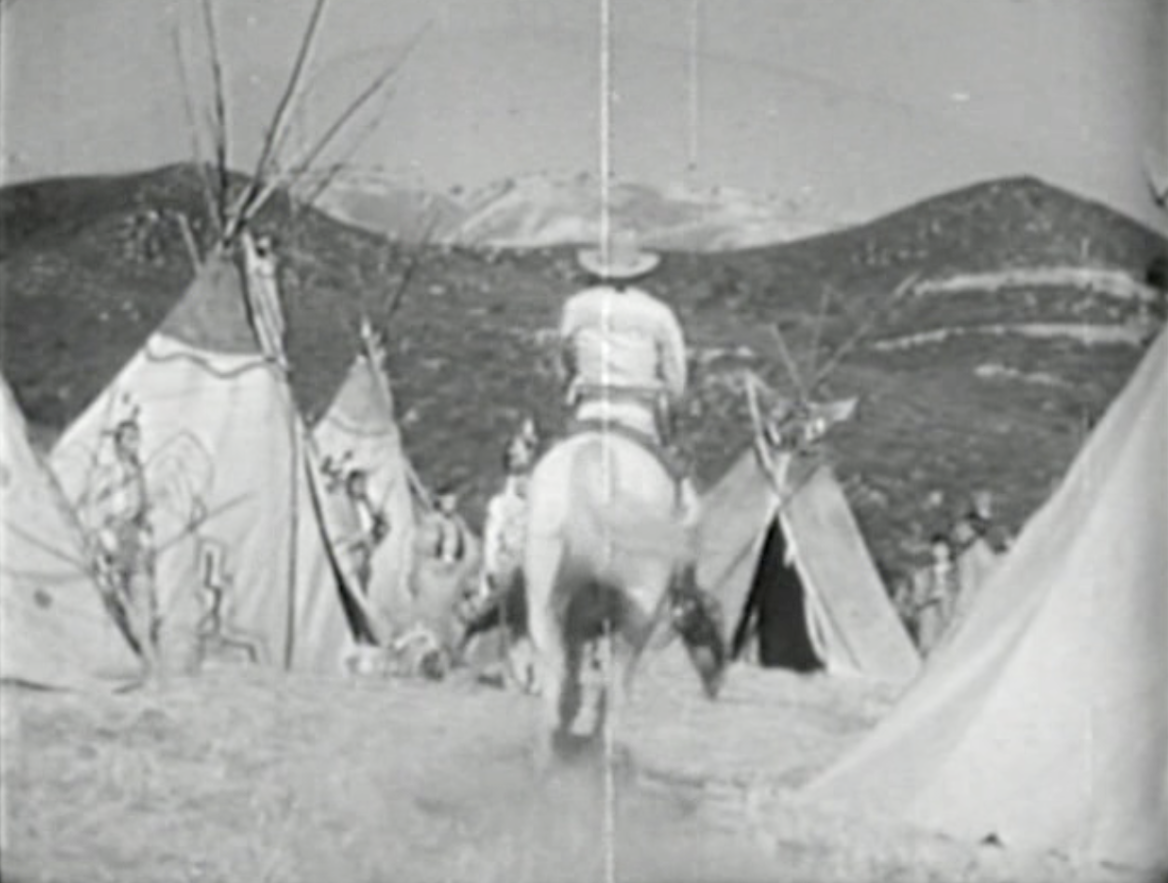
"Buffalo Bill Rides Again" (1947) — teepee village on the Upper Iverson, 
with Oat Mountain in the background, center, flanked by
 Two-Humper, left, and Notch Hill, right

Much of his best Iverson work was done during this Range Busters/PRC period, including the Range Busters installments Underground Rustlers and Fugitive Valley (both 1941) and the Buster Crabbe/Billy the Kid/Billy Carson yarns Western Cyclone and Devil Riders (both 1943) at PRC. 


An early Iverson standout for Cline is the 1938 Bob Steele feature Paroled to Die from A.W. Hackel.

"Buffalo Bill Rides Again" — Hangover Shack in the background

He rarely stayed long in any one place, adding to the mystique of Robert Cline as a restless and perhaps troubled genius. He avoided the one thing that almost all major Iverson cinematographers share: a lengthy stay at Republic Pictures. Maybe it’s part of his genius that he found a way to keep himself from getting sucked into the machine in a big way, something almost no one else seemed able to resist.

Thunder River Feud — Hangdog, a sandstone giant
on the Iverson Movie Ranch

Cline has presided over my pantheon of Iverson DPs from the beginning, and was the inspiration for the creation of a pantheon in the first place. His volume of work doesn’t stand alongside prolific Republic shooters such as Ernest Miller or John MacBurnie, but Robert Cline is clearly one of the masters, if not THE master, at shooting the Iverson Movie Ranch. This despite his relatively high “miss ratio” — for example working quite a bit at Corriganville, working on low-Iverson-percentage Texas Rangers movies and working extensively in the silents (and therefore largely unseen and presumably largely lost).

One of Robert Cline’s later career highlights is the Lash LaRue movie Law of the Lash from PRC, released in 1947, after Cline’s death.

"Thunder in the Desert" (1938) — Hangdog in the background

Like many of the cinematographers of the B-Western era, Robert Cline was born out West. He came from Arizona, which may have helped instill his affinity for Westerns and the Western landscape. And like so many of the cinematographers of the period, he died young — in his case even younger than most, at 48. But he also started young, well back into the silent era. His career essentially spanned 1925-1946, with a few releases coming out after his death, in 1947, and he left behind a legacy of 139 productions listed in his filmography — all well worth a look, if I can say so after having only seen a fraction of them. Cline lived long enough to see television coming, but he died before he got his chance to work in the new medium.