Why we love old movie locations — especially the Iverson Movie Ranch

For an introduction to this blog and to the growing interest in historic filming locations such as the Iverson Movie Ranch — the most widely filmed outdoor location in movie and TV history — please read the site's introductory post, found here.
• Your feedback is appreciated — please leave comments on any of the posts.
• To find specific rock features or look up movie titles, TV shows, actors and production people, see the "LABELS" section — the long alphabetical listing on the right side of the page, below.
• To join the MAILING LIST, send me an email at iversonfilmranch@aol.com and let me know you'd like to sign up.
• I've also begun a YouTube channel for Iverson Movie Ranch clips and other movie location videos, which you can get to by clicking here.
• Readers can email the webmaster at iversonfilmranch@aol.com
.

Showing posts with label North Cluster. Show all posts

Tuesday, March 31, 2015

Dinosaur-related news: A rock that looks like a trachodon

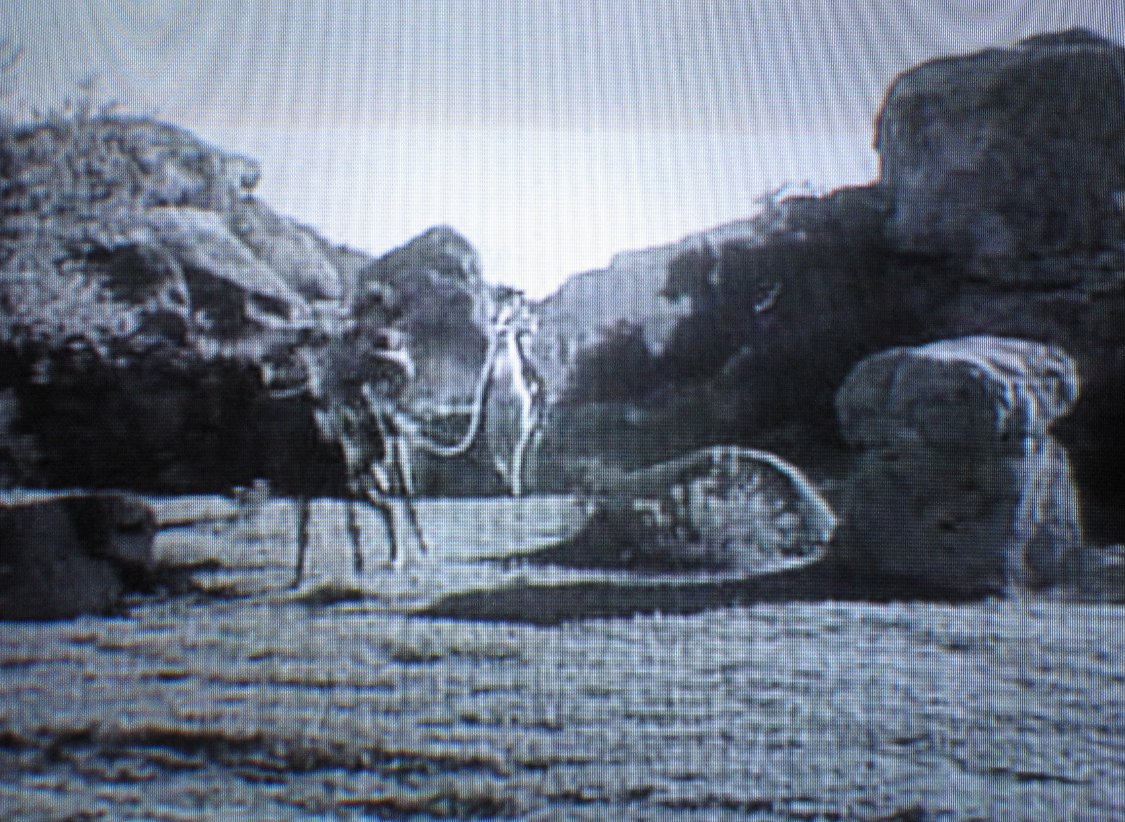
Trachodon

This rock can be found north of Garden of the Gods, in a section of the former Iverson Movie Ranch that has been preserved as parkland. I'd be willing to bet that "Trachodon" found its way into a movie or TV show, but at this point I've still never seen it, other than in person. If you happen to spot this thing anywhere, please let us know!

The Sinclair Dinoland version of a trachodon

Here's another rendition of a trachodon, from Sinclair Dinoland. Who knows how accurate either version is — to state the obvious, no one alive today has seen an actual trachodon, as they lived in the Campanian age, about 80 million years ago. Make a note of that — it might come in handy for bar trivia.

"The Life and Legend of Wyatt Earp" TV episode: "One" (April 15, 1958)

Unlike its fellow dinosaur Trachodon, Stegosaurus shows up regularly in movies and TV shows — including multiple appearances on the "Wyatt Earp" TV series. Click here to see another example from "Wyatt Earp."

1950s-vintage Marx dinosaurs — not the author's collection

I probably see more "dinosaurs" at Iverson than I should — I blame my childhood obsession with my toy dinos. I think I still have two shoeboxes full of them somewhere. If you ever want to visit a site run by someone who's WAY into the toy dinos ... check out this link.

"Journey to the Center of the Earth" (1959)

It was probably "Journey to the Center of the Earth," more than any other single event, that was responsible for my obsession. I've been partial to dimetrodons ever since — and I know I'm not alone!

Friday, October 24, 2014

It's Now or Never: Time to find out whether Elvis Presley ever worked the Iverson Movie Ranch

The King of Rock 'n' Roll — in costume for "Harum Scarum" (1965)

I've been trying for some time now to nail down a definitive answer to the question of whether Elvis Presley ever appeared in movie footage shot at the Iverson Movie Ranch. That answer was surprisingly elusive, but I believe I finally have it — and the answer is ... Yes!

It happened in the 1965 MGM musical "Harum Scarum." It's widely known that a number of the outdoor scenes for the movie were shot at Iverson, but I had to put together a few separate pieces of evidence to determine whether Elvis himself took part in filming at the movie ranch. Finally, I can confirm that Elvis not only showed up at Iverson, but also ran around among its famous rocks.

"Harum Scarum" — Is that Elvis running around in the North Cluster?

This shot features Elvis' character, at the center of the frame, running near an Iverson rock that can be recognized from its appearances in other movies, as noted below. The shot does not provide a clear look at Elvis, but it's about as good as it gets as far as actually seeing the King at Iverson in the movie. (You may want to click on the photo to see a larger version.)

The rock seen just to the right of Elvis in the shot is one that appears frequently in old Westerns, which I call E.T. I've been aware of this shot for a few years, but I didn't consider it proof that Elvis was at Iverson because it could be that a stand-in was used in the shot. In those days big stars were routinely spared from having to do actual location work for long shots, especially in a harsh locale such as the Iverson Ranch. Until recently I remained skeptical about the actual presence of Elvis — Then I saw the promo still.

Promo still for "Harum Scarum" (1965) — shot on the Lower Iverson 

The promotional still, from the collection of film historian Jerry England, makes it clear that Elvis was indeed at Iverson. Whether the action here was a special setup for the photo or was a part of the actual filming doesn't matter. Clearly, the actors are all in costume for the movie, positioned in their same spots from the movie, and they're running through the same sequence that appears in the movie. Add it all up, and it means that's indeed Elvis in the scene in the movie.

The action in both the promo still and the movie scene takes place in a section of the former location ranch just north of Garden of the Gods known as the North Cluster. In this version of the shot I've identified the rock I call E.T.

"Come On, Cowboys" (1937)

This shot from the Three Mesquiteers movie "Come On, Cowboys" might help explain the origin of the name "E.T." The rock appears from a different angle here than in the Elvis movie, but is once again at the right of the frame.

This shot pinpoints E.T., as I want to make sure readers are certain which rock I'm talking about.

"E.T. the Extra-Terrestrial" (1982)

I find the shape of the rock to be strongly reminiscent of the title character in the Steven Spielberg movie. This shot also features a young Drew Barrymore.

"Stagecoach" (1939) — the stage arrives at Apache Wells

E.T. — the rock — appears in a minor role during an iconic sequence in one of the most high-profile movies filmed at Iverson, John Ford's Great American Western, "Stagecoach." The sequence in which the stagecoach arrives at the Apache Wells outpost, with the Garden of the Gods rock behemoths in the background, also includes the much smaller E.T. — although it would be easy to miss.

This version of the "Stagecoach" shot points out E.T. As I mentioned, it would be easy to miss the rock in this shot if you didn't know exactly where to look.

Here's a more widely recognized shot from the sequence, in which the giant Garden of the Gods towers are prominently featured in the background. From this angle, E.T. is blocked out by the wall and cannot be seen.

The best shot of E.T. in "Stagecoach" is probably this one, which appears as the stage pulls out of Apache Wells.

Pointing out E.T. one final time. In these shots we can begin to see that the rock was sort of out by itself, in a flat area where it was distanced from the other rocks. Its solitude and distance ultimately proved fatal, as E.T. was removed when the flat area was prepped for condo development in the 1980s.

"Harum Scarum": Is that Elvis, or a stand-in?

Getting back to "Harum Scarum," I wanted to point out a couple of other shots. The above scene is filmed at Iverson, with Cactus Hill in the background. But as with some of the other shots, it's unclear whether it's Elvis in the scene. His character is riding the second horse in the group, but here again, it could be a stand-in — and in this sequence, where only distant shots are included, my hunch is that this is not Elvis.

The situation is similar with this sequence of shots taken in the Iverson Gorge. Elvis is again supposedly a part of the group of riders, but it's impossible to be sure in the long shots. This shot includes the rock feature Bald Knob, directly above the riders. I talked about this shoot in a post about Bald Knob a couple of months back, which you can see by clicking here.


Below are some links to DVD versions of "Harum Scarum" and "Stagecoach," along with a link to a streaming version of "Come On, Cowboys," for those who are interested in seeing more of the Iverson Movie Ranch in these movies — or maybe just seeing the movies themselves.


Friday, April 25, 2014

Where's the logic? Beloved "Star Trek" figure Leonard Nimoy goes on the warpath

 "Mackenzie's Raiders" (1959) — Leonard Nimoy as Yellow Wolf, right

I believe it's fairly well-known among fans of "Star Trek: The Original Series" that Leonard Nimoy, the actor who played the landmark TV show's iconic and always logical Mr. Spock, worked quite a bit in television before he got that role, including often appearing as Native American characters in early TV Westerns.

Leonard Nimoy, second from left, and other Native American characters on "Mackenzie's Raiders"

I recently ran across a nice example of Nimoy's pre-"Star Trek" work that brought him in full Native American regalia to the Iverson Movie Ranch, where he went on the warpath as the renegade Yellow Wolf in an episode of the TV Western "Mackenzie's Raiders." The episode, titled "Joe Ironhat," first aired in 1959, seven years before Nimoy clocked in as Spock on "Star Trek." In the above shot he appears alongside well-known Chiricahua Apache actor Dehl Berti, at right, playing the title character, Joe Topanga, or "Joe Ironhat."

Dehl Berti, left, and Leonard Nimoy in "Mackenzie's Raiders" 
— with Iverson's Cactus Hill in the background

In "Joe Ironhat," Nimoy's character represents the Native Americans' militant, Cavalry-hating wing while Berti's Joe Topanga is friendly with the white man and is working to make peace. The above shot is taken on the Lower Iverson Movie Ranch in Chatsworth, Calif., with widely filmed movie feature Cactus Hill visible behind the actors.

Tensions build until the episode culminates in the inevitable shootout between the Cavalry and the Native Americans. Here Yellow Wolf leads a small band of warriors as they get in position to do battle. You may notice Berti as Joe Topanga hovering reluctantly in the background. The scene takes place in Iverson's North Cluster, adjacent to Garden of the Gods, with this shot featuring a familiar movie landmark, Cleft Rock.

Here's that same shot with Cleft Rock and Nimoy pointed out. You can read more about Cleft Rock by clicking here.

Nimoy's Yellow Wolf, taking cover behind one of the rocks of the North Cluster, aims to gun down as many Cavalrymen as he can.

Meanwhile, Yellow Wolf also has a beef with his rival Joe Topanga. In the above shot Yellow Wolf is coming after Joe with a knife. Nimoy's Yellow Wolf is a real sourpuss, with one of his most frequent lines in the episode being, "You will die!"

Thursday, February 27, 2014

The Cisco Kid was a friend of mine — and a friend of the Saddle, Cleft Rock, Bathtub Rock and Water Wiggle

Duncan Renaldo as the Cisco Kid

What do Duncan Renaldo, I. Stanford Jolley and Water Wiggle have in common? They all appeared together in an episode of "The Cisco Kid" called "Montezuma's Treasure."

"Montezuma's Treasure" — first aired Feb. 24, 1955; the shot features perennial B-Western baddie 
I. Stanford Jolley as, what else, a bad guy — the crooked Professor Danforth.

I can never get enough of the sandstone wonderland that was — and to a large extent, still is — the Iverson Movie Ranch's rock-strewn North Cluster, a portion of which is seen in the above screen shot. With that in mind, this blog post picks up where the previous one left off, breaking down the main rock features of the North Cluster with the help of "The Cisco Kid." The shot above depicts an especially rock-rich section as it appeared in 1955, looking toward the west. An adjacent chunk of equally rocky terrain can be seen in the screen shot of Cisco below, and I'll combine the two halves later in the post to present a wider view of the area.

By the way, "The Cisco Kid" is reportedly the first TV series filmed entirely in color. The early TV Western was a syndicated production from Ziv Television Programs that ran for six seasons and 156 episodes, with its first run stretching from 1950 to 1956. The odd thing is hardly anyone saw it in color until years later, because nobody had color TV sets at the time.

Duncan Renaldo as Cisco — another shot from the 1955 episode "Montezuma's Treasure"

In the above shot the Cisco Kid runs through the North Cluster in pursuit of the crook Danforth, played by I. Stanford Jolley. This shot is sort of the "other half" of the screen shot up above — you might spot the smaller two-humped rock known as the Saddle in both shots. It's at the left of the screen in the Cisco shot above, and at the right of the screen in the shot of Danforth.

I. Stanford Jolley, perennial B-Western heavy

I'll try to connect some of the dots among the rock features Toucan and Freddie Frog, which were examined in detail in the previous blog post (you can find it by clicking here), and a number of the other rocks seen in the two screen shots above, including the Saddle, Bathtub Rock and Cleft Rock. First up, allow me to introduce Water Wiggle ...

The rock highlighted above in the blue rectangle is Water Wiggle, and it was at the center of a long-running mystery for me. As of a few weeks ago, that mystery — like the mystery of Freddie Frog — is solved.

"Days of Jesse James" (1939)

The Water Wiggle mystery originated here, in the 1939 Roy Rogers/Gabby Hayes movie "Days of Jesse James." I became fixated on the large rock toward the right — shaped sort of like a bell, lying on its side. I eventually took to calling it Water Wiggle. It's highlighted in the shot below.

The name comes from the rock's bell shape, which reminded me of the old Wham-O hose attachment toy.

You know, this thing. Along with the way-more-fun (and of course, way-more-dangerous) Slip 'N Slide, the Water Wiggle was a children's summer staple for years, going back to the early 1960s. Historical note: The original version of the Water Wiggle itself was apparently also dangerous, and millions of them were recalled back in 1978 after at least a couple of youngsters drowned when the nozzles became lodged in their mouths.

It took me a few years to assemble the puzzle pieces I needed to find the real-life rock Water Wiggle, which was hiding in plain sight all along. The above shot shows Water Wiggle in recent times, largely obscured by foliage. One big problem is that it doesn't look much like it did in the old Roy Rogers movie, but that's the kind of challenge that makes this research as much fun as it is.

Back to the "other half" the "Cisco Kid" scene. Besides featuring an airborne Duncan Renaldo as Cisco, this shot from "Montezuma's Treasure" contains rocks that are adjacent to those found in the screen shot of Prof. Danforth. The rocks behind Cisco, above, are generally to the north of the rocks seen in the frame with Danforth. The Cisco frame seen here includes the landmarks (left to right) the Saddle, Bathtub Rock and Cleft Rock.

This is how the two halves fit together, more or less. As composites go, this one is a bit clunky, but I suppose it will do. You may want to click on it for a larger view. I'll get back to this shot again later in the post and will mark up the main rock features. But I wanted you to see most of the area in one piece before we continue.

Now, back to the "Cisco half" of the shot ...

One of the best-known features of the North Cluster, the Saddle, also known as Saddle Rock, is highlighted in the rectangle in the above shot.

"The Living Bible" (1952)

The Saddle surfaces pretty regularly in productions shot at Iverson. It's only partially visible in the above example, where it's positioned right behind what appears to be a small stable at the center of the shot. For some reason I find this use of Saddle Rock mildly amusing, as it had to be intentional to place it in the middle of the scene, but at the same time it's hard to see the point.

In case there's any doubt, this shot pinpoints the Saddle. By the way, the larger rock to the immediate right of the Saddle is Bathtub Rock, which will be discussed in more detail below.

I wanted to include this additional shot from "The Living Bible" because, even though it shows only a portion of the Saddle, it provides a little more detail — and it continues to use the rock in an unusual way. To my eye, the rock is just sitting there for no good reason with nothing to do, getting in the way of the other action to some extent. But as I'm a self-admitted "rock guy," I suppose it's to be expected that my focus would be drawn to the rock.

Probably not necessary, but again, in case there's any doubt, the Saddle is highlighted here. The Toucan also appears in these "Living Bible" shots, and I've noted it above as well.

This is the world of the Saddle today, forever in shadow beneath a large oak tree. The main use for the Saddle these days is as a step for people who want to climb up onto Bathtub Rock — the larger rock to the right of the Saddle. And people do want to climb up there to get a look at the tub.

I managed to catch the Saddle with sufficient light for a closeup on a visit to Iverson a few years back.

Directly to the right of the Saddle is the much larger Bathtub Rock, so named because Buster Keaton took a bath in a "tub" at the top of the rock in the silent feature "Three Ages."

Here's another view of what Bathtub Rock looks like these days, with its constant companion, Saddle Rock, lurking in the shade toward the left.

This is the famous shot of Buster in the "bathtub" from the shoot for "Three Ages" in 1923. Keaton plays a caveman in this portion of the movie.

The bathtub is still intact, and still holds water — as seen in this photo from modern times. It's rare to see the "tub" quite this full, but it can fill up whenever Southern California gets a decent rainstorm. Up to this point, I've resisted the temptation to get in the tub when it has water in it — but I will admit to having posed for a photo in the tub one time when it was dry.

To the immediate right of Bathtub Rock is another well-known Iverson Movie Ranch feature, Cleft Rock.

"Gunsmoke" TV show (1965)

Cleft Rock turns up pretty regularly in movies and TV shows. The above shot comes from the "Gunsmoke" episode "Two Tall Men," from Season 10 of the long-running Western series. The shot shows Festus, played by Ken Curtis, at the right, with Cleft Rock directly above his back. The larger rock to its left is again Bathtub Rock.

I've circled Cleft Rock here, as it's a little hard to make out in the "Gunsmoke" shot. I wasn't trying to circle Festus' head, but he's right in front of the rock.

"Outlaws of the Panhandle" (1941)

Here's a closeup of cowboy star Charles Starrett from the 1941 Columbia B-Western "Outlaws of the Panhandle," with Cleft Rock right behind him.

You're probably getting good at recognizing Cleft Rock by now, but here it is pointed out anyway.

The contemporary setting for Cleft Rock includes plenty of bushes, condos in the background and, as always, Bathtub Rock to the left. The rock is tucked away in a pretty obscure corner of Garden of the Gods Park, with ivy and other foliage gradually swallowing it up.

Once again, here's that composite photo of the site as it appeared in 1955 for "The Cisco Kid." I've highlighted the main rock features, making for a "busy" shot, but I thought it might be a useful way to summarize the rocks found at the location. Again, you may want to click on the photo for a larger view.

Almost all of these rocks remain in place today and can be seen on a visit to Garden of the Gods Park — although in some cases you'll have to look under trees to find them. In the case of Freddie Frog, let's just say that Freddie's not himself these days ... but you can still visit his two halves.

http://iversonmovieranch.blogspot.com/2014/02/the-toucan-makes-appearance-in-cisco.html

"The Cisco Kid" remains one of the best sources of color footage of the Iverson Movie Ranch when it was still a working filming location. As you can see in this post and the previous one, the show extensively documented the North Cluster. But that was just the beginning, as the series was all over the 500-acre ranch during Cisco's six-year run on TV. I've blogged before about the TV show, including a weird entry about faces in the rocks, which you can see by clicking here. I also expect to be writing more about "The Cisco Kid" in upcoming posts.

In the meantime, you may want to take a look at the "Cisco Kid" TV show DVD sets being sold on Amazon, as they're highly recommended if you're into the Iverson Movie Ranch, location research in general or just old TV Westerns. The picture quality is generally really good — I'm not sure how well it comes across in the screen shots you see here, but this is by far the best "Cisco Kid" TV show stuff I've seen. I'll include some links below to the same sets I'm using for these posts. One minor disclaimer: Collection 1 doesn't have much Iverson content, although the other sets are loaded with it.