Why we love old movie locations — especially the Iverson Movie Ranch

For an introduction to this blog and to the growing interest in historic filming locations such as the Iverson Movie Ranch — the most widely filmed outdoor location in movie and TV history — please read the site's introductory post, found here.
• Your feedback is appreciated — please leave comments on any of the posts.
• To find specific rock features or look up movie titles, TV shows, actors and production people, see the "LABELS" section — the long alphabetical listing on the right side of the page, below.
• To join the MAILING LIST, send me an email at iversonfilmranch@aol.com and let me know you'd like to sign up.
• I've also begun a YouTube channel for Iverson Movie Ranch clips and other movie location videos, which you can get to by clicking here.
• Readers can email the webmaster at iversonfilmranch@aol.com
.

Showing posts with label Potato Rock. Show all posts

Wednesday, February 12, 2014

Shirley Temple dies — and she probably never knew she had a rock named after her

Shirley Temple, 1928-2014

I was sorry to hear the news this week of the death of Shirley Temple Black at age 85. She was a unique talent and had an enormous impact not just on movie fans of the 1930s, but on American culture. She also earned a special place in Iverson Movie Ranch history, starring in one of the most important Iverson productions, "Wee Willie Winkie," released in 1937.

Shirley Temple was the biggest movie star in the world in the mid-1930s, even though she was still just a little kid. When she appeared in the John Ford epic "Wee Willie Winkie," along with established Hollywood stars including Victor McLaglen and Cesar Romero, Shirley — who was 8 years old during filming of the movie — was top-billed. And McLaglen was already an Oscar winner for his lead role in "The Informer" in 1935.

Shirley Temple, as young Priscilla Williams — Wee Willie Winkie — with Cesar Romero, as the warrior 
Khoda Khan, in a promotional still for John Ford's "Wee Willie Winkie." The photo, shot on the 
Iverson Movie Ranch, comes from the collection of film historian Jerry England.

As she always did, Shirley stole the show in "Wee Willie Winkie," a war movie about the British colonial period in India. Shirley's character charmed her way into the hearts of soldiers on both sides of the conflict, while the young actress chewed up the scenery across two elaborate sets built for the movie on the Iverson Movie Ranch — widely considered to be the most extensive construction ever done for a movie at Iverson.

In a battle sequence from the film, Shirley stopped to survey the situation from atop a particular rock, seen above. The scene takes place in the Iverson Gorge, among buildings that were part of the set built as India freedom fighter Khoda Khan's mountain stronghold. I've blogged about this scene before — and you can click here to read that earlier post. Shirley's scene on this rock led to the rock being referred to — by me, initially, but to some extent by other location researchers as well — as Shirley Temple Rock.

Here's a wider view of Shirley Temple Rock from "Wee Willie Winkie," with 8-year-old Shirley scampering down from the rock feature.

The rock has turned up in other productions as well, which helped pinpoint its location. Here's an appearance by Shirley Temple Rock many years after the "Wee Willie Winkie" filming, in an episode of the TV show "The Virginian" called "Run Quiet," which first aired Nov. 13, 1963. Shirley Temple Rock is the shade-covered rock feature occupying the lower left corner of the frame. This shot also includes a number of other significant features of the Iverson Gorge — I'll post an annotated version of the photo below to point those out.

Here you can get an idea of the various rock features seen in the shot above this one, from "The Virginian." The hill in the background, across much of the top of the frame, is Cactus Hill, located to the north of Iverson Gorge. Most of the rock features seen in this shot remain in place today — but Shirley Temple Rock was not as fortunate. Sadly, the rock did not survive the development of the former Iverson Movie Ranch, being demolished to make way for condos.

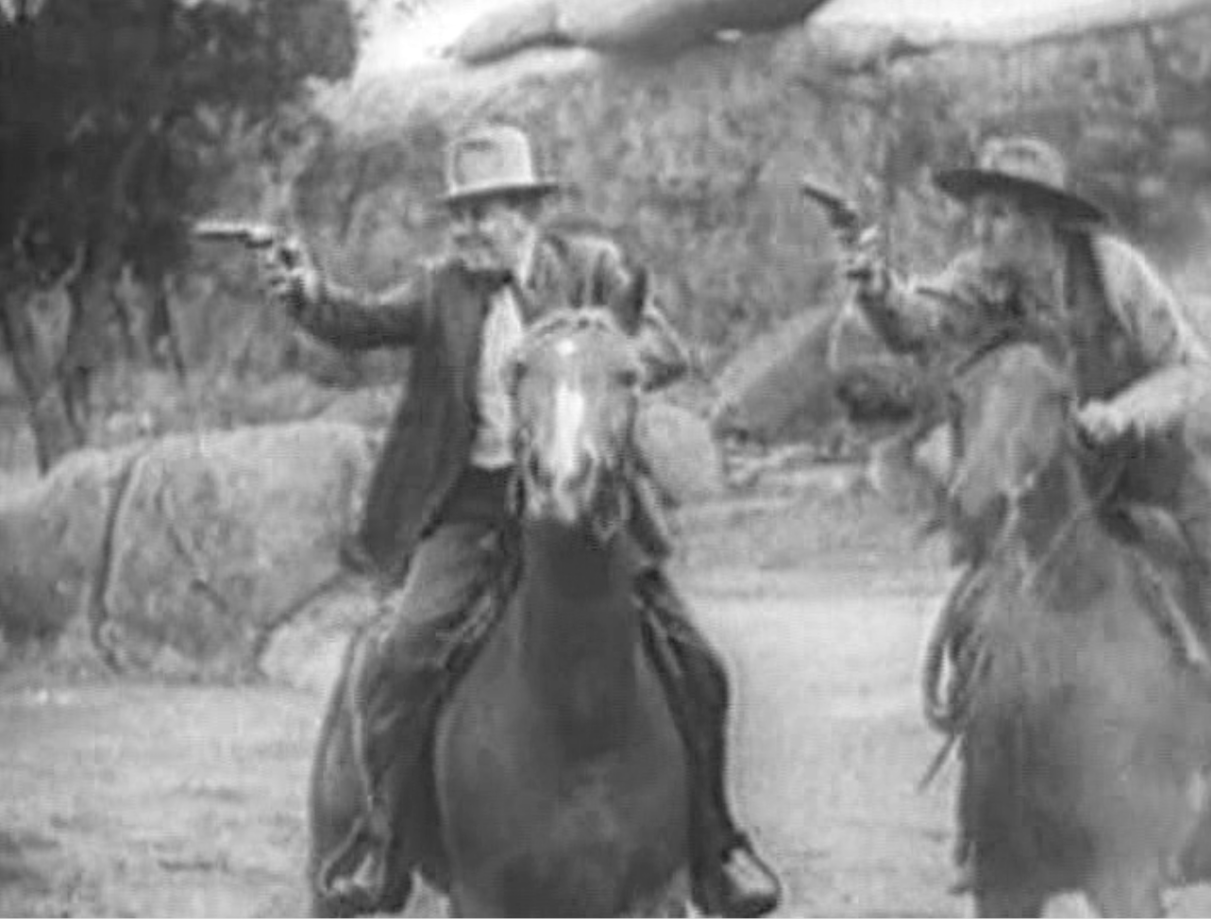
Here's another appearance by Shirley Temple Rock, in the 1938 Bob Steele B-Western "Thunder in the Desert." The picture quality isn't the greatest, but you may be able to make out the rock at the left, below the shooter's outstretched arm. The background is filled by the rock feature known as The Wall, and a portion of Potato Rock, on top of The Wall, can be seen. I'll point out these features in the next shot.

This is the same shot as above, from "Thunder in the Desert," with key rock features highlighted. Unfortunately, all of the rocks seen here — including Shirley Temple Rock — were destroyed to make way for the Cal West Townhomes.

Shirley Temple on the set of the India outpost, built at Sheep Flats on the Iverson Movie Ranch,
in a scene from "Wee Willie Winkie." 

Other key scenes in "Wee Willie Winkie" took place on Iverson's Sheep Flats, where a massive set, usually called the India outpost or the India fort, was built. A small portion of this set can be seen in the shot above. By coincidence, my previous blog entry, published about a week before Shirley Temple's death, also featured Shirley Temple, "Wee Willie Winkie" and the India fort. You can go to that entry by clicking here, or you should be able to find it below this post. Additional posts about "Wee Willie Winkie" may be found here.

Shirley Temple Black

I would be shocked if I found out Shirley Temple Black ever heard of Shirley Temple Rock, or knew she had a rock named in her honor — a rock she scampered up as a child, with that scampering preserved for future generations thanks to the magic of celluloid. The rock name is a modest honor, to be sure — nothing formal, just a tribute to an actress and a little girl who won over the hearts of millions.

Monday, October 21, 2013

Adventures of the Three Stooges on the Iverson Movie Ranch, Part I: "Have Rocket, Will Travel"

This is the first installment in a three-part series on Three Stooges feature films shot at Iverson, with part one focusing on the 1959 outer space romp "Have Rocket, Will Travel."

The movie is one of several productions in which the Stooges wind up in outer space, including the 1957 short "Outer Space Jitters" and the 1962 feature "The Three Stooges in Orbit." "Have Rocket, Will Travel" is billed as their first feature-length film, even though they previously appeared in the 1951 Western comedy "Gold Raiders," in which they shared the bill with cowboy star George O'Brien. And an earlier lineup of the Stooges headlined the 1945 Western musical "Rockin' in the Rockies."

"Gold Raiders" was also shot at Iverson, and is the focus of part two of my series. Part III wraps up this round of Stooges posts with an entry on the 1962 feature "The Three Stooges Meet Hercules," in which the Stooges turn the Iverson Movie Ranch into ancient Greece.

Here's the cover of a 45 released in 1959 in connection with the movie, with the Three Stooges singing — yes, singing — the title song, "Have Rocket, Will Travel." I wouldn't advise anyone to go out of your way to find it. This period for the Stooges isn't generally considered to be representative of their best work, and the fact that they sang didn't help matters one bit. At any rate, for whatever it's worth, their rendition of the song also appears in the movie.

In the movie, things only get good — if "good" is the right word — once the Stooges land on Venus, with the Iverson Movie Ranch in Chatsworth, Calif., playing Venus. The above shot is the first time we see Iverson, with the Stooges' rocket having landed in Iverson's Upper Gorge. Credit this shot to special effects, as I don't think the filmmakers hauled an actual 60-foot-plus rocket out to Iverson. Most of the rocks seen in the right half of the shot remain in place today, although they're now surrounded by the Cal West Townhomes.

In this shot the Stooges, in retro space suits, have begun to "deplane" on Venus. The action takes place in the same location as the previous shot, and includes a closer look at the rock all the way at the right of that shot, which is part of the Devil's Doorway cluster and can be found today amid the condos. I call this rock Devil's Doorway Wall, and have featured it in earlier posts that can be seen if you click here. If you'd like to really zero in on this rock, including what it looks like today, check out this blog entry. The above shot looks toward the west, and shows the Rocky Peak area of the Santa Susana Mountains in the background. The shot also offers a glimpse of Rock Island, the smooth rocks in the bottom third of the photo, near the center — just to the right of the boot of the Stooge on the ladder.

While we're on the subject of Rock Island, here it is in the 1941 Errol Flynn feature "They Died With Their Boots On." This shot again looks toward the west, with the Rocky Peak area again seen in the background — pretty much the same direction as the previous photo, but from a higher angle. This angle reveals more of Rock Island, including the scale — with a battalion of mounted soldiers riding below it. Today Rock Island is almost entirely buried under asphalt in the swimming pool area off Redmesa Road in the Cal West development.

This shot strikes me as kind of sad, from a movie history standpoint, but this is what's left of Rock Island today, at least above ground. The bulk of it was buried when developers graded the Iverson Gorge to put in condos in the late 1980s, and will probably never be seen again — at least not by humans.

Another shot of Rock Island as it exists today — you could call it Rock Island Prison. This photo includes one of the surviving towers, visible behind the foliage in the top left portion of the photo. The fence contains the Cal West Townhomes swimming pool area. You can click here to see some additional blog posts on Rock Island.

Back to the movie. In case you're wondering how the Three Stooges ended up on a rocket ship to Venus, I can't blame you, but then again, should we care? The Three Stooges always had a knack for ending up anywhere, whether it was ancient Greece, the Old West or outer space. Wherever they went, the focus was on causing mayhem, and how they got there was never important. I think in this case they may have been sent in to clean up the rocket and then accidentally fired the thing, but I can't swear to it.

A giant tarantula menaces the Stooges while they're on Venus, and is representative of the caliber of special effects used in the movie — in fact, this may be the money shot. The sequence jumps around among various locations on the Lower Iverson, with the above shot taking place in the Sheep Flats area, now the site of the Indian Hills Mobile Home Village on Topanga Canyon Boulevard. In the background is Iverson's Eucalyptus Grove, usually called simply the Grove.

Another shot of the tarantula shows Church Rock in the background, just above the spider's abdomen, if I'm remembering my bug anatomy correctly. Church Rock remains in place today, as do most of the Grove area rocks seen in the first spider shot, along with a significant clump of eucalyptus trees. But it's all on private property and hard to access. By the way, this giant tarantula shoots out fire, which you can see in the video clip at the bottom of this post.

At one point as the Stooges are fleeing the big spider, a stuntman, er, Stooge, finds himself on top of a legendary Iverson rock feature known as The Wall. The smaller rock at the right, sticking over the edge of The Wall, is Potato Rock. One reason The Wall is legendary is because it didn't make it — it was a casualty of condo development, and no longer exists.

After being chased for a while by the tarantula, the Stooges encounter a "unicorn" at Sheep Flats. This shot includes the rarely seen Iverson Pond, a water formation that I believe only turned up after a good rain. The big rock to the right of the Stooges is one I call Pond Rock, which has also been called Stacked Rocks.

Another shot from the unicorn sequence provides a better look at Iverson Pond and another view of Pond Rock, along with a number of the rocks surrounding Sheep Flats. Many of those background rocks remain in place today and provide ambiance for the mobile home village, although Pond Rock was removed to make way for mobile homes. I assume the developers also took steps to alleviate the regular flooding that created Iverson Pond.

Iverson Pond also shows up — in color this time — in a 1963 episode of the TV Western "The Virginian," and here again, Pond Rock is featured prominently, appearing toward the left in the above screen shot. The episode, "Strangers at Sundown," makes what is probably the most dramatic use of Iverson Pond that I've seen, including making the water feature appear larger than it really was.


The Iverson Western street, as seen in "Calamity Jane and the Texan" (1950)

From 1945 to 1957 this same area was the site of Iverson's widely filmed Western town, sometimes called Iverson Village or El Paso Street. Here it's seen in its glory days in a shot from "Calamity Jane and the Texan" focused mainly on the General Store. When the town was in place, Pond Rock was a part of the town, located right next to the General Store. So the Stooges scene at Iverson Pond would not have been possible two years earlier.

This is the same shot from "Calamity Jane and the Texan" (also known as "The Texan Meets Calamity Jane"), with Pond Rock highlighted. Once you know where it is, you almost can't help but see it in shots of the town.

During the period when Iverson Village was in place, the body of water that would later become Iverson Pond was nothing more than a flooded version of the town, as seen above in an episode of "The Roy Rogers Show" called "Ghost Town Gold," which first aired May 25, 1952.

By 1952 the Western town was starting to be pretty rundown, which really shows up in this shot from "Ghost Town Gold." The story goes that when they showed up to shoot this episode of "The Roy Rogers Show" at Iverson Village they found the place flooded — and they just wrote the flooding into the script.

Another shot from "Ghost Town Gold" shows Pat Brady and Bullet, Roy's German shepherd, driving through the flooded street in Nellybelle, Pat's Jeep. Pond Rock can be seen above and to the right of Pat's head, partially in shadow. Some of these same shots, along with a number of other ones, also appear in a blog entry I did a while back about the flooded and deteriorated town, which you can see by clicking here.

Iverson Pond and Pond Rock would surface again in "The Three Stooges Meet Hercules," filmed three years after "Have Rocket, Will Travel." I'll get into that more in the upcoming post on that movie.

The Stooges at the time of "Have Rocket, Will Travel" consisted of the two perennials, Larry Fine and Moe Howard, along with Curly Joe DeRita, who was the fourth guy to take that rotating No. 3 spot — following Shemp Howard, Curly Howard and Joe Besser.

This is another pretty cool shot from "Have Rocket, Will Travel," with the Stooges tromping around the area above Nyoka Cliff. A number of Iverson's classic movie rocks can be seen here, including a portion of Hangdog at the right (in front of Larry) and Sticky Bun at the top (between Moe and Curly Joe). 


Here's an unusual clip in which director John Landis — who has nothing to do with this movie, as far as I can tell — provides a commentary on the trailer for "Have Rocket, Will Travel." Landis is known for directing "Animal House," "American Werewolf in London," "The Blues Brothers," "Beverly Hills Cop III" and a number of other popular movies. His commentary on the Stooges trailer is suspect at times — I find it hard to believe his explanation of how the spider shoots fire, for one thing — and at other times is flat-out wrong. He erroneously declares that the unicorn sequence is filmed in Agoura, Calif., for example, when it is unmistakably shot at Iverson, in Chatsworth. But at least he finds it worth mentioning locations, and his misinformation is a reminder of how misunderstood Iverson's legacy is and why it's important for those of us who care to keep trying to set the record straight. Anyway, the trailer and the commentary are worth a couple of minutes.


Again, you can find Part II of this series, on the Three Stooges movie "Gold Raiders," by clicking here, and Part III, on "The Three Stooges Meet Hercules," by clicking here.

Saturday, April 20, 2013

A few "Tarzan" scenes filmed on the Iverson Movie Ranch in Chatsworth, Calif.

The many Tarzan movies filmed over the decades, including the wildly popular Johnny Weissmuller movies of the 1930s and 1940s, have an intermittent track record at Iverson. The widely filmed movie ranch, better known for its stagecoach holdups, Western shootouts and rocky landscape, wasn't exactly a jungle location. But Iverson did make significant appearances in a number of Tarzan movies. Here's a look at a few key scenes.

Johnny Weissmuller and Maureen O'Sullivan 
at Iverson in "Tarzan the Ape Man," 1932

The movie considered by many fans to be the start of the Tarzan franchise is MGM's "Tarzan the Ape Man," released in 1932 — Weissmuller's first appearance as the Lord of the Jungle. A number of Tarzan movies predated this one, going back to 1918 and silent movie star Elmo Lincoln. But MGM and Weissmuller — along with Maureen O'Sullivan, who fueled Tarzan's jungle passions as Jane — turned Tarzan into a cultural phenomenon.

This is the same rock — known as Three Ages Rock — where Tarzan and Jane stood during the iconic "wave goodbye" scene at the end of "Tarzan the Ape Man." The rock can still easily be seen today, from Redmesa Road, just below the Cal West Townhomes development. You may be able to match up the vertical crack and the smaller rock below Three Ages Rock in the above two shots. (You can enlarge any of these photos by clicking on them.)

The setup for the "wave goodbye" shot provided a couple of nice touches, including unloading an elephant in Iverson Gorge for the above sequence. The large rock feature at the right, known as The Wall, no longer exists, having been torn down to build condos. The overhanging rock just above and to the right of the heads of the riders is Potato Rock, which was also a casualty of that development. What's still around are the Elders, at the center of the shot (directly to the left of the riders' heads), and Elders Peak, top center. These features, seen in the backgrounds of many Iverson movies, are above Chatsworth Park, "across the street" from Iverson — south of Santa Susana Pass Road.

Here's a look at Elders Peak and the Elders in modern times. This shot is from 2008, just after the Porter Ranch Fire, which accounts for the area's barren appearance.

Cheeta made his way to Iverson along with the rest of the "Tarzan the Ape Man" cast and crew, and was filmed racing past Nyoka Cliff to join the "wave goodbye" sequence.

Here's a shot of that same section of Nyoka Cliff as seen on a recent visit to the site, which can be matched up with the details of the Cheeta shot above even though the two shots are from slightly different angles. The tall triangular shape near the center of both shots — a "witch's hat" shape — and the dark "hole in the rock" toward the right are among the better markers.

This is what Nyoka Cliff looks like today — pulling back from the above closeup. The massive cliff is one of the most prominent rock features at Iverson, and is easily seen from Redmesa Road. The "witch's hat" shape is still visible here, in shadow, a little right of center.

The elephant heads down the Gorge after dropping off Jane — who has decided to remain in the jungle with Tarzan in "Tarzan the Ape Man."

The steps visible toward the left of this shot are somewhat famous among film location researchers. The weight of opinion is that they were put in place specifically for "Tarzan the Ape Man," to enable Tarzan, Jane and Cheeta to easily scamper up to the top of Three Ages Rock.

Cheeta arrives at the top of the stairs, which are concealed by a shadow. Oops: It appears that someone has installed a couple of "African-looking" dry palm trees between the previous shot and this one without bothering to reconcile the set arrangement with the shots of Tarzan and Jane, sans palms, ascending the steps.

"Rough Riders' Round-Up" (1939)

The "Tarzan the Ape Man" steps surface in other productions from time to time, including the above shot from the 1939 Republic B-Western "Rough Riders' Round-Up." In this screen shot Three Ages Rock is the large horizontal boulder directly above the top of the steps. The rock immediately to the right of the rider is a fascinating character I've blogged about before, which I call the D-Train.

"The Charge of the Light Brigade" (1936)

Those same rocks also appear in the 1936 movie "The Charge of the Light Brigade," but as you can see in the top right corner of the above shot: no steps. It looks to me as though someone went to the trouble to smooth over that stairway, probably with cement. The shot of the steps above this one that appeared in "Rough Riders' Round-Up" in 1939 could be explained by the use of recycled older footage, but that's just a guess. Another theory would be that someone fashioned a "disguise" for the steps, so they could be covered up or exposed as needed. It sounds like a stretch, but it was not unheard of at Iverson back then to complement the rocks with what might be called "prosthetics."

Tarzan helps Jane climb to the top of Three Ages Rock. You may notice that her outfit got shorter in the time it took her to climb the stairs — an illusion created by a torn dress after it was damaged during her jungle adventures. Jane had yet to shed her "city dress" and move into her far more revealing loincloth, but the producers may have made the choice to show more skin here to illustrate Jane's loss of inhibition as she transitioned from city girl to jungle dweller — and of course, to raise the level of interest in future movies.

The jilted suitor, Harry Holt — whom Jane dumped for Tarzan — rides off on his elephant down Iverson Gorge, with the Garden of the Gods in the background in the top-left corner. You may have to squint to see Harry, played by Neil Hamilton, and his elephant near the bottom center of the shot.

Tarzan, Jane and Cheeta — one big happy family, atop Three Ages Rock. The producers of "Tarzan the Ape Man" were blessed with a dramatic Chatsworth sky on the day of this shoot, and were apparently content to overlook the fact that it didn't match the sky as it appeared in other shots during the sequence.

Lex Barker as Tarzan on the Upper Iverson
in a scene from "Tarzan and the Slave Girl," 1950

Later versions of "Tarzan," including some of the RKO releases in the 1950s in which the ape man was played by Lex Barker ("Tarzan and the Slave Girl," 1950; "Tarzan's Savage Fury," 1952) or Gordon Scott ("Tarzan's Hidden Jungle," 1955; "Tarzan and the Trappers," 1958), featured a number of Iverson scenes, such as this one filmed on the Upper Iverson.

Here's what that same easily recognized rock, which I call Notch Rock, looks like today. It's a frequent landmark in old movies and early TV shows.

This is the same view from farther back. The whole formation has been called Easter Island or the Totem Pole Rocks.

Lex Barker gives the producers a little extra — and risks his neck in the process — by venturing over the edge of Notch Rock. He wouldn't have got much farther than this, but even this much proves he didn't just play a he-man in the movies — he really was one.

In another scene from "Tarzan and the Slave Girl," Lex Barker leads an expedition across the rocky bed of Fern Ann Creek on the Upper Iverson. This sequence is a personal favorite of mine, not because the scene itself is anything special but because the creekbed was rarely filmed, and it took some doing to identify the location. Fern Ann Creek, sometimes called Iverson Creek, still flows (trickles, really) through Chatsworth today and eventually feeds into the "wash" — the concrete drainage system that runs through the San Fernando Valley and is part of what's loosely called the "L.A. River." You can find another shot of Fern Ann's rocky creekbed in this post about a "Bonanza" shoot.

"Tarzan's Savage Fury" (1952)

One of the most ambitious Iverson shoots in the Tarzan movies was for the 1952 release "Tarzan's Savage Fury," again starring Lex Barker. An African village consisting of about 10 huts and other structures appears in the movie, just north of Garden of the Gods. I've always figured it's probably a composite shot, with a portion of the village not really at Iverson. But at least part of it is real, including three or four huts seen in the photo below. In the above shot, all of the rocks are recognizable and familiar, and the flat area in the foreground that contains most of the village is known to be a flat area in reality, which is now full of condos. The rocks at the right, behind the large building in the center, are now a part of Garden of the Gods Park, although the smaller clump of rocks at the far right, directly behind the second hut from the right, was destroyed.


In this shot from inside the village, the Phantom, one of the main rock features of Garden of the Gods, can be seen in the top left corner. This shot establishes that at least a portion of the village was in fact built at Iverson.

Here's a contemporary view of the Phantom.

 Tarzan and Jane — Maureen O'Sullivan 
and Johnny Weissmuller


The producers' battles with the censors over Jane's skimpy loincloths are the stuff of Hollywood legend. But there's no denying the chemistry between Weissmuller's Tarzan and O'Sullivan's Jane, a pairing that lasted throughout the 1930s and into the early 1940s and was on display in six Tarzan movies.