Why we love old movie locations — especially the Iverson Movie Ranch

For an introduction to this blog and to the growing interest in historic filming locations such as the Iverson Movie Ranch — the most widely filmed outdoor location in movie and TV history — please read the site's introductory post, found here.
• Your feedback is appreciated — please leave comments on any of the posts.
• To find specific rock features or look up movie titles, TV shows, actors and production people, see the "LABELS" section — the long alphabetical listing on the right side of the page, below.
• To join the MAILING LIST, send me an email at iversonfilmranch@aol.com and let me know you'd like to sign up.
• I've also begun a YouTube channel for Iverson Movie Ranch clips and other movie location videos, which you can get to by clicking here.
• Readers can email the webmaster at iversonfilmranch@aol.com
.

Showing posts with label Bobby. Show all posts

Thursday, June 14, 2012

Look who dropped in on the Iverson Ranch: It's a bird, it's a plane, it's ... George Reeves in the 1950s TV series "Adventures of Superman"

The iconic 1950s TV series "Adventures of Superman" is widely thought to be shot in part at the Iverson Movie Ranch, but until recently a confirmed sighting had eluded me. Then Superman aficionado Dave Spiceland tipped me off that the episode "Panic in the Sky," which first aired Dec. 5, 1953, as part of the show's second season, contains some stuff that looks a lot like Iverson. Sure enough, it turns out the episode has a couple of scenes shot on the old Upper Iverson.

I understand the episode is a fan favorite, with an unusual storyline that has the entire planet in peril and sends Superman into space — twice. When an asteroid threatens to destroy Earth, Superman flies up there to face it head-on and initially manages to divert the thing and send it into orbit. But the effort leaves him in bad shape, suffering from a concussion and amnesia. (What's worse, he later has to go back up and tussle with the big brute again.) In the above shot, a woozy Superman has just landed back on Earth, too disoriented to know where he is. But we know he's on the South Rim of the old Upper Iverson, as the next few shots will reveal.

Once Superman stands up we see a familiar rock behind him. I call this one Notch Rock — part of a distinctive set of rock towers that have been called Easter Island or the Totem Rocks.

Here's a shot of the Totem Rocks/Easter Island in modern times, with Notch Rock hard to miss near the center of the shot.

Superman manages to get changed into his Clark Kent outfit — where he stashed the gear while he was off wrangling the asteroid seems like a plot hole, but no need to nitpick. That's the legendary Wrench Rock filling up much of the right half of the shot. (Update: It's not a plot hole after all. Thanks to "Superman" fan Steve Brant, who explained how it works. See comments.)

This is what the rest of Wrench Rock — aka Indian Head, aka Upper Indian Head, aka Bobby — looks like these days. Another shot of it, from the other side, appears at the top of this blog.

Another glimpse of Wrench Rock, on the left, with an askew George Reeves as Clark Kent.

A woman in an old jalopy turns up just in time to rescue Clark and give him a lift to town. That's part of a rock feature I call the Tomb on the left and a portion of the Slates on the right.

In the background is the Cliff, also known as the T-Cliff. The whole Iverson sequence is shot in one small area.

Off they go. I believe the actress is Jane Frazee.

The final Iverson shot in the sequence includes Gold Raiders Rock, top right. The small rock was cemented onto the top of the larger rock around 1950, and it remains in place today.

Gold Raiders Rock today, from the other side.


I have yet to become an expert on "The Adventures of Superman," but I've heard season two is the best for Iverson content. Above are some Amazon links (updated in late 2018), where you can find a complete DVD set of all six seasons of the show (the first link) along with various Amazon rental and digital purchase options.

Tuesday, March 22, 2011

Sorting out the many "Indian Heads" found on the Iverson Movie Ranch

At least four different rocks on the former Iverson Movie Ranch have been called "Indian Head" at various times, while a number of other rocks found on the ranch look so much like Indian heads that they seem to be begging for the name. Here's a rundown of some of Iverson's Indian heads:

"Perils of Nyoka" (Republic serial, 1942): Tower Rock (sometimes called "Indian Head")

Tower Rock is one of the most famous rocks on the Iverson Ranch. This view, in my opinion, presents the rock looking its most "Indian head-like," although other observers may see it differently.

As one of the most widely filmed rocks at Iverson, Tower Rock is also one of the most widely filmed rocks in movie and TV history. The Iverson family used the name Tower Rock to refer to the feature, but in the early filming era some filmmakers called it "the Pinnacle."

John Ford's "Stagecoach" (1939): Tower Rock and the Sphinx in the background

Tower Rock is often seen in tandem with its larger and at least equally famous neighbor, Sphinx. Sphinx has its own naming issues, including once having been called "Indian Head," which we will discuss below. More recently it has been called "Eagle Beak," a name that tends to still be used at times even though it's incorrect.

The arrival at Apache Wells in "Stagecoach," looking south toward Garden of the Gods

As a pair, Tower Rock and Sphinx are considered to be the defining rock features of the Iverson Ranch's fabled and heavily filmed Garden of the Gods. The two sandstone giants made a legendary appearance during the stagecoach's arrival at the Apache Wells outpost in "Stagecoach."

The "Stagecoach" sequence at Apache Wells was just one of hundreds of movie appearances for Tower Rock and Sphinx, going all the way back to the early silent film era. Click here for more about the locations in "Stagecoach."

Tower Rock and Sphinx in modern times

Above is a recent shot showing what Tower Rock and Sphinx look like today. Their location, in the Garden of the Gods on the former Lower Iverson, is known for its large, charismatic sandstone boulders — especially these two.

"The Golden Stallion" (Roy Rogers, 1949): Wrench Rock, on the Upper Iverson

This gargoyle rock found on the former Upper Iverson is a personal favorite. In the early days of my Iverson exploration I called it "Bobby," for reasons that probably wouldn't make sense if I tried to explain them.

I eventually learned that "Bobby" was well-established as an Iverson movie rock and already had a number of other names, including Indian Head, Upper Indian Head and Wrench Rock. I finally came to accept that it should be called Wrench Rock even though it may be the least glamorous of all the choices. It avoids confusion with all the other Indian Heads, and it's plain to see that the rock does resemble a crescent wrench.

"Fury at Showdown" (1957): Wrench Rock, from the other side

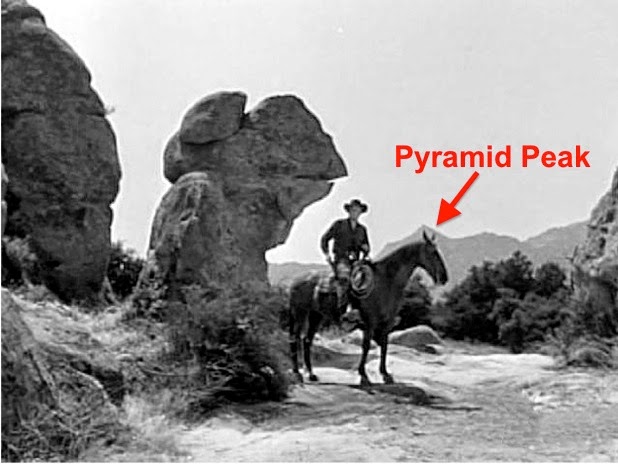
Incidentally, that's also Wrench Rock at the top of the page, seen from the other side in "Fury at Showdown." This is the rock's eastern profile, and you might also notice Pyramid Peak to the west, outlining the horse's ears.

Lone Ranger Rock — once known as Indian Head

Next in our list of Iverson's "Indian Head" rocks is one of the most familiar features on the ranch, but its original name has been largely forgotten. In fact, this rock is so universally recognized as Lone Ranger Rock that it is hard to believe it ever had a different name. But it did.

"Ben-Hur: A Tale of the Christ" (MGM, 1925): Lone Ranger Rock long before it had that name

By the time the Lone Ranger rode up on Silver in the opening to the TV show in 1949, the rock that would come to be known as Lone Ranger Rock had already been appearing in movies for at least 25 years. And before it became Lone Ranger Rock, it was known as Indian Head.

Another familiar rock with an unfamiliar name: Sphinx, Eagle Beak ... and Indian Head? Yes!

Getting back to the Sphinx, part of its name confusion goes back to the 1948 Monogram B-Western "Overland Trails," starring Johnny Mack Brown — the source of the screen shot above. One of the key plot elements in the movie concerns trying to find a hidden mine. The mine is located near a waterhole, and there's an early clue about an Indian watching over it. Later we find out the miner has written in a letter to his wife, "There's a rock above the waterhole that looks just like an Indian head." After the miner dies, the search is on to find that Indian head and thereby locate the mine.

The Sphinx in 2015

Fast-forward to later in the picture and about the time we're ready to give up, Johnny Mack Brown says to his partner, "Hey Dusty, look — look at that rock. Doesn't that look like an Indian head to you?" And Dusty says, "Well, it sure does!" And it turns out what they're looking at is the rock we now know as Sphinx. With that kind of attention being paid to it in the movie — any actual discussion of the rocks in the movies is rare — it has to be taken seriously. So Sphinx, too, has a claim to the name "Indian Head." And, well, it does look like a head, after all.

"Stagecoach": Batman Rock — deserving of the name "Indian Head"?

What about the rocks at Iverson that look even more like Indian heads than most of those seen above, but have never been called "Indian Head" (at least, as far as anyone knows)? Probably the prime example is Batman Rock, shown above in a scene from "Stagecoach." To my eye it looks as though it could have come right off the Buffalo Nickel. Its appearance in the movie is part of the "reveal" of the ruins of the Lee's Ferry station, which has been destroyed in an attack by ... who else, Indians. I suspect the irony wasn't lost on "Stagecoach" director John Ford, and that the placement of the ruins directly below the big chief (not yet known as Batman Rock) was no accident.

Batman Rock in modern times

Batman Rock is named after its appearance in Columbia's "Batman" serials of the 1940s. I can't help wondering whether the filmmakers who shot it for Westerns back in The Day had their own names for it. At any rate, it's a spectacular rock — even today, after the vegetation has grown up around it and largely blocked the view of its face. These days it presides over a driveway into the condo area just north of Garden of the Gods, and despite everything it still projects strength and a certain quiet dignity.

"The Man From Colorado" (Columbia, 1948) (promo still from the Jerry England collection)

A lot of rocks will start looking like an Indian head if you stare at them long enough. Notice the rock all the way at the left of the frame.

It seems to me this rock, which does not have a formal name that I know of (although I consider it part of the "Three Kings" formation), could also reasonably be described as looking like an Indian head.

"Little Big Horn" (1951): Filmed by Iverson cinematographer extraordinaire Ernest Miller

Sometimes changing the angle even slightly can bring out still more of the "Indian Head" in a rock.

"Rocky Mountain Rangers" (1940): Three big rocks with stakes in the "Indian Head" debate

These three sandstone behemoths, along with Wrench Rock, Lone Ranger Rock, Batman Rock and others, illustrate some of the potential problems associated with the rock name "Indian Head." Once you start finding Indian heads in the rocks, it never ends.

Monday, August 9, 2010

Then and now: a famous movie rock known as Wrench Rock (aka Indian Head, Upper Indian Head, Bobby ...)

One of the first and most compelling mysteries I chased at Iverson was who was that gargoyle figure who showed up briefly in the background in "Thunder River Feud" (1942). The blurry black-and-white image above, snapped from the TV screen, haunted me in the early stages of my expeditions to Iverson — as the rock that I soon began calling "Bobby" seemed to be winking at me with that "eye" of his.

It took a few months to find him, but Bobby turned out to be one of the most intriguing characters still lurking on the site of the old Iverson Movie Ranch. It was an emotional high point to finally see Bobby in person — not the least of which was attributable to knowing for the first time that he had survived.

I later learned that the rock I had been calling "Bobby" had already been given at least a couple of names over the years. One that seems to have stuck is Indian Head (or Upper Indian Head), which is unfortunate because it creates confusion with a more famous Indian Head located on the Lower Iverson, in Garden of the Gods. Another name for Bobby that has been around for a while is Wrench Rock. I usually embrace the existing names when I learn about them, so I reluctantly let go of "Bobby." My name for this one now is Wrench Rock, in part because it avoids confusion with Iverson's many rocks known as Indian Head.

Wednesday, June 30, 2010

Take another bow, Bobby ... er, Wrench Rock


"Fury at Showdown" (1957)

I can't ever get too much of this especially weird rock, so here's another star turn by the leading man of the South Rim — usually referred to as Wrench Rock, sometimes called Indian Head or Upper Indian Head ... and referred to by me at one time, before I knew any better, as Bobby. This shot is from United Artists' John Derek Western "Fury at Showdown," and it's pretty definitive Wrench Rock — so much so that I've adopted the shot as the page header for the blog.

Needless to say, Wrench Rock is the unusual rock figure in the center of the photo, hovering over the rider. The larger rock to the left of Wrench Rock came to be known briefly, among Iverson aficionados with an active sense of whimsy (myself, mainly), as Bobby's Girlfriend — inspired by how she always seemed to be batting her eyelashes (presumably an illusion created by some flora growing out of a crack about two-thirds of the way up). The two rocks together form something that has been called Devil's Gate — a reference to the gap between the two rocks, which originated in "Death on Sun Mountain," the second episode of the long-running TV show "Bonanza."

Also in this shot is Pyramid Peak, which is the pyramid-shaped hill profile in the background, almost perfectly framing the horse's ears. That's the name it has taken on in the research, anyway, but it may in reality be Rocky Peak. Rocky Peak is over in that direction, but I've never been able to nail down exactly which of several peaks in that area is Rocky Peak. At any rate, that pyramid-shaped peak is in a LOT of movies.

Wrench Rock today — largely hidden behind a tree

It's hard to get a decent shot of Wrench Rock from that side these days because a tree has affixed itself to the rock's eastern profile. (That tree is probably the shrub seen in the 1957 shot.) But you can still make out the profile, somewhat, lurking behind the tree.

Click here for other views of Wrench Rock.

Tuesday, June 22, 2010

Did we not notice a giant Rooster Foot in the suburbs of L.A.?

Rooster Foot, on the site of the former Iverson Movie Ranch

Here's a contemporary bird's-eye view of a large rock configuration I call Rooster Foot, located on the South Rim of the Upper Iverson. You can probably spot the shape, as it takes up much of the left half of the photo. The two houses also seen in the photo are representative of the estates that now occupy much of what was once the Upper Iverson Movie Ranch.

In case you're not seeing it, here's a labeled version of the same photo pinpointing Rooster Foot.

In case you still don't see it ... here's a comparison of Rooster Foot, Chatsworth's giant rock formation, on the left, and an actual rooster foot, on the right. If you still don't see it after this, I'm afraid I've done all I can.

The bird's-eye view of Rooster Foot is loaded with famous movie rocks. Among those pictured here are the Cul de Sac Crew (just above the cul de sac, visible in the photo), Wrench Rock (also known as Indian Head, Upper Indian Head or Bobby), The Cliff (which I often call T-Cliff because of a large letter "T" that has been carved into it over the centuries by natural forces), and others. You can read more about these features and see photos of them by clicking on the links in this paragraph.

Along the top edge of the Rooster Foot is sort of a trough or gulley where many a climactic fight scene was staged, often culminating in a dummy drop off The Cliff. The edge of the cliff at the northernmost end of this gulley is generally known as Lookout Point.

Rooster Foot Gulley — site of many climactic fight sequences

Here's a closer view of the recessed area, or gulley, above Rooster Foot, where a lot of those fights were staged. You may be able to recognize it from the bird's-eye view by the dull green color of the foliage. That's Oat Mountain in the background, a fixture in the backgrounds of countless B-Westerns.

Sunday, February 28, 2010

Classic Rock: Reflecting on the Iverson Movie Ranch's quirky Wrench Rock

"Annie Oakley" TV series (1956)

Here's a scene starring the always fascinating Wrench Rock — sometimes called Indian Head, Upper Indian Head or Bobby — in a relatively artistic shot from the TV show "Annie Oakley." This scene appears in the 1956 episode "Dilemma at Diablo." I love the full reflection of the rock in the pool of water.

Also visible in the shot are the Aztec and the background hill Two-Humper, an important Iverson marker. The main features seen here are located on the South Rim of the former Upper Iverson Movie Ranch in Chatsworth, Calif.

The same setting in recent times

Here's the same group — Wrench Rock, the Aztec and Two-Humper — in a recent photo taken from close to the same angle. The shot is taken in springtime when California's neon green is in full bloom.

Wrench Rock was apparently originally called "Indian Head" until that name became associated by mistake with another rock, which was originally known as Tower Rock (and sometimes called the Pinnacle), located on the Lower Iverson.
 
"Stagecoach" (1939): Arrival at Apache Wells (Tower Rock at top center)

Tower Rock, often called Indian Head (and often seen paired with another big rock, properly known as Sphinx but often called Eagle Beak), became one of Iverson's most famous rocks, helped by an appearance in John Ford's 1939 epic "Stagecoach."

My guess is that's one reason Wrench Rock ultimately started being called other things, including Upper Indian Head, which isn't exactly elegant. (But then, neither is Wrench Rock.)

"Thunder River Feud" (1942): My first glimpse of Wrench Rock, at the right

I didn't help matters when I came along years later, unaware of any of the rock's existing names, and started calling it Bobby. But I've since come to my senses, and I think Wrench Rock is the least confusing name for it.

"Saddle Tramp" (1950): Joel McCrea with Wrench Rock

If you want to get deeper into the complexity of rock names at Iverson, here's a blog post attempting to sort out the movie ranch's many so-called "Indian Heads."

This post is part of a series on "Classic Rocks" — sandstone giants located on the former Iverson Movie Ranch in Chatsworth, Calif., that became a part of not only America's physical landscape but also its cultural heritage, through featured roles in old movies, cliffhanger serials and early TV shows. Other entries in the series can be seen by clicking here.