Why we love old movie locations — especially the Iverson Movie Ranch

For an introduction to this blog and to the growing interest in historic filming locations such as the Iverson Movie Ranch — the most widely filmed outdoor location in movie and TV history — please read the site's introductory post, found here.
• Your feedback is appreciated — please leave comments on any of the posts.
• To find specific rock features or look up movie titles, TV shows, actors and production people, see the "LABELS" section — the long alphabetical listing on the right side of the page, below.
• To join the MAILING LIST, send me an email at iversonfilmranch@aol.com and let me know you'd like to sign up.
• I've also begun a YouTube channel for Iverson Movie Ranch clips and other movie location videos, which you can get to by clicking here.
• Readers can email the webmaster at iversonfilmranch@aol.com
.

Showing posts with label Boris Karloff. Show all posts

Tuesday, September 12, 2017

Commemorating one of the baddest of the Western bad guys — Glenn Strange gets an Iverson Ranch rock dedicated in his honor

Glenn Strange, fixin' to do some ambushing at "Glenn Strange Rock" in "The Lone Ranger"

Something's happening this month that will be of interest to fans of the Iverson Movie Ranch, "The Lone Ranger" and perennial Western bad guy Glenn Strange — Glenn is having a rock dedicated in his name.

Glenn Strange as Sam the Bartender on "Gunsmoke"

You might remember Glenn as Sam Noonan, the gruff but lovable bartender on "Gunsmoke." But before he mellowed out enough to tend bar in Dodge for 12 seasons, most of his characters were harder to love.

Glenn Strange as Frankenstein's Monster

Sometime after Boris Karloff decided he was sick of being typecast as Frankenstein's Monster — and after brief, not entirely successful stints as the Monster by horror icons Lon Chaney Jr. and Bela Lugosi — it was Glenn Strange who stepped up to the plate.

Strange donned the green facepaint and neckbolts for Universal's final three Frankenstein movies of the '40s, making his debut as Frankenstein's Monster in "House of Frankenstein" in 1944.

Karloff stepped up from his old role as the Monster to play the Mad Doctor this time around, and Chaney returned to his familiar role as sad sack Larry Talbot — aka the Wolf Man.

Strange didn't rate a mention of his name on the lobby card or other promo material for "House of Frankenstein," part of a conscious effort by the studio to downplay that the role had been handed off yet again.

Swedish poster for "House of Frankenstein" (1944)

The lack of recognition for Strange's work as the Monster went global, as in this example from Sweden, where, as usual, Strange's name is nowhere to be found — even though his face is prominently depicted.

Poor Elena Verdugo had a lot of monsters to contend with in "House of Frankenstein," but Lon Chaney's Wolf Man was especially persistent in letting his intentions be known.

Verdugo was much more receptive to Chaney when he wasn't in one of his "moods."

Red "X" poster for "House of Frankenstein"

The studio made a point of marketing the sex angle. Here it's Anne Gwynne's character who's depicted in peril, although Gwynne's name is kept out of it — as is Glenn Strange's, yet again.

Anne Gwynne — World War II pinup girl

This is what Anne Gwynne — no relation to "Herman Munster," Fred Gwynne — looked like in the flesh. She was one of the most popular pinups among U.S. servicemen during World War II.

Two monsters share a tender moment in "House of Frankenstein"

Karloff and Strange — the former Frankenstein's Monster and the new one — are featured in a promo still for "House of Frankenstein." Karloff, who reportedly had health problems related to the heavy makeup, appears to be checking on how Strange is feeling under all that greasepaint.

"House of Dracula": Glenn Strange has another go at the Monster

Strange apparently didn't mind the makeup, the anonymity or other inconveniences of playing the Monster, tackling the role two more times — in "House of Dracula" in 1945 and "Abbott and Costello Meet Frankenstein" in 1948.

Onslow Stevens and Glenn Strange in "House of Dracula" (1945)

By the time of "House of Dracula," Boris Karloff had seen enough of Universal's monsters and bowed out of the franchise for the time being, opening the door for Onslow Stevens to slide into the role of the Mad Doctor.

"Abbott and Costello Meet Frankenstein" (1948)

It was only a matter of time before Universal brought in Abbott and Costello to take the series in a whole different direction — and once again, Glenn Strange was on board in all his green glory.

"Abbott and Costello Meet Frankenstein": Bela Lugosi and Glenn Strange

Strange wound up working with all three of the movies' "Big Three" classic horror icons — Karloff, Chaney and Lugosi. Here he has a scene with Bela in "Abbott and Costello Meet Frankenstein."

Glenn Strange in his "Abbott and Costello" monster makeup

The movie may have played the monster thing for laughs, but Glenn was as terrifying as ever.

"The Lone Ranger," episode one: "Enter the Lone Ranger" (premiered Sept. 15, 1949)

Still, the scene that cemented Glenn Strange's place in TV history and the annals of Western bad-guydom took place one year after Glenn wiped off the green goo for the last time, and it took place on the Iverson Movie Ranch.

It was 1949 and TV was just getting up to speed — with "The Lone Ranger" poised to become one of its first big successes — when Strange, as Butch Cavendish, masterminded the ambush of the Texas Rangers that launched the saga of the Lone Ranger — all from a perch behind the rock that will now bear his name.

Glenn Strange Rock in modern times

The rock where Strange made TV history back in 1949 remains in place today on the former Iverson Movie Ranch. The rock is on public land and is easy to get to, so "Lone Ranger" fans can visit the spot whenever they want.

This is what Glenn Strange Rock looks like from a bit farther back — that's it on the right.

Butch Cavendish would have been perched on the south side of the rock during the "Lone Ranger" ambush — on a precarious slope, presumably with some scaffolding in place to make his stay more hospitable.

I suppose there's some poetic justice in the fact that the spot where the venomous Cavendish once did his nasty business is now home to a massive infestation of poison oak.

Glenn Strange Rock keeps some good company — the Phantom, on the left, appears in hundreds of productions, and in the center is the "laundry rock" made famous by Laurel and Hardy as the foundation for the massive pile of Foreign Legion laundry in the 1939 RKO comedy "The Flying Deuces."

Stan Laurel stands atop the famous laundry pile in "The Flying Deuces"

In fact, Glenn Strange Rock apparently had a hand in that famous laundry scene — it's probably the source of the telltale bump noted here. (You can read all about the Laurel and Hardy laundry scene by clicking here.)

The prolific and imposing Glenn Strange may not have received the recognition he deserved during his career, but the dedication of Glenn Strange Rock should begin to make up for that oversight.

A special event celebrating the dedication of the rock takes place Friday, Sept. 22, at the Valley Relics Museum, 21630 Marilla St. in Chatsworth, Calif. Doors open at 6 p.m., with the presentation set for 7 p.m.

Julie Ann Ream, the niece of Glenn Strange, will be on hand to give the inside scoop on her famous uncle, and will present the first episode of "The Lone Ranger." I plan to be there to help out if needed.

Valley Relics Museum founder Tommy Gelinas shows off the old Iverson Movie Ranch sign

The event is a fund raiser for the Valley Relics Museum, which is doing much-needed work to preserve the history of the San Fernando Valley. Some readers may recall that earlier this year I discovered an old sign for the Iverson Movie Ranch at the museum.


I hope to see some of you there next week! For more about Glenn Strange Rock and the "Lone Ranger" ambush, including a map to the site, please click here to see my post from 2015.

Thursday, May 28, 2015

Terrific find: An old Western "town" set near Garden of the Gods — and Boris Karloff working at Iverson, one year before "Frankenstein"

"The Utah Kid" (1930): A rare early adobe in front of the Phantom, near Garden of the Gods

I recently found out about a group of buildings that stood near Garden of the Gods, on the Iverson Movie Ranch, all the way back in 1930. Film location researcher Tinsley Yarbrough brought the discovery to my attention after he spotted the structures in the early sound Western "The Utah Kid," starring Rex Lease.

The set appears to consist mainly of three "adobe" buildings. That is, they're adobe in appearance, although in all likelihood they were made of something more flimsy — and cheaper.

It's possible that other buildings were included in the set, but these three are the only ones I was able to find in "The Utah Kid." For research purposes, I've labeled them Adobes A, B and C. I have begun to think of the set as what may be the earliest Western "town" set built on the Iverson Ranch — although it's a stretch to call it a town.

The buildings are tucked in just north of some of the most familiar sandstone giants on the Lower Iverson, including the Garden of the Gods mainstays Tower Rock, Sphinx and Phantom.

Inside the Saloon at "Robber's Roost" (studio shot)

The set appears in "The Utah Kid" as "Robber's Roost," a gathering place for bad guys where they can enjoy many of the comforts of the law-abiding world — including a busy saloon — while they're hiding out.

The giant sandstone boulder known as the Phantom looms over Adobe A

Much of the focus in the movie is on Adobe A, the fanciest of the three buildings, by far. The building, distinguished by its unusual angled roof, serves as the exterior for the Robber's Roost saloon.

Adobe B

The much smaller Adobe B also gets a fair amount of screen time in "The Utah Kid," with a role as a honeymoon hideaway of sorts.

In this shot of Rex Lease in front of Adobe B, we get a more detailed view of the building.

Boris Karloff lurks outside Adobe B

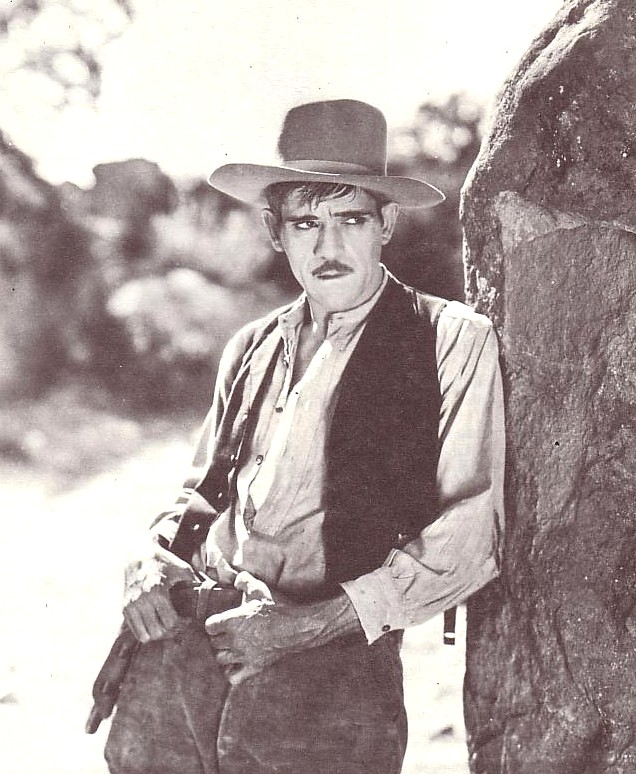
One of the many surprises in "The Utah Kid" is that it features Boris Karloff in a rare Western role, playing a henchman. The release of "Frankenstein" a year later — with Karloff in the role of "The Monster" — would make the actor a household name.

Boris Karloff on the Iverson Ranch — promo still for "The Utah Kid"

Here's a promotional photo of Karloff taken for "The Utah Kid," which offers a clearer look at the actor. The print we have of "The Utah Kid" isn't horrible, but it's pretty heavily scored in some places, as you may have noticed.

Lobby card for "The Utah Kid" — where's Karloff?

I found it interesting that Karloff, who had already spent more than a decade honing his acting chops in the silent movies, wasn't big enough yet to crack the movie's "top five" and find his way onto the lobby card. His role in "The Utah Kid" was larger than those of some of the actors who did get their names on the card.


An ad for the movie, apparently from a newspaper published around the time of the film's release, misspells the name of the leading lady, Dorothy Sebastian.

Adobe C

Adobe C, the smallest of the three buildings, is barely used in the movie. But it does appear on screen, albeit a bit blurry, as Rex Lease and Sebastian, his leading lady, ride past.

Adobe A — the Robber's Roost saloon — under siege

Adobe A, the saloon, becomes the focal point of a climactic siege on Robber's Roost by the sheriff and his men. In this shot the building is obscured by gunsmoke as the firefight rages.

Head bad guy Tom Santschi, center, and his henchman, Boris Karloff, leave the Saloon

While "The Utah Kid" makes good use of the Robber's Roost set, it is unlikely that the set was built for the movie. The studio behind the picture — Tiffany Productions, a notoriously low-budget Poverty Row studio — would have been reluctant to spend the kind of money needed to build even a flimsy version of the relatively elaborate set.

"The Utah Kid" — shootout filmed from the interior of Adobe A

Some of the camera angles seen in the big shootout were filmed from the interior of Adobe A, with the view outside the door — including a wispy tree, presumably a fake — matching the actual location as it appears in exterior shots.

This version of the shot points out the wispy tree.

A wide shot of the Robber's Roost set area includes the same wispy tree, seen from the reverse angle.

Here's another shot taken from the interior of Adobe A. The inclusion of these shots means the building was designed with sufficient room inside for the clunky filming equipment in use at the time — adding fuel to the theory that the set construction would have been too expensive for Tiffany Productions.

A minor set that also turns up in "The Utah Kid" is this corral area, situated not far from where the adobes were built. The location of this set, just south of the Phantom in Central Garden of the Gods, is pinpointed by Getaway Rock, the large rock that dominates the background of the shot.

"Tennessee's Partner" (1955) — Getaway Rock, in Central Garden of the Gods

Getaway Rock gets its name from its appearance in the 1955 John Payne-Ronald Reagan Western "Tennessee's Partner," where the rock marks the getaway route of the villainous Turner in the film's climactic sequence. You can read a detailed account of the location shoot for this sequence by clicking here.

Getaway Rock as it appears today

Getaway Rock can still be found easily today. It's in Central Garden of the Gods, at the west end of the open area south of Phantom and Sphinx.

Rex Lease outside Adobe B in "The Utah Kid"

Rex Lease, the star of "The Utah Kid," may not be among the best-known cowboy heroes, but he had a prolific and durable movie career, mostly in low-budget Westerns — many of them filmed at Iverson.

"Rough Riding Ranger" (Superior, 1935)

He played his share of bit parts, going all the way back to 1924, eventually working his way up to lead status and starring in a string of B-Westerns for Poverty Row studios such as Superior and Argosy, as well as Tiffany.

"Custer's Last Stand" (Stage and Screen, 1936)

Like many cowboy heroes of the '30s, Rex also put in his time in the matinee serials. One of his most high-profile cliffhangers was "Custer's Last Stand," which once again had Rex riding the Iverson Ranch.

Rex Lease with actress Charlotte Merriam, his first wife (1928)

In all, Lease appeared in about 250 movies in a career spanning more than 35 years. Capping off his career, he played a series of "henchman"-type roles in the late '50s on the TV series "The Life and Legend of Wyatt Earp," before hanging up his spurs in 1960. The West Virginia native died in Van Nuys, Calif., in 1966 at age 62.


Given that it's unlikely the adobe set was built for "The Utah Kid," we're left with an obvious question: Who, then, did build the set? For now, that question remains unanswered, and it could prove challenging to answer. In fact, given the scarcity not just of records from this period, but also of movies from the era — with many films from the '20s having dissolved into piles of nitrate dust — we may never know. But let's not let that keep us from trying.