Why we love old movie locations — especially the Iverson Movie Ranch

For an introduction to this blog and to the growing interest in historic filming locations such as the Iverson Movie Ranch — the most widely filmed outdoor location in movie and TV history — please read the site's introductory post, found here.
• Your feedback is appreciated — please leave comments on any of the posts.
• To find specific rock features or look up movie titles, TV shows, actors and production people, see the "LABELS" section — the long alphabetical listing on the right side of the page, below.
• To join the MAILING LIST, send me an email at iversonfilmranch@aol.com and let me know you'd like to sign up.
• I've also begun a YouTube channel for Iverson Movie Ranch clips and other movie location videos, which you can get to by clicking here.
• Readers can email the webmaster at iversonfilmranch@aol.com
.

Showing posts with label Lower Iverson. Show all posts

Tuesday, March 4, 2014

Iverson's "Angry Cardinal" — not to be confused with other "Angry Birds"


Iverson Gorge, as seen in "Panic in Year Zero" (1962)

One rock feature I began seeing in movies early in my study of the Iverson Movie Ranch came to be known in my research as the Angry Cardinal. It typically appears in overviews of the Iverson Gorge filmed from the camera mount area at Overlook Point, as in the above example from the 1962 Cold War movie "Panic in Year Zero." In this shot looking northeast, Angry Cardinal is seen to the left of center, just below the background hills. I'll highlight it in the next shot.

This is the same "Panic in Year Zero" screen shot, with Angry Cardinal identified. The shot also includes a number of other Upper Gorge features, such as Sticky Bun in the top right corner, Doglips almost exactly in the center of the frame and Lone Ranger Rock to the right of Doglips. You can learn more about each of these features by clicking on the links in this paragraph, and I'll identify them below to make it easier for you to find them in the photo.

In this busy version of the photo I've identified a number of the other features seen in the "Panic in Year Zero" shot. All of these features of Iverson's Upper Gorge turn up frequently in old movies and early TV shows, and you can find information about most or all of them by searching for the rock names in the extensive index at the right of this page, or by clicking on the various links in this post. Here are a few additional links to blog entries containing info about the rock features seen here: Zorro's Cave, Cagney Rock, Overhang Rock.

This is a detail shot of Angry Cardinal from the above "Panic in Year Zero" screen shot.

For comparison, here's a look at one of the logos of the Louisville Cardinals — which apparently is also called the "Angry Cardinal." I know it's far from a perfect match, but maybe it's close enough to point out how I arrived at the name for the rock. You may notice that the Iverson rock even has a similar "angry eyebrow."

Of course, the "Angry Cardinal" of Louisville University isn't the only red bird around with a bad attitude. The Louisville logo has a lot in common with the familiar red meanie from "Angry Birds." But before I wander even further off track, suffice to say the Angry Cardinal found at the Iverson Movie Ranch doesn't have anything to do with "Angry Birds."

"The Vanishing Legion" (1931)

This is probably one of the earliest appearances of the Angry Cardinal on film. The screen shot comes from the 1931 Mascot serial "The Vanishing Legion," and offers almost exactly the same view of the Gorge and Angry Cardinal found more than 30 years later in "Panic in Year Zero," although this 1931 version is not as sharp — and therefore the cardinal may not appear quite as angry.

Closeup of Angry Cardinal from the above "Vanishing Legion" screen shot.

"The Lone Gun" (1954)

A beautiful shot of the Iverson Gorge, in color, can be found in the 1954 George Montgomery Western "The Lone Gun," from United Artists, as seen above. It's taken from an angle that's similar to those used in "Panic in Year Zero" and "The Vanishing Legion," but I've made it a point to include this shot because it adds a few important features and also because it's easier to make out some of the features, such as Lone Ranger Rock, here than it is in the shots up above. The Angry Cardinal again appears in its full fury, although being in color this time — pretty dated color, I must say — doesn't really add much. I'll point out a few key features in the shot below.

One thing I like about this shot is that it provides a good look at a portion of Iverson's so-called "Stagecoach Road." I'm putting it in quotes because it's easy to get confused and think it was once an actual stagecoach road, which it was not. The real stage road did come into the San Fernando Valley from Simi Valley not far from here — a few miles south and west, below Santa Susana Pass Road. But this one was strictly a movie stagecoach road.

The area where the two actors are fighting is the camera mount, also known as Overlook Point — a vantage point from which countless film and TV crews aimed their cameras toward the Iverson Gorge. The site still has remnants of the old metal camera track and mount used for the movies, as I've mentioned elsewhere on the blog. You can click here to find out more about it.

 "Al Jennings of Oklahoma" (1951)

Although Stage Road Rock appears small in some of these photos — especially those presenting a wide vista of the Gorge from the camera mount, which was some distance away — it was, and is, a substantial rock. The above scene from the Columbia Western "Al Jennings of Oklahoma," shot from the top of Nyoka Cliff, gives some idea of the rock's size. This photo also provides a good look at the clearing next to the rock, which was a favorite site for stagecoach holdups.

It's worth noting that features such as Stage Road Rock and Lone Ranger Rock, along with much of the "stagecoach road," have been preserved as part of Garden of the Gods Park and can be easily visited today. Most of the features you see in this blog entry remain in place along the east side of Redmesa Road. That side of the road is not marked as a park — the plaque above is located in the section of park on the west side of Redmesa — but it's all public parkland. Feel free to hike there, as long as you steer clear of the condos just to the north — and please watch out for rattlesnakes and poison oak.

The story of the Angry Cardinal — and in particular, what became of it — has a few additional twists. I've added a follow-up entry that goes into detail about that part of the Angry Cardinal story, which you can read by clicking here.

I've also included a few links below where you should be able to find DVD versions of some of the movies discussed in this post ...

Tuesday, April 23, 2013

Fans flock to famous rock

Fans of old movies and early TV shows find a lot to love at the site of the former Iverson Movie Ranch in Chatsworth, Calif., but the single feature that attracts more interest than anything else is Lone Ranger Rock. It's not the most beautiful or most interesting rock at the site — far from it. But it's the most famous.

The rock became famous mainly because of its appearance in the opening to every episode of the old TV show "The Lone Ranger," in which the masked man, played by Clayton Moore, rears up on Silver right next to the rock — part of the famous "Hi-yo, Silver!" sequence. The rock was seen in many other productions as well, but this was its defining moment. 

"Ben-Hur: A Tale of the Christ" (MGM, 1925)

The rock was making appearances in the movies decades before Clayton Moore first rode up. Above is a screen shot from one of its early appearances, back in the silent movie era. That's Lone Ranger Rock (not yet known by that name) in the top right corner, with a group of characters from biblical times standing on it and a whole mob gathered at its base.

Lone Ranger Rock, in the silent movie "Ben-Hur: A Tale of the Christ"

It's not widely known that Lone Ranger Rock used to be called Indian Head. No one I've heard from knows how or when that name came about, but the name has been confirmed by Iverson family members. It's worth noting that at least four rocks on the former Iverson Ranch have been called Indian Head at one time or other. I blogged about the site's many Indian Heads in an earlier post that you can find by clicking here.


The TV show had its first run on ABC from 1949-1957, and it was probably around that time that the rock first started being called Lone Ranger rock. The above title shot was filmed on the Upper Iverson, while Lone Ranger Rock was located a few miles away on the Lower Iverson.

The good news is that Lone Ranger Rock, by any other name, is still alive and well. It can be seen without even getting out of your car, from Redmesa Road, just north of Santa Susana Pass Road in Chatsworth. It is also relatively easy to get to on foot, if you don't mind tromping through the sagebrush. The rock is on land that has been preserved as a park, so you don't have to risk being shot at by the locals to get your photo op. It's in Garden of the Gods Park — named after the huge sandstone boulders found mainly across the street, on the west side of Redmesa Road, which also appeared in many old Westerns and TV shows.


I was interested to see what other fans did on their visits to Lone Ranger Rock, and I tracked down a few YouTube videos documenting fan pilgrimages. I've posted them below.


First, here's a short clip by David August:


This one posted in 2016 traces the Lone Ranger's route through the Iverson Gorge, identifying a number of the rocks he passes along the way:


You can see another cool video about a fan visit to Lone Ranger Rock by going to this YouTube link. That one has embedding disabled, so I can't post it here. But it's worth checking out.

If you're thinking about heading out to Chatsworth to see the rock for yourself, I have two minor cautionary notes: (1) Watch out for poison oak, and (2) watch out for snakes.

Poison oak at Iverson, not far from Lone Ranger Rock

Poison oak is easier to spot after it starts turning red — and it also gets more potent then. But it's dangerous even when it's green, which is one of its sneaky and unpleasant characteristics. (Others include making you itch like heck, being resistant to just about any kind of treatment, and sticking to clothes and everything else, meaning you can get it from just touching your clothes.) In case you haven't had the "pleasure" of coming into contact with it before, take my word for it: You don't want to. If you're not sure you can recognize it in the wild, try not to touch any plants, and be careful when handling your shoes and pants after you hike in the area.

Western diamondback rattlesnake

The other warning is about snakes. A number of different species live at Iverson, but the ones you have to worry about are the rattlers. I still have yet to see my first rattlesnake at Iverson — the above photo is not shot there — but I've encountered other snakes at the site, and that was scary enough. The rattler is known to live there, so be careful about where you step, and if you do see one, give it some room. Word is they don't usually hassle you if you don't hassle them.

Just a reminder: You CAN see Lone Ranger Rock from your car, or from the sidewalk, if you're reluctant to tromp around in the brush. If you head north up Redmesa Road from Santa Susana Pass Road, the rock is one of the first things you'll see, on the right. But I still recommend getting out of the car.


Below are Amazon links to some of the DVD packages of the old "Lone Ranger" material, with a warning that many of the best packages go out of print from time to time.

Saturday, January 14, 2012

Oscar Wilde visits the Iverson Movie Ranch and Gorge Arch

John O'Malley as Oscar Wilde in "Have Gun Will Travel"

Let's get this much settled right up front: It was a TV version of Oscar Wilde, not the real-life Irish-born playwright and poet. The real Oscar Wilde, who wrote "The Importance of Being Earnest" and "The Picture of Dorian Gray," was a sensation in London in the late 19th century before dying in 1900 — a little too early to make his way into TV or movie productions. But he toured the U.S. in the 1880s, visiting the American West when there still was such a thing, and found his way into a few tidbits of Western lore — drinking whisky with miners in Leadville, Colo., and so forth. Years later, during Hollywood's long love affair with the Wild West, a favorite plot device was to snatch famous visitors to the West from real life and put them in either an exaggerated or completely made-up storyline. Oscar Wilde's turn came around in 1958, and as luck would have it, he had his curtain call at Iverson.

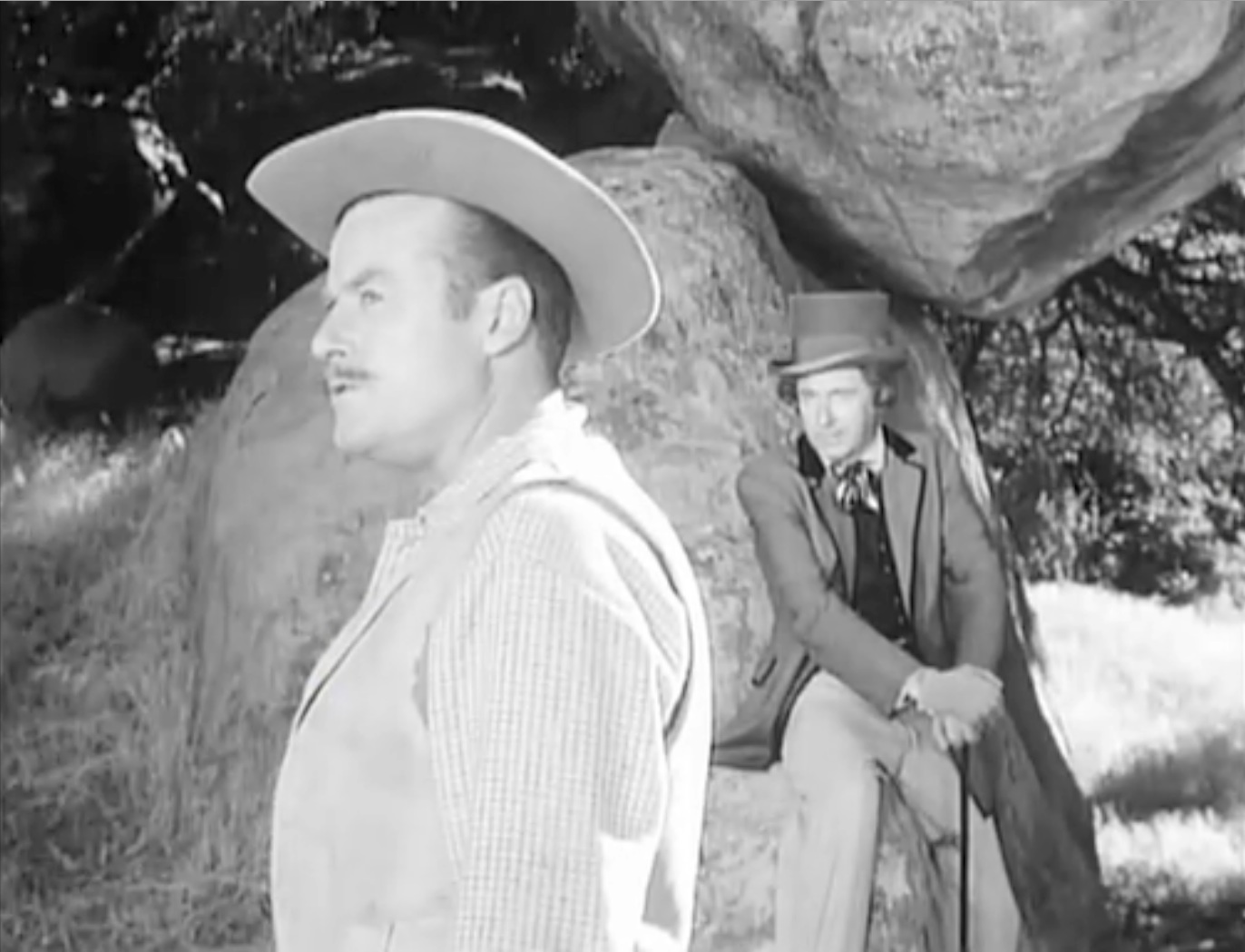
Richard Shannon as Boss Rook, with John O'Malley sitting on the Gorge Arch

The character Oscar Wilde, played by Australian actor John O'Malley, had a central role in an episode of "Have Gun Will Travel" called "The Ballad of Oscar Wilde," which premiered Dec. 6, 1958. The story had Wilde kidnapped by a bad guy named Boss Rook, played by Richard Shannon, who held Wilde hostage in the Iverson Gorge.

While awaiting his fate, Wilde cooled his heels on a small boulder that was part of one of the Iverson Movie Ranch's legendary rock structures — the Gorge Arch, legendary in large part because it no longer exists, having been replaced by condos. The arch, which consisted mainly of three large boulders, was big enough to ride a horse through, and for a while in the late 1930s and early 1940s it stood next to the Gorge Cabin. In the setting above, the cabin would have been to the right, out of the shot (but it was no longer in place at the time this show was shot). The two big rocks in the background had a corral and shed in front of them for much of the period that the cabin was in place. The cabin, corral and shed, along with a fake mine entrance that was often seen in the area, were all long gone by the time "Have Gun Will Travel" showed up to tape this episode.


Inevitably, it's the series' hero, Paladin, played by Richard Boone, who rides to Wilde's rescue. At first Paladin, on the right, tries to arrange a prisoner swap, but predictably, he ends up having to shoot it out with Boss Rook.

Rook initially takes cover inside Gorge Arch — giving viewers a rare look at the inside of the arch.

Paladin makes his move, climbing on top of the smaller boulder on the left side of the arch to get the drop on Rook.

Rook slips around to the right side of Gorge Arch, providing an extremely rare detailed view of the huge boulder that makes up that side of the rock structure.

Wilde, at the left, creates a diversion, enabling Paladin to swoop in for the capture. I'm including this shot mainly because it shows the scale, with Paladin perched on the smaller of the Gorge Arch's two "base" rocks.

With the situation finally under control, Wilde and Paladin find time to exchange a few pithy quips for comic relief. Some things never change.


The real Oscar Wilde

Sunday, October 10, 2010

Lone Ranger's bushwackers lying in wait at the Phantom


"The Lone Ranger" TV series (1949)

Click here to go to an updated, more detailed and all around better post about this same scene. 

Otherwise, feel free if you still want to read the original post from 2010:

Here's a screen shot from one of the most important scenes in the TV show "The Lone Ranger," shot in 1949. This famous ambush sequence is also seen in the 1952 film version, which was a re-edited version of the first three episodes of the show. It took a while to figure out where this scene was shot. The smaller rock at the top is an obvious clue, but a lot of rocks at Iverson have similar "pebbletops" — including one rock called Pebblehead, located not far from this one. After several months I finally put the pieces together and realized that this rock is the Phantom, which you can get a better look at here. It's in Garden of the Gods on the Lower Iverson Movie Ranch in Chatsworth, Calif.


Glenn Strange as Cavendish — behind him is the rock the Phantom, in Garden of the Gods

These shots of the bad guys lying in wait are part of the infamous sequence that sets up the whole saga of the Lone Ranger, in which bushwhackers led by Glenn Strange's character Cavendish wipe out a party of Rangers in a brutal ambush — including almost killing the man who would go on to become the Lone Ranger. The sequence is spliced together from footage shot here in Garden of the Gods and footage filmed elsewhere in L.A., in Bronson Canyon, where the cave featured in the Batman TV show also plays a part in the Lone Ranger saga.

Tuesday, September 7, 2010

Have you seen this rock?


"Perils of Nyoka" (1942): "Kinda Like Doglips"

This shot from the Republic serial "Perils of Nyoka," filmed by master Iverson cinematographer Reggie Lanning, shows a rock I call Kinda Like Doglips because it is reminiscent of, well, Doglips — a familiar rock on the Lower Iverson, near Lone Ranger Rock.

"Hannah Lee: An American Primitive" (1953): The real Doglips

Early in my research, I operated for a while under the misconception that Doglips, seen here, and the then-unnamed rock at the top were the same rock. Once I came to terms with reality — that they were two different rocks with a few strongly imitative characteristics — the new rock name "Kinda Like Doglips" sprang up.

"Son of Paleface" (1952): Kinda Like Doglips

I never found Kinda Like Doglips, and initially I didn't know whether it was at Iverson or somewhere else. Eventually I narrowed it down — yes, it would have once stood at Iverson, in an area known as Silverland (not to be confused with Silvertown, which was the name of the Western town at Corriganville).

"White Squaw" (1956): Kinda Like Doglips in background

Sadly, Kinda Like Doglips doesn't exist anymore. It was destroyed years ago to make room for a concrete basin that still remains on the site. I'm unclear on just what the function of the basin was, but I've heard a rumor that the project in that area was a failed attempt to build a sewage facility.

Bird's-eye view: former Silverland area in bottom right corner

The concrete basin, and the former site of Silverland, is adjacent to the southwest corner of the Indian Hills Mobile Home Village Some of the mobile home village's famous movie rocks are also seen here — the ones surrounding the swimming pool in particular were widely filmed.

"From Here to Texas" (1958): Silverland

Silverland was a beautiful section of Iverson in the filming era, and it showed up quite a bit in the movies. These days the place is fenced off and can't easily be accessed, besides which not much remains of the landmark rocks from the filming days — Kinda Like Doglips (not seen here) and most of its neighbors were destroyed.


Here's a shot of Doglips in recent times. Not the best photo, but maybe you get the idea. Again, Doglips and Kinda Like Doglips are not the same rock.

 Here's another look at Doglips as it appears today.

Wednesday, September 1, 2010

Classic Rock: Hawk Rock

This blog entry is part of a series on "Classic Rocks" — rocks located on the Iverson Movie Ranch in Chatsworth, Calif., that were featured in old movies, cliffhanger serials and early TV shows.


Hawk Rock, in modern times, as seen from Garden of the Gods

Hawk Rock, named for its appearance in "The Hawk of Powder River" (1948), is a cool rock, and another one that displays a range of personalities when seen from various angles. It's one of the easiest Iverson Movie Ranch rocks to find, located right beside Redmesa Road just north of Santa Susana Pass Road. Above is the "fierce side" of Hawk Rock, as seen from inside Garden of the Gods.

Hawk Rock, in modern times, as seen from Redmesa Road

Here's a look at Hawk Rock from the opposite side, as it appears from Redmesa Road. This is the more common view, and the first side most people would see of the rock on a visit to Iverson. When I first spotted it there I thought it looked goofy, and I initially called it Goofyhead. I later learned it already had a name, Hawk Rock, which now seems more fitting.

"Stagecoach" (1939)

Sadly, this is the aspect of Hawk Rock that was captured in one of its most high-profile film appearances — little more than an anonymous pillar. It's the tower sticking up at the top of the shot, near the center, just to the left of the rider holding up a rifle. When I first spotted this image in the John Ford classic "Stagecoach," something about that tower resonated. It occurred to me that it might be Hawk Rock (I was still calling it Goofyhead then) because I had seen the rock from more or less that angle while walking on the sidewalk along Redmesa Road. I tried to duplicate the angle in a photo but initially was unable to convince myself the "Stagecoach" shot was Hawk Rock.

This is the "Stagecoach" shot again, with Hawk Rock pointed out.

"King of the Cowboys" (1943)

Things came together when I found this similar image, taken essentially from the same "Stagecoach" angle, in the Roy Rogers B-Western "King of the Cowboys." The Republic production, directed by Iverson regular Joseph Kane and filmed by one of the great Iverson cinematographers, Reggie Lanning, contains only a tiny bit of Iverson footage. But this was an important clip, as it provided a better look at the surrounding rocks.

Hawk Rock in modern times, from the "King of the Cowboys" angle

Here's my attempt to shoot Hawk Rock in recent times from the approximate angle used in "King of the Cowboys" and "Stagecoach." On close examination the rocks to the left of Hawk Rock match those in the two movies, which erased any remaining doubts.

The list below provides a sampling of the productions in which Hawk Rock appears:

"The Gambling Terror" (1937)
"Stagecoach" (1939)
"Zorro's Fighting Legion" (1939)
"Southward Ho" (1939)
"King of the Cowboys" (1943)
"Raiders of Ghost City" (1944)
"The Hawk of Powder River" (1948)
"The Lone Ranger" (TV series, 1949-1957)
"The Roy Rogers Show" (TV series, 1951-1957)