Why we love old movie locations — especially the Iverson Movie Ranch

For an introduction to this blog and to the growing interest in historic filming locations such as the Iverson Movie Ranch — the most widely filmed outdoor location in movie and TV history — please read the site's introductory post, found here.
• Your feedback is appreciated — please leave comments on any of the posts.
• To find specific rock features or look up movie titles, TV shows, actors and production people, see the "LABELS" section — the long alphabetical listing on the right side of the page, below.
• To join the MAILING LIST, send me an email at iversonfilmranch@aol.com and let me know you'd like to sign up.
• I've also begun a YouTube channel for Iverson Movie Ranch clips and other movie location videos, which you can get to by clicking here.
• Readers can email the webmaster at iversonfilmranch@aol.com
.

Showing posts with label silent movies. Show all posts

Thursday, May 30, 2024

Stoney Point: A Chatsworth landmark's hidden movie history

Stoney Point, Chatsworth's No. 1 landmark

Everyone who takes busy Topanga Canyon Boulevard through Chatsworth, Calif., drives past Stoney Point. Situated on the east side of Topanga near the 118 Freeway, it's the town's largest and best-known landmark.
 
A view of Stoney Point from the Iverson Movie Ranch (Cliff Roberts photo)

Sticking out above the flat San Fernando Valley, this high-rise sandstone rock formation is a close neighbor of the former Iverson Movie Ranch, sitting just across Topanga to the southeast.
 
"The Grapes of Wrath" (1940): Stoney Point crashes a promo still

The massive butte has a tendency to pop up in the backgrounds of movies and TV shows filmed on the Iverson Ranch. That's Stoney Point on the left in this promo still for John Ford's "The Grapes of Wrath."
 
How about putting a McDonald's on Stoney Point?

Longtime blog followers may recall that Stoney Point once came dangerously close to having a McDonald's on top of it — or worse. If you find that hard to believe, and who wouldn't, please click here for the full story.
 
Stoney Point for sale in the mid-1970s

Stoney Point was once offered for sale for $280,000. This real estate listing from about 1975 suggests installing a cable car to help bring customers to the top. And they were serious about it.
 
Rock climbing on Stoney Point

Miraculously, Stoney Point was saved from development, becoming an L.A. city park in 1982. Today it's a popular spot for rock climbers, and a system of trails — while not always easy to find — winds its way to the top.
 
"Seinfeld": Kramer and George on a TV version of Stoney Point

Stoney Point even made an appearance on "Seinfeld." In the 1993 episode "The Stall," Kramer and George go rock climbing on one of its steep faces, although closeups were shot on a soundstage with a fake rock.
 
"Seinfeld": A landmark rock meets a landmark sitcom

Wide shots featured in the "Seinfeld" episode show the actual Stoney Point, presumably with stand-ins, and not the series stars, hanging from Stoney's sheer cliff face.
 
"The Captive God": William S. Hart filming in Chatsworth, 1916

But Stoney Point's screen appearances go back way before "Seinfeld," and way before TV. We have to go all the way back in time to the silent era — more than a century ago — to trace its movie history.
 
An early screen appearance by Stoney Point

The William S. Hart feature "The Captive God," filmed in Chatsworth in 1916, included images of Stoney Point looming in the distance.
 
"The Captive God": Stoney Point at top right

Stoney Point is a little more recognizable in this screen shot from the movie.
 
Silent film-era crew on "mystery rock"

In at least one instance, a silent-era film crew hauled its cameras and other gear all the way to the summit of Stoney Point. This shoot resulted in a terrific behind-the-scenes photo, which baffled film historians for years.
 
Back when "knickers" were in style

Zooming in on the film crew, we can get a sense of how old the photo is, based in part on the movie equipment but also on the styles of clothing worn by the crew. The shot is clearly from the silent film era.
 
Plenty of other clues in the mysterious photo

The photo, which features a distinctive rock with a flat top, can still be found on a number of websites, often described as an "unknown location," or worse, credited to the wrong location.
 
The mystery photo, incorrectly identified as the "Iverson Ranch" and "1922"

Here's just one of the many examples of false information associated with this photo that can still be found online. The photo was not taken on the Iverson Ranch, and was not taken in 1922.
 
It's not true!

Sorry to make a big deal out of this, but it's important that people realize this information is incorrect. It's hard to get this kind of stuff right, so no disrespect to whoever posted the false info. But I wish people could resist the temptation to present "information" as fact when it's not actually true.
 
There are always exceptions, of course

We're just kidding around here, but we do make an effort to check our facts, and we don't mind saying something is "thought to be" if we don't know for sure. But when it comes to this photo, we know for sure.
 
Aerial view of Stoney Point (Google Maps, 2024)

When I began researching the old photo, it wasn't long before I became interested in a triangular rock located at the very top of Stoney Point.
 
The old movie rock in modern times

It turned out to be the same historic movie rock, which I was able to confirm on a recent expedition to the summit of Stoney Point.
 
The same movie rock, in the '20s and almost 100 years later

Taken almost a century apart, the two shots of the rock are so similar that I was practically standing in the footprints of the photographer who snapped the behind-the-scenes photo in the 1920s.
 
Jimmie Adams and Doris Dawson in "Swiss Movements" (1927)

I was also able to pin down which movie it was that was being filmed when the old photo was taken. It was a Jimmie Adams comedy short called "Swiss Movements," from Christie Film Co.
 
"Swiss Movements": Two actors and a "bear," out on a rocky ledge

This is the sequence the film crew was working on when the behind-the-scenes shot was taken. The scene features two actors trapped on a rocky ledge, being harassed by someone in a bear suit.
 
"Swiss Movements": Jimmie Adams dangles his legs over the edge

This shot appears only briefly in the movie, but this is the angle the crew was filming when they stood on top of the flat rock. Here we see the film's star, Jimmie Adams, trying to avoid being mauled by the bear.
 
"Swiss Movements": The climbers head back down the ledge

In another shot from the same sequence — taken from a different camera position — the "bear" is out of the picture and the two actors attempt to head down the rocky ledge.
 
Key rock features that make up the shot

Notice the pointed rock and angular slope indicated here. I found it interesting that the "Swiss Movements" sequence is essentially about rock climbing — the same thing Stoney Point is still known for.
 
The pointed rock and angular slope in modern times


Here are those same rock features in a photo taken on our recent visit to the summit.
 
The filming location in context

A wider shot provides some context for the scene, showing more of what the rocks look like as part of the extremely rocky environment atop Stoney Point.
 
Pinpointing the "Swiss Movements" scene

The yellow rectangle approximates how the pointed rock and angular slope are framed in the movie.
 
Setup for the "Swiss Movements" shoot

In another photo from our Stoney Point expedition, we see the same rocks the "Swiss Movements" crew would have found when they arrived at the location in 1927.
 
How the shoot was set up

The rock on the left, with its flat top, provided the ideal spot for the camera, reflectors and key members of the crew, while the actors worked on the slightly more perilous angular slope.
 
The remarkable photo from 1927

And luckily for us, a still photographer who was also on the scene snapped the shot that enabled us to put together how the sequence was filmed — right down to the spindly ladder everyone had to use to get up on that rock.
 
Jimmie Adams on the Stoney Point summit (1927)

"Swiss Movements" includes plenty of other shots taken on top of Stoney Point, although many of the rocks are still waiting to be found. Here's one other group of rocks we were able to match up on our recent hike.
 
Looking west from Stoney Point

When Jimmie Adams steps aside, we get a pretty good look at the cluster of rocks he was standing in front of. These rocks are situated along the western edge of the summit area.
 
The same rocks in modern times

I didn't get the exact same angle, but you may be able to make out the rocks from the movie — especially toward the right of the frame. We also get a better look at the Santa Susana Mountains to the west.
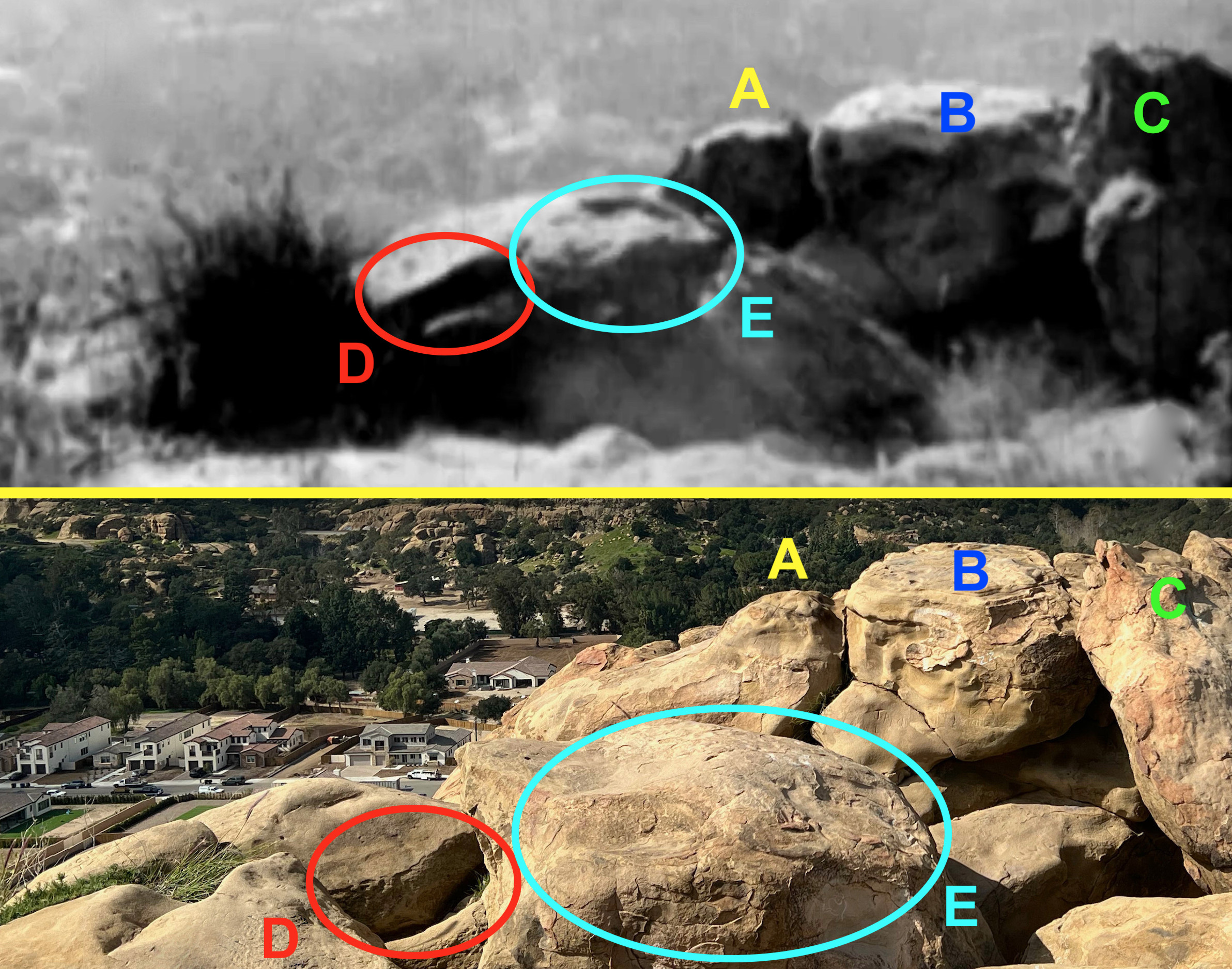
 
Identifying markers and matching rocks

Here are some of the key markers in the two shots, to make it easier to see how the rocks match up.
 
"Swiss Movements" (1927): Click here to watch the video

Here is the video of the comedy short "Swiss Movements." The movie includes many more shots taken on Stoney Point. Please let us know (in comments or by email) if you make your way up there and match up any shots.
 
Chatsworth Historical Society presentation on Stoney Point

For much more about the history of Stoney Point, including its movie history, please click here to see a presentation given in 2022 by Ray and Ann Vincent of the Chatsworth Historical Society — back before we knew the full story behind the "Swiss Movements" photo.

Monday, December 14, 2015

Silent movie cowboy William S. Hart, Hollywood pioneer Thomas H. Ince and the 1917 Western "The Silent Man": These are some of the earliest surviving film images of the Iverson Movie Ranch

I recently found a silent Western produced under the supervision of legendary studio mogul Thomas H. Ince and filmed on the Iverson Movie Ranch in Chatsworth, Calif. "The Silent Man," released in 1917, starred early movie cowboy William S. Hart, who also directed the feature film.

"The Silent Man" (1917): Gorge Arch (Garden of the Gods in background)

"The Silent Man" contains the earliest images I've seen of a number of Iverson rock features — including this early shot of the Gorge Arch. Garden of the Gods can be seen in the background, at top center.
 
Survival status of silent films (Library of Congress)

While filming on the Iverson Ranch is known to go back at least to 1913, most of the early silent films have been lost. Surviving films from the early silent era, such as "The Silent Man," are the exception to the rule, as this chart suggests. The red bars denote lost films, year by year, while the blue bars indicate the few survivors.

Picture quality in circulating copies of "The Silent Man" is less than spectacular by today's standards, but considering that the images were first captured on celluloid almost 100 years ago, they're pretty remarkable.

Lobby card for "King of the Jungle" (1933): Gorge Arch

The Gorge Arch went on to a fruitful screen career, but was rarely seen again in the "middle of nowhere" setting in which it appears in the 1917 shot.

"Adventures of Red Ryder" (Republic, 1940)

The arch is most commonly associated with the Gorge Cabin, which stood in the Iverson Gorge from about 1936-1944. As illustrated by this shot from the Don "Red" Barry B-Western "Adventures of Red Ryder," the Gorge Arch stood adjacent to the cabin during the years in which the cabin was in this location.

"The Life and Legend of Wyatt Earp" (ABC TV series, 1959)

After the cabin was removed from the area, the arch continued to appear in movies and TV shows. Sadly, the Gorge Arch was destroyed when development came to the Iverson Gorge in the late 1980s.

"The Silent Man" (1917): Looking through Devil's Doorway

Another natural arch, known today as Devil's Doorway, also turns up in "The Silent Man." In this shot the camera looks north through Devil's Doorway, with riders visible on the other side of the arch, at bottom center.

Devil's Doorway in modern times

Unlike the Gorge Arch, Devil's Doorway is still standing. Today it can be found among the residential units of the Cal West Townhomes complex, off Redmesa Road in Chatsworth, Calif.

The shot from 1917, while decidedly low-res, is still detailed enough to enable the identification of a number of markers in the rocks. All of the features noted above can still be found today.

Here we see the same rock markings and details on the shot from the modern era.

Even with the two photos taken almost a century apart, the rocks remain pretty much the same. The biggest differences between the two shots appear in the background, where mounted cowboys could be seen during filming of "The Silent Man" in 1917.

In modern times, the background contains condos and landscaping.

Crown Rock, in "The Silent Man"

Another image from "The Silent Man" captures Crown Rock in 1917. In this shot Crown Rock fills much of the left half of the screen.

Similar to Devil's Doorway, Crown Rock remains in place today as part of the Cal West landscape. However, the surviving section of the rock consists of only the northern half of the original formation.

Half of the rock was removed during construction to make room for a driveway through the condo complex.

"The Silent Man": Major rock features of the Upper Gorge, filmed in 1917

The images in this shot don't immediately leap off the screen, but it may be the most historically significant of any of the screen shots from "The Silent Man." On close examination, three particularly important rocks can be discerned in the top right corner.

These are the earliest images I've seen of any of the features noted above. I've written previously about each of these rocks — you can find posts about Angry Cardinal here, Hobbit House here and Plaza Rock here.

"Zane Grey Theatre" — Plaza Rock on the right

With any "stacked rock," such as Plaza Rock, the question comes up as to whether the feature occurred naturally or was created by human intervention, for example with a smaller rock being placed on top of a larger rock through the use of a crane and then held in place with cement.

Plaza Rock in 1957 ("Zane Grey Theatre" episode "The Freighter")

While not conclusive, the existence of Plaza Rock in 1917 — early in the evolution of the movie ranch — adds weight to the theory that the rock was naturally occurring.

Plaza Rock no longer exists — at least not above ground. In all likelihood, it's now buried beneath the lawn seen here, covered by dirt brought in for grading during construction of the Cal West Townhomes.

A portion of the Hobbit House remains above ground, but about three-quarters of what was once a tall rock tower is now buried.

The Angry Cardinal, too, has been effectively dismantled. A portion of the rock remains above ground behind some condos, but access is limited and virtually nothing remains that could be matched up with the movies. In this wide shot, Angry Cardinal is concealed beneath trees and other landscaping.

"The Silent Man": William S. Hart and Vola Vale 

Here's a shot of the two main stars of "The Silent Man," William S. Hart and Vola Vale, in the Iverson Gorge. The large rock feature seen behind the actors is recognizable from other films.

While this is far from its best movie angle, Three Ages Rock is a relatively well-known feature of the Upper Gorge.

"Tarzan the Ape Man" (1932) — Cheeta on Three Ages Rock

The same view of Three Ages Rock — spotlighting the north end of the rock — appears in the final sequence of "Tarzan, the Ape Man," the 1932 feature that launched the Johnny Weissmuller Tarzan franchise.

"The Big Show" (1936)

We get another look at the north end of Three Ages Rock in the Gene Autry movie "The Big Show," which we examined in a recent post that you can read by clicking here.

"The Fighting Seabees" (1944) — Iverson Gorge, looking south

Three Ages Rock also turns up in this shot of the Upper Gorge from the John Wayne war movie "The Fighting Seabees." Near the right of the frame is Crown Rock, which was discussed above. All of the rock features shown here took a hit when development came to the Iverson Gorge.

Three of the major features of the Upper Gorge are noted here. Much of Three Ages Rock has survived, but the north end of the rock — the "face" seen here — was removed to clear space for condos. The Wall was demolished in its entirety, along with about half of Crown Rock, as discussed above.

Promotional photo for "The Silent Man" — near the Gorge

A promo shot for "The Silent Man" shows Hart and Vale in an area above the Iverson Gorge. The photo includes a copyright date of 1919, but the shot would have been taken during filming on the Iverson Ranch in 1917.

The background detail on the promo shot is less than sharp, but it's possible to identify some of the rocks — including the so-called "Hole in the Wall" area.

The rocks making up the Hole in the Wall formation can still be found today, at the end of a long driveway through the condos — the same driveway that prompted the removal of half of Crown Rock. To read an earlier post with additional details about these rocks, please click here.

Another promo still for "The Silent Man," taken during the same shoot as the "Hole in the Wall" promo shot, offers a nice look at the film's two stars, William S. Hart and Vola Vale. The photo would have been taken on the Iverson Ranch, although the background features are unidentifiable.

Premiere of Grauman's Million Dollar Theatre, Feb. 1, 1918: "The Silent Man" on the marquee

"The Silent Man" provides an interesting snapshot of early Hollywood history — and of the role the Iverson Ranch played in that history. When Sid Grauman's famed Million Dollar Theatre held its grand opening in Los Angeles on Feb. 1, 1918, "The Silent Man" was the featured attraction.

The Million Dollar Theatre in modern times

The Million Dollar Theatre became a Spanish-language venue way back in the late 1940s, and for decades was one of the country's most important sites for Hispanic films and live productions. Located at 307 S. Broadway in downtown L.A., its stature has been diminished in recent years but it remains a functioning theater.

Grauman's Chinese Theatre — opened in 1927

Sid Grauman went on to open Grauman's Egyptian Theatre in 1922 and Grauman's Chinese Theatre — the last and most famous of his silent-era movie palaces — in 1927. The three theaters have all changed hands over the decades, but all three remain in operation today.

Thomas H. Ince, "Father of the Western"

One of the key players behind the scenes of "The Silent Man" was Thomas H. Ince, who supervised production. In previous years Ince had his own Western filming location, Inceville, in the Palisades Highlands near L.A. But the pioneering director and producer had abandoned Inceville a couple of years before "The Silent Man."

Inceville, in the Palisades Highlands above Pacific Coast Highway

Inceville is regarded today as the first modern film studio, and with Ince producing as many as 150 films a year at the site — most of them Westerns — he became known not only as the father of the Western but also as the creator of the Hollywood studio system.

Ince-Triangle Studios, Culver City, Calif. — the original Greek colonnade still stands today

Ince co-founded Triangle Pictures and the Ince-Triangle Studios in Culver City with his new partners D.W. Griffith and Mack Sennett in 1915, but the partnership lasted only a couple of years. By late 1917 Ince was between studios, and it's around this time that we begin to find Ince productions filmed on the Iverson Ranch.

Thomas H. Ince Studios, Culver City

At least two Thomas Ince Westerns — "The Silent Man" and "The Narrow Trail," released one month later — were filmed on the Iverson Ranch in late 1917. Ince would shift his focus again in 1918, when he began construction on his new state-of-the-art Thomas H. Ince Studios, a few blocks from the old Ince-Triangle Studios.

Sony Pictures Studios — built on the old Triangle lot in Culver City

Both of Ince's Culver City studios remain in use today. The old Triangle lot is now the home of Sony Pictures Entertainment, after serving as an MGM lot for more than 60 years.

The Culver Studios in recent years — the former Thomas H. Ince Studios

The old Thomas H. Ince Studios went through a number of incarnations, including stints as DeMille Studios, RKO-Pathe Studios, Selznick International Pictures and Desilu Studios, before being bought by an investment group and becoming The Culver Studios, as the facility is known today.

This Google aerial shows the proximity of the two main Culver City studios, both founded by Thomas H. Ince in the 1910s. The juxtaposition of the facilities and their long, complicated and intertwined histories have combined to create quite a bit of confusion about these two movie industry landmarks.


This post is part of a series of entries exploring silent movies filmed on the Iverson Movie Ranch.  Other movies in the series can be found at the following links ...

• "Man-Woman-Marriage" (Dorothy Phillips, 1921): Large-scale battle sequence filmed near the Garden of the Gods in 1920, billed at the time as "so stupendous that it amazed even the film colony of Los Angeles."

• "Richard the Lion-Hearted" (Wallace Beery, 1923): Special effects place a massive Medieval castle among the huge rock features of Garden of the Gods.

• "Three Ages" (Buster Keaton, 1923) — One of the most popular silent-era Iverson shoots, and for good reason. Examine "Buster's armory," controlled by Keaton's caveman character, built high atop Rock Island in the Iverson Gorge.

• Fake cave house: More good stuff from "Three Ages" (1923) — The fake rock feature stood near Garden of the Gods for several years in the 1920s — may even go back to the 1910s.

• "Ben-Hur: A Tale of the Christ" (Ramon Novarro, 1925): Terrific behind-the-scenes photos from Jill Bergstrom, granddaughter of the great Iverson cinematographer George B. Meehan Jr., who worked a camera on "Ben-Hur." Most of the material is non-Iverson, even though parts of "Ben-Hur" were filmed on the location ranch.

• "Tell It to the Marines" (Lon Chaney, 1926): MGM production featured construction of elaborate Chinese arched bridge supported by fake rocks; anchor points for the bridge-and-fake-rocks contraption are carved into the rocks north of Garden of the Gods.

• "Noah's Ark" (Dolores Costello, 1928): Noah's Ark is "beached" on top of the sandstone giants of Garden of the Gods, as in the series label above. Directed by Michael Curtiz, who later directed "Casablanca."