Why we love old movie locations — especially the Iverson Movie Ranch

For an introduction to this blog and to the growing interest in historic filming locations such as the Iverson Movie Ranch — the most widely filmed outdoor location in movie and TV history — please read the site's introductory post, found here.
• Your feedback is appreciated — please leave comments on any of the posts.
• To find specific rock features or look up movie titles, TV shows, actors and production people, see the "LABELS" section — the long alphabetical listing on the right side of the page, below.
• To join the MAILING LIST, send me an email at iversonfilmranch@aol.com and let me know you'd like to sign up.
• I've also begun a YouTube channel for Iverson Movie Ranch clips and other movie location videos, which you can get to by clicking here.
• Readers can email the webmaster at iversonfilmranch@aol.com
.

Showing posts with label Maureen O'Sullivan. Show all posts

Sunday, February 19, 2017

Binders full of women: Fondly remembering a time when Hollywood hotties roamed the Iverson Movie Ranch

Virginia Mayo

Some of the hottest actresses of the 1930s, '40s and '50s — and please feel free to interpret the word "hottest" however it suits you — appeared in movies and TV shows filmed on the Iverson Movie Ranch.

Rita Hayworth

The tantalizing Rita Hayworth was one of a number of top actresses of Hollywood's Golden Age to pay her dues at the Chatsworth filming location.

"The Renegade Ranger" (1938): Rita Hayworth and George O'Brien on the Iverson Ranch

Hayworth's Iverson Movie Ranch portfolio includes starring opposite George O'Brien in the 1938 RKO Western "The Renegade Ranger." Here the two stars are seen in a publicity still taken north of Garden of the Gods.

Rita Hayworth

When it comes to picking great photos of Rita Hayworth, a gorgeous movie star who moonlighted as one of the top pinups of World War II, it's hard to narrow it down to just a few.

Rhonda Fleming

Rhonda Fleming had a busy Iverson Movie Ranch career, including appearing in the Iverson movies "Tennessee's Partner," "Alias Jesse James" and "Yankee Pasha."

Rhonda Fleming

Rhonda cleaned up nicely.

In fact, here's a shot of Rhonda cleaning up — nicely.

Gene Tierney with Randolph Scott on the Iverson Ranch in "Belle Starr," 1941

Gene Tierney worked the Iverson Ranch as the title character in 20th Century-Fox's "Belle Starr." She dressed down for the part of the none-too-glamorous outlaw — and if you've ever seen a photo of the real Belle Starr, you know the role would have been a stretch for Tierney, considered one of the most beautiful actresses of her era.

Gene Tierney: Hay, babe, how 'bout it?

Like other screen babes of the era, Tierney was expected at times to be photographed either in or near hay — and I have a hunch we'll be seeing more combinations of women and hay before we're through here.

Gene Tierney

Tierney also had her more glamorous photo shoots.

Loretta Young

Speaking of glamour, Loretta Young helped class up a number of Iverson movies, including starring with Gary Cooper in "Along Came Jones," a landmark production for the movie ranch filmed in 1944 and 1945.

"Along Came Jones": Loretta Young, Gary Cooper and William Demarest on the Iverson Western street

Loretta's sudden display of affection catches Gary Cooper off guard as William "He'll Always Be Uncle Charley" Demarest looks on in disbelief. Cooper, who both starred in and produced "Along Came Jones," had the town set built specifically for the movie in 1944.

Loretta Young

Loretta seems to have no idea what all the fuss is about.

Jane Russell

Did I mention hay? Jane Russell rolled around in it with a six-shooter in a series of iconic promo shots for Howard Hughes' 1943 Western "The Outlaw."

Jane Russell

"The Outlaw" was not filmed on the Iverson Ranch, but Russell starred in her share of Iverson movies — among them, "The Paleface," "Son of Paleface" and "Waco."

Dale Evans

Speaking of hotties on the hay, we think mostly pure thoughts about Dale Evans, remembered fondly as Mrs. Roy Rogers, Queen of the West. But there's a reason the King of the Cowboys warmed up to her in the first place.

Dale Evans and soulmate Roy Rogers

If anyone had been counting, Roy and Dale would hold the record for "most often filmed couple on the Iverson Ranch" — by a lot. They lived in Chatsworth in the '50s and '60s, just 10 minutes from the movie ranch, and filmed almost all of the outdoor action for "The Roy Rogers Show" on the ranch.

Dale Evans

Evans played more than her share of saloon girls before she hooked up with Roy.

Maureen O'Sullivan as "Jane"

From the Queen of the West to the Queen of the Jungle, Maureen O'Sullivan raised the bar for all future Janes in the "Tarzan" movies of the '30s, with a number of her jungle adventures filmed on the Iverson Ranch.

You Tarzan, me Jane ... we half-naked: Maureen O'Sullivan gives Johnny Weissmuller ideas

Maureen created a stir with her skimpy Jane outfits, which helped convince Hollywood to start enforcing the Hays Code once the censors got a good look at Maureen's body in "Tarzan and His Mate" in 1934.

"Tarzan's Secret Treasure" (1941): The Tarzan family in the Iverson Gorge

O'Sullivan still made a pretty hot Jane, even after the new production code — along with her new job title as surrogate mom to Boy — forced her to cover up some of her attributes from the mid-'30s on.

Anita Ekberg in "La Dolce Vita"

Before Swedish bombshell Anita Ekberg became an international sensation in the 1960 classic "La Dolce Vita," she had a tour de force performance in the title role of 1957's "Valerie," filmed on the Upper Iverson.

Anita Ekberg

Something about this unusual colorized photo of Ekberg just works.

Ekberg comes across as someone who's comfortable in her skin.

Yvonne De Carlo

Speaking of skin, I hope my readers can handle photos of a young, scantily clad — and not-exactly-clad — Lily Munster, aka the sumptuous Yvonne De Carlo. These racy pics from the 1940s go back to early in her career.

De Carlo was no older than her early 20s at the time. Within a few years she was at Iverson starring in Universal Westerns in the late 1940s, including playing Calamity in "Calamity Jane and Sam Bass."

Dorothy Malone

Then there's Dorothy Malone, who could drive men to madness as a brunette cowgirl or a blonde femme fatale ... or a blonde cowgirl, for that matter. Really pretty much however they dressed her up.

Dorothy Malone and Rock Hudson, "Tarnished Angels," 1957

Dorothy's Iverson resume includes "The Nevadan," with Randolph Scott, and two early Roger Corman movies from 1955 — the original "The Fast and the Furious" and the unfairly overlooked Western "Five Guns West."

Dorothy Malone and Jonathan Haze, "Five Guns West," 1955

Malone was put to extremely good use as Shalee, the unbearably seductive fuel for outlaws' passions in Roger Corman's first directorial effort, "Five Guns West," filmed on the Iverson Ranch and Ingram Ranch.

A young Dorothy Malone does her part for the war effort

What's that you say? More Dorothy Malone? You got it!

Dorothy Malone and Penny Edwards: Double your hot cowgirl pleasure

We also have Dorothy to thank for roping in Penny Edwards, as the two tag-teamed a memorable cowgirl photo shoot around the time they appeared together in Warner Bros.' 1948 release "Two Guys From Texas."

Penny Edwards: Um, what am I supposed to do with these?

Penny, who brought her own fireworks wherever she went, starred in a batch of Iverson productions — usually billed third after the lead cowboy and his horse.

Penny Edwards

Penny starred with Roy Rogers in "Trail of Robin Hood" (1950) and "Spoilers of the Plains" (1951), appeared opposite Rex Allen in "Utah Wagon Train" (1951) and worked with Allan "Rocky" Lane in "Captive of Billy the Kid" (1952) — all filmed on the Iverson Movie Ranch.

As a beautiful woman working in Westerns, Penny had her share of opportunities to get in the hay — let's just say a number of photographers apparently saw it as a metaphor.

Penny Edwards and co-star

It's easy to see why Penny got so much work in Westerns — she made a super-cute cowgirl.

Gale Robbins

While we're on the subject of super-cute cowgirls, how about a shout-out to the insanely hot Gale Robbins?

Gale Robbins

Gale's filmography includes the noteworthy Iverson Movie Ranch feature "Quantrill's Raiders" (1958), along with the late '50s TV shows "Trackdown" and "State Trooper," both of which shot at Iverson.

Peggie Castle

The gorgeous Peggie Castle was another frequent visitor to the Chatsworth location ranch, including appearing in "Son of Belle Starr" (1953), "The Oklahoma Woman" (1956) and "Hell's Crossroads" (1957).

Peggie Castle and John Russell, promo still for "Lawman," 1962

Peggie also had a regular role as saloon owner Lily Merrill, love interest for John Russell's Marshal Dan Troop, from 1959-1962 on "Lawman," another TV Western filmed on the Iverson Ranch.

"Beginning of the End" (1957): Peggie Castle and Peter Graves

When I was just a little kid — years before I would attain a level of "maturity" sufficient to fully appreciate Peggie Castle's hotness — said hotness was hiding in plain sight in one of my favorite "nature run amok" sci-fi movies of the '50s, "Beginning of the End." Back then all I cared about was the giant grasshoppers.

Viola Richard in the Garden of the Gods, "Flying Elephants" (1928)

Many readers may be unfamiliar with the beautiful Viola Richard, who had one of the nicest smiles of the silent film era. Viola shared the screen not only with comedy giants Laurel and Hardy, but also with the sandstone giants of the Iverson Ranch's Garden of the Gods.

Viola Richard

The sporty Viola was under contract to the Hal Roach Studios in the late 1920s, so her body of work consists almost entirely of silent comedy shorts.
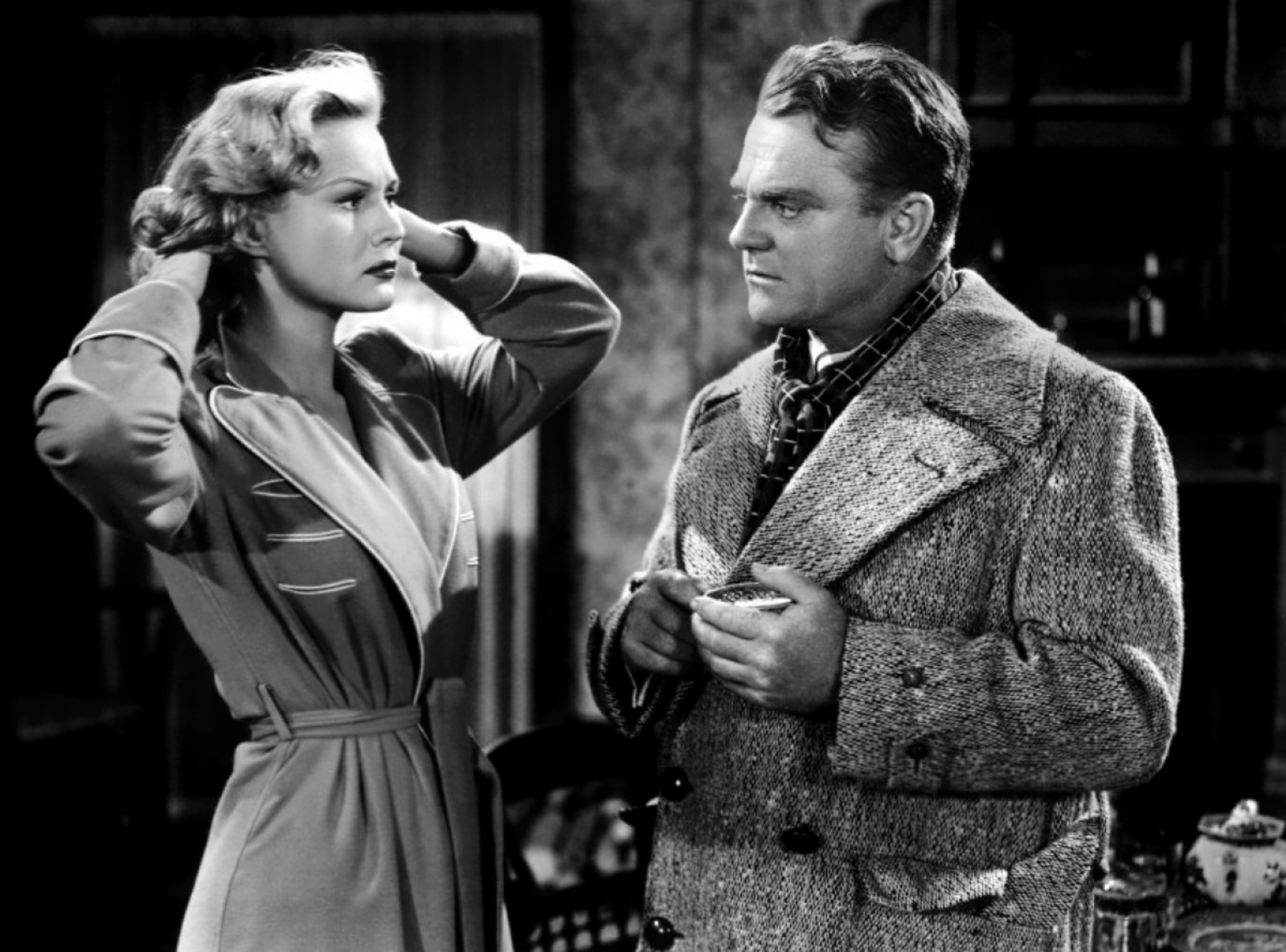
Virginia Mayo and James Cagney, "White Heat" (1949)

Virginia Mayo, also seen at the top of this post, had a way of getting under James Cagney's skin in "White Heat," one of only a handful of films noir to shoot on the Iverson Ranch.

Virginia Mayo

Any tension with Cagney's grumpy "White Heat" character was understandable — Mayo, who was another popular pinup girl during World War II, was clearly worth getting worked up about.

Virginia Mayo

The photogenic Mayo appeared in a number of Iverson Movie Ranch productions, including the 1954 Warner Bros. feature "King Richard and the Crusaders."

Abby Dalton

Abby Dalton was an unknown back in 1957 when Roger Corman cast her in the lead role in his Iverson Movie Ranch showpiece "The Saga of the Viking Women and Their Voyage to the Waters of the Great Sea Serpent."

Abby Dalton

Dalton was back at Iverson the following year in "Cole Younger, Gunfighter" before going on to a prolific career in television that included a long run on the prime-time soap opera "Falcon Crest" in the 1980s.

Mara Corday

Mara Corday offers another variation on the theme of "girls, guns and hay." Mara put in some time in the Westerns, including the 1957 20th Century-Fox feature "The Quiet Gun," filmed on the Iverson Ranch.


Believe it or not, we've barely scratched the surface when it comes to gorgeous women who worked the Iverson Ranch. Let me know if you like this sort of thing and I'll see what I can do to put together a Part 2.

Saturday, April 20, 2013

A few "Tarzan" scenes filmed on the Iverson Movie Ranch in Chatsworth, Calif.

The many Tarzan movies filmed over the decades, including the wildly popular Johnny Weissmuller movies of the 1930s and 1940s, have an intermittent track record at Iverson. The widely filmed movie ranch, better known for its stagecoach holdups, Western shootouts and rocky landscape, wasn't exactly a jungle location. But Iverson did make significant appearances in a number of Tarzan movies. Here's a look at a few key scenes.

Johnny Weissmuller and Maureen O'Sullivan 
at Iverson in "Tarzan the Ape Man," 1932

The movie considered by many fans to be the start of the Tarzan franchise is MGM's "Tarzan the Ape Man," released in 1932 — Weissmuller's first appearance as the Lord of the Jungle. A number of Tarzan movies predated this one, going back to 1918 and silent movie star Elmo Lincoln. But MGM and Weissmuller — along with Maureen O'Sullivan, who fueled Tarzan's jungle passions as Jane — turned Tarzan into a cultural phenomenon.

This is the same rock — known as Three Ages Rock — where Tarzan and Jane stood during the iconic "wave goodbye" scene at the end of "Tarzan the Ape Man." The rock can still easily be seen today, from Redmesa Road, just below the Cal West Townhomes development. You may be able to match up the vertical crack and the smaller rock below Three Ages Rock in the above two shots. (You can enlarge any of these photos by clicking on them.)

The setup for the "wave goodbye" shot provided a couple of nice touches, including unloading an elephant in Iverson Gorge for the above sequence. The large rock feature at the right, known as The Wall, no longer exists, having been torn down to build condos. The overhanging rock just above and to the right of the heads of the riders is Potato Rock, which was also a casualty of that development. What's still around are the Elders, at the center of the shot (directly to the left of the riders' heads), and Elders Peak, top center. These features, seen in the backgrounds of many Iverson movies, are above Chatsworth Park, "across the street" from Iverson — south of Santa Susana Pass Road.

Here's a look at Elders Peak and the Elders in modern times. This shot is from 2008, just after the Porter Ranch Fire, which accounts for the area's barren appearance.

Cheeta made his way to Iverson along with the rest of the "Tarzan the Ape Man" cast and crew, and was filmed racing past Nyoka Cliff to join the "wave goodbye" sequence.

Here's a shot of that same section of Nyoka Cliff as seen on a recent visit to the site, which can be matched up with the details of the Cheeta shot above even though the two shots are from slightly different angles. The tall triangular shape near the center of both shots — a "witch's hat" shape — and the dark "hole in the rock" toward the right are among the better markers.

This is what Nyoka Cliff looks like today — pulling back from the above closeup. The massive cliff is one of the most prominent rock features at Iverson, and is easily seen from Redmesa Road. The "witch's hat" shape is still visible here, in shadow, a little right of center.

The elephant heads down the Gorge after dropping off Jane — who has decided to remain in the jungle with Tarzan in "Tarzan the Ape Man."

The steps visible toward the left of this shot are somewhat famous among film location researchers. The weight of opinion is that they were put in place specifically for "Tarzan the Ape Man," to enable Tarzan, Jane and Cheeta to easily scamper up to the top of Three Ages Rock.

Cheeta arrives at the top of the stairs, which are concealed by a shadow. Oops: It appears that someone has installed a couple of "African-looking" dry palm trees between the previous shot and this one without bothering to reconcile the set arrangement with the shots of Tarzan and Jane, sans palms, ascending the steps.

"Rough Riders' Round-Up" (1939)

The "Tarzan the Ape Man" steps surface in other productions from time to time, including the above shot from the 1939 Republic B-Western "Rough Riders' Round-Up." In this screen shot Three Ages Rock is the large horizontal boulder directly above the top of the steps. The rock immediately to the right of the rider is a fascinating character I've blogged about before, which I call the D-Train.

"The Charge of the Light Brigade" (1936)

Those same rocks also appear in the 1936 movie "The Charge of the Light Brigade," but as you can see in the top right corner of the above shot: no steps. It looks to me as though someone went to the trouble to smooth over that stairway, probably with cement. The shot of the steps above this one that appeared in "Rough Riders' Round-Up" in 1939 could be explained by the use of recycled older footage, but that's just a guess. Another theory would be that someone fashioned a "disguise" for the steps, so they could be covered up or exposed as needed. It sounds like a stretch, but it was not unheard of at Iverson back then to complement the rocks with what might be called "prosthetics."

Tarzan helps Jane climb to the top of Three Ages Rock. You may notice that her outfit got shorter in the time it took her to climb the stairs — an illusion created by a torn dress after it was damaged during her jungle adventures. Jane had yet to shed her "city dress" and move into her far more revealing loincloth, but the producers may have made the choice to show more skin here to illustrate Jane's loss of inhibition as she transitioned from city girl to jungle dweller — and of course, to raise the level of interest in future movies.

The jilted suitor, Harry Holt — whom Jane dumped for Tarzan — rides off on his elephant down Iverson Gorge, with the Garden of the Gods in the background in the top-left corner. You may have to squint to see Harry, played by Neil Hamilton, and his elephant near the bottom center of the shot.

Tarzan, Jane and Cheeta — one big happy family, atop Three Ages Rock. The producers of "Tarzan the Ape Man" were blessed with a dramatic Chatsworth sky on the day of this shoot, and were apparently content to overlook the fact that it didn't match the sky as it appeared in other shots during the sequence.

Lex Barker as Tarzan on the Upper Iverson
in a scene from "Tarzan and the Slave Girl," 1950

Later versions of "Tarzan," including some of the RKO releases in the 1950s in which the ape man was played by Lex Barker ("Tarzan and the Slave Girl," 1950; "Tarzan's Savage Fury," 1952) or Gordon Scott ("Tarzan's Hidden Jungle," 1955; "Tarzan and the Trappers," 1958), featured a number of Iverson scenes, such as this one filmed on the Upper Iverson.

Here's what that same easily recognized rock, which I call Notch Rock, looks like today. It's a frequent landmark in old movies and early TV shows.

This is the same view from farther back. The whole formation has been called Easter Island or the Totem Pole Rocks.

Lex Barker gives the producers a little extra — and risks his neck in the process — by venturing over the edge of Notch Rock. He wouldn't have got much farther than this, but even this much proves he didn't just play a he-man in the movies — he really was one.

In another scene from "Tarzan and the Slave Girl," Lex Barker leads an expedition across the rocky bed of Fern Ann Creek on the Upper Iverson. This sequence is a personal favorite of mine, not because the scene itself is anything special but because the creekbed was rarely filmed, and it took some doing to identify the location. Fern Ann Creek, sometimes called Iverson Creek, still flows (trickles, really) through Chatsworth today and eventually feeds into the "wash" — the concrete drainage system that runs through the San Fernando Valley and is part of what's loosely called the "L.A. River." You can find another shot of Fern Ann's rocky creekbed in this post about a "Bonanza" shoot.

"Tarzan's Savage Fury" (1952)

One of the most ambitious Iverson shoots in the Tarzan movies was for the 1952 release "Tarzan's Savage Fury," again starring Lex Barker. An African village consisting of about 10 huts and other structures appears in the movie, just north of Garden of the Gods. I've always figured it's probably a composite shot, with a portion of the village not really at Iverson. But at least part of it is real, including three or four huts seen in the photo below. In the above shot, all of the rocks are recognizable and familiar, and the flat area in the foreground that contains most of the village is known to be a flat area in reality, which is now full of condos. The rocks at the right, behind the large building in the center, are now a part of Garden of the Gods Park, although the smaller clump of rocks at the far right, directly behind the second hut from the right, was destroyed.


In this shot from inside the village, the Phantom, one of the main rock features of Garden of the Gods, can be seen in the top left corner. This shot establishes that at least a portion of the village was in fact built at Iverson.

Here's a contemporary view of the Phantom.

 Tarzan and Jane — Maureen O'Sullivan 
and Johnny Weissmuller


The producers' battles with the censors over Jane's skimpy loincloths are the stuff of Hollywood legend. But there's no denying the chemistry between Weissmuller's Tarzan and O'Sullivan's Jane, a pairing that lasted throughout the 1930s and into the early 1940s and was on display in six Tarzan movies.