

We have breaking news on the former Iverson Movie Ranch in Chatsworth, Calif., and I mean literally "breaking." One of the ranch's high-profile movie rocks just broke in half.

I don't mean exactly in half, but the movie rock, known as "Bugeye," split into two large pieces — call it a big half and a little half. The rock is seen here in better days, when it was still in one piece and was being featured regularly in movies and early TV Westerns.

Along with its "neighbor to the right" Trapezoid, Bugeye appeared in countless Hollywood productions during the more than five decades the Iverson Movie Ranch was an active filming location.

In recent years the two rocks have been sharing what appeared until recently to be an uneventful retirement, perched in a high-profile spot overlooking the Indian Hills Mobile Home Village.

The two rocks have been so closely associated with each other for the past 100 years that I sometimes refer to the formation as simply "B&T." The larger rock that provides a base for the formation is "Fireplace Rock."

But Bugeye's peaceful retirement was recently shattered — quite literally. For unknown reasons, the rock just broke into two pieces, an unexpected development that apparently took place sometime in 2018 or early 2019.

It's a little hard to see what's going on up there, with some smaller rocks blocking the view. Meanwhile, the trees and other foliage have grown taller and are also getting in the way. But that crack is huge.

The smaller rocks blocking the view of Bugeye aren't much to look at, but they've also been in their share of movies and have their own identity. I call this small formation the "Gila Monster."

I hope this angle justifies the "Gila Monster" name. That's what it looks like to me, anyway.

Any Cagney fans out there? He rarely did Westerns, but when he filmed "The Oklahoma Kid" with Humphrey Bogart, the movie shot extensively on the Iverson Ranch — including an encounter with Bugeye and Trapezoid.

A wider shot from the same "Oklahoma Kid" photo session not only gets Bugeye some camera time alongside Trapezoid, but also works the Gila Monster into the frame.

Here are some of the key rock features. You probably spotted Cagney as the holdup man on the horse.

Three years later, the Western comedy "Shut My Big Mouth" used the same rocky background for its own promo stills. That's Joe E. Brown on the right and Chief Thundercloud getting into a hassle with a couple of cowboys.

After discovering the crack earlier this summer, I had to climb up there for a closer look. Based on photos I have in my database, I was able to determine that the split occurred between February 2018 and July 2019.

That's a pretty tight window on the geological timeline, considering that these old movie rocks can be hundreds of millions of years old and typically only shift their position every once in an eon or two — if they move at all.

But it's not unheard of to find that an old movie rock broke apart — I've tracked a few of them over the years, including the Peach Slice. You can read more about the flight of the Peach Slice by clicking here.
 The Peach Slice in its landing spot
The Peach Slice post is mainly about the longest-standing set on the Iverson Movie Ranch, which occupied the same spot. If you scroll down toward the end of the post, you'll find the full story on the Slice. Here's the link again.
 Intruder rock discovered near the base of the Sphinx
Another wandering rock on the Iverson Movie Ranch is perhaps the best example of an "intruder rock." I studied it back in 2018 and was eventually able to figure out its trajectory and where it was previously positioned.
 Wider shot of the Sphinx, showing the intruder rock
It's always interesting — and sometimes even terrifying — when rocks start moving around, because we tend to think of them as being relatively stable.
 Promo still taken in 1925 for the silent movie "Dick Turpin"
It's even more interesting when we have the benefit of old movies, where we can figure out the rocks' previous position and contemplate what the situation was before they pulled up stakes.
 The apparent trajectory of the intruder rock
I documented my research into the intruder rock in two posts in 2018. The first of these, which you can click here to read, focused on the Sphinx, while the second updated the research and covered a number of related topics.
 Google aerial showing the crack in Bugeye (2021)
Getting back to Bugeye, the crack that now runs through the rock is easily big enough to be seen from outer space. The above Google Maps shot, taken from a satellite, clearly shows the crack.
 Bugeye's big crack
In fact, it was on Google Maps that I first spotted the crack. I did a double-take when I first saw it, and soon made my way to the location to get up close and personal with the mangled rock.
 Main rock features of the Fireplace Rock/Bugeye and Trapezoid group
The satellite map shows the proximity of the Fireplace Rock/B&T group to Topanga Canyon Boulevard, running along the right side of the frame, along with the rocks' position just above a row of mobile homes.
 Bugeye from the Topanga side, post-crack — from this angle, the crack is barely visible
One reason I wanted to examine the rock right away was to do a safety check. I was concerned about hunks of rock rolling down onto nearby Topanga Canyon Boulevard or crashing through the roof of a mobile home.
 I didn't realize the rock was already cracked when I took this photo in July 2019
Not that I'm a geologist, a structural engineer or whatever I would have to be to actually know this, but the split appears to have made Bugeye more stable than it was before, not less. In a sense it was a self-correction initiated by the rock itself — perhaps prompted by an earthquake or other natural forces.
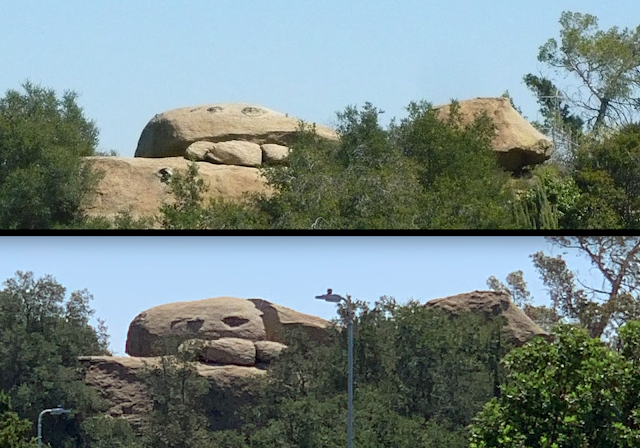 Bugeye before and after the crack — Here's looking at you, kid
These two shots contrast how Bugeye appeared before and after it cracked — in 2012 (top) and just a few weeks ago. You may notice that the "new" Bugeye (bottom) appears to be looking directly at the camera, while the old version was more pensive, staring off into space.
 Bugeye in 2021: Is the crack ready for its closeup?
Here's a closeup of the crack as seen from the vantage point of Bugeye's partner rock Trapezoid. A sign on the 118 Freeway, just after the eastbound Topanga exit, can be seen at top right.
 Do not try to insert Tab "A" into Slot "B"
It quickly becomes evident how the pieces used to fit together, as the triangular "Tab A" is an exact match for "Slot B." If you used to build models as a kid — or if you buy Ikea furniture — you might be tempted to follow instructions and "insert Tab A into Slot B," but I can assure you in this case it can't be done.
 Diagram of a breakup
The positioning of the two markers reveals the direction in which the rock rotated after it broke — essentially, the "little half," on the left here, rotated forward and down, shifting by at least a good couple of feet.
 Tab "A" and Slot "B" in a Google satellite view
The shift is substantial enough to be easily visible from space, as are both Tab "A" and Slot "B."  Google 3D image showing the crack

The Peach Slice post is mainly about the longest-standing set on the Iverson Movie Ranch, which occupied the same spot. If you scroll down toward the end of the post, you'll find the full story on the Slice. Here's the link again.

Another wandering rock on the Iverson Movie Ranch is perhaps the best example of an "intruder rock." I studied it back in 2018 and was eventually able to figure out its trajectory and where it was previously positioned.

It's always interesting — and sometimes even terrifying — when rocks start moving around, because we tend to think of them as being relatively stable.

It's even more interesting when we have the benefit of old movies, where we can figure out the rocks' previous position and contemplate what the situation was before they pulled up stakes.

I documented my research into the intruder rock in two posts in 2018. The first of these, which you can click here to read, focused on the Sphinx, while the second updated the research and covered a number of related topics.

Getting back to Bugeye, the crack that now runs through the rock is easily big enough to be seen from outer space. The above Google Maps shot, taken from a satellite, clearly shows the crack.

In fact, it was on Google Maps that I first spotted the crack. I did a double-take when I first saw it, and soon made my way to the location to get up close and personal with the mangled rock.

The satellite map shows the proximity of the Fireplace Rock/B&T group to Topanga Canyon Boulevard, running along the right side of the frame, along with the rocks' position just above a row of mobile homes.

One reason I wanted to examine the rock right away was to do a safety check. I was concerned about hunks of rock rolling down onto nearby Topanga Canyon Boulevard or crashing through the roof of a mobile home.

Not that I'm a geologist, a structural engineer or whatever I would have to be to actually know this, but the split appears to have made Bugeye more stable than it was before, not less. In a sense it was a self-correction initiated by the rock itself — perhaps prompted by an earthquake or other natural forces.

These two shots contrast how Bugeye appeared before and after it cracked — in 2012 (top) and just a few weeks ago. You may notice that the "new" Bugeye (bottom) appears to be looking directly at the camera, while the old version was more pensive, staring off into space.

Here's a closeup of the crack as seen from the vantage point of Bugeye's partner rock Trapezoid. A sign on the 118 Freeway, just after the eastbound Topanga exit, can be seen at top right.

It quickly becomes evident how the pieces used to fit together, as the triangular "Tab A" is an exact match for "Slot B." If you used to build models as a kid — or if you buy Ikea furniture — you might be tempted to follow instructions and "insert Tab A into Slot B," but I can assure you in this case it can't be done.

The positioning of the two markers reveals the direction in which the rock rotated after it broke — essentially, the "little half," on the left here, rotated forward and down, shifting by at least a good couple of feet.

The shift is substantial enough to be easily visible from space, as are both Tab "A" and Slot "B."

In another satellite image, this time providing a bird's-eye view, we can readily see how the "face" of Bugeye — containing its two trademark "bugeyes" — dropped significantly after it broke off from the right half of the rock.
 "Wanted: Dead or Alive" (1951) — Thanks for the memories, Bugeye!
But let's not get all broken up about the fate of Bugeye. It had a good run, leaving behind countless images of its Hollywood career. Here's a shot of Bugeye in its favorite position, top left, in an old Monogram lobby card.
 Roy Rogers leads an all-star charge past Bugeye in "Bells of Rosarita" (Jerry England collection)
One last memory of Bugeye: Some readers may be able to name all the movie cowboys storming past the rock in the star-studded 1945 Roy Rogers B-Western "Bells of Rosarita." Bugeye can be seen, as usual, at top left.

But let's not get all broken up about the fate of Bugeye. It had a good run, leaving behind countless images of its Hollywood career. Here's a shot of Bugeye in its favorite position, top left, in an old Monogram lobby card.

One last memory of Bugeye: Some readers may be able to name all the movie cowboys storming past the rock in the star-studded 1945 Roy Rogers B-Western "Bells of Rosarita." Bugeye can be seen, as usual, at top left.


