Why we love old movie locations — especially the Iverson Movie Ranch

For an introduction to this blog and to the growing interest in historic filming locations such as the Iverson Movie Ranch — the most widely filmed outdoor location in movie and TV history — please read the site's introductory post, found here.
• Your feedback is appreciated — please leave comments on any of the posts.
• To find specific rock features or look up movie titles, TV shows, actors and production people, see the "LABELS" section — the long alphabetical listing on the right side of the page, below.
• To join the MAILING LIST, send me an email at iversonfilmranch@aol.com and let me know you'd like to sign up.
• I've also begun a YouTube channel for Iverson Movie Ranch clips and other movie location videos, which you can get to by clicking here.
• Readers can email the webmaster at iversonfilmranch@aol.com
.

Showing posts with label Smooth Hill. Show all posts

Sunday, May 25, 2014

Bigfoot Subdues Dracula: Pure whimsy ... or so I thought

"Thunder River Feud" (1942)

The image above, from Monogram's weirdly filmed, and not particularly well-preserved, Range Busters B-Western "Thunder River Feud," has haunted me since I first saw the movie back in 2008. It was one of the first movies in which I found features filmed on the Iverson Movie Ranch, as my fascination with the filming location was just beginning to blossom.

In part because of the poor quality of my version of the movie, in part due to my inherently whimsical nature — and, I still want to believe, in part because of some degree of perverse intent on the part of the filmmakers — I found something in the shot that I couldn't help thinking looked like a large Bigfoot lying on top of something I thought bore some resemblance to Dracula. I began referring to the image as "Bigfoot Subdues Dracula."

In case there's any doubt as to what I thought I was seeing here — and why wouldn't there be — I've labeled the two "protagonists" of the formation in the shot above. The screen shot became, initially, a focus of failed attempts to figure out just what I was seeing, and subsequently, a symbol for the unfindable oddities that lurk in the backgrounds in any number of old movies. I came to accept long ago that Bigfoot Subdues Dracula would never be seen again, and it became a running joke both when sifting through old movies and on expeditions to the former Iverson Movie Ranch, as I would remark about any remotely similar rock feature: "Look, there's Bigfoot Subdues Dracula ... ha ha!"

"Last of the Bad Men" (1957) (false lead)

It became apparent long ago that Bigfoot Subdues Dracula — or simply "Bigfoot," as I later came to call the feature — was unlikely to ever turn up in the real world, but I would occasionally see something in the movies that caused me to consider whether, by some miracle, I might be seeing the formation again. I went through a series of false leads, including the above shot from the Allied Artists Western "Last of the Bad Men," in which a potential Bigfoot, positioned with a similar "attitude" to the original, lurks meaningfully in the background. The sequence is shot on the Iverson Ranch, as are the bulk of the movie's outdoor sequences. But as it turns out, it's not Bigfoot.

"The Great Alaskan Mystery" (1944) (once again, NOT Bigfoot)

Another false lead, shown above, surfaced in the 1944 Universal serial "The Great Alaskan Mystery," starring Milburn Stone — who later became a TV icon playing Doc for 20 years on "Gunsmoke," and winning an Emmy in the process.

"Fighting Bill Fargo" (1942)

A clue surfaced a couple of years ago when I spotted the above formation in the Johnny Mack Brown B-Western "Fighting Bill Fargo." But by this time I was resigned to thinking of Bigfoot, and the elusive image of a Bigfoot overpowering a Dracula character, as nothing more than a trick of light — and an illusion that would never evolve into a "real" filming location sighting. As a result, I didn't give this sighting as much thought at the time as it may have deserved.

"Treasure of Ruby Hills" (Allied Artists, 1955)

Finally, it happened: Six years after the original sighting in "Thunder River Feud," the actual Bigfoot Subdues Dracula, no mistaking it this time, resurfaced, looking remarkably similar to what I thought all this time had been just an illusion. The formation turned up in this shot from the B-Western "Treasure of Ruby Hills," and while "Bigfoot" doesn't look nearly as "Bigfoot-y" here as it did in the original, far more grainy, "Thunder River Feud" shot, to my eye "Dracula" appears, if anything, even more Dracula-esque here than in the original.

In another piece of news to come out of this sighting, the approximate location for the rock feature is now known: Smooth Hill is recognizable in the background — it's the view of the hill from the northwest, from the general vicinity of the Middle Iverson Ranch Set.

"Two Guns and a Badge" (Allied Artists, 1954)

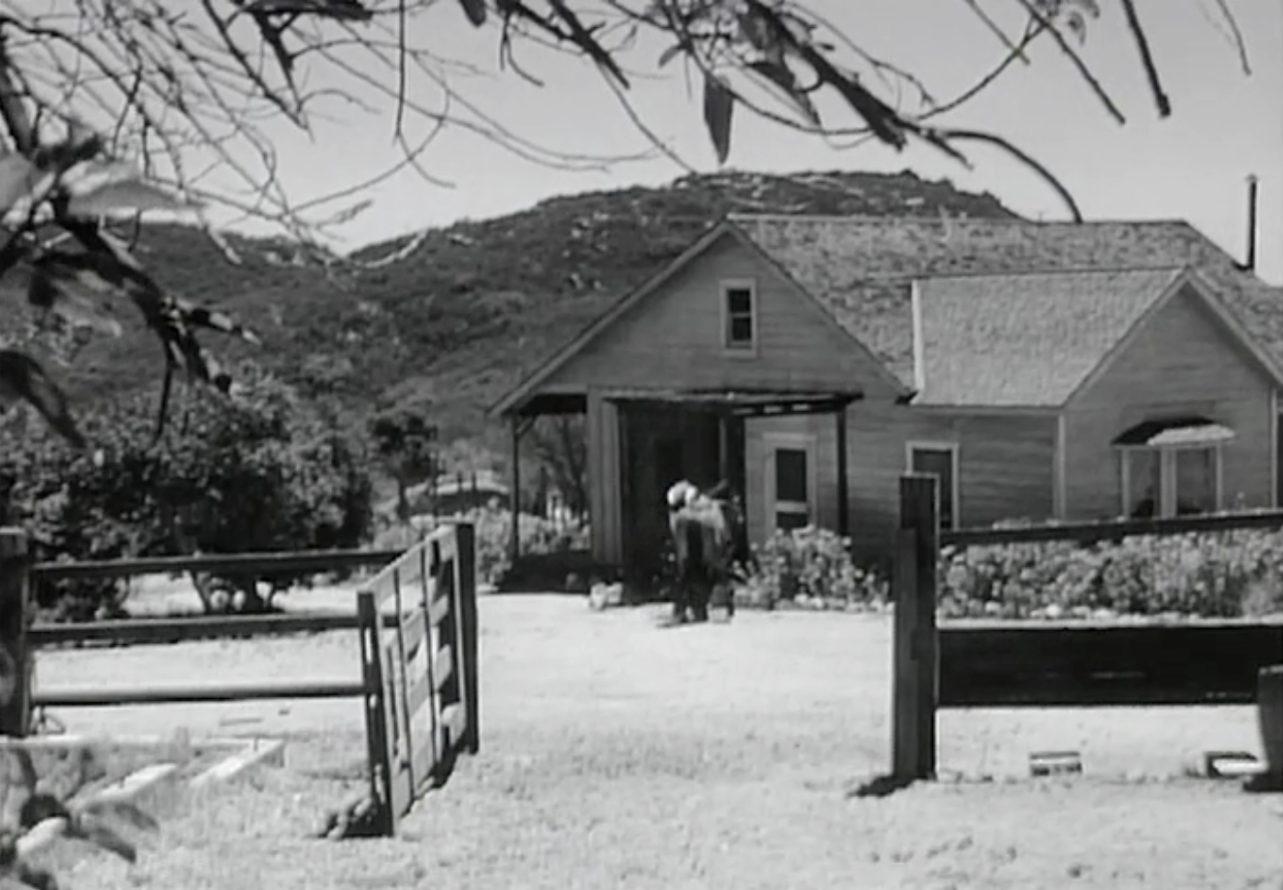
This shot from the Wayne Morris B-Western "Two Guns and a Badge" is extremely low-res, but it provides a similar view of Smooth Hill to the shot above from "Treasure of Ruby Hills" — and also contains the main house from the Middle Iverson Ranch Set. Bigfoot would be concealed behind the house in this shot.

Here's a comparison of the two above shots, highlighting a large split rock that helps establish that it's the same hill in both shots.

"Bells of Rosarita" (1945)

Smooth Hill, on the left, looms again behind the Middle Iverson Ranch Set in this scene from the Roy Rogers movie "Bells of Rosarita," in which Gabby Hayes is famously trapped in the trunk of an out-of-control old coupe.

North side of "Smooth Hill"

The hill appears much less smooth here than it does in "Treasure of Ruby Hills," illustrating how rocks, hills and other features can take on a vastly different appearance when the camera position shifts slightly. Smooth Hill was usually filmed from a different direction entirely — from the south, including frequent appearances in the background of shots of the Iverson Movie Ranch Western street, as seen below.

"Son of Paleface" (1952) — Smooth Hill from the other side

Smooth Hill, seen here from its more familiar southern side, is widely recognized as the hill in the background of shots of the Iverson Western street looking toward the north, including the example above from Bob Hope's Western comedy "Son of Paleface." The Western street, also known as El Paso Street, appears in the movie a ghost town — in other words, tumbleweeds were brought in and a few windows were boarded up. The bodies lying around are a separate issue.

"Rocky Mountain Rangers" (Three Mesquiteers, 1940)

Here's a nice view of Smooth Hill's southern side — looking characteristically smooth — from before the Western street was built, when Sheep Flats, the area seen in the foreground, was more wide-open. The shot comes from the Republic B-Western "Rocky Mountain Rangers," which I have in my pantheon of the greatest Iverson Ranch productions. The Western town set was built about four years later, in 1944, but would have been off to the left, out of the frame from this particular angle.

For a change the background is clear enough to spot a number of the telephone poles that were beginning to proliferate in the area by 1940. In some productions, such as those set in the earlier stages of the American West, the poles would have been an anachronism. But filmmakers typically shot without much apparent concern for them, and most of the time the backgrounds were so fuzzy it didn't matter.

Smooth Hill was later leveled, and a large apartment complex was built on top of it. Also seen here is the 118 Freeway, which was built in the mid-1960s, effectively bringing a halt to filming on the Lower Iverson. In the foreground is the Topanga onramp heading east.

"Cheyenne Takes Over" (PRC, 1947)

Back on the northern side of Smooth Hill, the story of Bigfoot continues to unfold. It turns out the rock was there all along in shots of the Middle Iverson Ranch Set, but it would have been pretty hard to find without knowing what we know now. You may or may not be able to pick it out in the above shot from the Lash LaRue movie "Cheyenne Takes Over."

Bigfoot is way in the background and really small in this screen shot, but once you know what the feature looks like and where it should be, you can tell that this is it.

"Captain Video, Master of the Stratosphere" (Columbia, 1951)

A wider shot of the Middle Iverson Ranch Set again includes both Smooth Hill and Bigfoot, as noted below. The shot comes from the "Captain Video" serial, which starred Judd Holdren and Larry Stewart.

The Chatsworth landmark Stoney Point can be spotted in the distance, and the shot also shows off the rarely seen back side of the Bunkhouse, part of the Middle Iverson Ranch Set.

"Treasure of Ruby Hills" (1955)

Back to "Treasure of Ruby Hills," and still another angle on Bigfoot. This shot displays the impressive span of the full rock feature in all its glory and includes the "Dracula" head popping out again, albeit slightly blurry.

"Treasure of Ruby Hills" also contains closeups of Bigfoot Subdues Dracula, such as this one showing mainly the "Bigfoot" portion. It's hard to tell from this angle (or any angle, really) how the "Dracula" image is formed, but presumably it's generated by the darker rocks at bottom left.

"The Life and Legend of Wyatt Earp" (1958)

The formation figures prominently in the background of this shot of Hugh O'Brian as Wyatt Earp in "The Bounty Killer," an episode of the "Wyatt Earp" TV show that first aired Sept. 30, 1958. "Dracula" can again be seen, but the figure transforms with each new angle. We may all be seeing something entirely different.

"The Roy Rogers Show" (1954)

This is what Bigfoot looks like from the other side — a lot like the first side. This shot comes from "Last of the Larrabee Kid," an episode of "The Roy Rogers Show" that premiered Oct. 17, 1954. In the background is the northeast face of the main house at Middle Iverson, which indicates we're looking more or less toward the west and viewing the southeastern face of the rock.

Recent shot of the Bigfoot area, now filled with condos

The story of Bigfoot does not have a happy ending. The rock formation was destroyed after the filming era wound down and that portion of the former Iverson Movie Ranch became a condo development. The photo above shows the approximate spot where Bigfoot once stood, looking toward the southeast.

Tuesday, September 10, 2013

Ma and Pa Kettle's Wild Ride: The rural American archetypes take a "shortcut" through the Iverson Movie Ranch — see the video below

The archetypal rural American characters Ma and Pa Kettle, played by Marjorie Main and Percy Kilbride, were featured in a series of popular comedy movies released by Universal over a period of about 10 years starting in the late 1940s.

Pa Kettle behind the wheel, with Ma riding shotgun during rampage at Iverson

The fourth installment in the 10-movie series, "Ma and Pa Kettle Back on the Farm," from 1951, included a wild jalopy ride that covered much of the Iverson Movie Ranch, along with a few other spots in Chatsworth, Calif. The sequence provides a high-speed scenic tour of Iverson, and ranks among the most memorable action sequences shot at the ranch.

Early in the sequence the Kettle clan arrives in the family convertible at the old Chatsworth Train Station, which was torn down around 1962. The station was next to the train tracks that roughly follow Canoga Avenue, between Devonshire and Lassen. (Please click on any of these photos to enlarge them.)

In this shot the car enters Sheep Flats on the Iverson property, with a nice view of Smooth Hill in the background — complete with the same telephone poles that occasionally snuck into the old Westerns as anachronisms. The Indian Hills Mobile Home Village now fills Sheep Flats, and Smooth Hill was leveled when the 118 Freeway came through in the late 1960s. The top half of Smooth Hill is now gone, replaced by a large apartment complex and some condos — as seen in the photo below.

This is all that's left of Smooth Hill today, dominated by the Summerset Village Apartments, with a few condos visible at the far left and the 118 Freeway slicing through the middle of the shot.

Another shot from the Sheep Flats sequence reveals that the filmmakers brought in a few cows — presumably to add to the rural feel of the movie. They would have had to pay a small daily fee per head of livestock to the Iverson family as part of the price of filming at the site.


Later in the sequence, Pa Kettle's "shortcut" takes the group through Iverson's Upper Gorge, roughly following the course the Lone Ranger rode on Silver in the opening to the TV show "The Lone Ranger." When the Lone Ranger got to about where the car is here, he turned right and rode up to Lone Ranger Rock — visible at the far left in the above shot. The Lone Ranger then famously reared up on Silver at the start of each episode, and could be heard shouting his trademark "Hi-yo, Silver!" Most of the rocks in the above shot, including Lone Ranger Rock, remain in place today and are in an area that has been preserved as a park.

This shot — a rare view of the Iverson Movie Ranch without any rocks — shows the Kettles powering through Iverson's eucalyptus grove.

In this scene the old jalopy is traveling along the stagecoach road at bottom right, with the large boulders making up Lower Nyoka Cliff in the bottom left corner and Stoney Point in the background, along with a portion of the road that would now be Topanga Canyon Boulevard. (Back then it was Santa Susana Pass Road.) For the record, the so-called stagecoach road, which ran below Nyoka Cliff, was never a real stagecoach route. But it was used so often as a stagecoach road in the old Westerns that it became known as the stagecoach road and that's what it's still called.

Here's a nice view of the corral area directly south of Iverson Village, complete with hay bales that were probably brought in special for the movie — in fact, I'm sure of it, because at one point Pa Kettle crashes into the hay bales. In the background are Hook Rock, just left of center, Lash LaRue's Arch, partially visible to the right of Hook Rock, and a number of other rocks that collectively are called the Cave Rocks — although from this angle I usually call them the Corral Rocks.

The Middle Iverson Ranch Set is prominently featured in the jalopy sequence, including the above shot of the bunkhouse. You'll know you're at Middle Iverson when the car rips through a bunch of laundry hanging on a line.

The Kettles speed through an area north of Garden of the Gods that I call the North Cluster. Today this area borders the Cal West Townhomes development, and some of these rocks have been destroyed while others survived. The large rock at the top-center of the photo — which I call Faux Hangdog 1 for research reasons that are too complicated (in other words, too embarrassing) to get into here — can still be found today. But it's a hard one to locate, as it is now concealed beneath a large tree. The rocks in the foreground have been removed, and condos now stand in that area.

The clip below contains the bulk of the jalopy ride, including most of the shots seen above. The clip includes much more Iverson material than I've been able to spotlight in photos. The clip consists mostly of Iverson footage, but does briefly show one building that was non-Iverson, along with a couple of additional train sequences that are shot nearby in Chatsworth but not at Iverson — including a nice shot of the train emerging from the tunnel above Chatsworth Park. The Smooth Hill/Sheep Flats sequence mentioned above appears a little bit earlier in the movie and is not included in the clip.

Here you go — hang on:


Friday, December 23, 2011

Center Rock, Sheep Flats, Smooth Hill ... and a bunch of utility poles

"Rocky Mountain Rangers" (1940): Center Rock on the left 

Here's a nice shot from one of the best Iverson movies, the 1940 Three Mesquiteers installment Rocky Mountain Rangers, from Republic Pictures. It's directed by George Sherman, with cinematography by Jack Marta — both men worked a lot at Iverson and contributed mightily to documenting its legacy through cinematic images.


Zooming in on the utility poles

One thing I like about this shot is it reveals no fewer than five utility poles on and around Smooth Hill, all the way back in 1940. That means they were in place for the bulk of the B-Western shoots, including throughout the lifespan of the Iverson Movie Ranch Western street. Some of them can occasionally be seen as anachronisms in the background of Westerns, but rarely are they as easy to spot as they are here.


Above is a link to the "Saturday Matinee Double Feature" DVD, which includes the great Iverson movie "Rocky Mountain Rangers" along with the non-Iverson Buck Jones/Tim McCoy Rough Riders movie "Arizona Bound."

Click here for a post that explains what happened to Smooth Hill and also shows what it looked like in the background of the Iverson Movie Ranch Western street.


Another shot from Rocky Mountain Rangers, from approximately the same angle, gives a better look at Center Rock, the light-colored clump of rocks at the left of the shot. Center Rock was in the middle of Sheep Flats, where Iverson's Western town was built a few years later. This cluster of rocks was noteworthy for a number of things, including its isolated location, its protruding ledge and the odd little arch at its base. Somewhat miraculously, Center Rock survived, even as a mobile home park — the Indian Hills Mobile Home Village — was built around it.

Center Rock in its current predicament

Today Center Rock's setting isn't nearly as grand, as it's been stuffed behind fences and barriers and is essentially part of a maintenance facility at the park. I've been especially frustrated by that white plywood, which not only is a bit of an eyesore but also conceals the rock's trademark arch.


Here's a shot of Center Rock in the 1948 Republic serial G-Men Never Forget, showing pretty much the same angle as the contemporary shot above. Looks like the arch would be just about big enough to hide a motorcycle.


Here's what Center Rock looks like today from the other side. The rock was rarely filmed from this side.

Monday, February 1, 2010

Iverson's Western street: The northern end of town ... and the demise of Smooth Hill


"The Hills of Utah" (1951) — Iverson Village looking north

I recently posted photos of the southern end of Iverson Village (you can click here to see that post), and this is what the rest of the town looked like. The shot above is from the Gene Autry B-Western "The Hills of Utah." Note the stone buildings on both sides of the street — the Saloon on the left and the Livery Stable on the right. Most Western movie towns were made of wood, so the buildings' stone appearance helps distinguish Iverson Village.

A number of the town's main structures are identified in this version of the shot, along with Smooth Hill, a landmark that sat just north of the town. The consensus for years among film historians was that the main street was oriented more or less north and south, although comparing the positions of Gumdrop and Church Rock, the marker rocks at the southern end of town seen in the earlier post, gave rise to the idea that the street would have had to be positioned at an angle, leaning a bit southwest to northeast.

Aerial photo of Sheep Flats, 1952

This idea was confirmed after the above aerial photo surfaced from 1952, when the Western town was still in place. The town was located on a sprawling flat area known as Sheep Flats, which is now occupied by the Indian Hills Mobile Home Village.

"Check Your Guns" (1948) — Smooth Hill (before Casa Grande was built)

I searched at Iverson Ranch for months for the hill at the north end of town, which I began calling Smooth Hill. It eventually became apparent, even though I had a hard time believing it at first, that the hill was gone. It turns out the thing was basically leveled when the 118 freeway went through in the 1960s. Chunks along the southern edge of the hill were blown away to put the freeway through, and while they were at it they lopped off the top of it.

The former site of Smooth Hill as it appears today, now occupied by apartments and condos

The destruction of Smooth Hill cleared the way for what is now a batch of condos and a couple of large apartment buildings sitting on that spot, overlooking the freeway just above the Topanga interchange.

"Rocky Mountain Rangers" (1940) — Smooth Hill, before the town was built

Smooth Hill was a presence in movies even before the Western street was built, as in the above example from Republic's Three Mesquiteers Western "Rocky Mountain Rangers." Not only was the hill a key marker identifying Iverson Village in the old movies, but it was also kind of famous in its own right — and its loss is felt.

"Calamity Jane and the Texan" (1950)

This shot from the Columbia Western "Calamity Jane and the Texan" shows more of the eastern side of the street, and provides a look at Oat Mountain to the north — the series of hills with streaks of white, in the background. One of the markers on Oat Mountain, the Triangle Brand, is also visible, at the top of the photo, toward the left, partially hidden behind a small hill (Notch Hill).

Here's the same screen shot with some of the key features highlighted. The town set is also called El Paso Street, after its role in the 1949 movie "El Paso." Once again, for a look at the southern end of the Western street, please click here.