Why we love old movie locations — especially the Iverson Movie Ranch

For an introduction to this blog and to the growing interest in historic filming locations such as the Iverson Movie Ranch — the most widely filmed outdoor location in movie and TV history — please read the site's introductory post, found here.
• Your feedback is appreciated — please leave comments on any of the posts.
• To find specific rock features or look up movie titles, TV shows, actors and production people, see the "LABELS" section — the long alphabetical listing on the right side of the page, below.
• To join the MAILING LIST, send me an email at iversonfilmranch@aol.com and let me know you'd like to sign up.
• I've also begun a YouTube channel for Iverson Movie Ranch clips and other movie location videos, which you can get to by clicking here.
• Readers can email the webmaster at iversonfilmranch@aol.com
.

Showing posts with label Cal West Townhomes. Show all posts

Sunday, October 9, 2016

An Iverson Movie Ranch mystery solved: Here's what happened to the "Hangman's Tree"

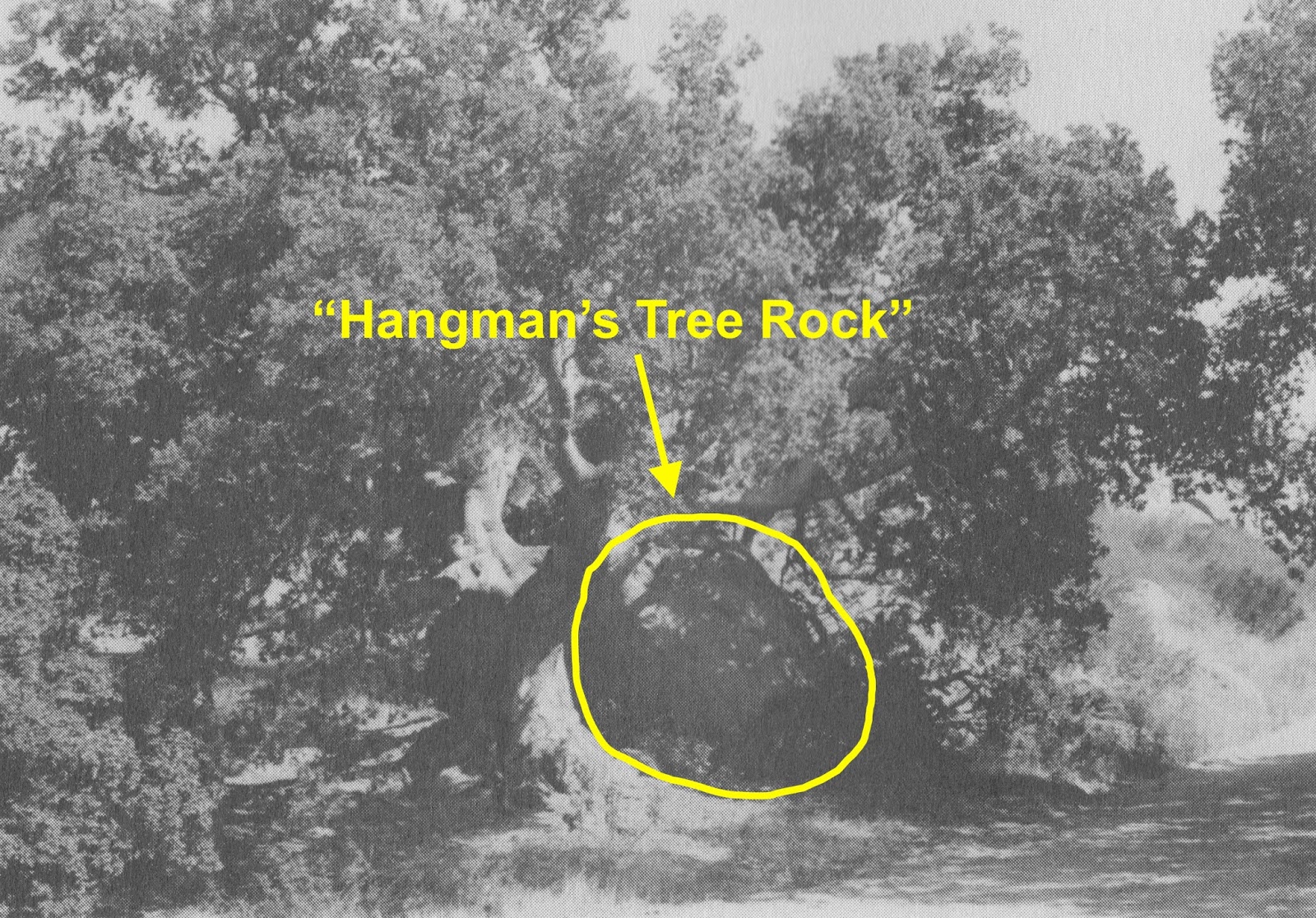
"Hangman's Tree" on the Lower Iverson Movie Ranch in 1981 
(photo from "An Ambush of Ghosts," by David Rothel)

I've been obsessing for a while over this photo of what's been called the "Hangman's Tree." And after several months, my obsessing finally paid off.

"Hangman's Tree" location in 2016

On a recent visit to the former Iverson Movie Ranch, I was able to pinpoint the location where the Hangman's Tree once stood. Unfortunately, the tree is long gone.

"Pioneer Justice" (1947): The Hangman's Tree

As is usually the case, it took multiple sources of information to crack the mystery. In this instance, the biggest clue surfaced in the Lash LaRue movie "Pioneer Justice."

I couldn't match the tree in "Pioneer Justice" directly with the tree in Rothel's book, but it has all the hallmarks of a good hanging tree. And it's right next to a rock that looks like it might be easy to find.

Another great clue lurks in the background of the "Pioneer Justice" shot — something that looks suspiciously like Zorro's Cave. That would be the first place I'd look.

Hangman's Tree area, including "Hangman's Tree Rock," in 2016

When I arrived at the target area, everything was right where it was supposed to be — except the tree. "Hangman's Tree Rock" has survived, and still looks exactly as it did in "Pioneer Justice."

The tree and rock in 1981, in "An Ambush of Ghosts"

The rock is easy to miss in Rothel's landmark Western locations book, but it's there, hidden in the shadows. As the only surviving feature in the shot, the rock holds the key to locking down the spot.

"Pioneer Justice"

As a bonus, I was able to identify a couple of other rocks seen in "Pioneer Justice," still in place today and further pinpointing the tree's former location.

The same area, photographed in 2016

Those same two rocks can be identified today, still in the same positions.

It's no longer possible to see Zorro's Cave from this vantage point, but it's back there and can be seen from other angles.

Hangman's Tree Rock in 2016 (angle approximates the 1981 photo)

The final puzzle piece is to see whether "Hangman's Tree Rock" matches the rock in the 1981 photo when they're shot from approximately the same angle.

It does. The key markers are noted here in the 1981 photo, with the rock's vertical face and its sloping profile being especially important.

While I couldn't match the high angle of the 1981 shot, all of the same markers can be found on the rock today even from ground level.

If the Hangman's Tree were still in place, this is about where it would be standing. The tree apparently did not fit in with the landscapers' vision for the Cal West Townhomes.

Nearby Zorro's Cave can still be found, but today it has a metal gate blocking the west entrance and is situated on private property adjacent to the condos.

The former Hangman's Tree area also stands on private property, at an intersection of driveways among the condos on the former Lower Iverson.


Click on the link above to go to Amazon.com to learn more about David Rothel's excellent book on Western movie locations, "An Ambush of Ghosts." You may or may not be able to purchase a copy depending on availability.

Friday, March 14, 2014

One rock to rule them all? A Hobbit House hides among the condos

Bilbo Baggins at home at Bag End

Bilbo Baggins, the Hobbit from "Lord of the Rings," would be right at home in the Cal West Townhomes community in Chatsworth, Calif. The condo development was built on the site of the former Iverson Movie Ranch — the most heavily filmed outdoor location in the history of the movies — and as luck would have it, there's a Hobbit House, or something that looks like one, hidden among the condos.

"The Trusted Outlaw" (1937)

I talked about my search for Plaza Rock in the previous blog entry, and I teased the fact that, while I was unable to find Plaza Rock amid the condos, I did find something pretty cool. What I found was the larger mushroom-shaped rock that is often seen behind Plaza Rock, as in the above screen shot from the Bob Steele movie "The Trusted Outlaw." For reasons I will explain below, I began referring to the larger rock as "Hobbit House."

Hobbit House as it appears today, amid the Cal West Townhomes

After discovering the mushroom-shaped rock in its current setting — where it serves as a large-scale planter decoration in the condo community — I realized the rock has something in common with the Hobbit dwellings in "Lord of the Rings." Like a Hobbit residence in the Shire, most of the rock is now underground.

"Stagecoach Express" (1942)

Here's a shot from the Don "Red" Barry B-Western "Stagecoach Express" from Republic that gives some idea of how tall and imposing Hobbit House was back in its movie days. The rock is at least twice the height of a stagecoach and much taller than Gorge Cabin.

"The Old Corral" (1936)

As you can see in this shot cropped from "The Old Corral," Hobbit House as it stood in the filming era towered over Plaza Rock, which was itself a substantial formation, seen here looming above a large car.

But to create the present-day community of condos surrounding Hobbit House, developers had to make compromises. One of those compromises was to bury most of Hobbit House, fill in the area in front of it with dirt and plant a sprawling lawn, as can be seen in this shot taken on a recent visit to the site.

Hobbit House then — in the 1942 movie "Stagecoach Express," on the left — and now, on the right.

Here's a side-by-side comparison of two shots — one showing Hobbit House as it appeared in the movies in 1942, on the left, and one taken in recent times revealing the rock's new role as a lawn sculpture, on the right. The comparison makes it clear just how significantly the rock formation's stature was diminished when the bulk of it was buried during grading for the condo project.

Today residents of the condo community have the privilege of driving past Hobbit House on their way to and from their garages, as the former movie rock is situated right next to a main driveway. As excited as I was to find the rock — and to learn that it had survived, more or less — I was saddened to see that it had been somewhat brutally "domesticated" in order to make it compatible with a community of townhomes.

 "The Trusted Outlaw" (1937)

But the fate of Hobbit House is better than what happened to Plaza Rock. Which reminds me, what DID happen to Plaza Rock?

All we know is what we can see ... and what we can see makes it pretty clear: Plaza Rock is no more. This shot and the even wider view a couple of photos up present a fairly complete picture of the area in front of and around Hobbit House. If Plaza Rock were still to be found, it would be somewhere in these two shots. My hunch is that Plaza Rock remains under this lawn, completely buried ... probably with the top part of the rock knocked off.

The other option is they broke it up, maybe blew it up, and trucked it off in pieces to a remote location, as illustrated above. (The photo is just an illustration, and has no connection with Iverson.) It strikes me as a lot of wasted effort when they could have just buried the thing. They knew they were going to fill the area with dirt, and that would have been the easiest way to get rid of the "problem" of Plaza Rock.

1952 aerial photo of the Upper Gorge

An aerial view of a portion of Iverson's Upper Gorge, taken in 1952 — when the rocks were still above ground — shows the proximity of Hobbit House and Plaza Rock, which were practically on top of each other. The aerial also highlights a couple of nearby features: the Angry Cardinal, a large rock formation that was the focus of this recent blog post, and the site of Gorge Cabin, which was already gone by 1952. You can click here to read an earlier blog entry that goes into detail about Gorge Cabin. My post previous to this current one, which focuses mainly on Plaza Rock, also discusses the location of Gorge Cabin, and can be seen by clicking here.

This is what the same area looks like today in an aerial view, noting the positions of Hobbit House and Plaza Rock among the condos.


Until someone comes up with a better idea, I'm going on the theory that Plaza Rock remains buried under the lawn. X marks the spot.

Sunday, March 9, 2014

I know, it's only Plaza Rock ... but I like it

As those great rock 'n' roll philosophers the Rolling Stones once said, you can't always get what you want, but if you try sometimes, you just might find, you get what you need.

"The Bold Caballero" (1936)

I had an experience along those lines recently when I was searching the grounds of the former Iverson Movie Ranch in Chatsworth, Calif., looking for a particular "classic rock" from the movies — a stacked formation I call Plaza Rock. You can see it in the shot above, from the old Republic Zorro movie "The Bold Caballero," starring Bob Livingston. That's Plaza Rock filling up much of the left half of the screen.

"The Old Corral" (1936)

I started calling it Plaza Rock in my research because often when I saw the rock in the movies, it had a sort of dirt "plaza" in front of it, and appeared to be positioned strategically at a crossroads, as if presiding over the plaza. You can get an idea of the plaza in the above screen shot from the Gene Autry movie "The Old Corral." You may also want to pay attention to that much larger rock in the top right corner, which sort of lurks meaningfully behind Plaza Rock. That rock will be discussed in the post that follows this one, and it is a big part of the Plaza Rock story. But for now I'm going to hold off on talking about it and keep the focus on Plaza Rock itself.

Here's that same shot from "The Old Corral" with a couple of features noted, just to make sure we're on the same page.

"The Lone Ranger" (Republic serial, 1938)

During the years when the Gorge Cabin was in place, from about 1936-1944, Plaza Rock was one of the nearest rock features to the cabin. In fact, one thing that makes Plaza Rock especially important is that it helps pinpoint the location of the cabin. I've blogged previously about Gorge Cabin, and you can read more about it and see a bunch of other movie shots of the cabin by clicking here.

Promotional still, circa 1940-1943, featuring Gorge Cabin and much of Iverson's Upper Gorge

The above promotional still comes from the collection of film historian Jerry England, and it's one I've featured before on the blog. In addition to providing one of the clearest looks at the Gorge Cabin, this shot includes a number of important features of Iverson's Upper Gorge. No one has successfully determined — yet — which production the shot was made for, although it's thought to be from a Columbia serial, possibly "Batman" (1943). For now I'll have to give a date range for it rather than a specific year.

Here's that same early 1940s promo shot, with a number of key features marked. One thing that becomes clear upon studying some of these photos is that the cabin essentially occupied the "plaza" area in front of Plaza Rock.

"Outlaw's Son" (1957)

The above screen shot from "Outlaw's Son," a relatively obscure Western feature from United Artists that starred Dane Clark and Ben Cooper, provides a look at the same area where Gorge Cabin stood, but after the cabin was gone, in 1957. The camera angles are comparable, though far from exact, between this shot and the early 1940s promo shot above, and a couple of key rocks appearing in both photos serve to further pin down the location of the cabin. It would have been in the flat "plaza" area adjacent to Plaza Rock, toward the back of the shot, behind the tree that appears directly in the center of the shot.


The above markup shows an experiment I did that attempts to draw a closer comparison between the two preceding shots — with and without the cabin. I can't honestly say I'm convinced that this effort contributed much, if anything, to the process of pinpointing the former location of the cabin. But it was something I thought I'd try and this was the result, for better or worse. Besides Plaza Rock, the same large foreground rock appears in both shots, and the dotted line between the two rocks should intersect the cabin location.

Well, I didn't get what I wanted — I never found Plaza Rock in the real world, although I eventually developed a pretty solid theory as to what happened to it. I'll delve into that subject in the next post. (Please click here to read it.) For now I'll just mention again that in the process of searching for Plaza Rock, I found something unexpected, and pretty darn cool in its own right. As the Stones might say, I got what I needed. I've already dropped one big hint: It has to do with that larger rock you see hovering above Plaza Rock in some of the shots above. I'll fill in the details in the next post.


In the meantime, here are some links to Amazon in case you want to try to track down DVD copies of some of the productions mentioned in this post — or if you're Jonesing for some Old Stones:


Click here to see Western movie location expert Jerry England's blog, where he talks about the Iverson Movie Ranch, other filming locations in the Santa Susana Mountains, a little family history and all things cowboy.

Friday, May 17, 2013

Hangin' around Hangdog: Great Iverson Movie Ranch scene found in the 1941 Republic serial "Dick Tracy vs. Crime, Inc."

The 1941 production "Dick Tracy vs. Crime, Inc.," starring Ralph Byrd, is considered by many fans to be among the best serials ever made. It was the fourth and last of Republic's four Dick Tracy serials — a series that also included "Dick Tracy" (1937), "Dick Tracy Returns" (1938) and "Dick Tracy's G-Men" (1939). The last three installments all included sequences shot at Iverson.

I recently got my first look at "Dick Tracy vs. Crime, Inc." and ran across a particularly compelling Iverson sequence — including the above view of a dynamic rock I call Hangdog. The rock was at the center of a big shootout sequence, with one guy picking people off from on top of the rock and a bunch of other guys shooting at him from behind cars, as seen above. The shot really shows the scale of the rock, with a normal-sized man positioned atop Hangdog and dwarfed by the rock.

Hangdog is still intact, and looks like this today. Other views of the rock give a better idea of why it's called Hangdog. Click here to see a previous blog entry featuring additional shots of Hangdog.

 Stunt jump off Hangdog, Part 1

Stunt jump off Hangdog, Part 2

Stunt jump off Hangdog, Part 3

Stunt jump off Hangdog, Part 4

Included in the sequence is the above stunt jump off Hangdog — off a rock that looks to me like a shoulder — into the covered bed of a truck.

Here's what that same "shoulder" of Hangdog looks like today.

Scene from "Spy Smasher" (1942)

In a mildly amusing example of cross-promotion, the above shot from the 1942 Republic serial "Spy Smasher" includes a plug for "Dick Tracy vs. Crime, Inc." in the form of a set of posters on a gate.

Here's another shot of Hangdog in recent times, which I think shows the rock's two main "faces" — I tend to see it as a lion on the left and a Scooby-Doo-type dog on the right. Or another lion.

Ruh-roh! (Catch phrase often attributed to Scooby-Doo, 
above, but in fact originated by Astro on "The Jetsons")

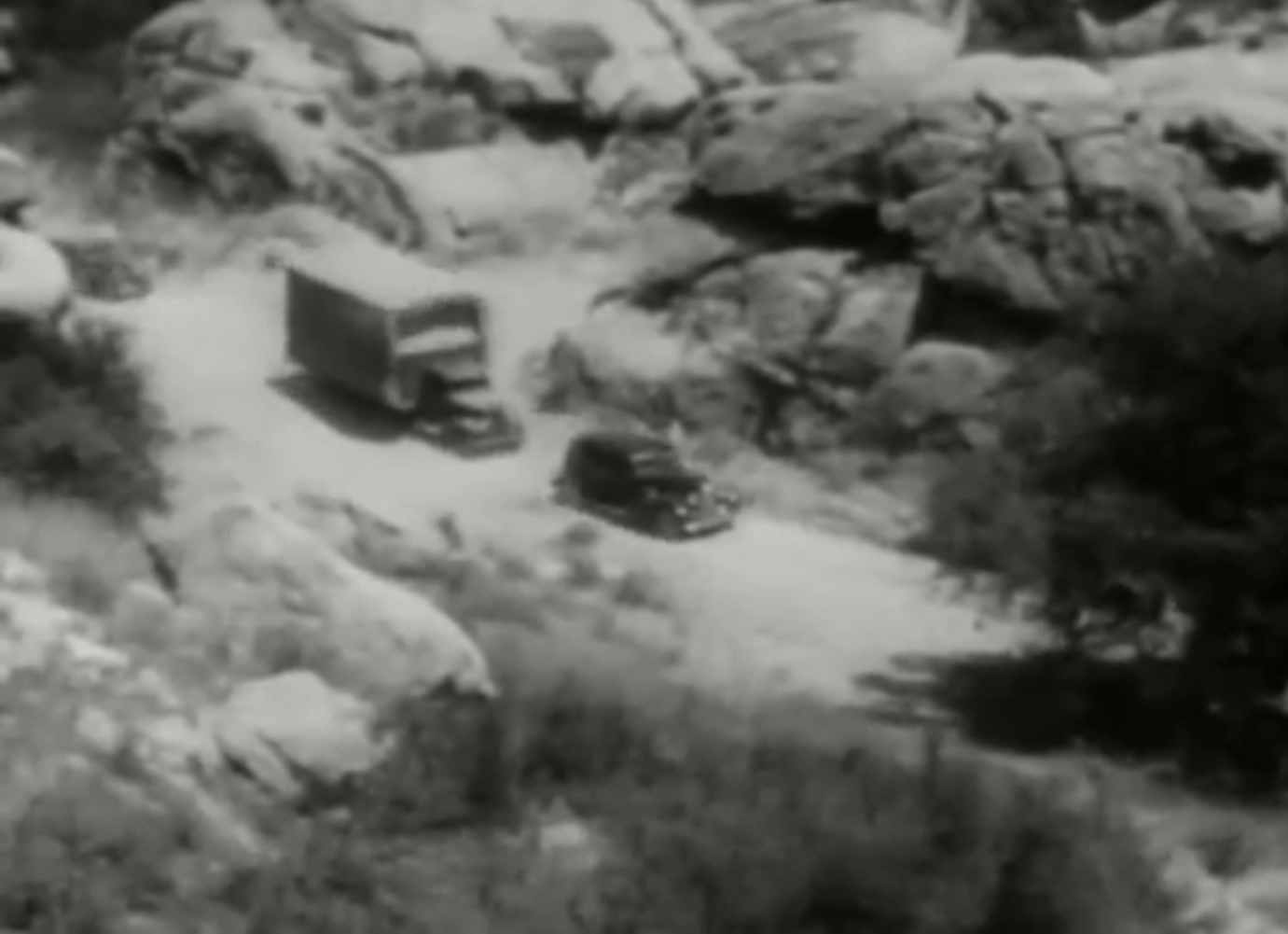
The thing that really elevates the "Dick Tracy vs. Crime, Inc." shootout sequence, in my opinion, is its bird's-eye views, including the above shot of a frequently filmed area known as Devil's Pass or Vultura's Pass. That's Hangdog again at top right, above the car, although the angle makes it hard to recognize. The pass itself starts to the right of the truck and continues east, behind Hangdog.

Vultura's Palace, in "Perils of Nyoka" (1942)

The same site turns up again the following year as the location of Vultura's Palace in the seminal Republic serial "Perils of Nyoka." That's a portion of Hangdog — including the shoulder, again — at the right in the above shot. You may notice the similarity between the rock directly above the palace entrance (at top center in the above shot) and the one seen in the "two-faced" shot of Hangdog a few shots up (above the Scooby-Doo cartoon), in the top-left corner. That's because it's the same rock in both shots. For more about this location, click here.

Another bird's-eye view from the "Dick Tracy vs. Crime, Inc." sequence, this one shows the guy posted atop Hangdog in the foreground, with an unusual angle on Bill Rock, the large rock at left center, near the car. The road where the vehicles are parked, which would pass by the front of Vultura's Palace the following year in "Perils of Nyoka," is sometimes called Vultura's Trail. Also visible here, in the background — and not in much detail — are the Devil's Doorway Cluster and Devil's Doorway Wall, in the top-left corner. The low, horizontal rock all the way in the corner is Devil's Doorway Wall.

This shot shows the same general area from a lower angle, with a portion of Bill Rock again seen at the left, the cars parked along Vultura's Trail, and Cactus Hill in the background. The flat area below Cactus Hill is where much of the Cal West Townhomes development now stands.

Reggie Lanning, at far right, operating the camera 
for the 1930 movie "The Big House"

The cinematographer on "Dick Tracy vs. Crime, Inc." was the great Reggie Lanning, a Republic stalwart who was responsible for some of the best camera work at Iverson from the late 1930s through the 1940s — not the least being the serials "Zorro's Fighting Legion" (1939), "Jungle Girl" (1941) and "Perils of Nyoka" (1942). He also did some nice work at Iverson for the Roy Rogers movies "Cowboy and the Senorita" (1944) and "Song of Arizona" (1946). For more about Lanning's incredible track record at Iverson, please read this blog entry. And please click here for more about the forgotten legacy of the great cinematographers of the B-movie era.

In the above promo still for the 1930 movie "The Big House," Lanning — who was uncredited on the production — works alongside cinematographer Harold Wenstrom shooting the film's star, Chester Morris. It's a rare glimpse of Lanning at work.


If you're interested in getting your own copy of "Dick Tracy vs. Crime, Inc." on DVD, you should be able to buy it off Amazon by clicking on the image above.