Why we love old movie locations — especially the Iverson Movie Ranch

For an introduction to this blog and to the growing interest in historic filming locations such as the Iverson Movie Ranch — the most widely filmed outdoor location in movie and TV history — please read the site's introductory post, found here.
• Your feedback is appreciated — please leave comments on any of the posts.
• To find specific rock features or look up movie titles, TV shows, actors and production people, see the "LABELS" section — the long alphabetical listing on the right side of the page, below.
• To join the MAILING LIST, send me an email at iversonfilmranch@aol.com and let me know you'd like to sign up.
• I've also begun a YouTube channel for Iverson Movie Ranch clips and other movie location videos, which you can get to by clicking here.
• Readers can email the webmaster at iversonfilmranch@aol.com
.

Showing posts with label Stoney Point. Show all posts

Thursday, May 30, 2024

Stoney Point: A Chatsworth landmark's hidden movie history

Stoney Point, Chatsworth's No. 1 landmark

Everyone who takes busy Topanga Canyon Boulevard through Chatsworth, Calif., drives past Stoney Point. Situated on the east side of Topanga near the 118 Freeway, it's the town's largest and best-known landmark.
 
A view of Stoney Point from the Iverson Movie Ranch (Cliff Roberts photo)

Sticking out above the flat San Fernando Valley, this high-rise sandstone rock formation is a close neighbor of the former Iverson Movie Ranch, sitting just across Topanga to the southeast.
 
"The Grapes of Wrath" (1940): Stoney Point crashes a promo still

The massive butte has a tendency to pop up in the backgrounds of movies and TV shows filmed on the Iverson Ranch. That's Stoney Point on the left in this promo still for John Ford's "The Grapes of Wrath."
 
How about putting a McDonald's on Stoney Point?

Longtime blog followers may recall that Stoney Point once came dangerously close to having a McDonald's on top of it — or worse. If you find that hard to believe, and who wouldn't, please click here for the full story.
 
Stoney Point for sale in the mid-1970s

Stoney Point was once offered for sale for $280,000. This real estate listing from about 1975 suggests installing a cable car to help bring customers to the top. And they were serious about it.
 
Rock climbing on Stoney Point

Miraculously, Stoney Point was saved from development, becoming an L.A. city park in 1982. Today it's a popular spot for rock climbers, and a system of trails — while not always easy to find — winds its way to the top.
 
"Seinfeld": Kramer and George on a TV version of Stoney Point

Stoney Point even made an appearance on "Seinfeld." In the 1993 episode "The Stall," Kramer and George go rock climbing on one of its steep faces, although closeups were shot on a soundstage with a fake rock.
 
"Seinfeld": A landmark rock meets a landmark sitcom

Wide shots featured in the "Seinfeld" episode show the actual Stoney Point, presumably with stand-ins, and not the series stars, hanging from Stoney's sheer cliff face.
 
"The Captive God": William S. Hart filming in Chatsworth, 1916

But Stoney Point's screen appearances go back way before "Seinfeld," and way before TV. We have to go all the way back in time to the silent era — more than a century ago — to trace its movie history.
 
An early screen appearance by Stoney Point

The William S. Hart feature "The Captive God," filmed in Chatsworth in 1916, included images of Stoney Point looming in the distance.
 
"The Captive God": Stoney Point at top right

Stoney Point is a little more recognizable in this screen shot from the movie.
 
Silent film-era crew on "mystery rock"

In at least one instance, a silent-era film crew hauled its cameras and other gear all the way to the summit of Stoney Point. This shoot resulted in a terrific behind-the-scenes photo, which baffled film historians for years.
 
Back when "knickers" were in style

Zooming in on the film crew, we can get a sense of how old the photo is, based in part on the movie equipment but also on the styles of clothing worn by the crew. The shot is clearly from the silent film era.
 
Plenty of other clues in the mysterious photo

The photo, which features a distinctive rock with a flat top, can still be found on a number of websites, often described as an "unknown location," or worse, credited to the wrong location.
 
The mystery photo, incorrectly identified as the "Iverson Ranch" and "1922"

Here's just one of the many examples of false information associated with this photo that can still be found online. The photo was not taken on the Iverson Ranch, and was not taken in 1922.
 
It's not true!

Sorry to make a big deal out of this, but it's important that people realize this information is incorrect. It's hard to get this kind of stuff right, so no disrespect to whoever posted the false info. But I wish people could resist the temptation to present "information" as fact when it's not actually true.
 
There are always exceptions, of course

We're just kidding around here, but we do make an effort to check our facts, and we don't mind saying something is "thought to be" if we don't know for sure. But when it comes to this photo, we know for sure.
 
Aerial view of Stoney Point (Google Maps, 2024)

When I began researching the old photo, it wasn't long before I became interested in a triangular rock located at the very top of Stoney Point.
 
The old movie rock in modern times

It turned out to be the same historic movie rock, which I was able to confirm on a recent expedition to the summit of Stoney Point.
 
The same movie rock, in the '20s and almost 100 years later

Taken almost a century apart, the two shots of the rock are so similar that I was practically standing in the footprints of the photographer who snapped the behind-the-scenes photo in the 1920s.
 
Jimmie Adams and Doris Dawson in "Swiss Movements" (1927)

I was also able to pin down which movie it was that was being filmed when the old photo was taken. It was a Jimmie Adams comedy short called "Swiss Movements," from Christie Film Co.
 
"Swiss Movements": Two actors and a "bear," out on a rocky ledge

This is the sequence the film crew was working on when the behind-the-scenes shot was taken. The scene features two actors trapped on a rocky ledge, being harassed by someone in a bear suit.
 
"Swiss Movements": Jimmie Adams dangles his legs over the edge

This shot appears only briefly in the movie, but this is the angle the crew was filming when they stood on top of the flat rock. Here we see the film's star, Jimmie Adams, trying to avoid being mauled by the bear.
 
"Swiss Movements": The climbers head back down the ledge

In another shot from the same sequence — taken from a different camera position — the "bear" is out of the picture and the two actors attempt to head down the rocky ledge.
 
Key rock features that make up the shot

Notice the pointed rock and angular slope indicated here. I found it interesting that the "Swiss Movements" sequence is essentially about rock climbing — the same thing Stoney Point is still known for.
 
The pointed rock and angular slope in modern times


Here are those same rock features in a photo taken on our recent visit to the summit.
 
The filming location in context

A wider shot provides some context for the scene, showing more of what the rocks look like as part of the extremely rocky environment atop Stoney Point.
 
Pinpointing the "Swiss Movements" scene

The yellow rectangle approximates how the pointed rock and angular slope are framed in the movie.
 
Setup for the "Swiss Movements" shoot

In another photo from our Stoney Point expedition, we see the same rocks the "Swiss Movements" crew would have found when they arrived at the location in 1927.
 
How the shoot was set up

The rock on the left, with its flat top, provided the ideal spot for the camera, reflectors and key members of the crew, while the actors worked on the slightly more perilous angular slope.
 
The remarkable photo from 1927

And luckily for us, a still photographer who was also on the scene snapped the shot that enabled us to put together how the sequence was filmed — right down to the spindly ladder everyone had to use to get up on that rock.
 
Jimmie Adams on the Stoney Point summit (1927)

"Swiss Movements" includes plenty of other shots taken on top of Stoney Point, although many of the rocks are still waiting to be found. Here's one other group of rocks we were able to match up on our recent hike.
 
Looking west from Stoney Point

When Jimmie Adams steps aside, we get a pretty good look at the cluster of rocks he was standing in front of. These rocks are situated along the western edge of the summit area.
 
The same rocks in modern times

I didn't get the exact same angle, but you may be able to make out the rocks from the movie — especially toward the right of the frame. We also get a better look at the Santa Susana Mountains to the west.
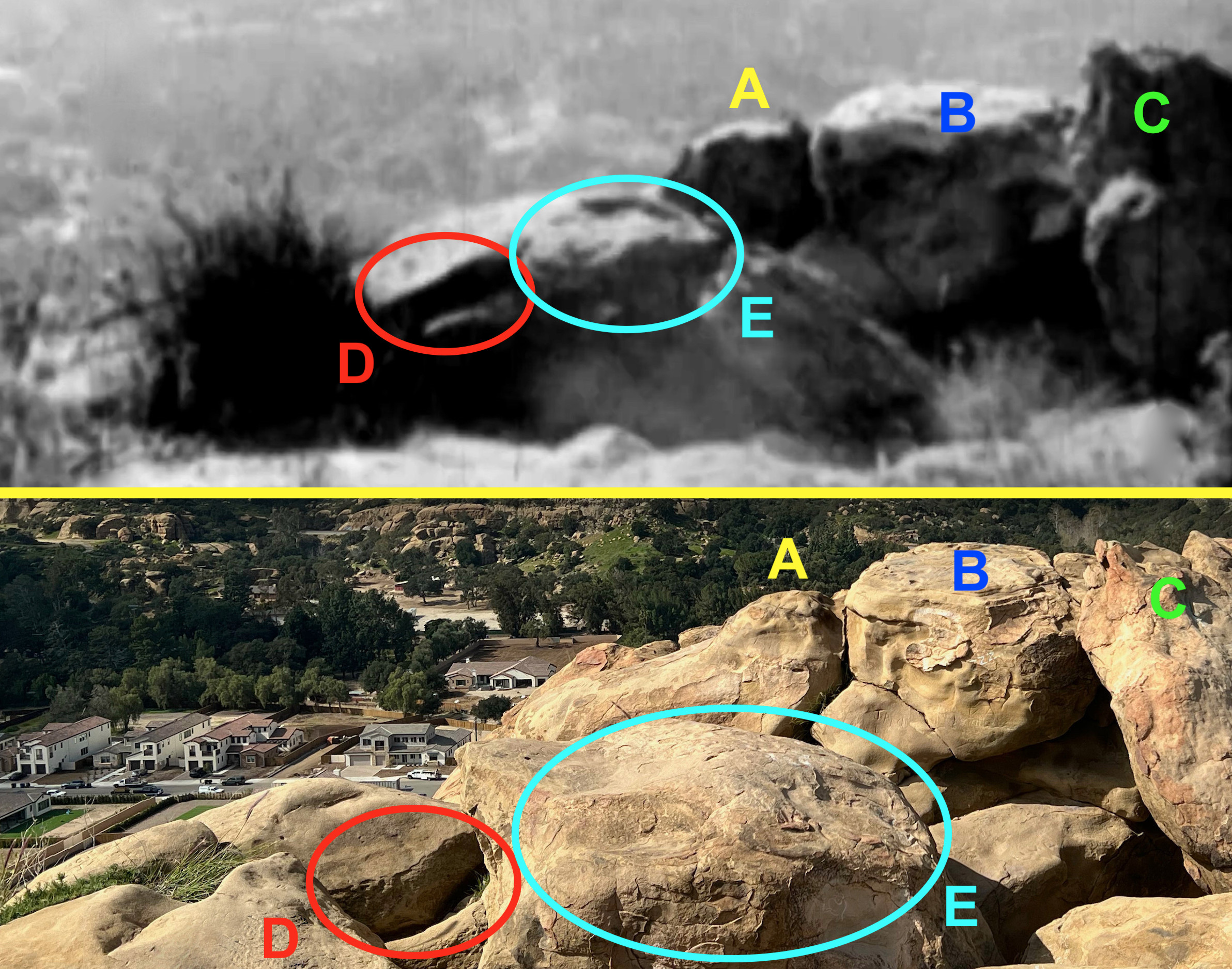
 
Identifying markers and matching rocks

Here are some of the key markers in the two shots, to make it easier to see how the rocks match up.
 
"Swiss Movements" (1927): Click here to watch the video

Here is the video of the comedy short "Swiss Movements." The movie includes many more shots taken on Stoney Point. Please let us know (in comments or by email) if you make your way up there and match up any shots.
 
Chatsworth Historical Society presentation on Stoney Point

For much more about the history of Stoney Point, including its movie history, please click here to see a presentation given in 2022 by Ray and Ann Vincent of the Chatsworth Historical Society — back before we knew the full story behind the "Swiss Movements" photo.

Sunday, May 10, 2020

Ray Kroc's crazy scheme to bring down Walt Disney — and destroy Stoney Point, Chatsworth and much of the San Fernando Valley

McDonald's magnate Ray Kroc enjoys a burger — back when unit sales were still tallied in millions

I must be spending too much time at home with nothing better to do, because I found myself thinking the other day about the time Ray Kroc, the man who built the McDonald's empire, got interested in the Iverson Movie Ranch.

He makes a few billion selling hamburgers and suddenly he's Confucius

Back in the late 1960s, Kroc was fixin' to buy up the Iverson Ranch along with all the land within a stone's throw — and after getting rich by creating the Age of Fast Food, Ray could throw a pretty impressive stone.

Ray Kroc means business — we know he does because he said "hell"

Ray got it in his head that it would be a good idea to transform the northwest San Fernando Valley into a massive theme park. And no, this is not a "crock" — sorry, I couldn't help myself. But this really happened.

Details about the plan were erased from history as thoroughly as the head honchos at McDonald's could manage, but a few tidbits survived. I heard the idea started out as a "Jetsons"-like space age theme park, but as it moved further along in the planning process, it transformed into a Wild West park.

Ray Kroc, left, and Walt Disney when the two men served in Ambulance Company A in France

Kroc's apparent reasons for the cockamamie scheme are even crazier than the plan itself — and involve his old World War I comrade Walt Disney.

Legend has it that Kroc had a vendetta against Disney ever since plans to install McDonald's outlets in Disneyland fell through in a dispute over the price of French fries. Ray supposedly backed out because Walt wanted a 5-cent cut on each bag sold.

McDonald's has a recurring cowboy fantasy

Kroc was hoping that "Western World," as the Chatsworth project came to be known among insiders at McDonald's, would put a crimp in Disneyland's profit margins — and maybe gain him some long overdue respect, as he saw it, from his fellow tycoon and no-longer-pal Walt Disney.

Feasibility study for Ray Kroc's crazy theme park project

Kroc took it as far as having a feasibility study done on the project in 1968 — a real one, although I have to represent it here with my own goofy version. The weird thing is mine might actually be more realistic.

Illustration — not the actual McDonald's Board of Directors

The McDonald's Board of Directors, meanwhile, was freaking out, concerned that Ray might just be crazy enough to bankrupt the company with his "Western World" scheme.

Chatsworth's Stoney Point

The details of the feasibility study are pretty dry, but my favorite part is the suggestion they came up with for Stoney Point, Chatsworth's most famous landmark.

Lawry's Prime Rib Restaurant, ca. 1968: Not as famous as McDonald's, but it's an actual thing

I'll quote from the feasibility study, which says of Stoney Point: "This rock formation would serve as an excellent base for a quality restaurant of the Lawry's Prime Rib class." I did not make this up!

View of the Valley from the top of Stoney Point looking southwest

The Ray Kroc feasibility study goes on to say: "Such a restaurant in this location will command a sweeping view of the entire San Fernando Valley." WILL command. They were clearly planning to do this.

Mockup of Stoney Point with a Lawry's Prime Rib Restaurant on top of it

To give readers an idea of what Stoney Point might look like with a Lawry's restaurant on top of it, I went ahead and did a mockup. Lacking PhotoShop skills, I banged out this work of art using scissors and tape.

"Noah's Ark" (1928)

It reminds me of when they dropped Noah's Ark onto the top of the Garden of the Gods back in 1928. They did a better job for the movie than I did with my Stoney Point mockup, but I think my picture might be funnier.

The original Lawry's Prime Rib back in 1938

I found it curious that the reference point for the feasibility study was the "Lawry's Prime Rib class." I had to look up the restaurant to try to find pictures, and, well, it just struck me as an odd choice.

What do YOU think of when you hear "Lawry's"?

I mean, I had heard of Lawry's before, but mainly for their seasoned salt — which is great on popcorn, by the way ... at least it was in the '70s. Back then we had to add the seasonings ourselves, so we could get creative.

THE flaw in THE Lawry's restaurant name?

I have a pet peeve about naming devices that make too big a deal about the word "THE." I think the name would be less annoying — besides actually making sense — if it were just "Lawry's Prime Rib," minus the "THE."

But they're still insisting on the extraneous "THE" in malls across America, all these decades later.

April Wine album "THE HITS"

One place where the "The" issue especially bugs me is on "Greatest Hits" albums, where a group is considered too important to just have "hits" or "greatest hits" — they have to be THE hits. I mean ... April Wine? Really?

Better use of the "THE"?

But if you were one of the great minds at Lawry's corporate headquarters, wouldn't you rather stick a big "THE" on this product? Even though anyone outside the company could tell them it would be lame.

"Service with a style" at Lawry's The Prime Rib (photo by Lawry's Restaurants Inc.)

The Internet says Lawry's features "service with a style" — plus, Keri Russell wannabes apparently frequent the place. (I will sneak in a subtle reference to "The Americans" anytime there's even the narrowest opening.)

And now I go into my Homer Simpson gurgle ...

I have to admit, that potato looks pretty awesome right about now. Not so much the potato itself, but just get a load of them fixin's. And I do mean a LOAD.

The "Doggie Bag" — one of TWO major services allegedly invented by Lawry's

In case you still don't think Lawry's is a big enough deal to deserve its own mention in a crazy Ray Kroc feasibility study, keep in mind that the restaurant claims to have invented the doggie bag. Oh, and valet service too.

Ray Kroc's hidden agenda?

Part of me thinks the reference to Lawry's in the feasibility study was just a smokescreen, and this is what Ray Kroc really had in mind. It just seems so normal.

McDonald's in Yangshuo, Guangxi Province, China

It wouldn't be the first time McDonald's created "view pollution" by slapping the Golden Arches on a scenic backdrop. (This photo, by the way, is real, and not one of my horrible mockups.)

McDonald's at Egypt's ancient Luxor Temple

In fact, it's a tradition for McDonald's to position itself at landmarks, historic sites and other cool spots across the globe. The Mickey D's peeking out through the ancient columns is in the city of Luxor, Egypt, founded in 1400 BC.

McDonald's at the North Pole

There's even a McDonald's at the North Pole — or at least in the vicinity. The address for this one is 352 N. Santa Claus Lane in North Pole, Alaska. (Technically the city isn't right at the North Pole.)

"UFO"-style McDonald's in Roswell, N.M.

McDonald's also has a "cute" habit of building customized beef emporiums to capitalize on whatever the locality is famous for — this one in Roswell, N.M., is designed sort of like a UFO.

The United Kingdom Hotel in Melbourne: Built in 1938 and later converted into a McDonald's

The burger chain angered some residents of greater Melbourne in Victoria, Australia, when it decided that the historic United Kingdom Hotel, seen here in 1977, would be a good place to peddle fast food.

The new, more McBurgery, United Kingdom Hotel

The neon sign on top of the building is just one of the many "improvements" that irk the locals. For what it's worth, the old hotel remains on the Victorian Heritage Register.

McDonald's in communist Hanoi

Of course, the McDonald's experience can be quite different in other parts of the world. This photo captures the grand opening of the new McDonald's in downtown Hanoi in 2017.

McDonald's on the Moon?

And apparently it doesn't end there — McDonald's even planted its flag on the moon, according to this shot. I'm going to presume this is a mockup, but as you can probably tell by the upgraded quality, it's not one of mine.

Speaking of my bad mockups, I took another look at that Mickey D's craft project, and ... I suppose it's no accident that something that looks like the wrapper from one of those 15-cent hamburgers snuck into the shot.

Fun with parabolas: Fight the real "Arch"-enemy!

Maybe this would be a more appropriate way to highlight the particulate matter fluttering about near the base of Stoney Point — at least in an alternate universe that, lucky for all of us, never came to pass.

"The Grapes of Wrath" (1940): The Joad family views Stoney Point and the West Valley

Imagine how different things might have been when the migrant Joad family arrived in California in "The Grapes of Wrath" and got their first look at the lush farmland and the promise of work in the fields ...

... If there'd been a freakin' McDonald's sitting on top of Stoney Point. Or even a Lawry's. OK, I promise that's the last of my bad cut-and-paste jobs.

118 Freeway through the northern San Fernando Valley: enough traffic, even without "Western World"

Fortunately for everyone involved — especially Chatsworth residents, rock climbers and anyone who drives the 118 Freeway, cooler heads eventually prevailed at McDonald's, and the Board of Directors was able to talk Ray Kroc out of his "Western World" delusions.

Real estate listing: Stoney Point for sale for $280,000 (ca. 1974)

Maybe the weirdest thing about all this is that it almost happened. Even after the Ray Kroc threat subsided, Stoney Point was still for sale in the 1970s — and dirt cheap.

Stoney Point "sheltered the home of the first American Homesteader"

If you can read the text of the real estate listing — you may want to click on the image to enlarge it — the sales pitch contains some colorful tidbits, including talking about how Stoney Point supposedly had a hand in the birth of "the first blue eyed American child" in the San Fernando Valley.

Roads, parking lot, delivery trucks, cable car ride

After celebrating the rock formation's historical importance, the listing goes on to note how roads could be built on the thing "for deliveries by trucks." It also suggests installing a cable car ride from the parking lot, to "add to the charm of the site as well as give that 'away from it all' feeling." They had it all figured out!

Stoney Point — rescued by activists and the City of L.A.

The "Stoney Point Scare" officially ended in 1982, when the property became a park. The City of Los Angeles purchased the 22-acre parcel for $250,000, culminating a seven-year battle spearheaded by the Sierra Club, the Santa Susana Park Association and other local activist groups.

Rock climbing at Stoney Point (Climbing magazine)

Today Stoney Point is open to the public — at least in non-pandemic times — and has become a mecca for rock climbers and more casual hikers. Thank goodness people stepped up and made this happen.


I don't know why, but I find this promo clip for the Lawry's restaurant in Singapore endlessly entertaining, right down to the jazzy "Greensleeves" soundtrack toward the end. The whole thing is a guilty pleasure — enjoy!