Why we love old movie locations — especially the Iverson Movie Ranch

For an introduction to this blog and to the growing interest in historic filming locations such as the Iverson Movie Ranch — the most widely filmed outdoor location in movie and TV history — please read the site's introductory post, found here.
• Your feedback is appreciated — please leave comments on any of the posts.
• To find specific rock features or look up movie titles, TV shows, actors and production people, see the "LABELS" section — the long alphabetical listing on the right side of the page, below.
• To join the MAILING LIST, send me an email at iversonfilmranch@aol.com and let me know you'd like to sign up.
• I've also begun a YouTube channel for Iverson Movie Ranch clips and other movie location videos, which you can get to by clicking here.
• Readers can email the webmaster at iversonfilmranch@aol.com
.

Showing posts with label Freddie Frog. Show all posts

Friday, November 25, 2016

Joe Iverson's "Garden of Stacked Rocks" on the Lower Iverson Movie Ranch

Joe Iverson builds a road through the Gorge, circa early 1930s

Joe Iverson, who ran all or part of the Iverson Movie Ranch for more than 60 years, was known to take it upon himself to "fine-tune" the ranch's rocky landscape.

"The Miracle Rider" (1935): Freddie Frog in foreground

One of Iverson's favorite techniques for changing the look of the place was to cement one rock on top of another — creating a "stacked rock" formation.

Freddie Frog, an early Iverson Ranch "stacked rock"

The earliest known example of a manmade stacked rock at Iverson is a feature I call Freddie Frog, which was in place as early as 1926.

Promo still for "Tell It to the Marines" (1926)

While it's relatively small and would be easy to miss in this early promo still, a careful examination of the shot reveals that Freddie Frog had already been created in 1926.

Remnants of Freddie Frog as found today

We know Freddie Frog was a manmade formation because remnants of the rock, including the cement that once held it in place, can be found today at the site.

I blogged about Freddie Frog back in February 2014, including getting into the nitty gritty about chunks of cement that remain from the formation's movie days.

"Range Beyond the Blue" (PRC, 1947)

This shot from the Eddie Dean movie "Range Beyond the Blue" shows Freddie at its most "frog-like." For more of the Freddie Frog story, please click here to read my blog post from 2014.

"Gold Raiders" (1951): Gold Raiders Rock appears at left

The Iverson Ranch was sprinkled with these "stacked rocks" throughout its filming era, and many of the stacks found their way into movies and TV shows. One of the best-known of the Iverson rock stacks is Gold Raiders Rock, seen above in the movie role that gives the rock its name.

"Ghost Town Renegades" (1947): Al "Fuzzy" St. John
rides past the future Gold Raiders Rock

Gold Raiders Rock, as it would later come to be known, also appeared in productions before it became a stacked rock. This is what it looked like before it had the smaller rock cemented on top of it.

Gold Raiders Rock today (photo by Jerry Condit)

A number of the original Iverson Movie Ranch stacked rocks have survived and can still be found on the former movie ranch. This is what Gold Raiders Rock looks like today.

"Five Guns West" (1955): "The Head" makes a rare appearance

An unusual stacked rock can be found near the west end of Cactus Hill. "The Head," as I call it, was rarely filmed, but did show its, um, head, in Roger Corman's terrific Western "Five Guns West."

The Head in modern times

The Head has survived and can still be found today next to the trail the riders used in "Five Guns West."

A closeup reveals the cement work that was done to hold the "head" in place.

A small bird rests on "The Head" as dusk approaches 

The Head may have had a limited film career, but it continues to make itself useful to the local wildlife.

Joe Iverson's "Garden of Stacked Rocks" in 2016

Joe Iverson outdid himself in one particular section of the former movie ranch, creating what amounts to a "garden of stacked rocks."

Contained within a small area are three distinct stacked-rock formations. The "garden" is located in a rarely explored private section of the former Lower Iverson, near Flat Rock and what remains of the Iverson Ranch Eucalyptus Grove.

For research purposes, I refer to the three stacked-rock formations as Grove Stacks A, B and C. The most familiar of the three is the triple stack identified here as "A."

"The Life and Legend of Wyatt Earp" (1960)

Grove Stack A is easy to spot in this scene from the "Wyatt Earp" TV series. The shot comes from an episode called "John Clum, Fighting Editor," which premiered April 12, 1960.

The key features of the "Wyatt Earp" shot are identified here. The camera is shooting northeast toward the nearby Eucalyptus Grove.

The same area is seen in this shot from a recent expedition to the site. A few new trees are in place, but the rock features are immediately recognizable.

"Escort West" (United Artists, 1959)

Another view of Grove Stack A, this time with the camera shooting south, appears in the Victor Mature movie "Escort West." The stacked formation can be seen at the left of the frame.

Grove Stack B in 2016

Grove Stack B, which is tucked in between Grove Stacks A and C, is the least frequently filmed of the three formations in Joe's "Garden of Stacked Rocks."

"The Roy Rogers Show" episode "Ghost Town Gold" (premiered May 25, 1952)

This rare shot from "The Roy Rogers Show" comes from one of the few scenes where it's possible to identify Grove Stack B in a production.

A portion of Grove Stack B appears at the far right in the "Roy Rogers Show" screen shot.

In fact, all three of Joe's Grove-area creations can be identified in the "Roy Rogers" shot, including a little bit of Grove Stack C hiding behind Grove Stack B.

"Hannah Lee: An American Primitive" (1953)

We get a better look at Grove Stack C in the John Ireland Western "Hannah Lee: An American Primitive."

The "Hannah Lee" shot also shows the stacked formation's proximity to Flat Rock.

"The Roy Rogers Show" episode "End of the Trail" (premiered Jan. 27, 1957)

Grove Stack C shares the screen with Roy Rogers in an episode from the final season of "The Roy Rogers Show."

Grove Stack C as it appears now, at left, and in "The Roy Rogers Show"

Here's a side-by-side comparison of the rock's profile in the "Roy Rogers" episode and in recent times.

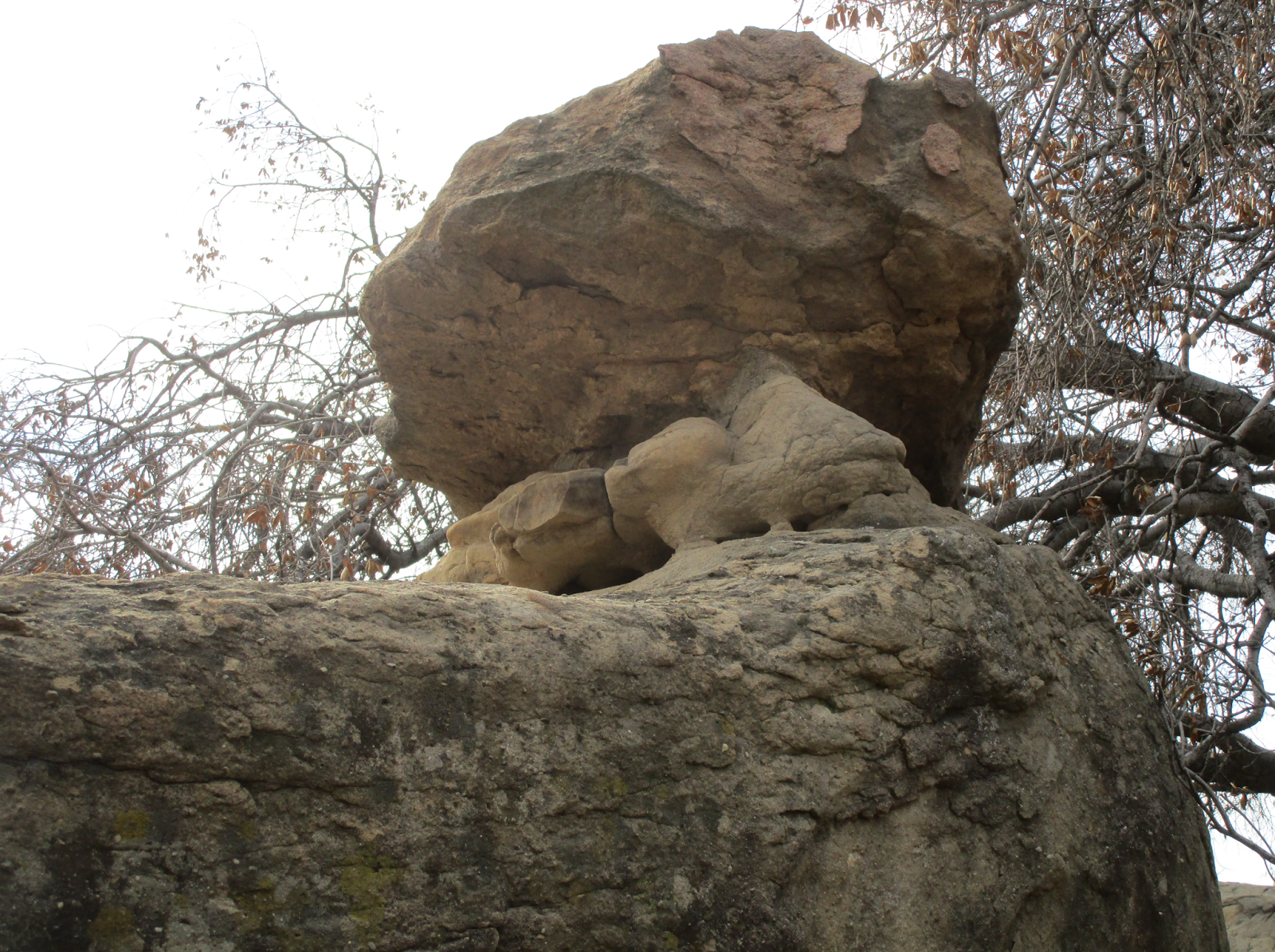
Grove Stack C shows off its duck-shaped body in this modern-day photo.

A closeup of Grove Stack C shows the area where the "head" attaches to the body.

Zooming in further, we get a look at the cement work that helps hold the head in place.

Grove Stack B

Grove Stack B, too, is put together with the help of cement.

This closeup of Grove Stack B provides a look at some of the cement work holding the rock together.

Grove Stack A

As a classic "triple stack," Grove Stack A would have necessarily been slathered in cement.

Cement is used not only to fasten the head of Grove Stack A to the middle section, but also to hold the middle section in place atop the feature's large base rock.

Here's a closer look at the cement holding the head in place on Grove Stack A.

The finished product: Grove Stack A, in "Cole Younger, Gunfighter" (1958)

Joe Iverson's handiwork, Grove Stack A, can be seen in the lower right corner of this shot from the Allied Artists Western "Cole Younger, Gunfighter."

Joe Iverson's "Garden of Stacked Rocks" in 2016

Today the "Garden of Stacked Rocks" stands as a cement and sandstone testament to a man who knew a lot about rocks, earned his living from them — and even on occasion made his own.

Wednesday, December 24, 2014

The Year in Review: Top 10 Iverson Movie Ranch finds of 2014


2014 was a busy year in Iverson Movie Ranch research. As I was looking back over the year's blog posts to help put together a Top 10 list of the most significant finds of the year, I realized it would be difficult to narrow it down to just 10. So in addition to the Top 10 Countdown that follows, you'll find a "Next 10" list at the bottom of this post, highlighting the discoveries that didn't quite make the Top 10.


Here's a countdown of the Top 10 Iverson Movie Ranch finds of 2014:

No. 10: Proof that Elvis Presley filmed on the Iverson Movie Ranch

Promotional still for "Harum Scarum" (1965)

It has been known for some time that Elvis Presley's 1965 Movie "Harum Scarum" was filmed in part on the Iverson Movie Ranch, but I had to put together a few puzzle pieces to prove that the King himself was captured on film at the ranch. The above promotional still played a key role in proving it.

Click here to read the blog post from October all about what Elvis was up to while he was at Iverson.

No. 9: The Forsythe Oak

The Forsythe Oak, located on the former Upper Iverson Movie Ranch

2014 was the Year of the Tree in Iverson research, with the Forsythe Oak being one of three trees to make the Top 10. Named after actor John Forsythe ("Bachelor Father"), the tree was spotted in an episode of the Western anthology series "Zane Grey Theatre" and helped unlock a broader discovery, the Midway Oaks — a small grove of trees that appeared in many productions, with quite a few of the trees still in place on the former Upper Iverson.

Click here to read the blog post from August about the Forsythe Oak.

No. 8: Evidence that Bald Knob was manmade

"The Virginian" (1963) — a bolt found in the rock known as Bald Knob

The secret behind the gravity-defying rock Bald Knob, a frequently filmed feature of the Iverson Gorge, appears to have been inadvertently revealed in an episode of "The Virginian," where a bolt can be seen presumably helping to keep the rock from tipping over.

I did an in-depth examination of Bald Knob in two posts back in August, starting with this one, which examines a number of appearances by Bald Knob, including in an episode of "The Life and Legend of Wyatt Earp" that contains a sequence I call the Battle of Bald Knob. The Bald Knob series continues with this post exposing the bolt and other possible enhancements that were made to the rock feature.

No. 7: The Charles Bronson Hanging Tree

"Bonanza" (1964) — Charles Bronson hanging from the Charles Bronson Hanging Tree

The tree from which Charles Bronson was apparently hanged during his guest appearance on "Bonanza" in 1964, in the episode "The Underdog," was found to still be in place on the former Upper Iverson. I blogged about the tree and the Bronson appearance back in September, and you can read that blog entry by clicking here.

No. 6: Tornado's Mine

"Zorro's Black Whip" (1944) — Tornado's Mine

Fellow film historians and location experts, including a number of readers of this blog, collaborated with me on my personal Iverson Movie Ranch research in 2014 more than ever before, with one example being the discovery of Tornado's Mine by Jerry Condit. Thanks to Jerry I found not only the exact location of the mine, but even some remaining pieces of the old movie set that are still in place.

I detailed the discovery of Tornado's Mine in a blog post in November that you can read by clicking here.

No. 5: Stone buttressing near Garden of the Gods

"Adventures of Captain Marvel" (1941)

Another collaborative effort went into the discovery near Garden of the Gods of the stone buttressing noted above that appeared in the Republic serial "Adventures of Captain Marvel." A sighting by "Spin and Marty" webmaster Kurt Spitzner launched the search, but it was intrepid Iverson explorer Cliff Roberts who found the structure.

You can read a post from November all about the buttressing, its location and its discovery by clicking here.

No. 4: Tom Mix bootholes from 1935

"The Miracle Rider" (1935) — Tom Mix contemplates his bootholes

I blogged in October about the discovery of the Tom Mix bootholes from the Mascot serial "The Miracle Rider" in a rock now known as Tom Mix Rock, which remains in place near the Garden of the Gods. The holes were spotted in the serial by a reader of this blog, Scotty, and I was able to track them down at the location and match them up with the holes as they remain in place today.

You can read my blog post about the bootholes by clicking here.

No. 3: The remains of Freddie Frog

"Range Beyond the Blue" (1947) — Freddie Frog

Freddie Frog was one of those rock formations at Iverson that I thought must just be my imagination — especially after trying in vain for years to find it. When I finally managed, back in February, not only to determine the location where the rock once stood, but also to find the busted-up pieces of what was once Freddie Frog, I realized I wasn't crazy.

I blogged about the Freddie Frog discovery in February, and you can read that post by clicking here.

No. 2: Bear Tree

"The Adventures of Spin and Marty" (1955)

Bear Tree was one of the first big Iverson Movie Ranch finds of 2014, and like many of the year's top discoveries, it was the result of a collaborative effort. "Spin and Marty" expert Kurt Spitzner tipped me off to the possibility that this scene from the Disney series might be filmed at Iverson, and some heads-up work by field operative Cliff Roberts produced the first confirmed contemporary photographs of the tree.

Bear Tree today

The discovery of Bear Tree helped open up a whole new "branch" of Iverson research, as it soon became apparent that in many cases a tree can be just as much help as a rock in telling a story about movie history. Following the discovery of Bear Tree, other secrets have begun to surface about the Oak Flats area, where Bear Tree is located, as well as the Midway Oaks and other tree-filled sections of the former Iverson Ranch.

To read the blog entry from back in March about Bear Tree then and now, please click here.

No. 1 — the Top Iverson Movie Ranch find of 2014: Hobbit House

Hobbit House, hidden among the condos on the former Lower Iverson

The discovery of Hobbit House early in the year helped tie up a number of loose ends about the movie history of the Upper Gorge, on the Lower Iverson. Hobbit House connects many of the dots among the Angry Cardinal, Plaza Rock, the Gorge Cabin and other features, while also revealing just how much history has been lost to the "fill dirt" used in construction of a condo community on the site.

"Stagecoach Express" (1942)

This photo of Hobbit House from 1942 gives some idea of the grandeur of the rock feature when it stood tall — before about three-quarters of it was buried. Click here to read the original blog post from March about the discovery of Hobbit House, including additional movie appearances by the rock feature. A follow-up post, which can be found by clicking here, goes into detail about Angry Cardinal, a larger rock feature of which Hobbit House forms the "top lip."


Here are some noteworthy Iverson Movie Ranch discoveries of 2014 that didn't quite make the Top 10 list — you can click on any entry to see the original blog post about the item; in no particular order:

• The site of the Snakeskin Mine Shack in "Gun Belt"

• Bigfoot Subdues Dracula

• Buster Keaton's "armory" in the towers of Rock Island

• Evolution

• Carey's Cabin on the Upper Iverson

• Lancer Arch, named for "The Lives of a Bengal Lancer"

• A new view of the Sheep Flats adobes, as seen in "The Light of Western Stars" (1940)

• Iverson after the brutal Southern California fires of fall 1970, as seen in "Cade's County"

• Crouching Cat, disguised by fake plaster rock material in "The Life and Legend of Wyatt Earp"

• Saddlehorn Village in widescreen CinemaScope in "Escort West"