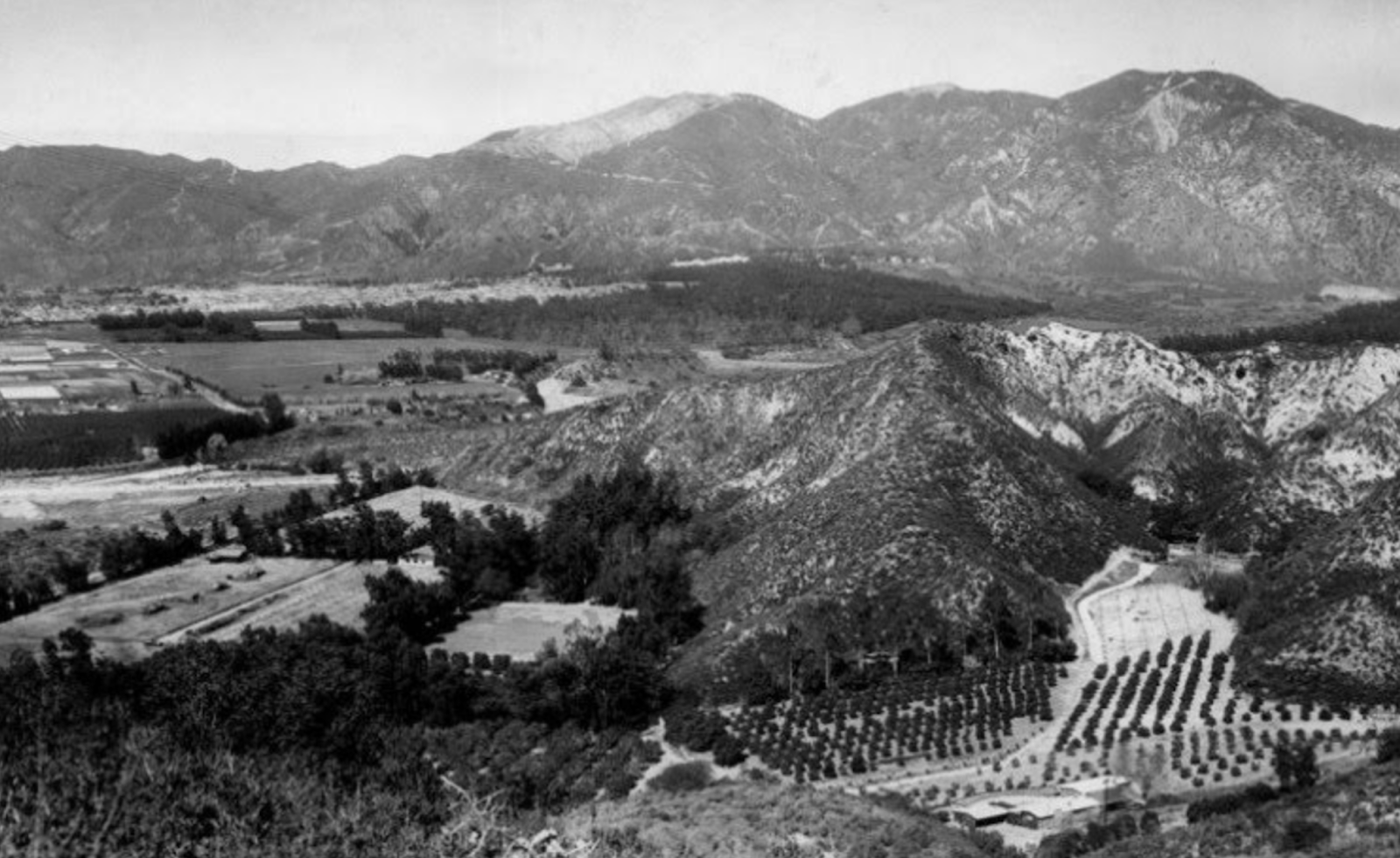
Fritz Burns ranch near San Fernando, 1957: formerly the D.W. Griffith Ranch
I've been fascinated with the so-called "Griffith Ranch" since I first heard about it several years ago. Hollywood pioneer D.W. Griffith reportedly bought the place in 1912 and used it as a filming location for early silent movies.
Plaque commemorating the Griffith Ranch
The ranch itself is long gone, but back in 1959 the former Griffith Ranch became "California Registered Historical Landmark No. 716," and today a plaque and stone monument stand in its memory.
Location of the Griffith Ranch monument in Sylmar
The monument stands at Foothill Boulevard and Vaughn Street in what is now Sylmar, Calif. That part of the Valley is best described today as "industrial," and the Griffith plaque is situated in front of Expo Propane.
The monument is easy to miss, as it blends in with the fence and gets lost among power lines, traffic signals and other "noise." I used to live in Sylmar and drove past the plaque all the time without knowing it was there.
I don't know whether it was the owner of Expo Propane who commissioned a custom fence to complement the shape of the monument, but it's kind of fun knowing that somebody would go to all that trouble.
One thing I always did notice in that area was a gathering of big rigs at the top of the hill in the background. The hilltop is home to a heavily used 18-wheeler parking area, accessed off Lopez Canyon Road.
Big rig parking adjacent to the former D.W. Griffith Ranch
The truck facility is an awesome spectacle in its own right, if you're into that sort of thing. This is what the top of the hill looks like in a Google 3D aerial view — more big rigs in one place than you're likely to see in a week.
Looking north from the big rig parking off Lopez Canyon (Google 3D)
One reason I wanted to point out the big rigs is because they help pinpoint the location of what was once D.W. Griffith's ranch. This is the view looking north from the ridge where many of the trucks are parked.
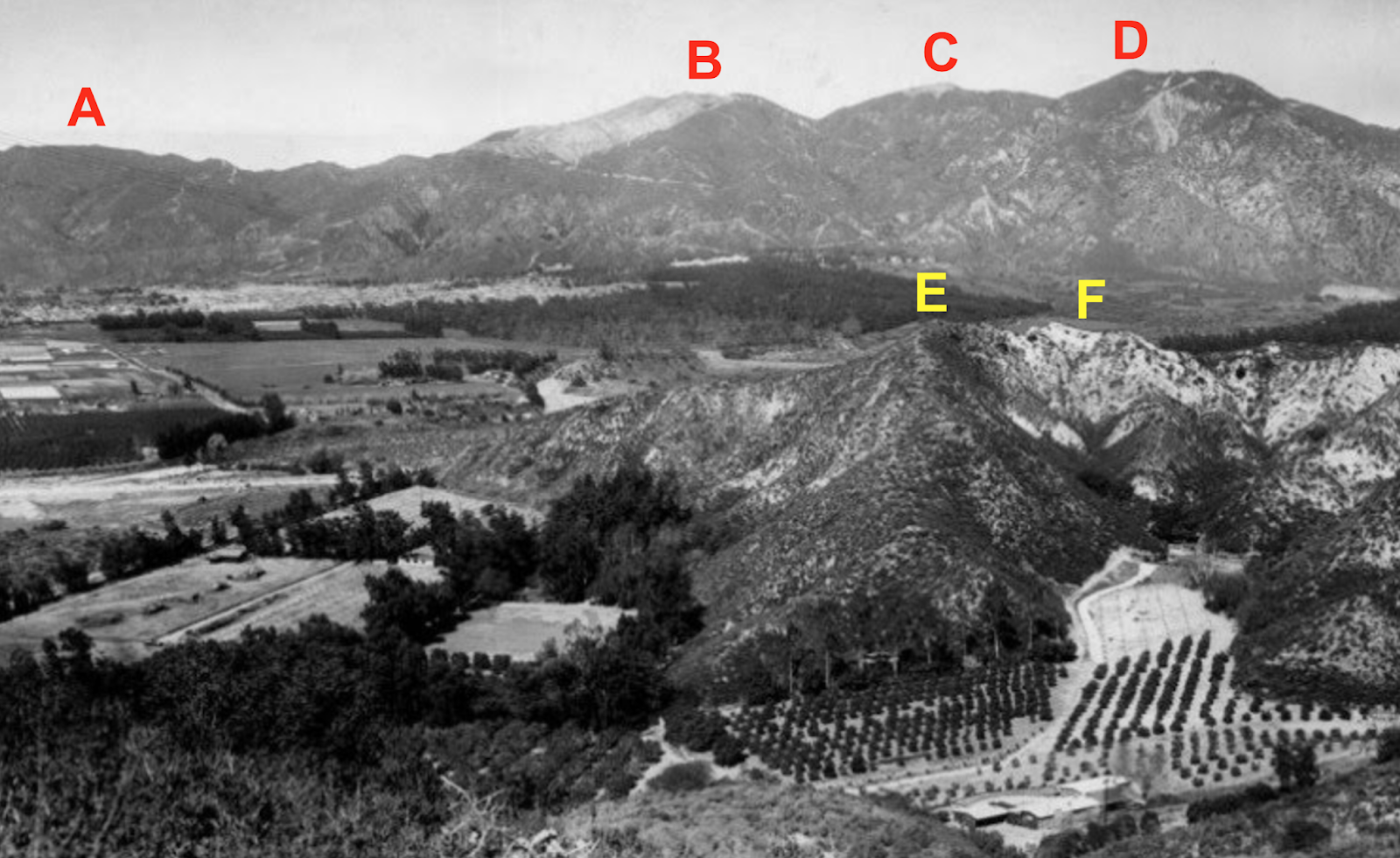
Notice the background hills to the north identified here as "A" through "D," along with two smaller nearby peaks, "E" and "F." I've also noted the ridge where the trucks are parked, along the bottom of the frame.
The same hills in 1957
These same hills can also be found in the 1957 photo of the Fritz Burns ranch — the former D.W. Griffith ranch. This is the same photo seen at the top of this post, with hills "A" through "F" marked.
By examining the 1957 photo along with old aerials of the region, we can determine that the area below the yellow line is roughly where the ranch property — or at least the "ranch" part of the ranch — was located.
When we trace the outline of the former ranch against the modern landscape, we can see that the land has been almost completely built out.
The single largest chunk of the former ranch is occupied today by the sprawling UPS Sylmar facility.
Valley News, Nov. 24, 1961
Fritz Burns, who bought the Griffith property in 1948, is a well-known historical figure too. He founded Panorama City that same year, and soon began bringing Santa and his reindeer to town each year at Christmas.
The real Santa Claus, with Rudolph in Panorama City
Every family has its own Santa lore, but in my family it was explained that the various Santas in all the department stores were "Santa's helpers," but the real Santa was the one who showed up in Panorama City with his reindeer.
It turns out the reindeer came from the former D.W. Griffith ranch, where Burns started a reindeer herd with about 30 animals he reportedly bought from Randolph Hearst.
Hearst Castle — original home of the Fritz Burns reindeer herd
So Santa's original "Panorama City nine" — Dasher, Dancer, Prancer, Vixen, Comet, Cupid, Donner, Blitzen and, of course, Rudolph — previously lived at the magnificent Hearst Castle in San Simeon, Calif.
Various animals continue to graze the grounds of Hearst Castle today as part of the castle's private herd.
Fritz Burns' reindeer get ready for their closeup
The Fritz Burns herd eventually grew to as many as 170 reindeer, with the original pack of nine star performers later joined by Violet, Rudolph's little sister, whose ears were died lavender for the annual event.
Santa's headquarters in Panorama City (ca. 1960s)
Burns continued to help out with Santa's annual visit to Panorama City for almost 30 years, with the tradition finally running out of steam after Burns died in 1979.
Documentation about a World War II P.O.W. camp in San Fernando
A surprising and little-known chapter in the history of the Griffith Ranch took place near the end of World War II. Details are hard to come by, but it appears that a German P.O.W. camp was set up on the ranch.
B.S. detector: Keep plenty of fresh batteries on hand if you do movie location research
I activated my B.S. detector when I started looking into rumors about the P.O.W. camp, and to my surprise, the story held up. The most reliable sources indicate the facility housed more than 300 German prisoners.
The P.O.W. camp remained open for several months in late 1945, and it's been reported that the prisoners were put to work in the citrus fields. I don't know whether D.W. Griffith still owned the property at the time.
The Griffith Ranch plaque: Can we trust it?
The truth is there are good reasons to doubt much of the
"information" that surfaces in connection with the D.W.
Griffith Ranch — and we can start by taking a hard look at that
historical marker.
The highlighted passage says the Griffith Ranch "provided the locale for many Western thrillers, including 'Custer's Last Stand.'" Really? That "Custer's Last Stand" reference appears to me to be pure fiction.
Three strikes — You're out!
No such movie exists — at least not by that title, not associated with D.W. Griffith, and not produced during the brief period when the ranch was used for filming, which appears to be mainly in the early to mid-1910s.
"Custer's Last Stand" (1936): NOT filmed on the Griffith Ranch and not associated with D.W. Griffith
But misinformation breeds misinformation, especially when it's on an official plaque. So now there are researchers around who believe, incorrectly, that the 1936 serial "Custer's Last Stand" was filmed on the Griffith Ranch.
"
Custer's Last Stand" happens to be a terrific Iverson Ranch movie, but it has nothing to do with D.W. Griffith, who directed his last movie in 1931, or the Griffith Ranch, which ceased to be used for filming years earlier.
But that's not even the most ridiculous piece of misinformation on the plaque. The highlighted passage claims the ranch "was the inspiration for the immortal production 'Birth of a Nation.'" I'll say it again: Really?
So Griffith's 1915 epic about slavery, the Civil War, the Reconstruction-era South, the Lincoln assassination and the Ku Klux Klan was somehow "inspired" by his ranch in Sylmar? Sorry, but my B.S. alarm just went off again.
Griffith Ranch plaque dedication, Dec. 13, 1959: Mae Marsh and Blanche Sweet lend a hand
To someone's credit, they rounded up two of Griffith's stars from the silent era for the plaque dedication in 1959. Blanche Sweet played Judith in Griffith's "Judith of Bethulia" and Mae Marsh was in "The Birth of a Nation."
Mae Marsh in "The Birth of a Nation" (1915)
I'm imagining Mae Marsh being consulted when they were writing copy for the plaque, and she tries to point them in the right direction. In my fantasy scenario, someone asks her, "So, they did film 'Birth of a Nation' at the ranch, right?" And she answers, "Well, no, not really. I suppose you could say the movie was 'inspired' by the ranch."
Continuing the fantasy, I'm assuming Mae never thought they would take her quite so literally. I don't know which actress is Mae Marsh, but the one on the left appears horrified upon getting her first look at the text.
A couple of the lesser mistakes on the plaque
I
wasn't going to bother with the kind of issues a career copy editor
might gripe about, but I couldn't resist at least pointing out a couple.
Suffice to say they did a crummy job with that plaque.
David Wark Griffith Middle School in East L.A.
Other monuments to D.W. Griffith can also be found around L.A., including an East L.A. middle school named after him. Activists involved with the heavily Latino school have been trying for years to get its name changed.
Parade group from D.W. Griffith Middle School
Students at the school continue to carry the Griffith name with pride, but a vocal contingent in the community has a hard time looking past the apparent racism running through "The Birth of a Nation."
D.W. Griffith's star on the Hollywood Walk of Fame
Naturally, the legendary filmmaker also has a star on the Hollywood Walk of Fame. Although Griffith has his share of critics, to my knowledge his star has yet to be jackhammered the way other controversial stars have been.
Griffith's landmark Western "The Battle at Elderbush Gulch" (1913): Filmed on the Griffith Ranch?
As with almost any historic filming location, a key to researching
the Griffith Ranch has been trying to figure out which movies filmed
there — and if we're lucky, finding some specific shooting
locations.
"The Battle at Elderbush Gulch": An old dirt road
I'm happy to report that I've had some success, both in confirming specific silent movies filmed on the ranch and in nailing down a few of the shooting sites. As far as
I know, this is the first time this research has been done.
The wagon stops along the road in "The Battle at Elderbush Gulch"
This old dirt road is featured quite a bit in "The Battle at Elderbush Gulch," one of Griffith's most important early films. When a wagon stops on the road, the low angle provides a look at the hills in the background.
Notice the peak identified by the blue arrow.
Google Earth view of the same peak and same background hills in 2019
The peak in the movie matches the hills above the old Griffith Ranch, as seen in this shot from Google Earth. The shot is taken looking east, and it's worth noting that the two shots are taken more than 100 years apart.
Once again we can see a portion of the big rig parking area on a hilltop south of the former Griffith Ranch. We also see another section of the ranch where trucks have taken over, around the big UPS facility.
If we pull back for a wider shot on Google Earth and view the area from a higher angle, we can see more of the lighter-colored ridge to the east. This ridge bordered a back section of the Griffith Ranch.
For the moment we can identify the two main ridges as "A" and "B."
Hidden behind Ridge "A," and tucked in between the two ridges, was a back section of the ranch where a significant portion of the filming took place.
Bird's-eye view of Griffith's hidden filming location (Google Earth)
This overview of the filming area hidden at the back of Griffith's ranch is taken looking northeast. It appears that the bulk of the filming on the ranch took place from 1912 until about 1914.
From this angle we see not only Ridges "A" and "B," but also a third ridge, which we can call Ridge "C." The hidden filming area was surrounded by these three ridges.
Dorothy Bernard, Mary Pickford and Claire McDowell in "The Female of the Species" (1912)
One movie I was able to confirm that filmed in this back section of the ranch is "The Female of the Species," a 1912 adventure about three women trying to survive a trip across the
desert.
The exact filming location is inaccessible today, but we can come fairly close to matching the background features using Google Earth. Notice the sections of the hills marked "W," "X," "Y" and "Z."
Here I've identified those same hills in a current Google Earth photo. In addition to points "W" through "Z," Ridges "A," "B" and "C" can all be found in the shot. (Point "W" is positioned along Ridge "A.")
Screen shot from "The Massacre" (1912) — filmed on the Griffith Ranch
Another example of filming in this back section of the Griffith Ranch can be found in the director's unheralded 1912 Western "The Massacre."
A section of Ridge "C" in modern times, looking similar to how it appears in "The Massacre"
Here again, the exact angle is difficult to replicate today. But using Google Earth we can at least match up a section of Ridge "C" in the background.
"The Battle at Elderbush Gulch": The town of Elderbush Gulch
One of the main goals I had with the Griffith Ranch research was to see whether I could pinpoint the location where D.W. Griffith built the set for the town of Elderbush Gulch in "The Battle at Elderbush Gulch."
D.W. Griffith's Elderbush Gulch in 1913
I suspected that Elderbush Gulch stood on the Griffith Ranch, but it has been reported (in error) to have been built in other parts of the San Fernando Valley — including Chatsworth. As it turns out, I was able to find the location.
"The Massacre" (1912)
It was one of the more challenging locations to pinpoint, requiring first matching up shots from "The Battle at Elderbush Gulch" and the earlier D.W. Griffith movie "The Massacre."
Take a look at the features noted in this shot from "The Massacre" — the round slope and flat ridge, along with the group of three rocks.
The town of Elderbush Gulch in "The Battle at Elderbush Gulch"
All of these features can be seen again behind the town set in "The Battle at Elderbush Gulch," proving that the two movies are filmed in approximately the same location.
"The Massacre": Wider shot reveals hills in the distance
Now look at this wider shot from "The Massacre," which again shows the rounded slope and flat ridge, but also reveals some hills in the distance, well behind those features.
Newton Street in Sylmar, looking northeast (Google Earth)
Here's a contemporary shot taken at the end of Newton Street in Sylmar, near what was once the northern end of the Griffith Ranch. You may already notice similarities between this photo and the shot from "The Massacre."
Here I've labeled some of the background features in the recent shot, "G" through "N."
And here are those same features, "G" through "N," noted in "The Massacre." The matching features pinpoint not only the shooting site for "The Massacre," but also the former location of the town of Elderbush Gulch.
The Elderbush Gulch town site in October 2019
By putting boots on the ground I was able to get a better sense of what Elderbush Gulch looks like today. My photo above, taken this month, provides a reasonable match for the "Massacre" screen shot.
"The Massacre": The same flat ridge and round slope seen behind the town of Elderbush Gulch
The most important background feature for matching up the town site is the flat ridge identified here, which I noted above in screen shots of the town of Elderbush Gulch. At the left end of the flat ridge is its rounded slope.
Here's the same flat ridge, with its rounded slope, in the photo I took on my latest visit to the former Griffith Ranch.
The town of Elderbush Gulch ("The Battle at Elderbush Gulch," 1913)
As noted previously, the same flat ridge and rounded slope can be found in the background behind the town of Elderbush Gulch in Griffith's 1913 Western "The Battle at Elderbush Gulch."
Site of the former Griffith Ranch (Bing aerial view)
Putting the pieces together in this overview of what was once D.W. Griffith's corner of today's Sylmar, we can approximate the location of Elderbush Gulch along with Griffith's secret filming location out back.
"Fighting Blood" (D.W. Griffith, 1911): A familiar dirt road?
More work remains to be done. For example,
I ran across a mystery in the movie "Fighting Blood," where a dirt road appears that looks a lot like the one we talked about above from "The Battle at Elderbush Gulch."
"The Battle at Elderbush Gulch": The same road?
The road in "Elderbush Gulch" is known to be on the Griffith Ranch. If it's the same road seen in "Fighting Blood," then Griffith was associated with the ranch at least by 1911 — a year earlier than is generally accepted.
Any questions?
But it wouldn't be movie location research if we didn't end up with unanswered questions. That's one of the main reasons it's as much fun as it is — it's never done.


-Plan%209%20From%20Outer%20Space-poster.jpg)

-Plan%209%20From%20Outer%20Space-Vampira%20(Maila%20Nurmi)%202-bw.jpg)


-Plan%209%20From%20Outer%20Space-Pioneer%20Cemetery,%20including%20palm%20trees-shot%20with%20alien%20ship%20landing-bw..jpg)

-Plan%209%20From%20Outer%20Space-house%20at%2015129%20Lakeside%20St,%20Sylmar%20(as%20%22old%20man's%20house%22)%201.jpg)
-Plan%209%20From%20Outer%20Space-LC-Tor%20Johnson%20and%20Mona%20McKinnon.jpg)
-Plan%209%20From%20Outer%20Space-Tor%20Johnson%20and%20Mona%20McKinnon-bw.jpg)
-Plan%209%20From%20Outer%20Space-LC-studio,%20fake%20trees-Mona%20McKinnon,%20Tor%20Johnson,%20Carl%20Anthony.jpg)
-The%20Beast%20of%20Yucca%20Flats-DVD%20cover-Tor%20Johnson.jpg)
-Plan%209%20From%20Outer%20Space-Tor%20Johnson's%20house-Bela%20Lugosi%20outside%201-bw.jpg)

-Plan%209%20From%20Outer%20Space-Tor%20Johnson's%20house-Bela%20Lugosi%20outside%203-bw.jpg)
%20Plan%209%20From%20Outer%20Space-Bela%20Lugosi-%20graveyard%20.jpg)
-Plan%209%20From%20Outer%20Space-Tom%20Mason%20as%20the%20Old%20Man.jpg)


-Plan%209%20From%20Outer%20Space-San%20Fernando%20city%20limit%20sign%20on%20Brand%20Blvd;%20buildings%20at%20802%20S%20Brand%20(L);%20808%20S%20Brand;%20and%20812%20S%20Brand-all%20still%20standing-matches%20Google%20SV.jpg)
-Plan%209%20From%20Outer%20Space-San%20Fernando%20city%20limit%20sign%20on%20Brand%20Blvd;%20buildings%20at%20802%20S%20Brand%20(L);%20808%20S%20Brand;%20and%20812%20S%20Brand-all%20still%20standing-matches%20Google%20SV-noted.jpg)
,%20808%20S%20Brand%20and%20812%20S%20Brand%20(R),%20seen%20in%20Plan%209%20From%20Outer%20Space.jpg)
%20and%20808%20S%20Brand,%20seen%20in%20Plan%209%20From%20Outer%20Space.jpg)
-Plan%209%20From%20Outer%20Space-police%20station.jpg)

-Plan%209%20From%20Outer%20Space-police%20car%20on%20dirt%20road.jpg)
-Plan%209%20From%20Outer%20Space-police%20car%20on%20dirt%20road%202.jpg)
-Plan%209%20From%20Outer%20Space-police%20car%20on%20dirt%20road-composite.jpg)
%20to%20hills%20that%20match%20Plan%209%20From%20Outer%20Space-cop%20car%20on%20dirt%20road%20sequence%20.jpg)

-Plan%209%20From%20Outer%20Space-Maclay%20Avenue,%20San%20Fernando-ambulance%20heading%20down%20road.jpg)
-Plan%209%20From%20Outer%20Space-graveyard%20scene.jpg)