Why we love old movie locations — especially the Iverson Movie Ranch

For an introduction to this blog and to the growing interest in historic filming locations such as the Iverson Movie Ranch — the most widely filmed outdoor location in movie and TV history — please read the site's introductory post, found here.
• Your feedback is appreciated — please leave comments on any of the posts.
• To find specific rock features or look up movie titles, TV shows, actors and production people, see the "LABELS" section — the long alphabetical listing on the right side of the page, below.
• To join the MAILING LIST, send me an email at iversonfilmranch@aol.com and let me know you'd like to sign up.
• I've also begun a YouTube channel for Iverson Movie Ranch clips and other movie location videos, which you can get to by clicking here.
• Readers can email the webmaster at iversonfilmranch@aol.com
.

Showing posts with label Eddie Dean. Show all posts

Wednesday, March 11, 2015

The Iverson Movie Ranch Western street, one building at a time ... Part XIV: The Church/Schoolhouse

Eddie Dean stands his ground in "Check Your Guns" (1948)

The Church at the south end of town had one of the shortest lifespans of all of the buildings on the Iverson Movie Ranch Western street, standing for just two years, from 1947-1949.

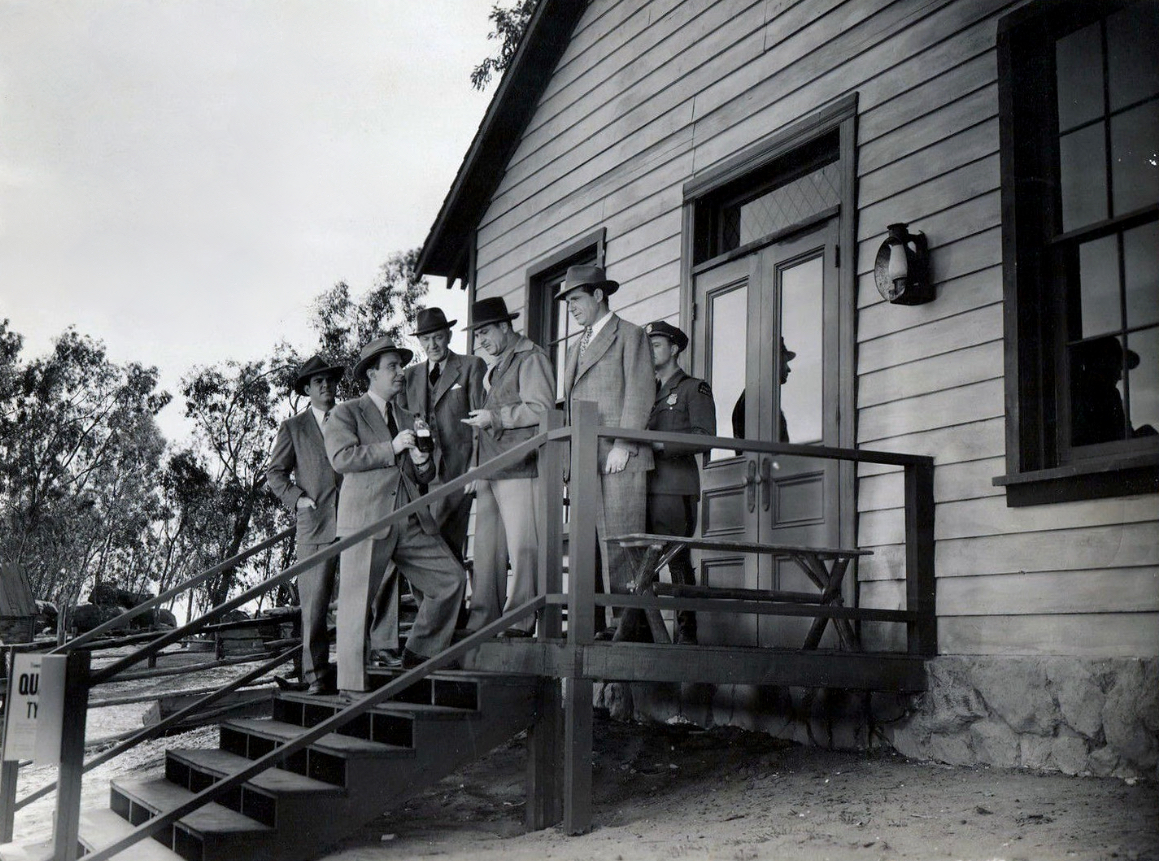
But despite the brevity of its movie career — or maybe because of it — the Church has a lot of cachet among film location aficionados. I've blogged about it in the past, and would like to refer readers to an in-depth entry I did on the Church less than a year ago, which you can find by clicking here.

Promo still for "The Millerson Case" (1947): The Church debuts as a schoolhouse

It's not clear who built the Church, but it was probably originally put up as a set for either the Crime Doctor movie "The Millerson Case" or the Hopalong Cassidy movie "The Marauders."

"The Marauders" (1947): First appearance of the Church as a church

The two movies were released a month apart — "The Millerson Case" on May 29, 1947, followed by "The Marauders" on July 1 — and the Church/Schoolhouse was prominently featured in both productions.

1947 aerial photo, featuring the Western street — including the Church

One development since I last blogged about the Church almost a year ago was that a historic aerial photo of the area surfaced from 1947. Watermarks on the photo say 2011, but it only recently came into circulation.

This version of the 1947 aerial shot highlights the Church. The photo is not as clear as similar shots from other years, but you may be able to make out the Iverson Western street near the center of the frame.

2003 aerial photo: Indian Hills Mobile Home Village

Adapting the location of the Church from 1947 to a more recent aerial photo, we can see that the area where the Church was located is now occupied by the Indian Hills Mobile Home Village.

After a lot of time spent scouring old aerial photos and screen shots, I was able to determine that the tree noted here, in the 1947 aerial, was fake.

"The Marauders": Fake tree

Taking another look at the "Marauders" screen shot, I believe this is the fake tree. When I say "fake," I mean, it may have been a real tree, but it was brought in. It did not grow on that spot — and at some point around when the Church went away, so did the tree.

"Check Your Guns" (1948)

The fake tree appears in other productions as well, and from some angles appears almost perfectly round. Once you know to look for it, it does begin to look like a movie tree.

I believe this is the same fake tree seen in the 1947 aerial and in "The Marauders."

"Bat Masterson" TV series (footage from 1947, aired in 1961)

The fake tree appears to have been in place before the Church went up. It can be seen in the above shot filmed in 1947, just before the Church was built. The footage surfaced several years later in an episode of the TV series "Bat Masterson" titled "The Fatal Garment."

The fake tree is noted in this version of the "Bat Masterson" shot. I discussed other features of this shot in a recent entry on the Rainbow Mine Co. building, which you can see by clicking here.

"Check Your Guns" — west side of the Church

While many of the buildings on the Western street were fake fronts, it appears that the Church was a complete building with four sides and a roof, an observation that is corroborated by the 1947 aerial photo. The above shot from "Check Your Guns" provides a look at the west side of the building.

"The Marauders" — Hoppy & Co. outside the Church

We get another look at the same side of the building in "The Marauders," this time with a nice close view of that movie tree. It looks pretty realistic from this angle — but that's what movie trees are supposed to do.

1947: Schoolhouse turret vs. Church bell tower

I won't go into detail here about how the building transformed from a schoolhouse to a church, and back again. I covered that process in the earlier entry on the Church, which you can see by clicking here.

"The Hawk of Powder River" (Eddie Dean, 1948, from PRC)

Many of the Church's screen appearances were in low-budget B-Westerns from Producers Releasing Corp., which set up shop on the Iverson Western street for much of the 1940s. The Church is frequently seen in the background in PRC's Lash LaRue and Eddie Dean movies from 1947-1949.

This version of the "Hawk of Powder River" screen shot points out two nearby rocks that are closely associated with the Church: Gumdrop and Church Rock.

"Calamity Jane and Sam Bass" (Universal, 1949)

Taking a break from its duties as PRC background material, the Church had a featured role — and a rare color showcase — in "Calamity Jane and Sam Bass" in 1949. The Church appeared as a schoolhouse in the movie — note the rectangular tops on the windows, in contrast to other photos in this post.

"Oklahoma Justice" (1951)

Once the Church was gone, it was much easier to spot Gumdrop at the south end of the street. Church Rock, meanwhile, with its distinctive overhang, continued to hover up above.

Both Church Rock and Gumdrop remain in place today, just across the brick wall that runs along the southern boundary of the Indian Hills Mobile Home Village.


"The Iverson Movie Ranch Western street, one building at a time" is a series of posts on the movie and TV history of each of the major structures making up the Iverson Ranch's town set, which stood from 1944 to 1957 and appeared in hundreds of productions.


To see all of the posts in the series on the Iverson Western street, please click on the following links:

Part I: Casa Grande
Part II: The Livery Stable
Part III: The Saloon
Part IV: The Hotel
Part V: The General Store 
Part VI: The Barn
Part VII: The Sheriff's Office
Part VIII: The North and South Adobes
Part IX: The Lost Dutchman
Part X: The original north end of town
Part XI: The North and South Towers
Part XII: The Harness Maker
Part XIII: Rainbow Mine Co. 
Part XIV: The Church/Schoolhouse  
Part XV: The Corral Rocks Shack
Part XVI: The decline and fall of the Western street

Saturday, April 28, 2012

Chili Pepper, Walnut, End Rock and Corner Rock: Where are they now?

I blogged some time ago about the Chili Pepper, seen above in the PRC B-Western "The Hawk of Powder River" (1948), starring singing cowboy Eddie Dean. At the time I thought it was on the Upper Iverson. It turns out that was wrong — it's on the Lower Iverson, specifically the area around the southeastern end of Sheep Flats, now the site of the Indian Hills Mobile Home Village. When I first examined this shot I didn't recognize Split Rock in the background — directly behind the rider, with the trademark vertical split seen just above the horse and to the right of the rider's head.

The "chili pepper" reference is probably obvious, but just in case, this is what it's based on. In the screen shot at the top, it even appears to have the curved stem — although that's an optical illusion.

Here's another look at Split Rock, in "Davy Crockett, Indian Scout" (1950), that shows the vertical split from a similar angle. Split Rock is a relatively well-documented Iverson feature, now found in the swimming pool area of the mobile home park.

I noticed what I thought might be Chili Pepper again in the above shot from the Iverson spectacle "Rocky Mountain Rangers" — a 1940 entry in Republic's Three Mesquiteers series. That's Chili Pepper toward the left and Walnut at the far right. Chili Pepper doesn't look as much like a chili pepper here as it does in the "Hawk of Powder River" shot at the top, so it still wasn't quite enough to call the mystery "solved." The shape, which I refer to generically as a "wedge rock," is fairly common — at one point I was calling this rock "the Doorstop" in my research.

It's worth pointing out that Split Rock appears again in the background in the above shot — directly above the second of the three horses — but it's easy to miss because the angle downplays the split.

Here's another view of Walnut, from the Republic serial "Secret Service in Darkest Africa" (1943). Until recently, Walnut remained a compelling mystery — I was pretty sure it was gone, but there was a chance it was hidden behind a mobile home. More recently I was able to put that mystery to rest, and, sadly, confirm that Walnut no longer exists. A mobile home now occupies the spot where Walnut previously stood.

Here's a regular walnut, for comparison. I think the textures are pretty similar, and the Iverson rock even has that horizontal "seam."

Chili Pepper turns up again in Monogram's 1942 Range Busters movie "Arizona Stagecoach," above. The context again places it in the mobile home village area — and this shot finally convinced me that the wedge rock seen in this location is in fact Chili Pepper. I don't think Chili Pepper survived the construction of the mobile home park, but I've only recently discovered its general location, and I'll have to snoop around a bit to make sure.

Here's where it gets interesting (if you find this sort of thing interesting). This is another shot from "Rocky Mountain Rangers," and it shows Chili Pepper and Walnut from a different angle — so different that you would never know they're the same rocks unless you're inclined to spend hours poring over this stuff in excruciating detail (guilty!). But that's Chili Pepper in the front and Walnut behind it. The shot looks more or less toward the west, with the expanse of Sheep Flats behind the riders, Cactus Hill in the background (including a nice view of its rockiest section) and the line of trees that bordered Sheep Flats to the west. The flat area is filled with mobile homes now, the line of trees is almost entirely gone and the 118 Freeway has cut through the area, but you can still see Cactus Hill, as in the shot below.

This is what that part of Cactus Hill looks like today, from pretty close to the same angle. Sheep Flats has been the site of the Indian Hills Mobile Home Village since the 1960s, with a few of the homes seen here. The wall visible about halfway up (mainly seen toward the right) separates the mobile home park from the 118 Freeway. At the top of Cactus Hill, toward the left, you may be able to make out the two water tanks that now sit atop the hill and pretty much define it. (Click on the photo to enlarge it for a better look.) Cactus Hill is just north of the 118 Freeway and just west of Topanga Canyon Boulevard.

Continuing to view the Chili Pepper area from different angles, this shot is from the 1941 PRC installment in the Lone Rider series "Lone Rider in Ghost Town," starring George Houston. The shot's a little fuzzy, but it looks down on Chili Pepper from the rocks to the east and a little south, so it aims more or less northwest. That's Chili Pepper at the left — no longer looking anything like a chili pepper — with a tiny portion of Walnut behind it. The rock at the top right, below the tree, is End Rock, which is a familiar feature to Iverson researchers — and which has apparently been preserved as a decoration of sorts in the mobile home village.

Here's End Rock today in its "rock museum" — the centerpiece of a planter out in front of the Indian Hills Mobile Home Village's rec room and pool area (not visible in this photo). I'm not sure what was done to End Rock to make it fit the setting — whether it was tilted, chopped, "cleaned up" or simply replaced — but to my eye it doesn't look much like it did in the movies. For one thing, it seems to have lost the curved top that always characterized it. To be honest, I've never been entirely convinced it's End Rock, but that's what a number of experts have said — and it's in more or less the right spot. At any rate, this is what it looks like now from the southeast, from somewhat the same direction as the "Lone Rider" shot above, albeit from a much lower angle.


This view of End Rock today — or what we call End Rock these days — is from the other side, from the northwest, and I think it shows what the park designers were going for — placing the rock in what is admittedly a picturesque planter setting. That's End Rock (or a reasonable facsimile) near the center of the photo, with part of the mobile home park's rec room visible at the right. A couple of other famous movie rocks can be seen as well: Range Rider Rock, sticking out above the mobile home at the center of the shot, and Corner Rock at the far left. Corner Rock, which was "shaved" to make room for the road, was commonly seen in the movies in tandem with End Rock, usually shot from the other side — from the south — with many a stagecoach, rider and chase group arriving between the two rocks.

A closer view of Corner Rock shows how it was modified to make room for a wider modern road, separated from the mobile homes by a low wall. Toward the bottom of the rock, a chunk of it was chipped away to get it out of the way of the road.

One of countless examples of the standard arrival scene between End Rock, on the left, and Corner Rock, on the right, this one is from the 1947 Eddie Dean movie "Shadow Valley," from PRC. The riders are arriving from the northwest, from Sheep Flats.


A number of the movies featured in this post are exceptional Iverson productions and deserve to be highlighted: "Rocky Mountain Rangers" (1940), "The Lone Rider in Ghost Town" (1941), "Shadow Valley" (1947) and "The Hawk of Powder River" (1948) are all on my list of "Great Iverson Movies." (Note that in this case the term "great" refers to the quality of the rocks and other Iverson features seen in the movies, not necessarily the quality of the acting, direction, script, action sequences, etc. However, typically the camera work in these movies is really good.) Check out the links above to Amazon if you're interested in snagging copies of any of these. Not all of them are available, but I've included a few links to what I think is good stuff. The 2-DVD set with "Hawk of Powder River" and "Stage to Mesa City" — another really strong Iverson movie — is an especially good deal.

Saturday, December 4, 2010

The Iverson Church wasn't originally a church

Update (April 12, 2014): I've done a more recent, updated version of this post, which you can read by clicking here. The older version below remains pretty much as I originally published it, and contains some information that didn't make it into the newer post. But in my opinion, if you had to pick one or the other as the place to start ... I'd go to the newer post. (Again, click here to go to the newer post.)

Film location researcher Bill Sasser tipped me off about a 1947 movie called The Millerson Case, part of a series of Crime Doctor movies from Larry Darmour Productions starring Warner Baxter, originally distributed to theaters by Columbia. The series is usually set in the big city, and so it rarely ventures into rustic Iverson territory. But in this installment the lead character goes on a hunting trip and finds himself in a small country town called Brook Falls — played by Iverson's Western street, sometimes called El Paso Street or Iverson Village.


Among a number of important finds in this movie is probably the first film appearance of what would become the Iverson Church. Tracking the release dates of movies in which the church appears — and there are only a few of them, all released from 1947 to 1949 — I've become convinced that the church was built specifically for The Millerson Case, which came out in May 1947, a couple of months before its next known film appearance — in the Hopalong Cassidy feature The Marauders — and a few months before the church would make the first of what are probably its most commonly seen appearances these days, in a string of PRC-produced B-Westerns starring Eddie Dean and Lash LaRue.


The most surprising twist in the story of the church is that when it was first built, it wasn't a church. It was a schoolhouse. It was subsequently modified to make it look like a church — with arched tops added to the two front windows and a taller turret, complete with arched window, replacing the bell tower, transforming it into a steeple. Above is a slightly askew shot from one of the late 1947 to early 1949 B-Westerns from PRC or its spinoff, Western Adventure, showing the church as a church. The tall rock to the left of the steeple, also visible in the top photo, is known as Church Rock, obviously because of its proximity to the church.


Location expert Tinsley Yarbrough offers what seems to be the most plausible explanation for the transformation of the schoolhouse into a church: It was probably undertaken by United Artists for The Marauders, where the building again plays a major role, this time as a church. Since I first published this post I had a chance to see The Marauders, and I can confirm that the movie is set almost entirely in and around the church. I agree with Tinsley that in all likelihood the producers of that Hopalong Cassidy movie were the ones who transformed the schoolhouse into a church — and it retained that identity for the remainder of its short life.


My original theory was that PRC had something to do with the construction of the church, but PRC was notoriously low-budget, and now that the Crime Doctor and Hoppy movies have surfaced with their more meaningful use of the building, that theory can be put to rest. I find it interesting too that once PRC begins shooting in the area — and the company was there a lot from 1947-1949, with Eddie and Lash — the church is always there, in the background, but it's never brought to the foreground or incorporated into the story.


Here's another shot of the schoolhouse in The Millerson Case, giving a better look at the original turret or bell tower. The schoolhouse plays a central role in the plot of the movie — as headquarters for treating an outbreak of typhoid fever. The building is featured far more in The Millerson Case and The Marauders than in any other movie I've seen.


Here's one more view of the schoolhouse in The Millerson Case, with a portion of Iverson Village also seen. The building on the right can easily be matched with the second photo, after the schoolhouse down at the end of town became the church down at the end of town. Note that horse-drawn carts and more modern vehicles such as the stylish coupe in the top photo coexist in the small country town depicted in The Millerson Case.

Monday, October 4, 2010

Hidden Valley Cabin on the Upper Iverson Movie Ranch


"Prairie Outlaws" (1948)

This screen shot from the old Eddie Dean B-Western "Prairie Outlaws" features a cabin that appeared on the South Rim of the Upper Iverson starting in about 1944. The cabin is usually called "Hidden Valley Cabin," and has been alternately referred to simply as "Stone Cabin."

The distinctive rock towering above the cabin, which helps pinpoint the structure's location, has been called Stone Cabin Rock. In this version of the "Prairie Outlaws" screen shot, Stone Cabin Rock is identified, as is the ubiquitous background feature Oat Mountain — along with Hidden Valley Cabin, or Stone Cabin, in the foreground.

"Cheyenne Takes Over" (1947)

This shot from the Lash LaRue B-Western "Cheyenne Takes Over" gives a good look at the porch of the cabin. The term "Stone Cabin" is a reference to its appearance, not its construction. Being a movie cabin, it would have been built as inexpensively as possible. The outer surface was made to look like stones, but was presumably made up of some kind of facing material — in other words, "movie magic."

Stone Cabin Rock and a portion of the old Upper Iverson in recent times

The cabin is long gone, and this shot of Stone Cabin Rock and its surroundings from a recent visit shows some of the mansions that now occupy much of what used to be the Upper Iverson Movie Ranch. The rock's name, Stone Cabin Rock, commemorates that the distinctive feature clearly marks the spot where the cabin previously stood.

Also visible in these photos, in the distance, is Oat Mountain, and in the recent shot, as noted above, microwave towers and related gear can be seen at top right. (You may want to click on the photo to enlarge it to get a better look.) Back in the Cold War years of the 1950s and 1960s a Nike missile base, part of the national defense system, was situated where the microwave towers now stand. I believe the small rectangular white building visible in the smaller blue box on the left was a part of the missile base.

I've blogged about the Nike base before, in an entry I wrote about the Cold War movie "Panic in Year Zero," which you can read by clicking here. That post includes a shot of the missile base that snuck into the background of the movie, which was released in 1962 at the peak of the nuclear scare.

"Prairie Outlaws," made by Producers Releasing Corp., has an interesting backstory. It was an edited version of a movie the company made two years earlier, "Wild West," with additional footage shot for the new movie even though the new movie wound up being shorter than the original.

The earlier production, "Wild West," was out of character for a notoriously cheap B-movie studio such as PRC: It was in color, for one thing, and at 73 minutes, longer than typical B-movie fare. It also had two cowboy stars instead of the usual one, featuring both Eddie Dean and Lash LaRue. And it had a dual love story AND a story about a heroic young boy.


When PRC reinvented the movie two years later as "Prairie Outlaws," the company was clearly targeting the Saturday matinee market, especially young boys. Much of the "mushy stuff" was cut out, but the plot line about the heroic kid was left in. Even with the movie shortened now to about 56 minutes, a batch of new footage was added — mostly action — at the opening of the movie. The number of songs was cut back, and this time the movie was released in black and white.

The outdoor action in the original movie, "Wild West," was shot entirely at Corriganville. But in the two years that had passed before "Prairie Outlaws" was pieced together, PRC had shifted its focus to Iverson, and that's where the new footage was filmed — including a big shootout at Hidden Valley Cabin.

"Prairie Outlaws" (1948): Hidden Valley Cabin, on the Upper Iverson

Many film historians believe Iverson's Gorge Cabin, which first appeared in 1936 and was located on the Lower Iverson, was taken apart and reassembled on the Upper Iverson, becoming what we now know as Hidden Valley Cabin. The move would have taken place in about 1944, as that's when the Gorge Cabin disappears from film footage of the Gorge.

"Adventures of Red Ryder" (1940): Gorge Cabin, on the Lower Iverson

The above shot shows the earlier cabin, located in the Iverson Gorge on the Lower Iverson. I have yet to find a "smoking gun" image of one or the other cabin that confirms whether they're the same cabin, but so far, I would have to say I still need some convincing. Even so, I have to admit the two cabins are pretty similar.