Why we love old movie locations — especially the Iverson Movie Ranch

For an introduction to this blog and to the growing interest in historic filming locations such as the Iverson Movie Ranch — the most widely filmed outdoor location in movie and TV history — please read the site's introductory post, found here.
• Your feedback is appreciated — please leave comments on any of the posts.
• To find specific rock features or look up movie titles, TV shows, actors and production people, see the "LABELS" section — the long alphabetical listing on the right side of the page, below.
• To join the MAILING LIST, send me an email at iversonfilmranch@aol.com and let me know you'd like to sign up.
• I've also begun a YouTube channel for Iverson Movie Ranch clips and other movie location videos, which you can get to by clicking here.
• Readers can email the webmaster at iversonfilmranch@aol.com
.

Showing posts with label Platypus Shack. Show all posts

Monday, October 6, 2014

Nailing down the location of the Snakeskin Mine Shack in the George Montgomery movie "Gun Belt"


The 1953 Western "Gun Belt" shot virtually all of its outdoor action on the Iverson Movie Ranch. The scene depicted in the above promotional still for the movie, featuring George Montgomery on the left with a young Tab Hunter, was filmed in Central Garden of the Gods.

"Gun Belt" (1953) — Snakeskin Mine Shack

The movie contains a few Iverson rarities, notably this small cabin located in the Rooster Foot area near the northern edge of Cactus Hill. The cabin is presumed to be a facade, as this view of it is the only one that appears in the movie. But it's noteworthy nonetheless, because it was extremely rare to find any manmade structures on Cactus Hill during the filming era.

I call the structure the Snakeskin Mine Shack because of this sign that appears early in the film, pointing the way to what turns out to be the shack.

Cactus Hill, on the former Iverson Movie Ranch

Cactus Hill, seen from the north in this Bing bird's-eye view, is a large hill that separated the Upper Iverson and Lower Iverson. Today it is home to a couple of water tanks, and construction of residential estates has recently begun at its eastern end. This shot and the additional bird's-eye views that follow can be seen in greater detail by clicking on them to enlarge them.

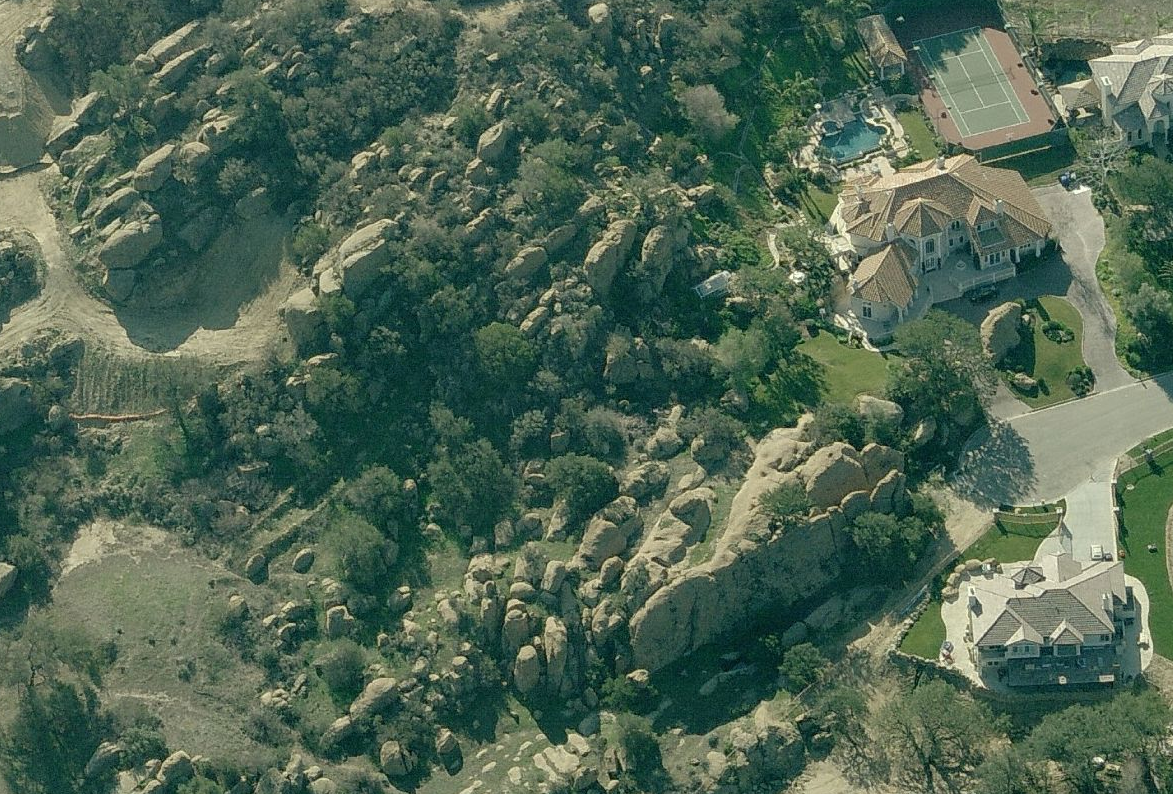
Much of the northern edge of Cactus Hill is strewn with heavily filmed movie rocks, appearing in this shot as a diagonal band of rocks stretching from bottom left to top right. Most of the former Upper Iverson has been taken over by large residential estates, a few of which can be seen in the bottom half of the shot. It should be noted that, because these shots look at Cactus Hill from the north, the shot is "upside-down," with the former Upper Iverson appearing at the bottom of the frame.

Of particular interest for examining the shack location in "Gun Belt" is this zoomed-in portion of Cactus Hill, again seen in a Bing bird's-eye view. This shot offers a better look at a large rock formation I call Rooster Foot, near the bottom of the frame.

This is the large rock feature I'm talking about when I refer to Rooster Foot.

Zooming in further on the Rooster Foot area we can pinpoint the location of the Snakeskin Mine Shack.

This shot points out the rocky background area that appears behind the mine shack in the movie shot.

Here's another look at the shack in "Gun Belt." Notice the rocks in the background.

This is what those rocks look like today. The shot was taken by photographer and film location researcher Jerry Condit, who discovered the location of the shack.

"Gun Belt" (1953) — Platypus Shack

"Gun Belt" contains a few other interesting Iverson structures as well, including an upgraded version of the Platypus Shack, seen in this screen shot. As modest as this building may appear, an earlier version of the Platypus Shack wasn't nearly as fancy. It was also located in a slightly different spot, sitting just a bit farther away from the rock Platypus, seen at the left of the shot. I've blogged previously about the Platypus Shack, and you can read that entry by clicking here.

"Gun Belt" lobby card showing action on the Upper Iverson

You can click on the Amazon link below to check out a four-movie DVD set that includes "Gun Belt" along with another nice Iverson movie, "The Lone Gun," from 1954. The set also contains two non-Iverson movies, "Gunsight Ridge" and "Ride Out for Revenge."

Tuesday, January 10, 2012

"Platypus Shack" and "Platypus Farm" — an oddity of the old Upper Iverson

This is a screen shot from the 1949 Paramount Western "El Paso," starring John Payne, Sterling Hayden, Gail Russell and Gabby Hayes, directed by Lewis R. Foster with cinematography by frequent Iverson shooter Ellis W. Carter. It shows a farm set I call "Platypus Farm," after the rock near the left of the shot, Platypus. (I call the rock in the center of the shot "Fish Head.") The farm set was probably built specifically for "El Paso," as the full set has not been spotted anywhere else. It has been suggested that the main house, on the right, may have been a false front or a mobile structure. Either way, by the end of the movie, it's gone.


The main building may have been destroyed in the production, as the house burns to the ground later in the movie. The above shot has the survivors burying two poor souls killed in an attack on the farm, and the charred remains of the house can be seen in the background, behind the rider on the right. It seems unlikely that they would have gone to the lengths of actually destroying a building to get the shot, but who knows? This shot seems to support the theory that the house was just a front and was perhaps designed to ultimately be destroyed on camera. Either way, at least part of the set — the shack, partially visible at the left of both of the above shots — survived and went on to appear in a number of productions, including episodes of the "Lone Ranger" TV show.


Here's "Platypus Shack" again, along with the rock Platypus, in the "Lone Ranger" episode "Barnaby Boggs, Esquire," which premiered Feb. 2, 1950, during the TV show's first season. The shot ran properly oriented in this episode, but in a different episode, the exact same footage was used — but flipped horizontally, as seen below:

This is how the shot ran in the "Man of the House" episode, which aired one week earlier, on Jan. 26, 1950. It may seem like shoddy production to run back-to-back episodes containing such an obvious shortcut — presumably just a way to save money by using the same footage twice. But that sort of thing was common in B-Westerns and carried over into early TV, where the producers were convinced, and probably rightly so, that no one was looking at this stuff very closely. Thankfully, we have DVDs and other digital media now and can really tear it down. (Click here for some additional posts about flipping shots.)


One more "Lone Ranger" shot, back to the "Barnaby Boggs, Esquire" episode, where Platypus Shack ran in its correct orientation. This shot offers a better look at the shack, with the Lone Ranger, played by Clayton Moore, circling around back. The shack stood from about 1949-1952 and appeared in a number of movies, including the Whip Wilson B-Westerns "Gunslingers" and "Silver Raiders" for Monogram (both 1950) and the Rocky Lane B-Western "Marshal of Cedar Rock" for Republic (released in early 1953 but filmed in 1952).

"Gun Belt" (1953) — "fancy" version of Platypus Shack

A fancier version of the shack, located a bit closer to the rock Platypus, can be seen in the 1953 movie "Gun Belt," which is discussed in a blog post here.


Here's another look at Platypus — the rock, minus the shack — in the slightly upscale Columbia B-Western "The Gun That Won the West" (1955).

And here's a real Platypus. Maybe you can see the resemblance in the bill, which gives the rock its name. I'll take the blame for it.

The 1957 George Montgomery Western "Gun Duel in Durango" provided this unusual shot of Fish Head, Platypus' neighbor to the east, with a couple of sentries on it — including one sitting on the rock's fish lips. As a footnote about Platypus and Fish Head, I believe both of these distinctive and heavily filmed rocks have survived, although I've never seen them in person. If they do still exist, they're "living" in someone's back yard on the former Upper Iverson Movie Ranch.