Why we love old movie locations — especially the Iverson Movie Ranch

For an introduction to this blog and to the growing interest in historic filming locations such as the Iverson Movie Ranch — the most widely filmed outdoor location in movie and TV history — please read the site's introductory post, found here.
• Your feedback is appreciated — please leave comments on any of the posts.
• To find specific rock features or look up movie titles, TV shows, actors and production people, see the "LABELS" section — the long alphabetical listing on the right side of the page, below.
• To join the MAILING LIST, send me an email at iversonfilmranch@aol.com and let me know you'd like to sign up.
• I've also begun a YouTube channel for Iverson Movie Ranch clips and other movie location videos, which you can get to by clicking here.
• Readers can email the webmaster at iversonfilmranch@aol.com
.

Showing posts with label Hangdog. Show all posts

Friday, January 29, 2016

How Roy Rogers solved the mystery of the Japanese sniper in John Wayne's "Fighting Seabees"

"The Fighting Seabees" (1944)

One photo I didn't put up when I blogged last summer about the John Wayne World War II movie "The Fighting Seabees" was this shot of a Japanese soldier using a diagonal crack in a rock as a sniper's perch.

"The Roy Rogers Show" (1952)

I didn't post the shot because I couldn't figure out where it was taken. But with some help from Roy Rogers, the mystery is now solved. Roy peers through the same crack in an early episode of "The Roy Rogers Show" called "The Train Robbery," filmed in 1951 and first aired Feb. 3, 1952.

Sniper's crack, on a recent visit to the Lower Iverson

Thanks to the context in the "Roy Rogers" episode, I was able to determine that the crack is part of a heavily filmed movie rock that I call Hangdog. The tricky thing about both the "Fighting Seabees" shot and the "Roy Rogers" shot above is that they feature the rarely seen "back side" of the rock.

"The Train Robbery" ("The Roy Rogers Show")

This is what the sniper's crack area looks like from the much more heavily filmed "front side" of the rock — its west side. In the "Roy Rogers" episode, Roy climbs on top of Hangdog to get a drop on the bad guys.

A portion of the crack is visible near the legs of the two bad guys. The section of Hangdog shown in this shot is just a fraction of the massive rock feature.

The rock, including the sniper's crack, remains intact today on the Lower Iverson Ranch. This recent photo of Hangdog shows the same section of the rock seen in the "Roy Rogers" shot.

The sniper's crack area is located at the north end of the rock.

This is what the rest of Hangdog looks like in modern times. The photo shows the west-facing side of the rock.

Hangdog today is on private property, and access is difficult. The rock is positioned near the southeast corner of the Cal West Townhomes, separated from the condo community by a brick wall.

Friday, April 17, 2015

Rocks that look like elephants

Elephant Rock, on the Lower Iverson

It's been a while since I rounded up the herd of elephants, elephant parts and other pachydermalia found on the site of the former Iverson Movie Ranch. This beauty is located in the Grove, on the former Lower Iverson.

Elephant and Monkey

A wider shot reveals that the Elephant has what looks like an oversized monkeyhead on its back.

Elephant's Trunk

Should you ever sojourn deep into Garden of the Gods, you might run across this oddity, which I think bears a striking resemblance to an Elephant's Trunk.

Woolly Mammoth — aka Vultura's Trail Rock

The most high-profile pachyderm-related rock feature at Iverson would have to be Woolly Mammoth, which is more properly known as Vultura's Trail Rock.

Woolly mammoth (artist's rendering)

The relationship between the prehistoric woolly mammoth and the contemporary elephant — particularly the Asian elephant — is well-established. As for the relationship between the rock I call Woolly Mammoth and the prehistoric creature ... you be the judge. The original woolly mammoth would probably sneer at the rock version's puny hump ... but the fact that they both HAVE humps in the same place strikes me as noteworthy.

"Heroes" (NBC TV series, 2008) — Woolly Mammoth with a rock painting

Woolly Mammoth, or Vultura's Trail Rock, has had countless appearances in movies and TV shows. It's usually seen from another angle — where it looks nothing like a woolly mammoth — but when NBC landed at Iverson in 2008 for the TV show "Heroes," the show captured what I think is the essence of the rock.

Woolly Mammoth just after the "Heroes" shoot (2008)

Shortly after the "Heroes" production team pulled out of Iverson in late summer 2008, Woolly Mammoth still bore what appeared to be a temporary "scar" from the production. Like other rocks in the area, Woolly Mammoth served as a storyboard on the TV show, providing a backdrop for rock paintings depicting the future. It appeared that a little bit of that paint was overlooked during the cleanup.

In the "Heroes" screen shot we can make out the exact spot on Woolly Mammoth where the small triangular patch of white paint originated.

Woolly Mammoth in 2015: The same patch of white paint remains

I assumed at the time that the paint was water soluble and would soon wash away. However, going on seven years later, that white spot remains visible on the rock today. My hunch is still that it's just a spot they missed when they were cleaning up, but I'm amazed that it has lasted this long.

Woolly Mammoth looks less mammoth-like from the other side, but this shot, looking toward the east, provides some context. That's Topanga Canyon Boulevard in the background, with the ridgetop homes of Porter Ranch and a small section of the 118 Freeway visible at top left.

"Rocky Mountain Rangers" (1940): Hangdog, foreground, with Woolly Mammoth

By far the most common angle depicting Woolly Mammoth in the movies is this one, as seen in the Three Mesquiteers B-Western "Rocky Mountain Rangers," an Iverson masterpiece from Republic.

Woolly Mammoth — which has been described as resembling a saddlehorn from this angle — almost always takes a back seat to its higher-profile neighbor Hangdog. Click here to read more about the enigmatic Hangdog.

Woolly Mammoth in 2008, with nearby ruins

Up until a few years ago, Woolly Mammoth could be seen with some ruins nearby. You can read more about these mysterious ruins in this earlier post.

"Tarzan the Ape Man" (1932)

It's worth noting that at one time real elephants roamed the Iverson Movie Ranch. In the final sequence from "Tarzan the Ape Man," shown above, Jane and others rode a live elephant through the Iverson Gorge.

Elephant rock on the Island of Heimaey in Iceland

Iverson doesn't have a monopoly on rocks that look like elephants. In fact, it turns out that elephants are a relatively widespread theme in the "rocks that look like other stuff" universe. Here are a few examples ...

Sardinia, Italy 

The locals report that this elephant rock on Sardinia, the second-largest island in the Mediterranean, was shaped by wind, and I have no reason to disagree.

New Zealand 

I like the mossy-looking foliage effect on this one.

Saudi Arabia 

Here's another variation on the fat-trunked elephant theme — this one is starting to grow on me.

City of Rocks National Reserve, Idaho 

I don't think this rock looks particularly elephant-like, but I had to include it for the obvious reason: It has a sign. Does it reflect poorly on me that this picture makes me want to block the gate?

Point Reyes, Calif. 

I've driven past this thing countless times without ever noticing its elephantine qualities. Thank you for the reality check, Internet!

Washoe County, Nevada 

For some reason I find myself feeling sorry for this one.

Prince Edward Island, Canada

No reason to feel sorry for this character, with plenty of water and fresh air to be found ... although living in a world with a skewed horizon line might get old after a while.


Island of Heimaey, Iceland 

This is the second photo I'm including of the elephant rock in Iceland. This thing looks great from any angle.

Old Hartlepool, England 

The elephant rock in Old Hartlepool was washed away in a storm in 1891, but at least it was around long enough to be immortalized in an old colorized postcard.


This post marks the launch of "Rocks that look like ..." — an occasional series that, needless to say, focuses on rocks that look like other stuff. I anticipate that the series will maintain a connection to the Iverson Movie Ranch in Chatsworth, Calif., where plenty of rocks can be found that look like other stuff.

Sunday, January 4, 2015

Title sequence to the movie "Wells Fargo": Check out the credits "painted" on the giant sandstone boulders of the Iverson Movie Ranch (Here's the video)


Here's a video clip of the title sequence for the 1937 Paramount Western "Wells Fargo," starring Joel McCrea. The opening is kind of fun from an Iverson Movie Ranch standpoint — I think it's the only movie I've seen in which the credits are made to appear as though they're painted on rocks. And the rocks are all at Iverson, mainly in the heavily filmed area around Devil's Pass on the Lower Iverson.

"Wells Fargo" (1937) — opening credits "painted" on rocks

This is an example of what the credits look like. While they're meant to appear as though they're painted on the rocks, I don't think anyone is trying to pass them off as in fact being painted on. The effect appears to be the result of adding just the right amount of rippling and transparency to the type face,

This set of credits appears against the eastern side of Hangdog, shot from above Devil's Pass.

In this shot from "Wells Fargo," which appears between the two sets of credits shown above, the stage is traveling west through Devil's Pass, also known as Vultura's Pass. This was the first shot that I was able to positively ID — I recognized part of Bill Rock here, along with a corner of Hangdog.

"Buffalo Bill Rides Again" (1947)

Here's a shot from a different movie, taken from a similar angle. In this shot from the Richard Arlen-Jennifer Holt Western "Buffalo Bill Rides Again," the riders are entering Devil's Pass from the west and are about to head east through the pass. Bill Rock is the feature that definitively links the two shots.

This version of the "Buffalo Bill Rides Again" shot has the main features identified.

Back to "Wells Fargo," and the same features appearing in "Buffalo Bill Rides Again" are highlighted. I've blogged previously about all these features, and you can find them in the long index at the right of the page. For views of the complex rock feature Hangdog from a number of interesting angles, please click here.

You may have already noticed the "creases" that distinguish Bill Rock in both movies, forming a triangular pattern on the rock. You can see additional angles on Bill Rock in this earlier blog item.

This set of credits appears against the western side of Hangdog, and I was able to get a positive ID even though I had to compare shots of the rock from somewhat different angles.

This is what that same side of Hangdog looks like in recent times.

In this shot I've noted approximately where the credits appear in the "Wells Fargo" shot.

Here's a closer view of Hangdog, zeroing in on the area featured in the "Wells Fargo" shot.

Note the two distinctive rock areas, designated "A" and "B."

Here are the same areas as they appear in the credit shot from "Wells Fargo."


Director Frank Lloyd, who also produced "Wells Fargo," gets his own distinctive credit near the end of the title sequence. I have not been able to pinpoint this rock, but I have a feeling it's also somewhere around Devil's Pass.

Friday, May 17, 2013

Hangin' around Hangdog: Great Iverson Movie Ranch scene found in the 1941 Republic serial "Dick Tracy vs. Crime, Inc."

The 1941 production "Dick Tracy vs. Crime, Inc.," starring Ralph Byrd, is considered by many fans to be among the best serials ever made. It was the fourth and last of Republic's four Dick Tracy serials — a series that also included "Dick Tracy" (1937), "Dick Tracy Returns" (1938) and "Dick Tracy's G-Men" (1939). The last three installments all included sequences shot at Iverson.

I recently got my first look at "Dick Tracy vs. Crime, Inc." and ran across a particularly compelling Iverson sequence — including the above view of a dynamic rock I call Hangdog. The rock was at the center of a big shootout sequence, with one guy picking people off from on top of the rock and a bunch of other guys shooting at him from behind cars, as seen above. The shot really shows the scale of the rock, with a normal-sized man positioned atop Hangdog and dwarfed by the rock.

Hangdog is still intact, and looks like this today. Other views of the rock give a better idea of why it's called Hangdog. Click here to see a previous blog entry featuring additional shots of Hangdog.

 Stunt jump off Hangdog, Part 1

Stunt jump off Hangdog, Part 2

Stunt jump off Hangdog, Part 3

Stunt jump off Hangdog, Part 4

Included in the sequence is the above stunt jump off Hangdog — off a rock that looks to me like a shoulder — into the covered bed of a truck.

Here's what that same "shoulder" of Hangdog looks like today.

Scene from "Spy Smasher" (1942)

In a mildly amusing example of cross-promotion, the above shot from the 1942 Republic serial "Spy Smasher" includes a plug for "Dick Tracy vs. Crime, Inc." in the form of a set of posters on a gate.

Here's another shot of Hangdog in recent times, which I think shows the rock's two main "faces" — I tend to see it as a lion on the left and a Scooby-Doo-type dog on the right. Or another lion.

Ruh-roh! (Catch phrase often attributed to Scooby-Doo, 
above, but in fact originated by Astro on "The Jetsons")

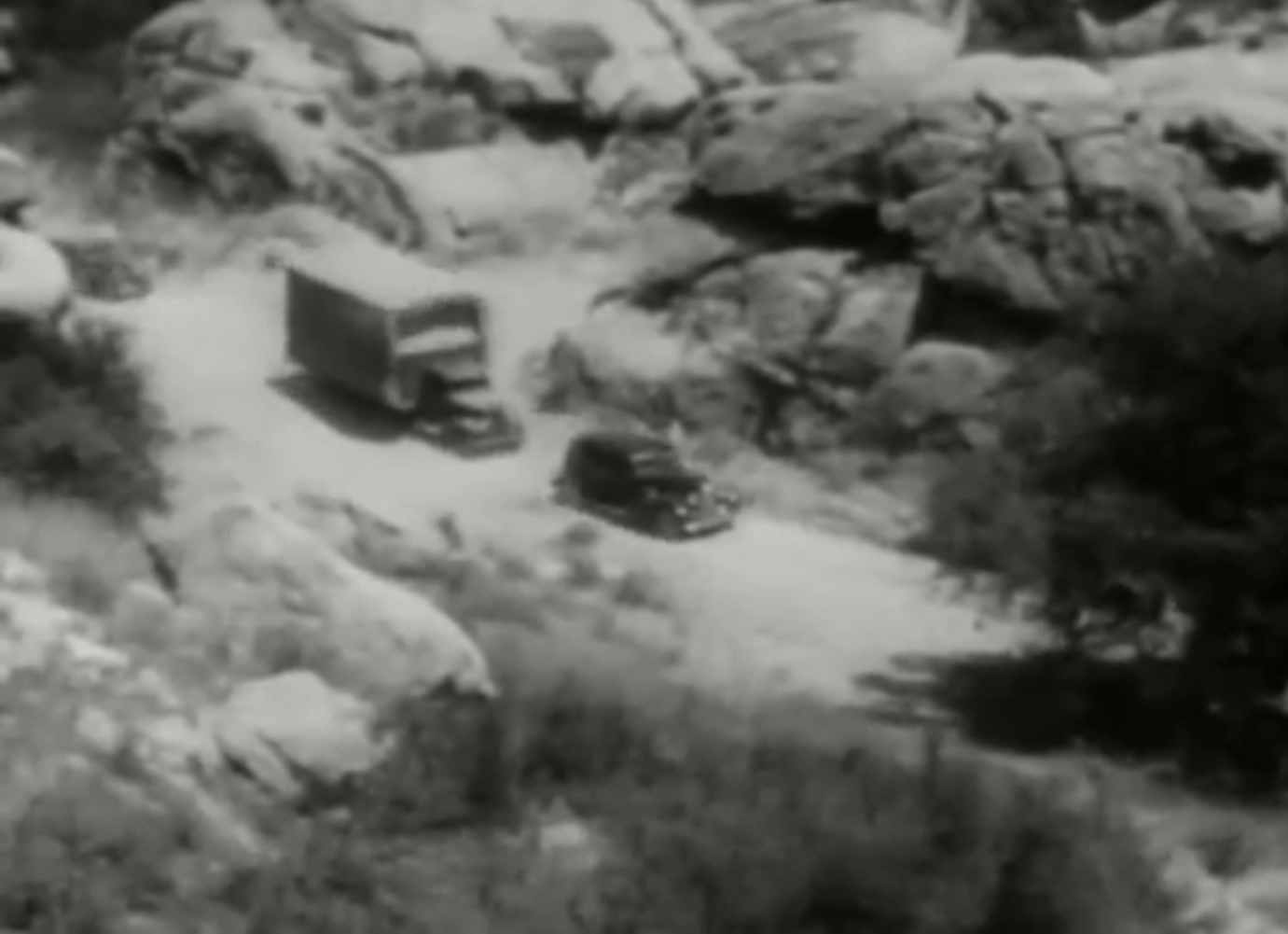
The thing that really elevates the "Dick Tracy vs. Crime, Inc." shootout sequence, in my opinion, is its bird's-eye views, including the above shot of a frequently filmed area known as Devil's Pass or Vultura's Pass. That's Hangdog again at top right, above the car, although the angle makes it hard to recognize. The pass itself starts to the right of the truck and continues east, behind Hangdog.

Vultura's Palace, in "Perils of Nyoka" (1942)

The same site turns up again the following year as the location of Vultura's Palace in the seminal Republic serial "Perils of Nyoka." That's a portion of Hangdog — including the shoulder, again — at the right in the above shot. You may notice the similarity between the rock directly above the palace entrance (at top center in the above shot) and the one seen in the "two-faced" shot of Hangdog a few shots up (above the Scooby-Doo cartoon), in the top-left corner. That's because it's the same rock in both shots. For more about this location, click here.

Another bird's-eye view from the "Dick Tracy vs. Crime, Inc." sequence, this one shows the guy posted atop Hangdog in the foreground, with an unusual angle on Bill Rock, the large rock at left center, near the car. The road where the vehicles are parked, which would pass by the front of Vultura's Palace the following year in "Perils of Nyoka," is sometimes called Vultura's Trail. Also visible here, in the background — and not in much detail — are the Devil's Doorway Cluster and Devil's Doorway Wall, in the top-left corner. The low, horizontal rock all the way in the corner is Devil's Doorway Wall.

This shot shows the same general area from a lower angle, with a portion of Bill Rock again seen at the left, the cars parked along Vultura's Trail, and Cactus Hill in the background. The flat area below Cactus Hill is where much of the Cal West Townhomes development now stands.

Reggie Lanning, at far right, operating the camera 
for the 1930 movie "The Big House"

The cinematographer on "Dick Tracy vs. Crime, Inc." was the great Reggie Lanning, a Republic stalwart who was responsible for some of the best camera work at Iverson from the late 1930s through the 1940s — not the least being the serials "Zorro's Fighting Legion" (1939), "Jungle Girl" (1941) and "Perils of Nyoka" (1942). He also did some nice work at Iverson for the Roy Rogers movies "Cowboy and the Senorita" (1944) and "Song of Arizona" (1946). For more about Lanning's incredible track record at Iverson, please read this blog entry. And please click here for more about the forgotten legacy of the great cinematographers of the B-movie era.

In the above promo still for the 1930 movie "The Big House," Lanning — who was uncredited on the production — works alongside cinematographer Harold Wenstrom shooting the film's star, Chester Morris. It's a rare glimpse of Lanning at work.


If you're interested in getting your own copy of "Dick Tracy vs. Crime, Inc." on DVD, you should be able to buy it off Amazon by clicking on the image above.