Why we love old movie locations — especially the Iverson Movie Ranch

For an introduction to this blog and to the growing interest in historic filming locations such as the Iverson Movie Ranch — the most widely filmed outdoor location in movie and TV history — please read the site's introductory post, found here.
• Your feedback is appreciated — please leave comments on any of the posts.
• To find specific rock features or look up movie titles, TV shows, actors and production people, see the "LABELS" section — the long alphabetical listing on the right side of the page, below.
• To join the MAILING LIST, send me an email at iversonfilmranch@aol.com and let me know you'd like to sign up.
• I've also begun a YouTube channel for Iverson Movie Ranch clips and other movie location videos, which you can get to by clicking here.
• Readers can email the webmaster at iversonfilmranch@aol.com
.

Monday, November 10, 2014

Shazam! Historic stone buttressing found in Garden of the Gods

An exciting new discovery was made in the past week in the park area preserved as the Garden of the Gods in Chatsworth, Calif. The site is part of the former Iverson Movie Ranch, and film historians have located the stone buttressing for an old movie road. The road and buttressing were seen in a handful of movies and TV shows, including an appearance in the 1941 Republic serial "Adventures of Captain Marvel."

"Adventures of Captain Marvel" (1941)

This shot from Chapter 12 of the serial shows the buttressing along the bottom of the photo. I became aware of the buttressing thanks to screen shots from Kurt Spitzner, who runs the wildly informative Spin and Marty site cinchset.com — a site I can enthusiastically recommend to anyone who has an interest in filming locations. This is the definitive screen shot of the buttressing in "Captain Marvel," and also features distinctive background rocks.

The tall rock in the top left corner pinponts the shot as Garden of the Gods, and with that I figured the buttressing was as good as found. But as tends to be the case at Iverson, insights don't always come easy. I wound up making a series of expeditions deep into Garden of the Gods in search of the elusive buttressing, coming up empty-handed each time — and only later learning that I had been searching too far south.

Ultimately it was fellow film historian and Iverson explorer Cliff Roberts who located the feature, on a visit in early November. This is what the buttressing looks like today, with the same rocks visible in the background that appear in the "Captain Marvel" shot. The buttressing can be seen near the bottom right corner of the shot.

Another angle reveals more of the buttressing, which is in the process of "going native" and has begun to be overtaken by the local flora.

Garden of the Gods Park (Bing bird's-eye view)

Here's an overview of the Garden of the Gods area as seen from the east, indicating where the buttressing is located. I recommend clicking on the picture to see a bigger version of it.

You may be able to find your way to the buttressing more easily using this zoomed-in version of the bird's-eye view. From the park entrance off Redmesa Road (just north of Santa Susana Pass Road), head up the Garden of the Gods Trail and keep going more or less in the same direction, straight across to the western side of Garden of the Gods. The buttressing area is just past the Phantom.

Garden of the Gods (1952 aerial photo)

Here's another perspective on where the buttressing is located in relation to the rest of Garden of the Gods, as it appeared in an aerial shot from 1952, during the filming era. The road that was buttressed by the stone structure was part of a network of dirt roads that criss-crossed the movie ranch. It appears to have been a minor road, and is barely visible in the old aerials.

The segment of the road in the area of the buttressing seems to roughly follow this path. The road appears to end abruptly just south of the buttressing, where the terrain becomes too rocky for a road.

Here's another look at the 1952 aerial without annotation directly on top of the road, to make it easier to see the road. However, I'll note again that the road is barely visible in these old aerials. Here I've also noted Sphinx and Phantom, two major landmarks located near the buttressed road.

The road that the buttressing was once there to buttress is little more than a dirt trail today, as this Bing bird's-eye view points out. This view is looking from the north.

This version of the bird's-eye view adds IDs for a few of the surrounding rock features.

"Adventures of Captain Marvel" owns at least a couple of major distinctions. Not only do many serial aficionados call it the best serial ever made — although Republic's "Spy Smasher" is also usually in the conversation — but "Captain Marvel" also is credited with being the production that started the trend of superheroes making the jump from comic books to the big screen — a trend that remains a big part of popular culture today, with Spider-Man, the Avengers, X-Men, Iron Man, Guardians of the Galaxy and others following suit.

Captain Marvel's Superman-like qualities

Captain Marvel is often compared to Superman, who became more of a household name due in large part to the popular 1950s TV show "Adventures of Superman." This 1941 poster for "Captain Marvel" uses language reminiscent of the familiar "Superman" TV opening: "Faster than a speeding bullet! More powerful than a locomotive! Able to leap tall buildings in a single bound!" Both descriptions appear to have originated in 1941, with the Superman mantra going back to the first of a series of eight revered Fleischer Studios "Superman" cartoons.

"The Life and Legend of Wyatt Earp" (1958)

The stone buttressing in the Garden of the Gods area did not appear frequently in productions, but it does show up in at least one TV show, "The Life and Legend of Wyatt Earp." The sequence seen above and in the shots that follow appears in the episode "My Husband," which first aired June 10, 1958.

This shot from the "Wyatt Earp" episode takes place moments later, following a bloodbath, and has the nice added touch of a dead guy's arm draped over the buttressing, not to mention another dead guy face down just below it. Earp is recognizable in his white shirt, second from left, and that's Doc Holliday sitting on the rock at right.

Earp, played by Hugh O'Brian, and Myron Healey as Doc showcase another vantage point on the buttressing.

Why not get another look at that dead guy's arm as long as Doc's sitting there showing off another angle on the buttressing area.


Thursday, October 30, 2014

Before he showed up at Iverson in "Stagecoach," John Wayne wooed Louise Brooks at the movie ranch in "Overland Stage Raiders"

John Wayne courts Louise Brooks on the Upper Iverson in "Overland Stage Raiders" (1938)

It's a little surprising that John Wayne, probably the biggest Western movie star of them all, only rarely worked on the Iverson Movie Ranch, the most heavily filmed Western movie shooting location by a long stretch. I know of only two Westerns in which the Duke put in time at Iverson: his breakthrough role in John Ford's 1939 masterpiece "Stagecoach," and a much lower-profile appearance the previous year in "Overland Stage Raiders." He also made a high-profile war movie, "The Fighting Seabees," at Iverson in 1944.

"Overland Stage Raiders" was made before Wayne became a big star, when he was still paying his dues playing Stony Brooke in Republic's low-budget Three Mesquiteers series. Wayne did get top billing over fellow Mesquiteers Ray "Crash" Corrigan and Max "Alibi" Terhune, but not by much.

Four of the key players in "Overland Stage Raiders" appear in a publicity shot for the movie. In the back row, from left, are John Wayne, Louise Brooks and Ray Corrigan, with Max Terhune in front. Wayne appeared in a total of eight of Republic's Three Mesquiteers features in the span of a little more than a year, from 1938-1939.

John Wayne leads the charge across the Upper Iverson in a blurry screen shot from "Overland Stage Raiders."

Here Wayne and his fellow Mesquiteers work the Gorge on the Lower Iverson.

A still shot offers a better look at Ray Corrigan, left, and John Wayne at work on the Lower Iverson in "Overland Stage Raiders" in 1938. Corrigan was already setting up his own movie location ranch at the time, having bought property in Simi Valley in 1937 and beginning construction on what would become Corriganville — one of the few location ranches to rival the success of Iverson during the heyday of the B-Western.

Wayne and Brooks continued to connect at the wrap party for "Overland Stage Raiders." 

A later poster for the movie gives greater heft to its star, John Wayne, after his career began to take off.

"Santa Fe Stampede" (1938) — Upper Iverson in the background, via rear projection

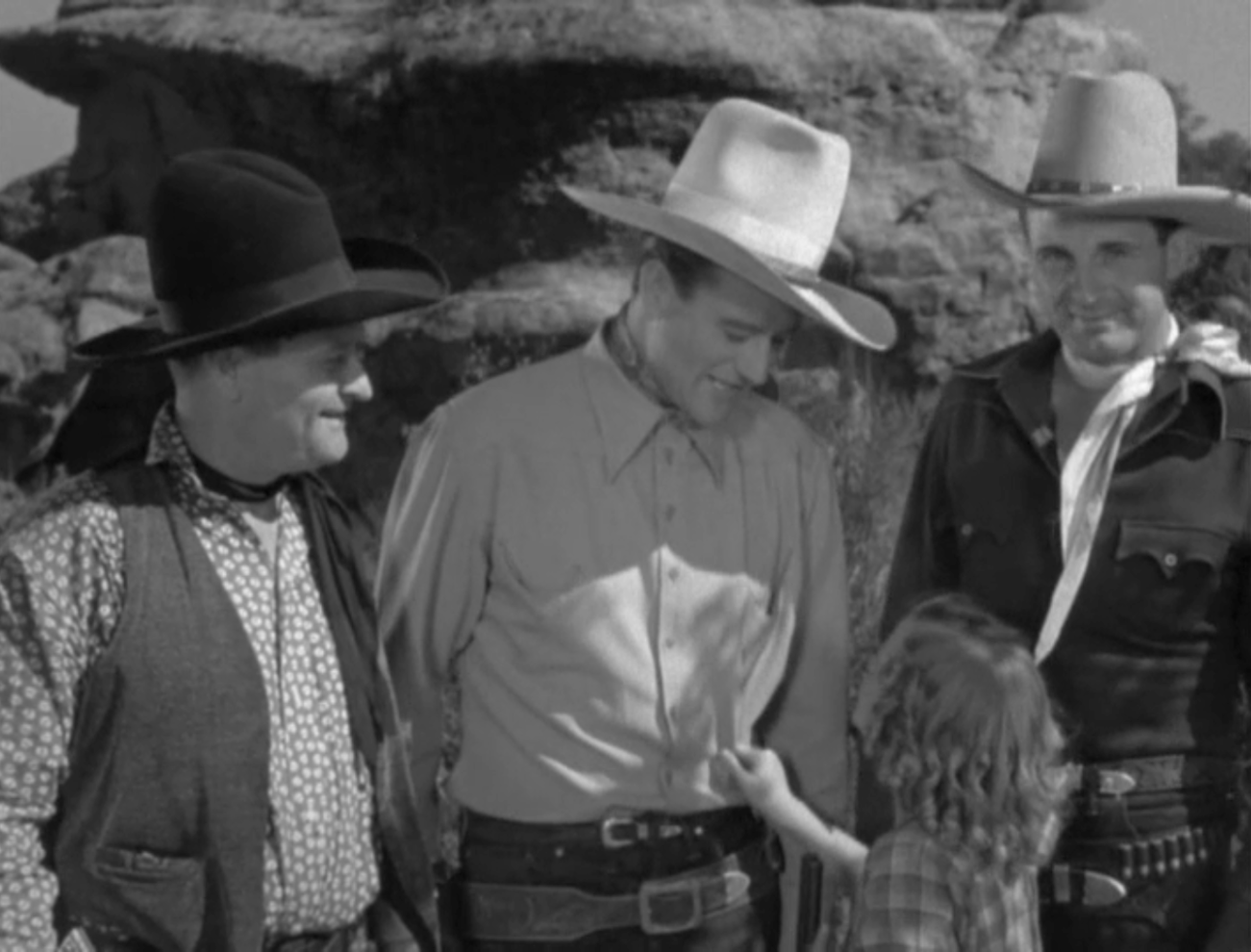
John Wayne does appear in a couple of other Three Mesquiteers movies that contain some Iverson footage, but as far as I can tell neither of these would have required the Duke to show up at Iverson. The "Santa Fe Stampede" shot above features the Upper Iverson in the background, but the lighting makes it pretty obvious the shot is done in the studio using rear projection. That's silent movie great William Farnum on the left, in one of his later roles, with child actress Genee Hall at center, jammed between the once and future legends.

"Santa Fe Stampede" — The Duke, center, on Brandeis Ranch in Chatsworth, Calif., interacting with young Genee Hall. The other Mesquiteers are again Max Terhune, left, and Ray "Crash" Corrigan.

The Duke did make his way to Chatsworth during filming for "Santa Fe Stampede" — and in fact, probably had to drive across the Iverson Ranch to get to work. That's because some of the location filming on the movie was done at Brandeis Ranch, Iverson's immediate neighbor to the west — and the entrance road to Brandeis ran through Iverson.

"Santa Fe Stampede": Brandeis Movie Ranch, with portions of the Upper Iverson in the background

With Brandeis and Iverson adjacent to each other, the two filming locations frequently appeared in the backgrounds of each other's movies, as in the example above. This scene prominently features a rock I call the Brandeis Toad, nearest the center of the frame. A little bit of the Upper Iverson is visible in the background, along with some familiar features to the east of Iverson.

Here's the same shot with some key features spotlighted. Cactus Hill and the rocks just below it are on Iverson property, while Two-Humper and Notch Hill are located east of Iverson and show up regularly in the backgrounds of productions filmed on the ranch. Brandeis, which was also known during the late 1930s as the Lazy A Ranch, operated as a filming site for only a short time, with the bulk of the production taking place from 1935 to 1942.

Corriganville, in a scene from "Santa Fe Stampede"

Additional location work for "Santa Fe Stampede" took place a few miles to the west at Corriganville in Simi Valley, where Ray Corrigan's location ranch was now up and running. The large rock face in the background at right later became known as Fort Apache Rock, as it appeared regularly in scenes with Corriganville's widely used Fort Apache set.

Both Fort Apache Rock and the much smaller, but equally distinctive, beetle-shaped rock toward the left, which I've nicknamed "the Scarab," became familiar sights in the movies as Corriganville developed into a busy filming location during the 1940s and 1950s. The Scarab can still be found at the site, but Fort Apache Rock was partially destroyed in the 1960s to make way for the 118 Freeway — the same freeway that dealt a severe blow to filming at Iverson, several miles to the east.

The only other Western on my list of John Wayne's Iverson productions is another Three Mesquiteers feature from Republic, "Three Texas Steers," released in1939. The Iverson material in this one is minimal, consisting of barely visible archival footage, again inserted through rear projection. In all, Republic cranked out 51 installments of its Three Mesquiteers franchise, spanning 1936-1943, with John Wayne featured in eight of those efforts.


Below I've included a few links to Amazon offerings of the movies discussed in this entry, including DVD and Blu-ray, along with a streaming version of "Santa Fe Stampede."

Tuesday, October 28, 2014

Someone carved footholes in a rock for cowboy hero Tom Mix back in 1935 — and they're still there today!

Tom Mix was Hollywood's biggest cowboy star of the silent era, appearing in close to 300 movies going back to 1909. He helped define the Western movie genre, rivaled contemporaries such as Douglas Fairbanks Sr. and Mary Pickford at the box office, and became known as the "Idol of Every Boy in the World."

Mix rode the Iverson Movie Ranch for his final full-length production, the 1935 Mascot serial "The Miracle Rider" — one of only a handful of talkies he made during his career. Running more than five hours long, the Western adventure, laced with minor sci-fi elements, was the only 15-chapter serial among the many cliffhangers produced by Mascot Pictures. The bulk of the production's outdoor sequences were filmed on the Iverson Ranch.

Tom Mix left his bootprints at Iverson with this production in a very real sense. The above lobby card for "The Miracle Rider" features a rock at the right that was used in a stunt sequence in which Mix climbed down from the top of the rock before supposedly jumping off of it onto a horse. The actual jump was done using a different rock, but the most interesting part of the sequence is where Mix climbs down from the top of the rock.

This version of the lobby card highlights the rock I'm talking about. The rock didn't previously have a name, although it has been featured in movies going back to the silent era — including a prominent role 12 years before "The Miracle Rider," in Buster Keaton's 1923 silent comedy short "The Balloonatic." But with Tom Mix literally leaving his footprints on the rock, I think it just about has to be called Tom Mix Rock.

"The Miracle Rider" (1935) — Tom Mix on Tom Mix Rock

"The Miracle Rider" was a landmark production for the Iverson Movie Ranch — one of the first big sound Westerns to shoot on the location ranch. In the above shot of Tom Mix on top of what I'm now calling Tom Mix Rock, a reader of this blog, Scotty, noticed while he was watching the serial that someone had carved two bootholes into the rock to help Mix with his descent. The sequence takes place in Chapter 3 of the serial.

The bootholes are clearly visible in the movie, as indicated here. Presumably a producer or someone else behind the cameras had a crew member go ahead and carve the holes into the rock — or at least widen existing indentations to make them big enough to accommodate the star's feet.

Here Mix, who plays a character named Tom Morgan, gets in position to climb down from the rock.

As he begins his descent, Mix puts his right boot directly in the carved boothole.

Notice how carefully Tom Mix is studying where to place his foot.

Now the actor has both feet planted squarely in the bootholes.

Here's a shot of that same rock as it appears today, taken on a visit to the site in late 2014. The bootholes are still visible — I've highlighted them in the shot below.

This is the same shot from that 2014 visit to the site, with the bootholes noted. The "A" and "B" labels correspond with the holes as labeled higher up in this post in a screen shot from the movie.

Boothole A, in closeup

Here's a closeup of Boothole A. Considerable weathering has occurred in the almost 80 years since the holes were set up for the "Miracle Rider" shoot, and the holes now blend in more with the rock's natural contours than they did in the movie. But thanks to the evidence we have in the serial itself, I think it's still possible to determine that these are not entirely naturally occurring holes.

Closeup of Boothole B

Here's a closer look at Boothole B. I think this boothole, more than Boothole A, retains the appearance of something that was manmade.

In this recent shot a film researcher demonstrates the use of the bootholes with a position similar to the one taken by Tom Mix in "The Miracle Rider.

Here's the shot of Tom Mix again, in a similar pose to that of the researcher in the recent photo above.

Garden of the Gods today — bird's-eye view

Tom Mix Rock can easily be found today in a section of the former Iverson Movie Ranch that has been preserved for public use as Garden of the Gods Park. The above bird's-eye view of Garden of the Gods pinpoints the location of Tom Mix Rock. If you can find your way to Redmesa Road in Chatsworth, Calif., just north of Santa Susana Pass Road, you'll find the park entrance on the west side of Redmesa. Just up the trail you can go straight to Tom Mix Rock. (I suggest clicking on the photo to see it in greater detail.)

Tom Mix Rock today

This is the view of Tom Mix Rock as you approach it from the top of Garden of the Gods Trail. The white chalk that can be seen on the rock in some of these shots was left by rock climbers — even though the rock is not particularly tall, its shape makes it useful for practicing certain climbing skills.

The area of interest for purposes of tracking the Tom Mix sequence in "The Miracle Rider" is marked in this version of the shot. The best way to view this area is by going around the left side of the rock.

Here's the view of Tom Mix Rock from the left side, which is the southern end of the rock.

The bootholes can be found near the southern end of Tom Mix rock, in the area indicated above. I've swapped out some of the recent photos and added a few new ones since I first posted this blog entry because I have been able to better nail down the position of the bootholes as they appear today.

The scene in "The Miracle Rider" transitions from here, with Tom Mix about to jump off Tom Mix Rock ...

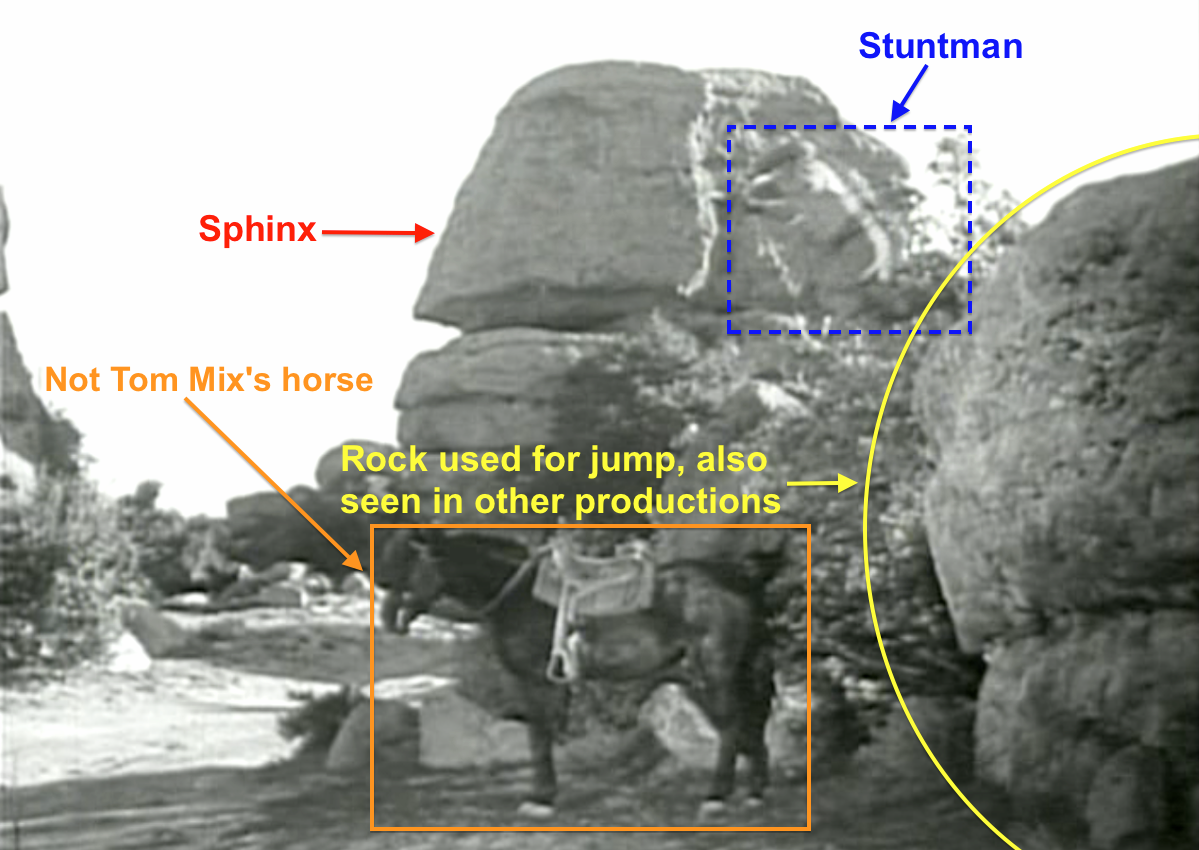
... to here, with a stuntman standing in for Tom Mix, taking a leap from a different rock, onto a horse that does not appear to be Tom's horse Tony Jr., which Mix rode in the serial. I'm assuming it's a stuntman, even though Mix was known to do a lot of his own stunts. Mix was 55 years old by the time "The Miracle Rider" was filmed — certainly not ancient, but maybe a bit too old to be jumping off rocks.

This is that same shot with a number of the main elements identified. I would guess that a big reason they opted to shoot the jump in this particular spot was so they could get a shot of the Sphinx in the background.

"Bonanza" episode "Escape to Ponderosa" (1960)

The rock from which the jump takes place no longer exists, but it is known from appearances in other productions, including the above scene from an episode of the long-running TV Western "Bonanza."

Here's the same "Bonanza" shot with a note about the jump rock.

"Army Girl" (1938)

Another shot of the jump rock, this time from the Republic movie "Army Girl," comes a little closer to duplicating the angle used in "The Miracle Rider."

Here's the same shot with two of the key rocks highlighted.

Tom Mix

My hunch is that the rules about carving holes in rocks at Iverson weren't particularly clear yet at the time Tom Mix rode the ranch in "The Miracle Rider," as it was still relatively early in the evolution of the movie ranch. Then again, maybe the Iversons gave their blessing for the carving work — they were known to do plenty of their own modifications on the rocks over the years. At any rate, I believe such things came to be frowned upon in the decades that followed, as the movie ranch became busier and its operation more professional. But Tom and "The Miracle Rider" left behind a nice movie relic for us to ponder all these decades later.


I'd like to thank Scotty for pointing out the bootholes in "The Miracle Rider" and enabling us all to share in a really cool bit of movie history.