Why we love old movie locations — especially the Iverson Movie Ranch

For an introduction to this blog and to the growing interest in historic filming locations such as the Iverson Movie Ranch — the most widely filmed outdoor location in movie and TV history — please read the site's introductory post, found here.
• Your feedback is appreciated — please leave comments on any of the posts.
• To find specific rock features or look up movie titles, TV shows, actors and production people, see the "LABELS" section — the long alphabetical listing on the right side of the page, below.
• To join the MAILING LIST, send me an email at iversonfilmranch@aol.com and let me know you'd like to sign up.
• I've also begun a YouTube channel for Iverson Movie Ranch clips and other movie location videos, which you can get to by clicking here.
• Readers can email the webmaster at iversonfilmranch@aol.com
.

Thursday, May 31, 2012

Robert Mitchum brings film noir to the Garden of the Gods

It was relatively rare for film noir to be shot at the Iverson Movie Ranch, where the staples were B-Westerns in particular, along with war movies, desert adventures and some sci-fi. But the movie ranch did see action in a few film noirs, including the acclaimed 1949 Robert Mitchum movie "The Big Steal."

"The Big Steal" (1949) — Jane Greer and Robert Mitchum on the Iverson Movie Ranch

Garden of the Gods stands in for the hills of Mexico in one scene late in the movie, with a key shootout taking place that puts Mitchum and his leading lady Jane Greer in peril.

The scene plays out mainly in the central Garden of the Gods area, near the camera mount and Overlook Point. The rocks that show up during the shootout are basically all still in place, in a section of the former Iverson Movie Ranch that has been preserved as a park.

A romp through Garden of the Gods often turns up that big rock with the horizontal crack, which tends to be a helpful identifier. I call it Moray Eel.

Not that it's easy to miss, but just to avoid confusion, Moray Eel is identified here.

Here's another look at Moray Eel and that same area from a recent visit to the site. This area was used a lot in the movies.

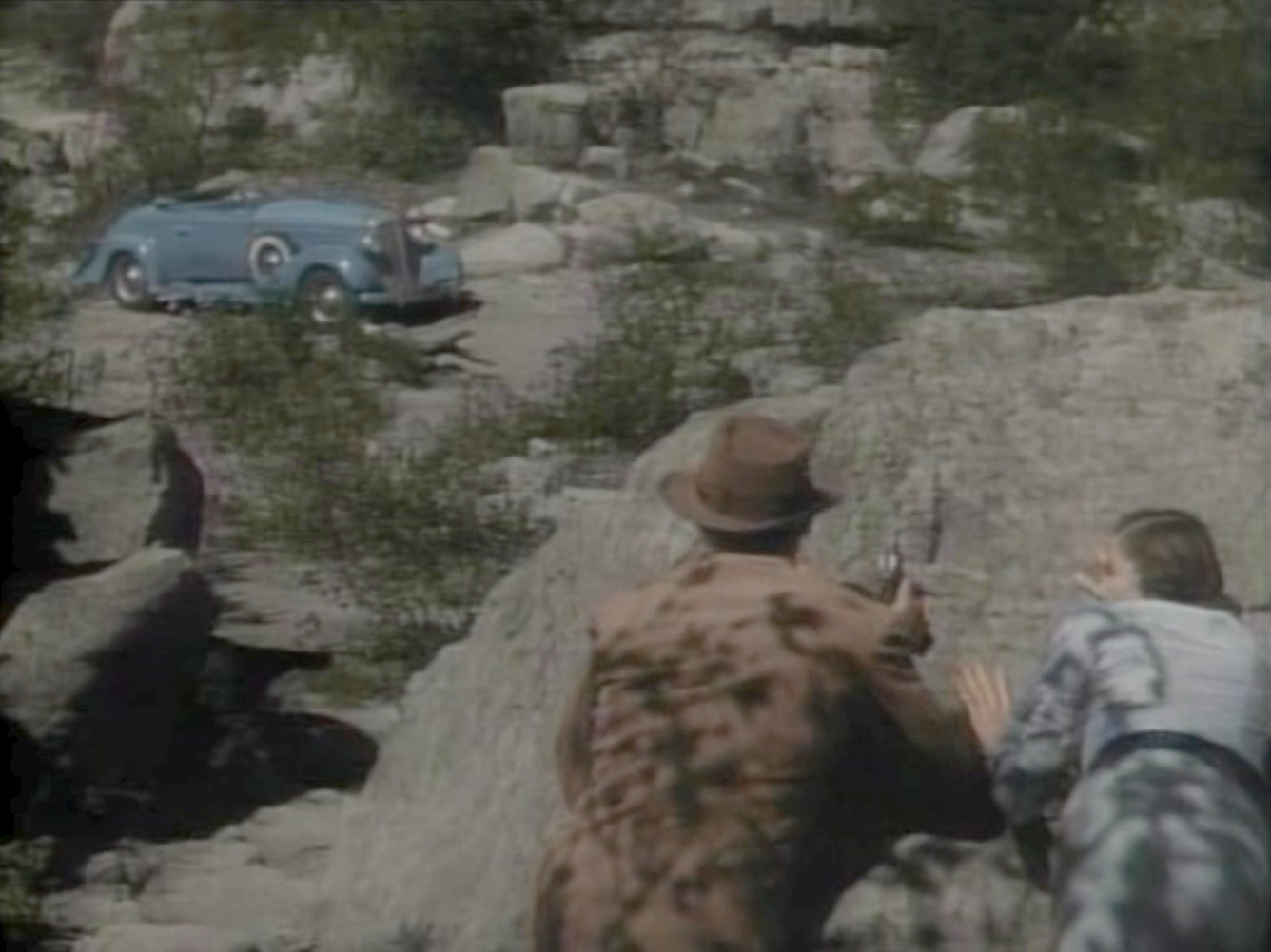
A colorized version of "The Big Steal" has also made the rounds. This is what Moray Eel and its surroundings look like in that version.

One of the hallmarks of film noir is the great-looking old cars, and "The Big Steal" is no exception. Here they drove the old convertible right up into the middle of Garden of the Gods, where it became part of the shootout.

Colorizing tends to miss the point of film noir, but that convertible does look good in baby blue.

Another angle on the Garden of the Gods shootout in "The Big Steal."

More Mitchum — putting up a fight in Garden of the Gods.

With Sphinx in the background, one of the bad guys gets the drop on Mitchum.

And it's all over — the whole Iverson scene lasts only about five minutes.

The legacy of "The Big Steal's" location shoot at the Iverson Movie Ranch includes a rock in Garden of the Gods that some people call Mitchum Rock. I started calling it that for the purposes of my research, and it seems to have caught on.


Here are a couple of options if you feel like picking up a copy of "The Big Steal" — try the above links, although at this point I seem to only be able to find it in relatively pricey DVD sets.

Sunday, May 27, 2012

John Ford gets a postage stamp

John Ford's appreciation for the Iverson Movie Ranch in Chatsworth, Calif., as a filming location never got as much publicity as his love for Monument Valley on the Utah-Arizona border — where he created a series of film images that became emblematic of the American West. But he was a regular at Iverson, directing some of the most important productions shot at the ranch and skillfully interweaving Iverson's rocky terrain with images filmed elsewhere to create a richer and more complex library of Western imagery. I have always considered him an important member of the Iverson "family," and I wanted to celebrate the release of Ford's new U.S. postage stamp.

Here it is — the new John Ford "forever" first-class stamp, depicting a scene inspired by "The Searchers" along with a rendition of the director. The movie scene appears to be based on the film's opening sequence, with Monument Valley in the background and a figure presumably inspired by John Wayne in the foreground. Wayne, by the way, was another Hollywood legend who worked at Iverson a time or two.

The Ford stamp is part of a set of four new stamps honoring American directors, including Frank Capra, Billy Wilder and John Huston. The set is officially designated the Great Film Directors (Forever) stamps by the U.S. Postal Service, and you can buy them now from usps.com.

The John Ford stamp continues a tradition of U.S. postage stamps celebrating the American West, including the above Sitting Bull stamp. Blogger Bennett Owen, inspired by the announcement last year of the Ford stamp, put up a nice post rounding up some of the most compelling Western-themed stamps over the years, which you can read by clicking here. I'll go ahead and post a few more of the images below, because they're mighty cool. Here you go ...


While Ford didn't shoot "The Searchers" at Iverson, his Iverson filmography includes some terrific movies. Among them:

"Stagecoach" (1939), often called the quintessential American Western. I did an extensive blog post on "Stagecoach" some time ago, found here, which breaks down the Iverson filming locations seen in the movie. You can find more about "Stagecoach" in various places throughout the blog by clicking "Stagecoach" in the long alphabetical index on the right side of the page, or by clicking here. One note about "Stagecoach" that I didn't mention last time is that the first appearance of John Wayne in the movie — an introduction that has been cited as one of the best ever for a screen actor — was created using a composite of Monument Valley footage and Iverson Movie Ranch footage. The stagecoach is seen traveling through scenery that is mostly Monument Valley with a little Iverson in the mix, but when the camera settles in on Wayne during his first encounter with the stage, the rocks seen behind him are at Iverson.

This screen grab from the John Wayne entrance sequence in "Stagecoach" is from a colorized version of the movie, although the movie itself was shot in black and white.

Another frame from the same sequence, but in the original black and white. The rocks behind Wayne were found in the Upper Gorge on the Iverson Movie Ranch, and for the most part were destroyed in the late 1980s to make way for condos.

"Wee Willie Winkie" (1937) — This Shirley Temple war movie (anti-war, really) about the British colonization of India was an important project in its day, and John Ford shot it largely at Iverson. The production included the building of elaborate sets at the movie ranch, and some of that construction became the foundation for other sets that remained in use throughout much of the filming era at Iverson.

Victor McLaglen and Shirley Temple at work on the Lower Iverson in John Ford's "Wee Willie Winkie." The movie comes up regularly on this blog, and you can read more about it by clicking here (or by looking up "Wee Willie Winkie" in the alphabetical index at the right side of the page).

Here's a promo still from "Wee Willie Winkie" that provides a good look at part of the elaborate "India fort" set built for the movie on Sheep Flats, on the Lower Iverson. The picture is courtesy of movie location expert Jerry England and his great blog, "A Drifting Cowboy," which you can read by clicking here.

"The Grapes of Wrath" (1940) — John Ford's definitive movie on the westward migration during the Dust Bowl is one of my favorite movies of the 1940s.

The movie only contains a little bit of Iverson — mainly the above shot, which looks out on the San Fernando Valley from Iverson. At that time the Valley was still mostly farms, and the shot depicted the migrant family's first look at California's rich farmland — farmland that held the prospect of jobs in the field. Click here for more about this shot and about "The Grapes of Wrath."


The above links can be used to shop for John Ford's Iverson movies on Amazon.

Sunday, May 13, 2012

L.A. band the Lonely Wild immortalizes Chatsworth's rocky hills in two music videos

The members of a young L.A.-based band called the Lonely Wild climbed Stoney Point — just across Topanga from the site of the former Iverson Movie Ranch in Chatsworth, Calif. — to perform a couple of their songs for music videos, which they've posted on YouTube.

The Lonely Wild 

Here's "Morning Song," with glimpses of the San Fernando Valley (including an unexpected pan at the end), some of the hills above Chatsworth (south of Iverson Ranch) and plenty of cool rocks in the background:


This next one's called "Hail." You can catch glimpses of Garden of the Gods and the southeast corner of the Lower Iverson in the background (for example, at 0:51, in the top right corner) along with some of the familiar background hills often seen in Iverson movie and TV footage, such as Pyramid Peak (top right corner, 0:43) and Boat Hill (top right corner, 0:59). Also visible in this video are Elders Peak and the rock formation known as the Elders (directly behind the drummer in the first shot of the band), above Chatsworth Park:


You can check out the Lonely Wild website here.

Saturday, April 28, 2012

Chili Pepper, Walnut, End Rock and Corner Rock: Where are they now?

I blogged some time ago about the Chili Pepper, seen above in the PRC B-Western "The Hawk of Powder River" (1948), starring singing cowboy Eddie Dean. At the time I thought it was on the Upper Iverson. It turns out that was wrong — it's on the Lower Iverson, specifically the area around the southeastern end of Sheep Flats, now the site of the Indian Hills Mobile Home Village. When I first examined this shot I didn't recognize Split Rock in the background — directly behind the rider, with the trademark vertical split seen just above the horse and to the right of the rider's head.

The "chili pepper" reference is probably obvious, but just in case, this is what it's based on. In the screen shot at the top, it even appears to have the curved stem — although that's an optical illusion.

Here's another look at Split Rock, in "Davy Crockett, Indian Scout" (1950), that shows the vertical split from a similar angle. Split Rock is a relatively well-documented Iverson feature, now found in the swimming pool area of the mobile home park.

I noticed what I thought might be Chili Pepper again in the above shot from the Iverson spectacle "Rocky Mountain Rangers" — a 1940 entry in Republic's Three Mesquiteers series. That's Chili Pepper toward the left and Walnut at the far right. Chili Pepper doesn't look as much like a chili pepper here as it does in the "Hawk of Powder River" shot at the top, so it still wasn't quite enough to call the mystery "solved." The shape, which I refer to generically as a "wedge rock," is fairly common — at one point I was calling this rock "the Doorstop" in my research.

It's worth pointing out that Split Rock appears again in the background in the above shot — directly above the second of the three horses — but it's easy to miss because the angle downplays the split.

Here's another view of Walnut, from the Republic serial "Secret Service in Darkest Africa" (1943). Until recently, Walnut remained a compelling mystery — I was pretty sure it was gone, but there was a chance it was hidden behind a mobile home. More recently I was able to put that mystery to rest, and, sadly, confirm that Walnut no longer exists. A mobile home now occupies the spot where Walnut previously stood.

Here's a regular walnut, for comparison. I think the textures are pretty similar, and the Iverson rock even has that horizontal "seam."

Chili Pepper turns up again in Monogram's 1942 Range Busters movie "Arizona Stagecoach," above. The context again places it in the mobile home village area — and this shot finally convinced me that the wedge rock seen in this location is in fact Chili Pepper. I don't think Chili Pepper survived the construction of the mobile home park, but I've only recently discovered its general location, and I'll have to snoop around a bit to make sure.

Here's where it gets interesting (if you find this sort of thing interesting). This is another shot from "Rocky Mountain Rangers," and it shows Chili Pepper and Walnut from a different angle — so different that you would never know they're the same rocks unless you're inclined to spend hours poring over this stuff in excruciating detail (guilty!). But that's Chili Pepper in the front and Walnut behind it. The shot looks more or less toward the west, with the expanse of Sheep Flats behind the riders, Cactus Hill in the background (including a nice view of its rockiest section) and the line of trees that bordered Sheep Flats to the west. The flat area is filled with mobile homes now, the line of trees is almost entirely gone and the 118 Freeway has cut through the area, but you can still see Cactus Hill, as in the shot below.

This is what that part of Cactus Hill looks like today, from pretty close to the same angle. Sheep Flats has been the site of the Indian Hills Mobile Home Village since the 1960s, with a few of the homes seen here. The wall visible about halfway up (mainly seen toward the right) separates the mobile home park from the 118 Freeway. At the top of Cactus Hill, toward the left, you may be able to make out the two water tanks that now sit atop the hill and pretty much define it. (Click on the photo to enlarge it for a better look.) Cactus Hill is just north of the 118 Freeway and just west of Topanga Canyon Boulevard.

Continuing to view the Chili Pepper area from different angles, this shot is from the 1941 PRC installment in the Lone Rider series "Lone Rider in Ghost Town," starring George Houston. The shot's a little fuzzy, but it looks down on Chili Pepper from the rocks to the east and a little south, so it aims more or less northwest. That's Chili Pepper at the left — no longer looking anything like a chili pepper — with a tiny portion of Walnut behind it. The rock at the top right, below the tree, is End Rock, which is a familiar feature to Iverson researchers — and which has apparently been preserved as a decoration of sorts in the mobile home village.

Here's End Rock today in its "rock museum" — the centerpiece of a planter out in front of the Indian Hills Mobile Home Village's rec room and pool area (not visible in this photo). I'm not sure what was done to End Rock to make it fit the setting — whether it was tilted, chopped, "cleaned up" or simply replaced — but to my eye it doesn't look much like it did in the movies. For one thing, it seems to have lost the curved top that always characterized it. To be honest, I've never been entirely convinced it's End Rock, but that's what a number of experts have said — and it's in more or less the right spot. At any rate, this is what it looks like now from the southeast, from somewhat the same direction as the "Lone Rider" shot above, albeit from a much lower angle.


This view of End Rock today — or what we call End Rock these days — is from the other side, from the northwest, and I think it shows what the park designers were going for — placing the rock in what is admittedly a picturesque planter setting. That's End Rock (or a reasonable facsimile) near the center of the photo, with part of the mobile home park's rec room visible at the right. A couple of other famous movie rocks can be seen as well: Range Rider Rock, sticking out above the mobile home at the center of the shot, and Corner Rock at the far left. Corner Rock, which was "shaved" to make room for the road, was commonly seen in the movies in tandem with End Rock, usually shot from the other side — from the south — with many a stagecoach, rider and chase group arriving between the two rocks.

A closer view of Corner Rock shows how it was modified to make room for a wider modern road, separated from the mobile homes by a low wall. Toward the bottom of the rock, a chunk of it was chipped away to get it out of the way of the road.

One of countless examples of the standard arrival scene between End Rock, on the left, and Corner Rock, on the right, this one is from the 1947 Eddie Dean movie "Shadow Valley," from PRC. The riders are arriving from the northwest, from Sheep Flats.


A number of the movies featured in this post are exceptional Iverson productions and deserve to be highlighted: "Rocky Mountain Rangers" (1940), "The Lone Rider in Ghost Town" (1941), "Shadow Valley" (1947) and "The Hawk of Powder River" (1948) are all on my list of "Great Iverson Movies." (Note that in this case the term "great" refers to the quality of the rocks and other Iverson features seen in the movies, not necessarily the quality of the acting, direction, script, action sequences, etc. However, typically the camera work in these movies is really good.) Check out the links above to Amazon if you're interested in snagging copies of any of these. Not all of them are available, but I've included a few links to what I think is good stuff. The 2-DVD set with "Hawk of Powder River" and "Stage to Mesa City" — another really strong Iverson movie — is an especially good deal.

Sunday, April 1, 2012

Judy Garland works the Iverson Movie Ranch — and her "rocky relationship" with Ronald Reagan

A recent post by film researcher Jerry England included a promo still released in connection with the 1946 movie "The Harvey Girls," starring Judy Garland. It reminded me that there's an interesting story about Judy's main Iverson scene from the movie, and a particular rock at Iverson.

Here's the still from "The Harvey Girls," featuring Judy Garland and John Hodiak. The movie is a romantic musical that's a long way from the B-Westerns and cliffhanger serials generally associated with Iverson. In this shot Judy is leaning on a rock that was located in the camera mount area of Garden of the Gods — an area also known as Overlook Point that overlooks Chatsworth and the northwest corner of the San Fernando Valley, as seen above. You can see that this portion of the Valley was mostly farmland in 1946, although of course it's much more developed now. Overlook Point, which is in a portion of the former Iverson Movie Ranch that has been preserved as Garden of the Gods Park, also overlooks the Iverson Gorge and provides great views of Nyoka Cliff and other rocks that were featured in hundreds of movies.

This is the same rock today, although it's almost unrecognizable. The rock, which I call Judy Garland Rock, is still found in the same general location, but in the intervening years it has fallen off the other rocks that were propping it up in 1946. Another possibility is it was removed intentionally and placed on the ground — perhaps as a safety precaution when the place was spruced up and preserved as Garden of the Gods Park. Whatever the reason, the rock now rests on the ground, meaning the shot with Judy leaning on it could never be duplicated. My best guess is Judy Garland Rock was knocked down by an earthquake, but if anyone has another theory, I'm open to it. By the way, the white horizontal strip in the above photo, to the right of the rock, is part of the metal camera track that remains in place from the filming days.

Here's another look at parts of the old camera mount that remain in place today, including the pipe that was used as a base for the cameras. I've never been quite sure how this worked, so if any of the cinematographers out there want to clue me in, please do. This shot also provides a view of the Valley from the camera mount, including some of the houses and stores that have proliferated in the decades since the peak filming era. The town of Chatsworth, where the Iverson Movie Ranch was situated in the San Fernando Valley's northwestern corner, hasn't been hit quite as hard by development as much of the rest of the Valley, in part because residents have fought to preserve its equestrian heritage.


The scene from "The Harvey Girls" that's depicted in the promo still has Judy and John singing "My Intuition," by Johnny Mercer and Harry Warren, as they fall in love in Garden of the Gods. (That's the video above.) The scene was deleted from the movie — probably a good call, as the song, which is pretty sappy by today's standards, was thought to slow down the movie, even in 1946. But the scene was included as an extra in the DVD release — and thank goodness, because even though the song might be lame, the rocks are cool. They're all rocks that can still be seen today on a visit to Iverson. Check out the view of Stoney Point on the right and Nyoka Cliff on the left at the 2:42 mark (if you can put up with the song that long).

Even though the song was deleted, the movie does include a number of Iverson shots. The above screen shot — part of the same sequence as the deleted song, although this one made it into the movie — shows Judy in Garden of the Gods. The flowers were brought in to make it appear as more of a garden spot than it really is.

In this shot from the movie a portion of the western end of the Lower Iverson and land farther west is used to wow Judy's character with the natural beauty of the West. The place is only green for a short time each year, so this scene would have had to be shot in late winter or spring.

The landscape is quite different today, with the 118 Freeway cutting through the once pristine region. The freeway construction required blasting away large sections of the area hills, as seen toward the left of the photo. But you still may be able to spot the same landmarks among the background hills in the above two shots. Built in the late 1960s, the freeway had a lot to do with ending the movie business at Iverson.

This shot from "The Harvey Girls" was done in the studio, but the producers included footage of Stoney Point, as seen from Iverson, in the background (at the right of the photo).

Another "Harvey Girls" shot that's a composite of a studio shoot and location footage, this scene starring Angela Lansbury features a fake train car in the foreground, what looks to me like a fake set full of cactus plants and other props in middle ground, and background footage shot on location that includes actual Iverson features, mainly Garden of the Gods (just below the overhanging roof of the train car), along with the hills above Chatsworth Park.

Here's a shot from a different movie, to add some perspective on Judy Garland Rock. In this scene from the 1955 Western "Tennessee's Partner," the horse in the middle of the photo is positioned right next to Judy Garland Rock. I like the context of this shot, with some of the less well-known rocks of the interior of Garden of the Gods in the foreground, and Iverson's Upper Gorge in the background.

This shot from later in the same sequence in "Tennessee's Partner" provides a closer view of Judy Garland Rock. As promised in the headline on this blog entry, that's Ronald Reagan having his own movie moment at the same rock where Judy Garland fell in love. Here Reagan's character is patting down the horse to find out whether it's been "freshly rode." Lone Ranger Rock is also in the shot, just above the horse's hindquarters, although it's not very distinctive at this distance. It's just to the right of a larger rock seen near the left edge of the photo. Click here for a detailed post about "Tennessee's Partner," including the exact location where Ronald Reagan's character was shot dead.