Why we love old movie locations — especially the Iverson Movie Ranch

For an introduction to this blog and to the growing interest in historic filming locations such as the Iverson Movie Ranch — the most widely filmed outdoor location in movie and TV history — please read the site's introductory post, found here.
• Your feedback is appreciated — please leave comments on any of the posts.
• To find specific rock features or look up movie titles, TV shows, actors and production people, see the "LABELS" section — the long alphabetical listing on the right side of the page, below.
• To join the MAILING LIST, send me an email at iversonfilmranch@aol.com and let me know you'd like to sign up.
• I've also begun a YouTube channel for Iverson Movie Ranch clips and other movie location videos, which you can get to by clicking here.
• Readers can email the webmaster at iversonfilmranch@aol.com
.

Showing posts with label Bat Masterson. Show all posts

Saturday, December 9, 2017

Unsolved mysteries of the Iverson Movie Ranch

I typically post about Iverson Movie Ranch mysteries that have been solved, but I wanted to let readers in on some of the countless mysteries that remain unsolved — and if you have any thoughts on these, please let us know either by commenting below or by sending me an email at iversonfilmranch@aol.com.

A road of steppingstones, north of Garden of the Gods

A short distance north of the main sandstone towers of the Garden of the Gods, a strip of stones appears to have been assembled into a short road — which remains in place today.

I call it the "Cobblestone Road," just for fun, even though technically cobblestones are smaller and rounder than the flat, steppingstone-sized rocks that make up the road.

"Perils of Nyoka" (Republic serial, 1942): The road glistens

The origin of the road is unknown, but it turns up on occasion in later productions that were filmed in the same area, such as the old Republic serial "Perils of Nyoka."

The road goes back at least to the early '30s, and may well be an artifact of the silent movie era.

"Bonanza" episode "The Long Night" (premiered May 6, 1962)

The Cobblestone Road came up in a post I published earlier this year about James Coburn on the TV show "Bonanza." That post, which you can read by clicking here, includes a map showing how to find the road.

The road survives as an intriguing document of early filming on the Iverson Ranch, but it would mean a lot more if the movie could be identified that was responsible for the road's construction.

Tent city from unknown production, north of Garden of the Gods

Numerous tent cities came and went during the filming era at Iverson, and some of them remain mysteries. This one, possibly from the silent era, conveys a Middle Eastern or biblical theme.

Photos of the tent city can be found in Robert Sherman's book "Quiet on the Set," where the set is attributed to the biblical movie "David and Goliath," supposedly filmed in 1920 — information that does not match any known films.

It was not uncommon for movies filmed on the ranch to have a working title that differed from the film's eventual title, but even an errant reference such as "David and Goliath" contains a clue, reinforcing the suggestion that this tent city was created for a biblical film.

"The King of Kings" (Cecil B. DeMille, 1927)

The Garden of the Gods tents are similar in design to tents seen in DeMille's biblical epic "The King of Kings," parts of which were in color. But on close examination, they do not appear to be the same tents.

Mystery military camp set on the Lower Iverson, circa 1918-1935

Another tent city, this one consistent with the style of U.S. military tents used in World War I, was part of another unknown production, probably from the silent era or the early 1930s.

Similar tents seen in "Draft 258" (not an Iverson production)

The style of the tents on the Iverson set matches this shot taken at a different location during filming of the 1917 silent movie "Draft 258." The photo turned up in a 1917 issue of the old trade magazine Motion Picture News.

The Iverson camp set stood west of a familiar rock feature known as Church Rock, which would later rise above the church that stood at the end of the Iverson Western street for a couple of years in the 1940s.

Sometimes the vehicles in the background hold the best clues to the age of a photo, but I can't get much out of either the truck on the left or the car on the right. The car looks like a Model T, probably no older than the early 1920s, but that doesn't narrow it down much.

"Posada" set on the Iverson Ranch, circa 1931

A number of buildings have turned up in old photos of the Iverson Ranch that have never been identified. This one appears in a photo believed to be from about 1931, with a sign on the building that includes the Spanish word "Posada," or "inn." The people in the photo are unidentified.

Middle Eastern set at Sheep Flats — north side of the building

Undated photos show a substantial Middle Eastern set that was erected on Sheep Flats on the Lower Iverson Ranch. My guess is that it was in place in the early 1950s, but it could be earlier.

The Sheep Flats location is pinpointed by the presence in the background of a well-known movie rock that I call "Saucer." For more about Saucer, click here to read a 2016 post about Silverland, adjacent to Sheep Flats.

The background also features what is presumably an old movie bus. I wish we could see more of it, but based on the rectangular windows it could be pre-World War II. The women in the photo have not been identified.

Eastern side of the set, including the garden

The set was quite elaborate, and included an ornate garden. I have yet to find the movie associated with this impressive set.

1959 aerial photo of the Upper Iverson Movie Ranch

One of the biggest mysteries I've encountered in my Iverson Movie Ranch research concerns a cluster of buildings that I first noticed in a 1959 aerial photograph of the Upper Iverson.

I refer to this set as the "Upper Iverson Village" or "Upper Village," although the relatively uniform size and shape of the buildings suggests that they may have been used to depict an Army barracks or similar facility.

The Upper Village was tucked out of the way in the far northwest corner of the Iverson Ranch, hidden on the north side of a heavily filmed rock feature known as the Rocks Across the Way, or the Festival Rocks.

Most of the rocks remain in place today and continue to pinpoint the location, even though the rest of the area has been developed as part of the Indian Falls Estates gated community.

Nearby features that turn up in the 1959 aerial include the Fury Set and the Midway House.

Also of interest in the old aerial is the Double Line of Trees.

"The Golden Stallion" (Republic, 1949)

The Double Line of Trees can be spotted occasionally in the backgrounds of productions filmed on the Upper Iverson, as in this example from the Roy Rogers movie "The Golden Stallion."

Running north and south, the Double Line of Trees formed part of the boundary between the Upper Iverson to the east and Brandeis Ranch to the west. A few of the trees remain in place today.

Closeup of the Upper Village in the 1959 aerial

A good starting point for trying to find the origins of the Upper Village would be to take a look at war movies or military-themed TV series from circa 1957-1958.

A mysterious "Rip Van Winkle" photo from 1921

It may be ironic that a "Rip Van Winkle" photo has been keeping me up at night, but this colorized lobby card for the 1921 silent movie based on Washington Irving's hard-sleeping bearded wonder has been haunting me. The rocks are strongly reminiscent of the Iverson Ranch area, but so far I've been unable to place them.
"Lorna Doone" (1922): Madge Bellamy among the rocks

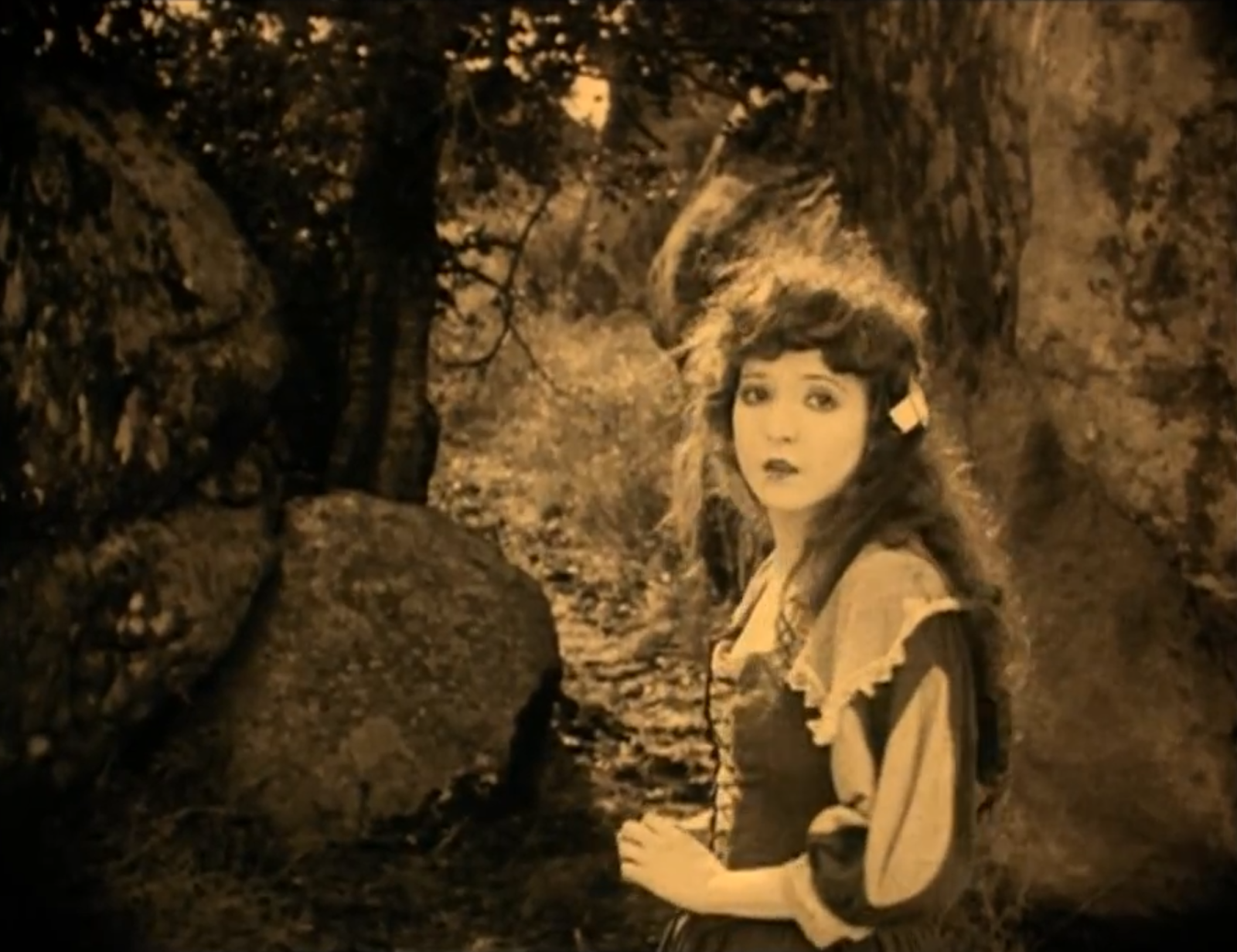
Another example of the "needle in a haystack" nature of these mysteries is this shot featuring early film siren Madge Bellamy looking fetching among some suspiciously Iverson-like rocks. It is unknown where this sequence was filmed, but it has long been suspected that "Lorna Doone" filmed at Iverson. I would love to find this spot.

"Bat Masterson" TV series: "Buffalo Kill" (1959)

Some rocks seem too big and unusual not to turn up at some point. Case in point, this beauty, which my gut tells me is somewhere along Cactus Hill.

"Buffalo Kill" — another interesting rock in the same episode

Another shot from "Bat Masterson" includes a similarly intriguing rock, whose whereabouts are also not known.

"Trigger Pals" (1939): Iverson ... or not Iverson?

The Cinemart/Grand National B-Western "Trigger Pals," starring Art Jarrett and Lee Powell, captures yet another mystery rock. The movie is mostly non-Iverson, so this thing could be anywhere — please give us a holler if you see it, whether it's in the real world or in a movie.

Popular Science Monthly (November 1935): Mystery buildings near the Garden of the Gods

A 1935 article about stuntmen featured this shot of some unknown buildings set up north of the Garden of the Gods, with the stuntman aboard the falling oil derrick identified as Matt Gilman. The buildings and the movie that featured the stunt remain mysteries.

"The Little Princess" (1917): Mystery rocks and fake rock wall

Here's a mystery that's 100 years old, even though it's one that we only recently ran across. It's a shot from the silent Mary Pickford movie "The Little Princess," from 1917.

The shot appears to include two real rocks, on the left and right, along with a fake rock wall in the middle, and some additional real rocks in the background, at top center.

"The Little Princess" (1917)

This shot from the movie provides a closer look at both the fake rock wall and the real rock on the right. These rocks look every bit the part of Iverson Movie Ranch rocks, but they have yet to be found.

The "assassins" in "Harum Scarum" (1965): Somewhere near the Garden of the Gods?

The Elvis Presley movie "Harum Scarum" has produced some cool sightings and rock matches, but it also presents its share of unsolved mysteries — including this shot of a group of assassins lurking among the rocks. I've been looking for these rocks for a few years, to no avail.

"Harum Scarum": The "ridge ride"

Another shot from "Harum Scarum" that has proved challenging is this "ridge ride." The rocks may not have survived, but if they did it seems as though they would be somewhere in the Gorge or the Garden of the Gods.

"Mystery Man" (1944): Iverson Ranch ... or Lone Pine?

The Garden of the Gods is also the focus of a lingering question involving the Hopalong Cassidy movie "Mystery Man." We found tons (literally) of key rocks from the movie a while back, but never did find these — and we're still unsure whether this shot is taken at Iverson or in Lone Pine, where much of the movie was filmed.


These are just a few of the countless mysteries that remain to be solved surrounding the Iverson Movie Ranch. If you spot any clues, please comment or send me an email at iversonfilmranch@aol.com.

You may already know this, but you can get a better look at the above photos — or at least see a larger version — by clicking on them. Happy hunting!

Wednesday, March 11, 2015

The Iverson Movie Ranch Western street, one building at a time ... Part XIV: The Church/Schoolhouse

Eddie Dean stands his ground in "Check Your Guns" (1948)

The Church at the south end of town had one of the shortest lifespans of all of the buildings on the Iverson Movie Ranch Western street, standing for just two years, from 1947-1949.

But despite the brevity of its movie career — or maybe because of it — the Church has a lot of cachet among film location aficionados. I've blogged about it in the past, and would like to refer readers to an in-depth entry I did on the Church less than a year ago, which you can find by clicking here.

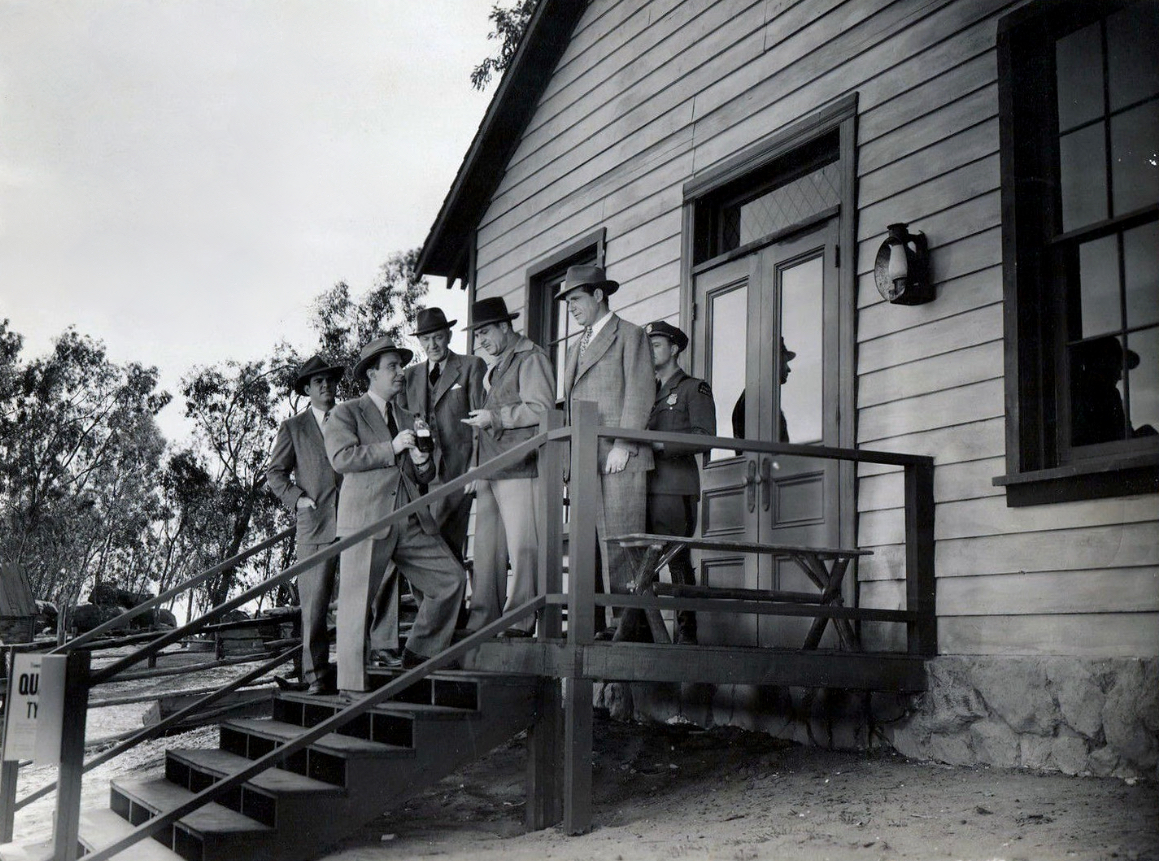
Promo still for "The Millerson Case" (1947): The Church debuts as a schoolhouse

It's not clear who built the Church, but it was probably originally put up as a set for either the Crime Doctor movie "The Millerson Case" or the Hopalong Cassidy movie "The Marauders."

"The Marauders" (1947): First appearance of the Church as a church

The two movies were released a month apart — "The Millerson Case" on May 29, 1947, followed by "The Marauders" on July 1 — and the Church/Schoolhouse was prominently featured in both productions.

1947 aerial photo, featuring the Western street — including the Church

One development since I last blogged about the Church almost a year ago was that a historic aerial photo of the area surfaced from 1947. Watermarks on the photo say 2011, but it only recently came into circulation.

This version of the 1947 aerial shot highlights the Church. The photo is not as clear as similar shots from other years, but you may be able to make out the Iverson Western street near the center of the frame.

2003 aerial photo: Indian Hills Mobile Home Village

Adapting the location of the Church from 1947 to a more recent aerial photo, we can see that the area where the Church was located is now occupied by the Indian Hills Mobile Home Village.

After a lot of time spent scouring old aerial photos and screen shots, I was able to determine that the tree noted here, in the 1947 aerial, was fake.

"The Marauders": Fake tree

Taking another look at the "Marauders" screen shot, I believe this is the fake tree. When I say "fake," I mean, it may have been a real tree, but it was brought in. It did not grow on that spot — and at some point around when the Church went away, so did the tree.

"Check Your Guns" (1948)

The fake tree appears in other productions as well, and from some angles appears almost perfectly round. Once you know to look for it, it does begin to look like a movie tree.

I believe this is the same fake tree seen in the 1947 aerial and in "The Marauders."

"Bat Masterson" TV series (footage from 1947, aired in 1961)

The fake tree appears to have been in place before the Church went up. It can be seen in the above shot filmed in 1947, just before the Church was built. The footage surfaced several years later in an episode of the TV series "Bat Masterson" titled "The Fatal Garment."

The fake tree is noted in this version of the "Bat Masterson" shot. I discussed other features of this shot in a recent entry on the Rainbow Mine Co. building, which you can see by clicking here.

"Check Your Guns" — west side of the Church

While many of the buildings on the Western street were fake fronts, it appears that the Church was a complete building with four sides and a roof, an observation that is corroborated by the 1947 aerial photo. The above shot from "Check Your Guns" provides a look at the west side of the building.

"The Marauders" — Hoppy & Co. outside the Church

We get another look at the same side of the building in "The Marauders," this time with a nice close view of that movie tree. It looks pretty realistic from this angle — but that's what movie trees are supposed to do.

1947: Schoolhouse turret vs. Church bell tower

I won't go into detail here about how the building transformed from a schoolhouse to a church, and back again. I covered that process in the earlier entry on the Church, which you can see by clicking here.

"The Hawk of Powder River" (Eddie Dean, 1948, from PRC)

Many of the Church's screen appearances were in low-budget B-Westerns from Producers Releasing Corp., which set up shop on the Iverson Western street for much of the 1940s. The Church is frequently seen in the background in PRC's Lash LaRue and Eddie Dean movies from 1947-1949.

This version of the "Hawk of Powder River" screen shot points out two nearby rocks that are closely associated with the Church: Gumdrop and Church Rock.

"Calamity Jane and Sam Bass" (Universal, 1949)

Taking a break from its duties as PRC background material, the Church had a featured role — and a rare color showcase — in "Calamity Jane and Sam Bass" in 1949. The Church appeared as a schoolhouse in the movie — note the rectangular tops on the windows, in contrast to other photos in this post.

"Oklahoma Justice" (1951)

Once the Church was gone, it was much easier to spot Gumdrop at the south end of the street. Church Rock, meanwhile, with its distinctive overhang, continued to hover up above.

Both Church Rock and Gumdrop remain in place today, just across the brick wall that runs along the southern boundary of the Indian Hills Mobile Home Village.


"The Iverson Movie Ranch Western street, one building at a time" is a series of posts on the movie and TV history of each of the major structures making up the Iverson Ranch's town set, which stood from 1944 to 1957 and appeared in hundreds of productions.


To see all of the posts in the series on the Iverson Western street, please click on the following links:

Part I: Casa Grande
Part II: The Livery Stable
Part III: The Saloon
Part IV: The Hotel
Part V: The General Store 
Part VI: The Barn
Part VII: The Sheriff's Office
Part VIII: The North and South Adobes
Part IX: The Lost Dutchman
Part X: The original north end of town
Part XI: The North and South Towers
Part XII: The Harness Maker
Part XIII: Rainbow Mine Co. 
Part XIV: The Church/Schoolhouse  
Part XV: The Corral Rocks Shack
Part XVI: The decline and fall of the Western street