Promo shot for "The Valley of Vanishing Men" (1942)
I ran across an oddity in a promotional still for the Columbia Western
serial "The Valley of Vanishing Men," taken in the Iverson Gorge. The photo is part of Jerry England's incredible collection.
The photo features Nyoka Cliff in the background. With apologies to Wild Bill Elliott, the star of the serial, the most interesting part of the photo, in my opinion, is in the top right corner — outlined here in blue.
Zooming in on that part of the promo shot, we get a better look at a ladder that's hanging on Nyoka Cliff, along with a bridge spanning a gap in the rocks near the top of the cliff.
Then there's this thing — the "oddity" I mentioned above. Not knowing what it is, I had to try to figure it out.
Taking a closer look at it — although, admittedly, it doesn't blow up very well — it appears to be a small table with a box of some kind on top of it. Movie equipment, maybe?
Promo shot for "The Valley of Vanishing Men" — with something missing
Here's where it gets interesting. Another version of the promo shot is in circulation in which the mystery object has been removed. Today we would probably say it was Photoshopped out, but in the analog days of 1942 they would have used a less up-to-date method to airbrush the photo.
In fact, they didn't do a great job of it — you can kind of tell something's going on if you take a close look at that part of the photo.
You can even see what's left of the table legs. To me the most interesting thing about the airbrushed version of the photo is simply its existence, which suggests someone involved in the movie also spotted the mystery object, determined it wasn't supposed to be there, and saw fit to get rid of it.
Lobby card for "The Valley of Vanishing Men"
Even so, a sepia lobby card was released for the serial that includes the promo shot — and the mystery object appears in the lobby card.
"The Valley of Vanishing Men": Fight sequence on Nyoka Summit
I was hoping the serial itself might hold a clue to the mystery object, and sure enough, the table with the box on it turns up right where it's supposed to be, on top of Nyoka Cliff.
The object is the focus of a big fight near the end of the serial. Even without already knowing that the mysterious box was positioned atop Nyoka Cliff, the location could be pinpointed by a number of background features.
The hill in the background turns up regularly in Iverson productions and is known to locals by a number of names, including Sunset Peak, Retz Peak and Rockridge. I've been calling it "Elders Peak" in my research for years.
Sunset Peak and the view looking south from the Iverson Gorge in modern times
Sunset Peak continues today to dominate the view to the immediate south of the former Iverson Ranch.
"The Fighting Seabees" (1944): John Wayne & Co. on Nyoka Summit
The tree, too, has quite a movie history, including an appearance in the John Wayne movie "The Fighting Seabees." I did a detailed post about "Seabees" back in 2015, which you can see by
clicking here.
"The Valley of Vanishing Men": Bad guys with a "blinker"
About that mystery object, it turns out to be an old-fashioned signal box, or "blinker" — a wooden box containing a lighting element and shutters, used to send messages in Morse code.
Sending a signal to the rest of the gang
The signal box is an important plot element in "The Valley of Vanishing Men," where the bad guys use it to send signals to other gang members to advance their nefarious plot.
Bill Elliott, center, and Slim Summerville seize control of the signal box
Remember that big fight that was going on earlier? Thanks to that fight, Wild Bill and his sidekick "Missouri Benson," played by the lean and lanky Slim Summerville, were able to get their hands on the blinker.
Slim stands guard while Wild Bill harnesses the power of the blinker to foil the bad guys' plan
As clunky as the device may seem today, back in the Old West it would have been state-of-the-art. It must have been solar powered, since they didn't have extension cords or Duracell batteries yet.
Sadly, the device ends up getting shot up in one of the serial's many gun battles. Still, I appreciated the unusual showcase for the old-school signaling device, as you just don't see a lot of these blinkers in old Westerns.
The serial also includes shots of that ladder seen in the promo still.
"Valley of Vanishing Men": A network of ladders ascending Nyoka Cliff
These shots reveal something I found surprising: The ladder section seen in the promo shot is just one part of an elaborate network of ladders extending all the way down to the floor of the Gorge.
Near the base of Nyoka Cliff, the bottom section of the ladder leans against a distinctive angular rock. In this sequence two bad guys escort a female hostage up the ladder.
That angular rock can still be seen today near the base of Nyoka Cliff, although the foliage has grown in a bit during the 75 years since it supported the ladder in "The Valley of Vanishing Men."
At the top of the angular rock is a platform between two main sections of the ladder.
Bill Elliott, chasing after the outlaws in an attempt to rescue their hostage, begins what will be a long and treacherous ascent of the ladder.
In this shot Wild Bill has arrived at the platform and prepares for the scariest part of the climb — up to the summit.
The ladder sequence appears to be filmed almost entirely on location. Lurking in the background, the familiar silhouettes of Garden of the Gods prove that this location shot is legit.
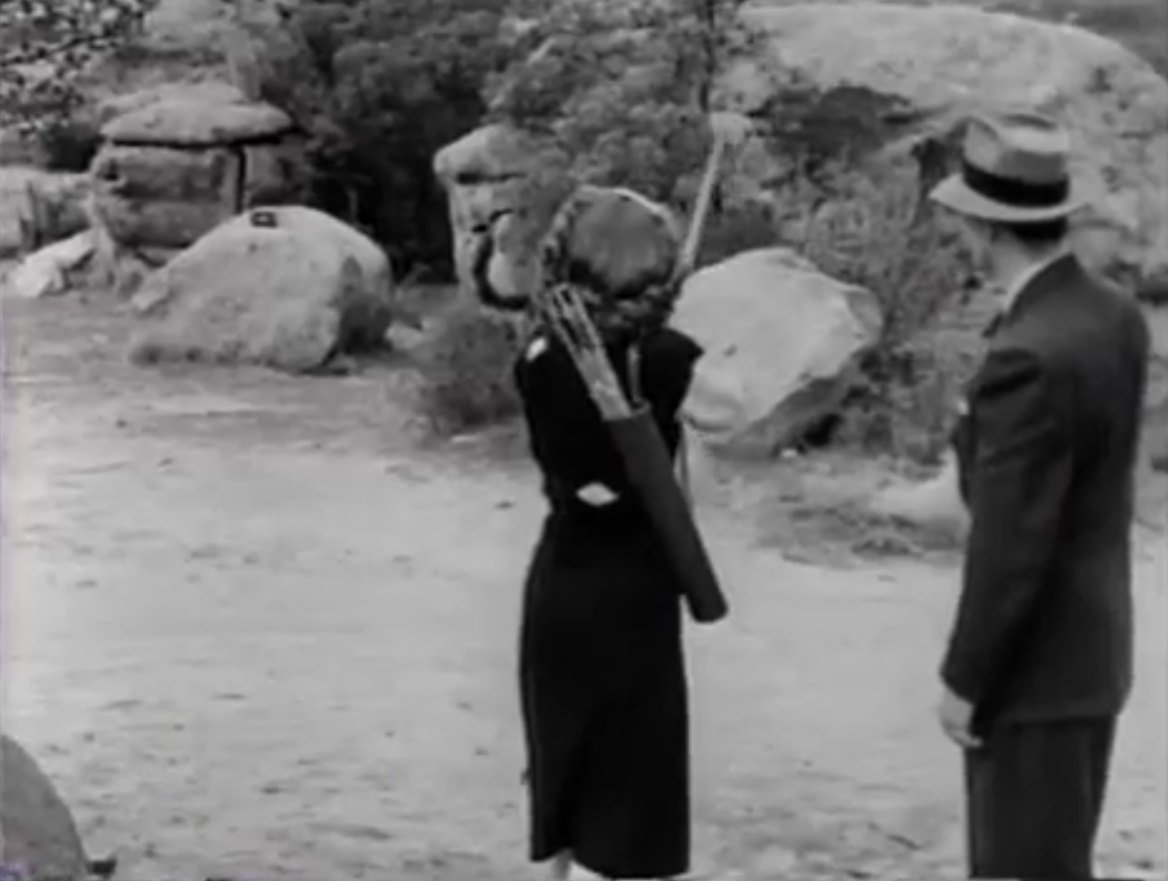
Elliott, who appears in the serial as a character named "Wild Bill Tolliver," works his way up the ladder. This part of the climb almost certainly would have been done by a stunt double.
At the top of the ladder, the leader of the gang barks out signals as he plans the old "knock the hero off the ladder" trick. This shot has a big problem from a continuity standpoint, though ...
Readers who are familiar with the Iverson Gorge may recognize some of the jagged rocks along the edge of Nyoka Cliff in the background. This shot would have had to be filmed from the opposite side of the Gorge.
Scene filmed in the Camera Mount area, with Nyoka Cliff visible to the east
In a wider shot showing the gang and their hostage supposedly at the top of Nyoka Cliff, it becomes painfully obvious that this shot is not taken on Nyoka. The cliff can be seen in all its glory across the Gorge.
There's a good reason for shooting the scene this way: It would have been too dangerous to mess around at the actual edge of Nyoka Cliff. Still, to anyone who pays attention to the rocks, this is a pretty big goof.
I got my hopes up for an even juicier continuity error, hoping to spot the actual ladder across the Gorge. Alas, no such luck — the picture isn't clear enough to be sure, but the ladder does not appear to be in place.
Vultura's Palace in "Perils of Nyoka" (Republic, 1942)
"Perils of Nyoka," the serial that gave Nyoka Cliff its name, filmed on the Iverson Ranch earlier in 1942, with "The Valley of Vanishing Men" arriving later that same year to film in many of the same areas on the Lower Iverson.
"The Valley of Vanishing Men": Accidental glimpse of Vultura's Palace
As it turns out, "Valley of Vanishing Men" captured a few artifacts left over from "Perils of Nyoka" on film. One of these is the front of Vultura's Palace, which can be spotted in the background as Bill Elliott rides the Upper Gorge.
"The Valley of Vanishing Men" came out about six months after "Perils of Nyoka," in December 1942, suggesting that the palace set must have remained in place for a while after shooting wrapped on "Perils."
"Perils of Nyoka": Fake cave entrance in the Iverson Gorge
It just gets "curiouser and curiouser," to borrow a favorite quote from "Alice in Wonderland." Another artifact from "Perils of Nyoka" turns up in the strangest place in "The Valley of Vanishing Men."
This fake cave entrance, built in the Iverson Gorge for "Perils of Nyoka," was seen a lot in that serial, and then apparently was left behind when the Republic crew wrapped up its location shoot.
"The Valley of Vanishing Men": Fake building front in the Iverson Gorge
Then when "The Valley of Vanishing Men" arrived, the production team built this modest structure — just a fake front — in exactly the same spot where the fake cave entrance had been filmed in "Perils of Nyoka."
The curious thing about this building is that it reveals not only that the fake cave entrance left over from "Perils of Nyoka" remains at the site, but also that it was incorporated into the new construction.
Columbia and Republic were competitors in the low-budget matinee cliffhanger space, so it's a hoot that Columbia came along a few months after the "Perils" shoot and quietly "borrowed" Republic's fake rocks.
"The Valley of Vanishing Men": A look inside the building
Apparently Columbia really wanted to have a fake cave inside its fake building. On occasion the building's doors open and we can see that much of the "Perils of Nyoka" fake cave entrance is indeed inside the building.
In fact the fake "Perils" cave forms much of the interior of the building.
Here we get a good look at the fake boulders inside the "Valley of Vanishing Men" building — and can confirm that they are a perfect match for the fakes seen in "Perils of Nyoka."
I found a lot to like in "The Valley of Vanishing Men" when it comes to Iverson Movie Ranch locations, but I have yet to find a version with upgraded picture quality. I hope somebody will eventually remaster these old serials.