Why we love old movie locations — especially the Iverson Movie Ranch

For an introduction to this blog and to the growing interest in historic filming locations such as the Iverson Movie Ranch — the most widely filmed outdoor location in movie and TV history — please read the site's introductory post, found here.
• Your feedback is appreciated — please leave comments on any of the posts.
• To find specific rock features or look up movie titles, TV shows, actors and production people, see the "LABELS" section — the long alphabetical listing on the right side of the page, below.
• To join the MAILING LIST, send me an email at iversonfilmranch@aol.com and let me know you'd like to sign up.
• I've also begun a YouTube channel for Iverson Movie Ranch clips and other movie location videos, which you can get to by clicking here.
• Readers can email the webmaster at iversonfilmranch@aol.com
.

Showing posts with label Robert Cline. Show all posts

Tuesday, November 9, 2010

I am searching for information on the great cinematographers of the B-movie era

I want to honor the legacy of the cinematographers and other production people who worked in relative obscurity during the heyday of the B-Western and the Saturday matinee serial. If you have information about DPs, directors, production managers or other behind-the-scenes people involved in making B-movies, serials or early TV shows from the silent era through the 1950s — especially those involved in location work and anyone who may have worked at the Iverson Movie Ranch — I would love to hear from you.


With the exception of the most high-profile figures from this period — movie stars and prominent directors, mainly — I have been able to dig up precious little information on the talented people who shaped our movie history and our culture through low-budget, independent productions. I think it would be tragic to allow their legacies to fade from memory while there are still people around who can tell their stories.

I would especially like to hear from the survivors — spouses, friends, co-workers, children, grandchildren and beyond — of those who played a role in making movies at Iverson, as well as anyone who is around who has memories of Iverson.

I am especially interested in hearing about the cinematographers — the men who aimed their cameras at Iverson's dramatic rock formations, among other things, and thereby recorded the ranch's legacy for posterity. I hope to hear from anyone who might be able to help flesh out their biographical information and gain insights into what made them tick.

Here are some of the cinematographers I would like to find out more about:

George Meehan
Bud Thackery
Jack Greenhalgh
Jack Marta
Mack Stengler
Marcel Le Picard
Benjamin Kline
Gilbert Warrenton
Ira H. Morgan
George Kelley
Rex Wimpy
William Hyer
James S. Brown Jr.
Edward Kull
Ellis W. Carter
Harry Neumann
... and others who may not yet be on the radar

Please contact me by commenting on any of the blog entries or by e-mailing me at iversonfilmranch@aol.com.

Saturday, August 14, 2010

The great Iverson cinematographers: Robert Cline

born July 1898, Arizona
died November 1946, Hollywood (age 48)

I refer to cinematographer Robert Cline as the mad genius of the Iverson Movie Ranch filming era, and he would probably hold that title even if he had shot just one film: his mystical 1942 Range Busters masterpiece "Thunder River Feud." I call it "his" movie even though it was directed by master B-Western director S. Roy Luby, because Cline's camera work clearly adds a strange quality to the movie that even Luby may not have envisioned. 

Thunder River Feud (1942) — the Iverson Gorge, as photographed
by the "mad genius," cinematographer Robert Cline

While it’s possible that the artistic “brilliance” of Cline’s fuzzy visual poetry in this strange and wonderful movie is purely accidental, it seems unlikely. Shot after shot reveals subtle, elusive images, often tucked away in the corners of the frame. For the viewer who is able to relax into it and surrender to the weirdness of it all, it adds up to a cinematic experience that is more akin to spotting faces in the clouds or looking at a book of hidden-eye puzzles than it is to watching a typical B-Western. 

"Fugitive Valley" (1941) — a leap off Range Rider Rock

Regardless of whether Cline intentionally injected illusions into his work, whether it’s all attributable to a bad print or whether the often puzzling images in his shots are purely imaginary, he showed a flair for Iverson in a solid string of 1940s B-Westerns, part of an ephemeral career that began in the silent era and soon saw Cline emerge as one of the key shooters in early sound Westerns.

"Range Beyond the Blue" (1947) — holdup gang 
waiting for the stage in front of a rock I call Tamale

By the time the genre hit its stride in the mid-1930s he was already a master of the outdoor action sequence, had already developed much of his unique visual style and had already begun shooting at the Iverson Movie Ranch. Working mostly with smaller outfits — including Trem Carr Pictures and William Berke Productions in the early days and later the Alexander brothers and A.W. Hackel’s Supreme Pictures — Cline found himself at the center of what was suddenly the hottest film commodity in the business, the B-Western. 

"Western Cyclone" (1943) — riderless horse on the Upper Iverson,
with Pyramid Peak and the Rocky Peak area in the background 

He began to connect with some of the bigger players, flirting briefly with Republic, where he shot three Westerns in the late 1930s. He found more steady work at Monogram starting in 1940, migrating over to Ray Corrigan’s Monogram-affiliated Range Busters Productions in 1941. He settled in for a good run with Corrigan, shooting 16 Range Busters features before moving on to PRC in 1943.


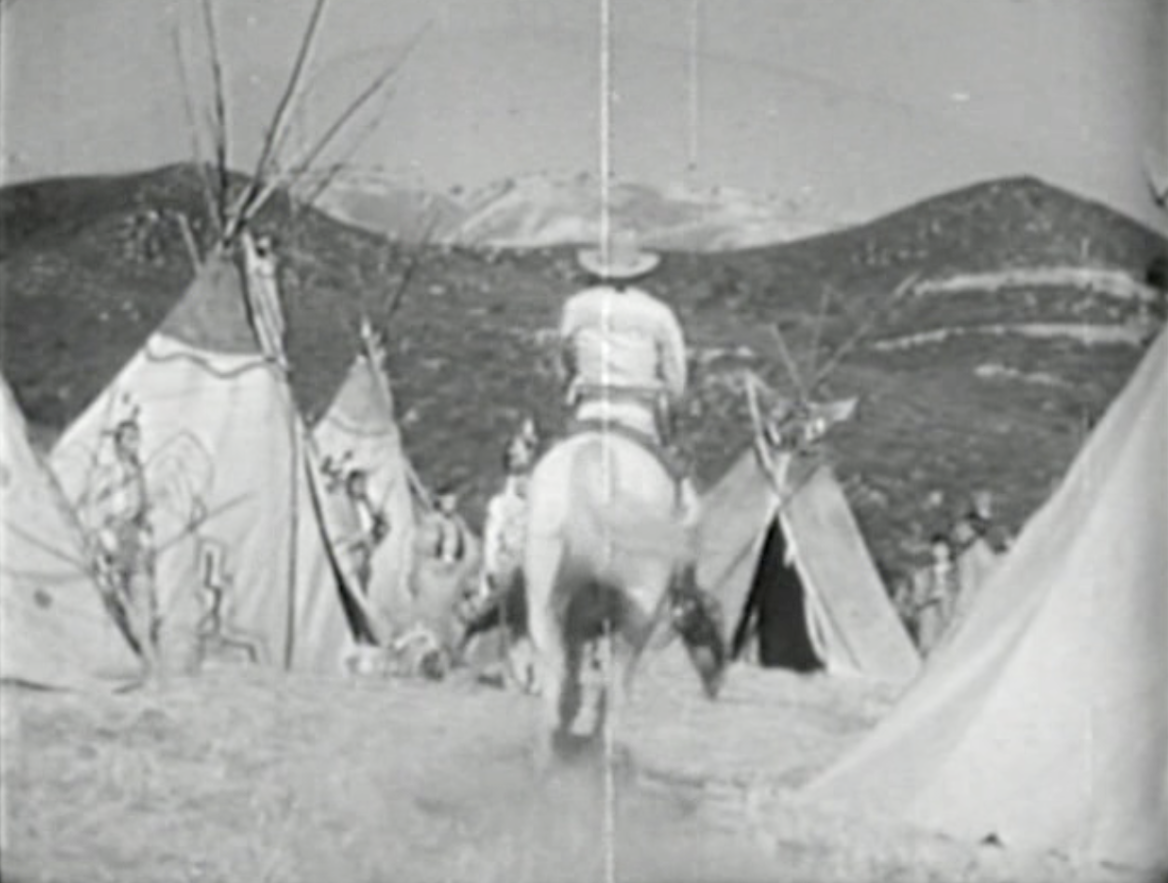
"Buffalo Bill Rides Again" (1947) — teepee village on the Upper Iverson, 
with Oat Mountain in the background, center, flanked by
 Two-Humper, left, and Notch Hill, right

Much of his best Iverson work was done during this Range Busters/PRC period, including the Range Busters installments Underground Rustlers and Fugitive Valley (both 1941) and the Buster Crabbe/Billy the Kid/Billy Carson yarns Western Cyclone and Devil Riders (both 1943) at PRC. 


An early Iverson standout for Cline is the 1938 Bob Steele feature Paroled to Die from A.W. Hackel.

"Buffalo Bill Rides Again" — Hangover Shack in the background

He rarely stayed long in any one place, adding to the mystique of Robert Cline as a restless and perhaps troubled genius. He avoided the one thing that almost all major Iverson cinematographers share: a lengthy stay at Republic Pictures. Maybe it’s part of his genius that he found a way to keep himself from getting sucked into the machine in a big way, something almost no one else seemed able to resist.

Thunder River Feud — Hangdog, a sandstone giant
on the Iverson Movie Ranch

Cline has presided over my pantheon of Iverson DPs from the beginning, and was the inspiration for the creation of a pantheon in the first place. His volume of work doesn’t stand alongside prolific Republic shooters such as Ernest Miller or John MacBurnie, but Robert Cline is clearly one of the masters, if not THE master, at shooting the Iverson Movie Ranch. This despite his relatively high “miss ratio” — for example working quite a bit at Corriganville, working on low-Iverson-percentage Texas Rangers movies and working extensively in the silents (and therefore largely unseen and presumably largely lost).

One of Robert Cline’s later career highlights is the Lash LaRue movie Law of the Lash from PRC, released in 1947, after Cline’s death.

"Thunder in the Desert" (1938) — Hangdog in the background

Like many of the cinematographers of the B-Western era, Robert Cline was born out West. He came from Arizona, which may have helped instill his affinity for Westerns and the Western landscape. And like so many of the cinematographers of the period, he died young — in his case even younger than most, at 48. But he also started young, well back into the silent era. His career essentially spanned 1925-1946, with a few releases coming out after his death, in 1947, and he left behind a legacy of 139 productions listed in his filmography — all well worth a look, if I can say so after having only seen a fraction of them. Cline lived long enough to see television coming, but he died before he got his chance to work in the new medium.

Wednesday, July 28, 2010

Robert Cline: The mad genius of the old B-Western cinematographers ... and his legacy of weird and wonderful shots

"Thunder River Feud" (1942)

I've watched hundreds of movies, serials and TV shows shot on the Iverson Movie Ranch, and almost all of them contain at least a few memorable shots. But the gift that keeps on giving is "Thunder River Feud." Either cinematographer Robert Cline was a genius, or he was accidentally brilliant in shot after shot. The above scene depicts the Iverson Movie Ranch's Upper Gorge, transforming it even in fuzzy old black and white — or especially in fuzzy old black and white — into a mystical wonderland.

"The Life and Legend of Wyatt Earp" (1959)

For comparison, this is what the same area of Iverson's Upper Gorge looks like in a more traditional shot, from an episode of the "Wyatt Earp" TV series called "Wyatt Wins One," which first aired Nov. 10, 1959. Not bad, and it sure is a lot easier to make out the rocks and other features. But to my eye it doesn't quite have the same magic as Robert Cline's earlier shot. And the cinematographer on this episode, Robert B. Hauser, was no slouch. Hauser had a long career as a DP, both in film and in television, including being nominated twice for Emmys for outstanding cinematography.

Squashed Sea Cucumber (aka Glenn Ford Rock), as seen in "Thunder River Feud"

On the surface, "Thunder River Feud" appears to be just another unexceptional hourlong entry in Monogram's Range Busters series, starring Ray "Crash" Corrigan, John "Dusty" King and Max "Alibi" Terhune. But I see it as much more — for one thing, it's the movie where I first encountered the Squashed Sea Cucumber, seen at the left in the above photo.

This is the same "Thunder River Feud" shot with Squashed Sea Cucumber identified. I later realized the rock needed a more accessible name, and for reasons you can read about by clicking here, it eventually became known as Glenn Ford Rock. 


Squashed Sea Cucumber — I mean, Glenn Ford Rock — as it appears today

Here's a look at the rock in modern times. It's actually made up of two separate rocks that create the illusion of being joined as one. Glenn Ford Rock sits on top of a rock feature known as Low Wall, situated just north of Garden of the Gods. The area directly to the left of Glenn Ford Rock in this shot is known as Boots Rock. (You can read about it here.)

Robert Cline, the cinematographer on "Thunder River Feud," was an Arizona native, born in 1898, who filmed something like 139 movies going back to the silent era. At the time he shot "Thunder River Feud" in 1941 (it was released in January 1942), he was getting a lot of work, filming as many as 15 movies a year. He shot a number of films on the Iverson Movie Ranch, including pairing up with "Thunder River Feud" director S. Roy Luby on other Range Busters productions, such as "The Kid's Last Ride" and "Fugitive Valley" (both 1941).


Robert Cline died in Hollywood in 1946, leaving behind a legacy of weird and wonderful shots. "Thunder River Feud" has been the subject of a number of other posts, including more than its share of "tricks of light." Again, was Robert Cline just lucky, or was he really that good?

Monday, September 14, 2009

Classic Rock: Hangdog — then and now

This blog entry is part of a series on "Classic Rocks" — sandstone behemoths located on the Iverson Movie Ranch in Chatsworth, Calif., that were featured in old movies, cliffhanger serials and early TV shows. The subject this time is Hangdog, a rock formation that, like many of Iverson's quirky rock giants, had multiple personalities — and still does.

"Thunder River Feud" (1942)

In the above screen shot from cinematographer Robert Cline's 1942 Range Busters masterpiece, "Thunder River Feud," the large rock formation behind the rider is Hangdog. This is the "gladiator armor" view of Hangdog, one of its more widely filmed angles.

Hangdog as it appears today, on the former Iverson Movie Ranch

The shot above shows what Hangdog looks like today, from something close to the same angle. It's located on private property in the "Above Nyoka" area of the Iverson Movie Ranch, just northeast of Nyoka Cliff.

"Albuquerque" (1948)

A different "face" of Hangdog is seen above, in the Paramount Western "Albuquerque," starring Randolph Scott. This is the view from the south, more or less, and you can see Cactus Hill in the background. 


Hangdog today, from still another angle

The recent shot seen above is taken from yet another angle, but it may be close enough to the "Albuquerque" screen shot above that you'll be able to spot some of the same features in the two shots.

More posts about Hangdog can be found here. For more entries in the blog series Classic Rocks, please click here.

You can click on the link below if you're interested in buying "Thunder River Feud" off Amazon. I recommend the movie — not for great acting or plot, but for a lot of weird shots of the Iverson Movie Ranch by the mad genius, cinematographer Robert Cline.