Why we love old movie locations — especially the Iverson Movie Ranch

For an introduction to this blog and to the growing interest in historic filming locations such as the Iverson Movie Ranch — the most widely filmed outdoor location in movie and TV history — please read the site's introductory post, found here.
• Your feedback is appreciated — please leave comments on any of the posts.
• To find specific rock features or look up movie titles, TV shows, actors and production people, see the "LABELS" section — the long alphabetical listing on the right side of the page, below.
• To join the MAILING LIST, send me an email at iversonfilmranch@aol.com and let me know you'd like to sign up.
• I've also begun a YouTube channel for Iverson Movie Ranch clips and other movie location videos, which you can get to by clicking here.
• Readers can email the webmaster at iversonfilmranch@aol.com
.

Showing posts with label John MacBurnie. Show all posts

Thursday, December 29, 2011

Topanga Canyon Boulevard — sort of — circa 1947 (updated)

This is an older blog entry that I decided to update and repost because I've learned more about it since then and wanted to clarify some details. The above shot is from the 1947 Republic serial "The Black Widow," directed by Spencer Gordon Bennet and Fred C. Brannon, with cinematography by the great John MacBurnie. We're looking north along what I believed when I originally posted this to be part of Topanga Canyon Boulevard in Chatsworth, circa 1947. I originally noted: "Anyone familiar with that corner of the San Fernando Valley knows that Topanga has come a long way from being an undeveloped two-lane country road with nothing but a fruit stand as far as the eye can see. These days it's fully built out and even at six lanes wide or more, constantly jammed with cars."

However, I've since learned that Topanga Canyon Boulevard didn't exist at that time, at least not that far north. It's a bit of a technicality, as this stretch of road appears to be in more or less the same place where one finds Topanga now — and old aerial photos of the area do show a country road following much of the route now occupied by Topanga. The stretch of road seen above was most likely part of Old Santa Susana Pass Road, which followed part of the current Topanga route through what was then a very rural eastern San Fernando Valley. It's definitely Chatsworth, based on the landmarks noted below (from the original post).

Among the landmarks in this screen shot are Stoney Point on the far right and some of the rocks at or near the Iverson Movie Ranch in the center background, which would be right where the 118 freeway now crosses Topanga. All the way in the background is Oat Mountain.

Here's a more recent shot of Stoney Point, which is a familiar sight to motorists traveling along the northern end of Topanga. It's a popular rock-climbing venue these days. It has minimal history as a movie location in its own right, but it appears frequently in the background of films shot at the nearby Iverson Movie Ranch.

Stoney Point also figures prominently in a well-known promo shot for John Ford's "The Grapes of Wrath" (1940), seen above. In the movie itself, Stoney Point was cut out of the shot, with the focus instead on the rich farmland that surrounded it in 1940 — all of which has since been fully developed into residential and business properties. Check out Jerry England's blog for a good entry on Stoney Point, including a bit more about "Grapes of Wrath."

Here's an example of how this shot is handled in the movie:

The sequence is shot from Iverson's Overlook Point, also known as the camera mount. This view signifies the arrival of the Joad family in the promised land of California, where they have been counting on finding agricultural jobs. After barely making it through the Mojave Desert, they're pretty excited to see how good the land is here.

While I've never been able to properly explain it, I find a sort of circular perfection — albeit a bit disturbing — in Hollywood telling the story of the migration to California for farming, when ultimately the even more defining migration to California may have been for Hollywood itself, for the burgeoning movie industry — a migration that in fact brought about the destruction of farmland for housing and movie sets (including Iverson), along with the decidedly "farming unfriendly" diversion of water from rural areas to L.A. Inevitably, Hollywood and L.A. got too big to even allow the industry's movie sets to survive, and they eventually succumbed to the spiraling development pressure and, in some cases (as in the case of the Upper Iverson), wound up hosting the sprawling homes of those who had made their fortunes in Hollywood.

"The Real McCoys" offers another perspective, even if it's a lot lighter in tone.

On another lighter note, Stoney Point is a great place to see faces pop out of the rocks. Below are a couple of the characters I spotted in the recent photo of Stoney Point:

Tuesday, November 9, 2010

I am searching for information on the great cinematographers of the B-movie era

I want to honor the legacy of the cinematographers and other production people who worked in relative obscurity during the heyday of the B-Western and the Saturday matinee serial. If you have information about DPs, directors, production managers or other behind-the-scenes people involved in making B-movies, serials or early TV shows from the silent era through the 1950s — especially those involved in location work and anyone who may have worked at the Iverson Movie Ranch — I would love to hear from you.


With the exception of the most high-profile figures from this period — movie stars and prominent directors, mainly — I have been able to dig up precious little information on the talented people who shaped our movie history and our culture through low-budget, independent productions. I think it would be tragic to allow their legacies to fade from memory while there are still people around who can tell their stories.

I would especially like to hear from the survivors — spouses, friends, co-workers, children, grandchildren and beyond — of those who played a role in making movies at Iverson, as well as anyone who is around who has memories of Iverson.

I am especially interested in hearing about the cinematographers — the men who aimed their cameras at Iverson's dramatic rock formations, among other things, and thereby recorded the ranch's legacy for posterity. I hope to hear from anyone who might be able to help flesh out their biographical information and gain insights into what made them tick.

Here are some of the cinematographers I would like to find out more about:

George Meehan
Bud Thackery
Jack Greenhalgh
Jack Marta
Mack Stengler
Marcel Le Picard
Benjamin Kline
Gilbert Warrenton
Ira H. Morgan
George Kelley
Rex Wimpy
William Hyer
James S. Brown Jr.
Edward Kull
Ellis W. Carter
Harry Neumann
... and others who may not yet be on the radar

Please contact me by commenting on any of the blog entries or by e-mailing me at iversonfilmranch@aol.com.

Saturday, July 17, 2010

The great Iverson cinematographers: John MacBurnie

born December 1892, New York
died September 1956, L.A. (age 63)


One of Republic Pictures' best and most prolific B-Western and serial shooters, John MacBurnie spent his brief but productive film career (1940-1953) with the studio before making a successful transition to television.


After polishing his skills on Republic’s low-profile Don “Red” Barry movies in the early 1940s, he moved on to the company’s serials and a wide variety of features. He eventually became a go-to shooter for higher-profile B-Westerns, making his mark in particular with the Allan “Rocky” Lane series. By the late 1940s he was shooting about 20 movies a year and working with Republic’s top Western stars, including Roy Rogers and Monte Hale as well as Rocky Lane, whom he continued to shoot from 1947 through the end of MacBurnie’s tenure at Republic — coinciding with the end of the Rocky Lane series — in 1953.


In Marshal of Amarillo, filmed by John MacBurnie, Allan "Rocky" Lane keeps an eye on the bad guys from an unusual vantage point — behind the rock known as World of Outlaws, in the North Rim. While most Upper Iverson filming was focused on the South Rim, Republic's Rocky Lane series shot extensively along the ranch's northern boundary.

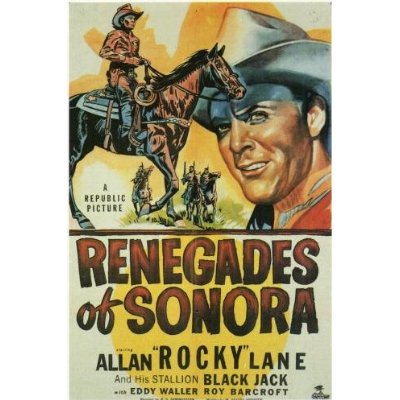
Like Ernest Miller, his Republic stablemate for much of their careers, MacBurnie’s camera work displayed the Iverson rocks in ways that reveal he had a fondness for them. His thoughtful showcasing of the movie ranch’s many dramatic rock features can be seen in Iverson masterpieces such as Call of the Rockies (1944), starring Sunset Carson, and Rocky Lane features Renegades of Sonora (1948), Marshal of Amarillo (1948) and Desperadoes’ Outpost (1952) as well as landmark Iverson serials Adventures of Frank and Jesse James (1948), Jesse James Rides Again (1947) and Desperadoes of the West (1950).


Even in El Paso Stampede (1953), the last movie in the Rocky Lane series, it appears that MacBurnie continued to work to set up interesting angles for whatever original footage was still being shot at Iverson. For one sequence in the film he went to the trouble to set up his camera in a rarely used elevated area on the backside of Water Tank Hill, above the Cliff on the South Rim of the Upper Iverson — and this was at a time when the filmmakers were relying heavily on recycled footage, shooting at the studio whenever possible and writing scripts based mainly on continuity while making the most of existing material.

During the early 1950s MacBurnie focused his lens on the company’s new star, popular singing cowboy Rex Allen. With Republic scaling back its operations at this time and opportunities opening up in television, MacBurnie made the leap to the new medium and worked steadily for the next few years. He died in 1956 at age 63.