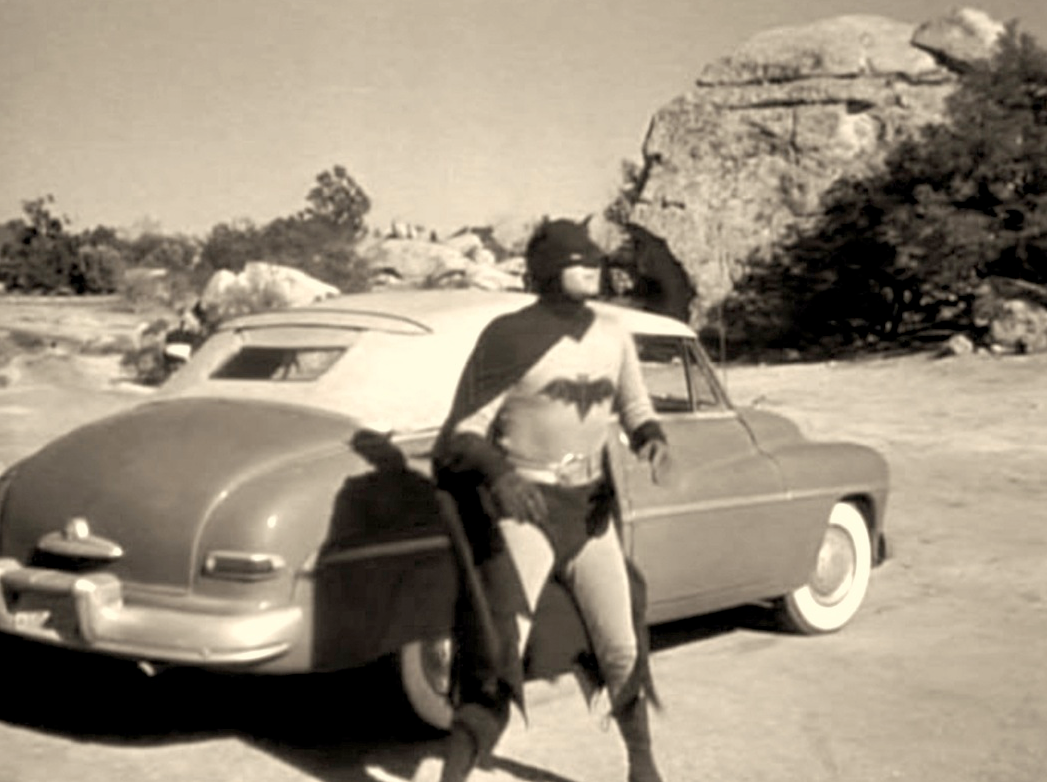
Why we love old movie locations — especially the Iverson Movie Ranch

For an introduction to this blog and to the growing interest in historic filming locations such as the Iverson Movie Ranch — the most widely filmed outdoor location in movie and TV history — please read the site's introductory post, found here.
• Your feedback is appreciated — please leave comments on any of the posts.
• To find specific rock features or look up movie titles, TV shows, actors and production people, see the "LABELS" section — the long alphabetical listing on the right side of the page, below.
• To join the MAILING LIST, send me an email at iversonfilmranch@aol.com and let me know you'd like to sign up.
• I've also begun a YouTube channel for Iverson Movie Ranch clips and other movie location videos, which you can get to by clicking here.
• Readers can email the webmaster at iversonfilmranch@aol.com
.

Showing posts with label Eagle Beak. Show all posts

Tuesday, March 22, 2011

Sorting out the many "Indian Heads" found on the Iverson Movie Ranch

At least four different rocks on the former Iverson Movie Ranch have been called "Indian Head" at various times, while a number of other rocks found on the ranch look so much like Indian heads that they seem to be begging for the name. Here's a rundown of some of Iverson's Indian heads:

"Perils of Nyoka" (Republic serial, 1942): Tower Rock (sometimes called "Indian Head")

Tower Rock is one of the most famous rocks on the Iverson Ranch. This view, in my opinion, presents the rock looking its most "Indian head-like," although other observers may see it differently.

As one of the most widely filmed rocks at Iverson, Tower Rock is also one of the most widely filmed rocks in movie and TV history. The Iverson family used the name Tower Rock to refer to the feature, but in the early filming era some filmmakers called it "the Pinnacle."

John Ford's "Stagecoach" (1939): Tower Rock and the Sphinx in the background

Tower Rock is often seen in tandem with its larger and at least equally famous neighbor, Sphinx. Sphinx has its own naming issues, including once having been called "Indian Head," which we will discuss below. More recently it has been called "Eagle Beak," a name that tends to still be used at times even though it's incorrect.

The arrival at Apache Wells in "Stagecoach," looking south toward Garden of the Gods

As a pair, Tower Rock and Sphinx are considered to be the defining rock features of the Iverson Ranch's fabled and heavily filmed Garden of the Gods. The two sandstone giants made a legendary appearance during the stagecoach's arrival at the Apache Wells outpost in "Stagecoach."

The "Stagecoach" sequence at Apache Wells was just one of hundreds of movie appearances for Tower Rock and Sphinx, going all the way back to the early silent film era. Click here for more about the locations in "Stagecoach."

Tower Rock and Sphinx in modern times

Above is a recent shot showing what Tower Rock and Sphinx look like today. Their location, in the Garden of the Gods on the former Lower Iverson, is known for its large, charismatic sandstone boulders — especially these two.

"The Golden Stallion" (Roy Rogers, 1949): Wrench Rock, on the Upper Iverson

This gargoyle rock found on the former Upper Iverson is a personal favorite. In the early days of my Iverson exploration I called it "Bobby," for reasons that probably wouldn't make sense if I tried to explain them.

I eventually learned that "Bobby" was well-established as an Iverson movie rock and already had a number of other names, including Indian Head, Upper Indian Head and Wrench Rock. I finally came to accept that it should be called Wrench Rock even though it may be the least glamorous of all the choices. It avoids confusion with all the other Indian Heads, and it's plain to see that the rock does resemble a crescent wrench.

"Fury at Showdown" (1957): Wrench Rock, from the other side

Incidentally, that's also Wrench Rock at the top of the page, seen from the other side in "Fury at Showdown." This is the rock's eastern profile, and you might also notice Pyramid Peak to the west, outlining the horse's ears.

Lone Ranger Rock — once known as Indian Head

Next in our list of Iverson's "Indian Head" rocks is one of the most familiar features on the ranch, but its original name has been largely forgotten. In fact, this rock is so universally recognized as Lone Ranger Rock that it is hard to believe it ever had a different name. But it did.

"Ben-Hur: A Tale of the Christ" (MGM, 1925): Lone Ranger Rock long before it had that name

By the time the Lone Ranger rode up on Silver in the opening to the TV show in 1949, the rock that would come to be known as Lone Ranger Rock had already been appearing in movies for at least 25 years. And before it became Lone Ranger Rock, it was known as Indian Head.

Another familiar rock with an unfamiliar name: Sphinx, Eagle Beak ... and Indian Head? Yes!

Getting back to the Sphinx, part of its name confusion goes back to the 1948 Monogram B-Western "Overland Trails," starring Johnny Mack Brown — the source of the screen shot above. One of the key plot elements in the movie concerns trying to find a hidden mine. The mine is located near a waterhole, and there's an early clue about an Indian watching over it. Later we find out the miner has written in a letter to his wife, "There's a rock above the waterhole that looks just like an Indian head." After the miner dies, the search is on to find that Indian head and thereby locate the mine.

The Sphinx in 2015

Fast-forward to later in the picture and about the time we're ready to give up, Johnny Mack Brown says to his partner, "Hey Dusty, look — look at that rock. Doesn't that look like an Indian head to you?" And Dusty says, "Well, it sure does!" And it turns out what they're looking at is the rock we now know as Sphinx. With that kind of attention being paid to it in the movie — any actual discussion of the rocks in the movies is rare — it has to be taken seriously. So Sphinx, too, has a claim to the name "Indian Head." And, well, it does look like a head, after all.

"Stagecoach": Batman Rock — deserving of the name "Indian Head"?

What about the rocks at Iverson that look even more like Indian heads than most of those seen above, but have never been called "Indian Head" (at least, as far as anyone knows)? Probably the prime example is Batman Rock, shown above in a scene from "Stagecoach." To my eye it looks as though it could have come right off the Buffalo Nickel. Its appearance in the movie is part of the "reveal" of the ruins of the Lee's Ferry station, which has been destroyed in an attack by ... who else, Indians. I suspect the irony wasn't lost on "Stagecoach" director John Ford, and that the placement of the ruins directly below the big chief (not yet known as Batman Rock) was no accident.

Batman Rock in modern times

Batman Rock is named after its appearance in Columbia's "Batman" serials of the 1940s. I can't help wondering whether the filmmakers who shot it for Westerns back in The Day had their own names for it. At any rate, it's a spectacular rock — even today, after the vegetation has grown up around it and largely blocked the view of its face. These days it presides over a driveway into the condo area just north of Garden of the Gods, and despite everything it still projects strength and a certain quiet dignity.

"The Man From Colorado" (Columbia, 1948) (promo still from the Jerry England collection)

A lot of rocks will start looking like an Indian head if you stare at them long enough. Notice the rock all the way at the left of the frame.

It seems to me this rock, which does not have a formal name that I know of (although I consider it part of the "Three Kings" formation), could also reasonably be described as looking like an Indian head.

"Little Big Horn" (1951): Filmed by Iverson cinematographer extraordinaire Ernest Miller

Sometimes changing the angle even slightly can bring out still more of the "Indian Head" in a rock.

"Rocky Mountain Rangers" (1940): Three big rocks with stakes in the "Indian Head" debate

These three sandstone behemoths, along with Wrench Rock, Lone Ranger Rock, Batman Rock and others, illustrate some of the potential problems associated with the rock name "Indian Head." Once you start finding Indian heads in the rocks, it never ends.

Wednesday, July 7, 2010

Classic Rock: The Phantom


Located in the Garden of the Gods next to the larger and more widely exposed Sphinx, or Eagle Beak (not seen here), the Phantom tends to be undeservedly overlooked. But it does get screen time in a lot of old movies and TV shows if you know where to look and can get past the "star power" of neighboring rocks Sphinx (aka Eagle Beak) and Tower Rock (aka Indian Head). The Phantom is typically seen just to the right of the Sphinx, if the camera happens to wander over that way.

"The Lone Ranger" TV show (1949) — the Phantom in background

The Phantom did play a featured role in an early episode of the Lone Ranger TV show, as seen above (with the footage also used in the Lone Ranger movie). In the shot above, the Phantom provides the background during an ambush sequence that sets in motion the whole Lone Ranger saga. Please check out this blog entry, which talks more about this famous scene.

Here's another view of the Phantom in modern times. The rock, which has any number of "moods" depending on the camera angle, seems a little grouchy here. The Phantom reminds me a little bit of one of those paintings on the wall in an old spooky movie, where the eyes follow you as you move through the room. In the above shot, I think the, um, "white stuff" under the eye, presumably left behind by an ongoing parade of birds that for some reason prefer that particular eye socket to "do their business," actually adds an emotional quality to the rock's face. I'll stop short of saying it looks like the Phantom is crying, but ... well, I think I would be grouchy too if that happened to my eye socket.

This post is part of a series on "Classic Rocks" — sandstone giants located on the former Iverson Movie Ranch in Chatsworth, Calif., that became a part of not only America's physical landscape but also its cultural heritage, through featured roles in old movies, cliffhanger serials and early TV shows. Other entries in the series can be seen by clicking here.

Monday, May 31, 2010

The Iverson Movie Ranch in glorious Technicolor

It's a little bit unusual to see the Iverson Movie Ranch on screen in color — especially good color. When I do see Iverson in color it's typically in the low-grade picture quality of early color efforts for TV. But here are some shots from one of only a handful of productions where Iverson appeared on film in glorious Technicolor: the Gary Cooper movie "Dallas," a Warner Bros. feature from 1950.

It always starts with Garden of the Gods and the two iconic figures: Eagle Beak, or Sphinx, on the right and Indian Head, or Tower Rock, on the left.

"Dallas" is the only production in which I've seen this cabin, which was built right in the middle of Garden of the Gods, somewhere behind the Sphinx. I initially thought it may have been built on the relatively small patch of flat ground where a camera mount was in place, overlooking Iverson Gorge. (The track for that camera mount is still in place today.) But further research determined that the cabin was more likely a little to the west of that spot, probably tucked in behind the Sphinx and a nearby rock known as Phantom. My guess is the cabin was built specifically for "Dallas" and was probably torn down soon afterward. Gary Cooper already had a track record of construction at Iverson, having been responsible for building Iverson Village for his 1945 movie "Along Came Jones." In that case the construction paid lasting dividends for Iverson, as the village was used in countless productions for the next 12 years or so.
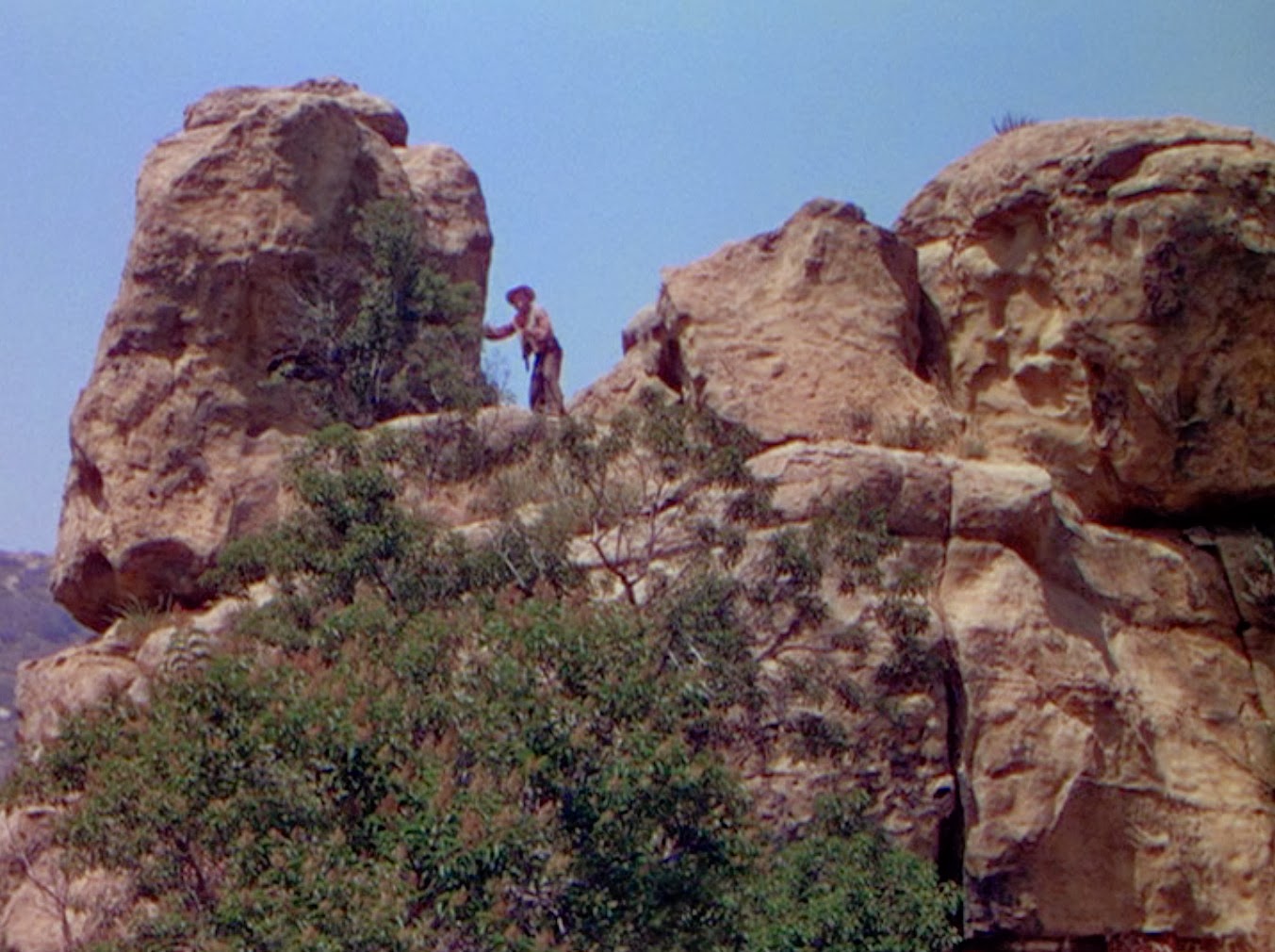
Lookouts were placed strategically on the rocks of Garden of the Gods, which served as an outlaws' hideout in "Dallas." In this shot the lookout is positioned near the base of the Sphinx, or Eagle Beak.

Here's another lookout perched up high, leaning on the rock known as Indian Head or Tower Rock.

That's Cleft Rock toward the left, just to the left of the clouds of gunsmoke. Cleft Rock is a relatively minor structure, but it has a distinctive shape and appears in a number of films and TV shows. My attempts to find it at Iverson proved fruitless for months, but I finally located it thanks to this movie. It's in the North Cluster area, just above Garden of the Gods, near a group of condos. These days it's covered with ivy and barely distinguishable.

Here's a shot of Gary Cooper in Garden of the Gods for his starring role in "Dallas."

Saturday, May 29, 2010

Saddlehorn Relay Station and related structures

"The Roy Rogers Show" (1954)

One of the many structures that came and went at Iverson during the filming era, the Saddlehorn Relay Station is a favorite of researchers, probably in part because it is a fairly complicated structure and in part because it has been a challenge to pin down details about it such as where it was located and when it existed. An early theory suggested that the building was relocated around 1946 or 1947, when it would have been moved a bit farther to the west, but later research indicates that it was probably in one spot all along. The above shot of the building comes from the "Backfire" episode of "The Roy Rogers Show," which originally aired Oct. 10, 1954.

"Escort West" (1959)

This screen shot from the Victor Mature movie "Escort West" shows the Saddlehorn Relay Station at the left, and a number of other buildings that first surfaced around this time, in the right half of the photo. "Escort West," which filmed in 1958 for an early 1959 release, was made near the end of the main filming period at Iverson, and a number of unusual buildings crop up in some of the later productions that didn't end up being around for long. But it appears the small cluster of buildings seen here, sometimes called Saddlehorn Village, lasted through the 1960s.

Here's another shot of the relay station, at right, taken from "Escort West." This one shows Garden of the Gods in the background, with Indian Head and Eagle Beak or Sphinx visible at the top of the photo on the left half.

"Adventures of Captain Marvel" (1941) — Saddlehorn Rock

Saddlehorn Relay Station is one of two main relay stations at Iverson, the other being Grove Relay Station. Saddlehorn Relay Station has also been called a variety of other names, including Heldorado Relay Station and Batman Rock Relay Station. Its location is generally described as near Batman Rock or north of Garden of the Gods. It is also sometimes spotted, obviously, near Saddlehorn Rock, which is shown above.

Saturday, February 27, 2010

The Lone Ranger and Tonto in the Garden of the Gods


"The Lone Ranger" TV show (1949)

Here are a couple of shots from early episodes of the "Lone Ranger" TV show (1949), also used in the 1952 movie version. The photo above provides sort of a concentrated glimpse at the combined heft of the major figures in Garden of the Gods on the Lower Iverson Movie Ranch — the Quintessentials, if you will. On the left are the Three Kings, including Tower Rock, or Indian Head, the tall figure just behind the Lone Ranger. To the right of Indian Head is a little glimpse of Pebblehead in the background. At right is a portion of the Sphinx, or Eagle Beak.


Another shot taken in the same area shows the rest of the Sphinx, aka Eagle Beak — including revealing the reason it's called the Sphinx — as it does bear some resemblance to the one in Egypt. To the right of Eagle Beak is the Phantom. Here's a more current look at the Phantom.

Friday, January 22, 2010

Batman Rock, as seen in "Stagecoach" (1939) — and today

John Ford's Great American Western "Stagecoach" (1939) made ample use of the Lower Iverson Movie Ranch, splicing together footage shot there with footage of Utah's Monument Valley to create a convenient Hollywood amalgam of the American West. Of the Iverson scenes, by far the most famous is the shot of the stage arriving at the relay station with the Sphinx (also known as Eagle Beak) and Tower Rock (also known as Indian Head) in the background. I've posted about it previously here. But Ford also was taken by the rock seen in the above screen shot from the movie, now widely known as Batman Rock because of its appearance in the Batman serials. Early in my research I called this rock Chief Um before I learned that it already had a name, so sometimes the name Chief Um still comes up, including on this blog. The name Chief Um comes from an old doo-wop song by Otis Williams and the Charms. But the name Batman Rock is preferred.

Batman Rock/Chief Um remains alive and well, albeit somewhat more hidden than in the heyday, now living alongside some condos and a driveway, just north of Garden of the Gods.

John Ford was something of a regular at Iverson, shooting a number of films at the location. His most extensive work at Iverson was for the Shirley Temple film "Wee Willie Winkie," produced two years before "Stagecoach," in 1937. He also shot a key scene at Iverson for "The Grapes of Wrath" (1940).

The blog The Great Silence, which focuses on movie locations and has some good entries on the Iverson Movie Ranch, has a detailed post about this "Stagecoach" shoot at Iverson here.

Monday, August 24, 2009

The obligatory "then and now" shot of two Garden of the Gods fixtures, as seen in "Stagecoach" ... and some confusion about rock names

"Stagecoach" (1939) — the iconic scene with background provided by the Garden of the Gods,
on the Iverson Movie Ranch in Chatsworth, Calif.

Same rocks as they appear today

Sphinx, on the right, also known as Eagle Beak, and Tower Rock, on the left, also known as Indian Head and sometimes as the Pinnacle, are among the most famous and most widely filmed rocks on the Iverson Movie Ranch. They're located in the Garden of the Gods on the former Lower Iverson, an area that has been preserved as a park.  

The sequence in which they appear in John Ford's landmark 1939 Western "Stagecoach" (top photo) is one of the most high-profile appearance of Iverson rocks on film, rivaled only by Iverson's other extremely high-profile feature, Lone Ranger Rock, and its appearance in the opening sequence of the "Lone Ranger" TV show. 

Sphinx, Tower Rock and Lone Ranger Rock tend to be the entry points for Iverson research, and they clearly have their appeal and their glamour. But in my own Iverson research, once I got past the initial excitement of seeing these familiar monuments in real life, I went on to discover hundreds of other rocks at the movie ranch that I found at least equally interesting. 

One bit of trivia about these two giants concerns their names: Indian Head is a name that has been applied to at least four different rocks at Iverson, including both of these. (Click here for a post that runs through all of Iverson's so-called "Indian Heads.") Sphinx (or Eagle Beak) has itself been referred to as Indian Head at least once in a movie. Additionally, before Lone Ranger Rock became identified with the Lone Ranger, it was known as Indian Head. And there's another Indian Head on the Upper Iverson, also known as Wrench Rock


"Batman and Robin" (Columbia serial, 1949) — Batman Rock at top right
 
The name "Indian Head" could easily have also been given to another Iverson rock, known as Batman Rock. Meanwhile, the name "Eagle Beak," which is now in wide use (probably more common, for example, than Sphinx, which is more correct), apparently came about as a result of an error, as it was reportedly confused with a different rock, Eagle Beak Rock, located on the Upper Iverson.
Enhanced by Zemanta