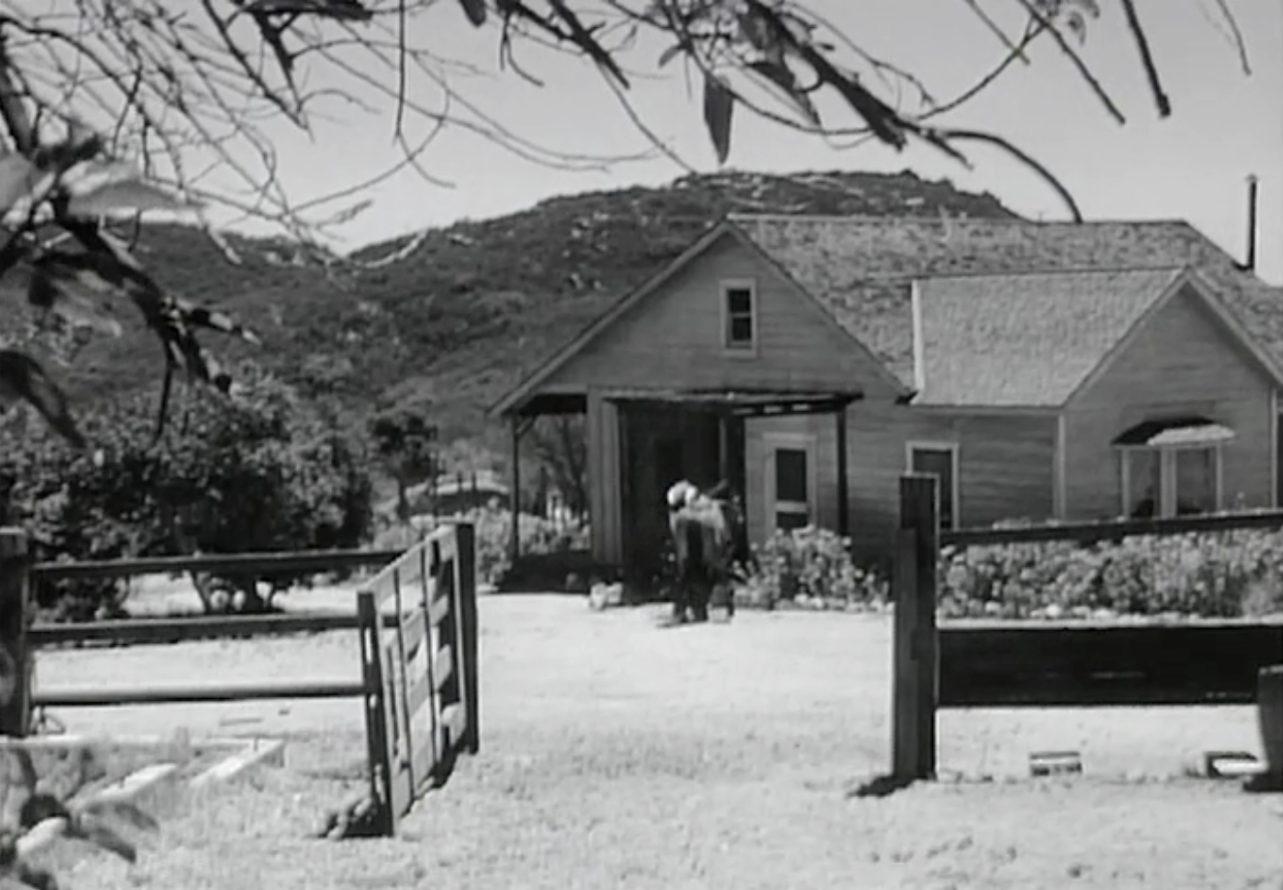
Why we love old movie locations — especially the Iverson Movie Ranch

For an introduction to this blog and to the growing interest in historic filming locations such as the Iverson Movie Ranch — the most widely filmed outdoor location in movie and TV history — please read the site's introductory post, found here.
• Your feedback is appreciated — please leave comments on any of the posts.
• To find specific rock features or look up movie titles, TV shows, actors and production people, see the "LABELS" section — the long alphabetical listing on the right side of the page, below.
• To join the MAILING LIST, send me an email at iversonfilmranch@aol.com and let me know you'd like to sign up.
• I've also begun a YouTube channel for Iverson Movie Ranch clips and other movie location videos, which you can get to by clicking here.
• Readers can email the webmaster at iversonfilmranch@aol.com
.

Showing posts with label Bigfoot. Show all posts

Sunday, March 6, 2016

Years before the TV show "Adventures of Superman" premiered, a different Superman flew all over the Iverson Movie Ranch

Kirk Alyn, the screen's first live-action Superman 
(Columbia promo still for the serial "Superman," 1948)

The first live-action version of "Superman" to appear on film was a delightfully weird oddity. With ballet-trained Kirk Alyn in the title role, Columbia's 1948 serial danced across the rocky terrain of the Iverson Movie Ranch in an unashamed celebration of the kind of gee-whiz goofiness that marked a more innocent era of superheroes.

Kirk Alyn as Clark Kent on the Upper Iverson

The serial provided a showcase for the movie ranch's charismatic rock features. In this shot Kirk Alyn, as mild-mannered reporter Clark Kent, rolls up on a bit of unpleasantness on the Upper Iverson's South Rim, with the rock formation Smiling Lion lurking in the top right corner.

"Superman" (Columbia serial, 1948)

By all accounts, Kirk Alyn the actor was a "super" nice guy — to the point where the kind of strong-arm work required of his Superman character could be an odd fit. But Alyn proved he was up to the task when it came time to don the Spandex and pull the old double-headlock, or bash two bad guys' heads together.

Here again, Smiling Lion purrs its approval — although at this time of day it's less clear whether the rock is smiling or frowning. A comparison of this photo with the Clark Kent shot above illustrates how the "mood" of the Iverson rocks could be altered by moving the camera a few feet or waiting for the light to change.

The producers of the 1948 "Superman" conjured up an animated version of the superhero as a budget-friendly solution to the problem of flying. The sometimes awkward result found cartoon Superman sharing the frame with rugged Iverson landmarks such as Bigfoot, the rock feature peering in at the left in the above shot.

Back on the South Rim, Clark Kent runs toward the concrete bridge across Fern Ann Creek, also known as Falls Creek. Notice the large metal valve above his shoulder.

As Kent ducks under the bridge to change into his Superman suit, we get a clear look at both the valve and the concrete base of the bridge. I believe the valve was used to cut off the flow of water through the bridge, turning the bridge into a dam and creating a small reservoir on the other side of the bridge.

A moment later, Superman emerges.

As Superman takes flight, he once again becomes a cartoon.

The serial also provides a view of the top of the bridge, as a car approaches. The "low ground" to the left of the bridge filled in with water when the valve was closed, forming the reservoir. The Midway Oaks can be seen behind the car, and above them the top of Oat Mountain looms in the background.

Here's a wider view of the bridge area, filmed from the top of the cliff along the north edge of Cactus Hill. The white area to the right of the bridge is the rocky bed of Fern Ann Creek. The creek itself is rarely more than a trickle, and has been especially dry during California's current drought.

"Ghost Guns" (1944): Johnny Mack Brown and Evelyn Finley at the reservoir

The reservoir was seen in a handful of productions, including providing the background for a burial sequence in the Monogram B-Western "Ghost Guns," starring Johnny Mack Brown.

"Ghost Guns" — the reservoir on Iverson's South Rim

From the proper angle, the small reservoir could be made to appear quite scenic.

"Gunman" (1952) — The reservoir, with the Cliff in the background

A shot of the reservoir several years later, in the Whip Wilson movie "Gunman," is less aesthetically pleasing, but presents a clear view of the cliff and other South Rim features. The shot is taken with the camera pointed south.

A severely decayed version of the concrete bridge and dam remains at the site today, in a rugged, out-of-the-way spot in the midst of a gated community of large estates.

The same space where Clark Kent put on his Superman outfit can still be found, although gaining access to the location poses considerable challenges.

Near the spot where Superman got into character under the bridge, a bunch of crooks set up a diabolical super-weapon in a rocky nook. Most of the rocks surrounding them are still in place today, part of a large rock cluster known as the Totem Rocks or Easter Island.

This is what that same nook — or is it a cranny? — looks like today. You may want to try to match up the rocks in the above two photos before you peek at the labeled versions below.

Here's the "Superman" shot again, with some of the rocks labeled.

And here are those same labeled rocks in the recent photo. Incidentally, there used to be a horse trail up the hill between rocks C and D.

"Border Feud" (PRC, 1947) — Lash and Fuzzy head up the horse trail

In the Lash LaRue B-Western "Border Feud," filmed just a year before "Superman," Lash and Al "Fuzzy" St. John ride up to Cactus Hill in the same spot where we saw the bad guys setting up their super-blaster.

Here's another example of the animated flying spectacle, with a crotch shot of cartoon Superman soaring over the Iverson Gorge. Stoney Point appears at the center of the frame, partially blocked by Superman. Iverson's stagecoach road and Lower Nyoka Cliff are visible at the bottom of the shot.

Cartoon Superman would typically touch down by disappearing behind some landmark. In this shot the animated character makes a landing behind the Hangover Shack on the Lower Iverson.

Here's another landing by cartoon Superman — back in the Fern Ann Creekbed on the Upper Iverson.

A moment later, up pops Kirk Alyn at the same spot. The odd shadow at bottom right belongs to a car door.

Iverson Ranch Road on the Lower Iverson was another focal point of the action in the 1948 serial, with Superman harassing evil doers as they drove around in postwar land yachts that many car lovers would kill to have now.

The familiar profile of Three Kings and a portion of Tower Rock are among the Garden of the Gods features visible in this shot, looking south as the streamlined cruiser travels west on Iverson Ranch Road.

A seemingly unremarkable shot again depicts a vehicle heading west on Iverson Ranch Road. Shots like this, showing a bird's-eye view of a relatively wide area, tend to be rare in old productions, as they required extra setup. But when they do turn up they can be a big help in figuring out the lay of the land.

The shot captures the intersection of Iverson Ranch Road with the west fork of Iverson's so-called "stagecoach road," along with the northwest corner of Rock Island. This part of the stagecoach road is located approximately where Redmesa Road now runs through.

A good deal of misinformation exists about the stagecoach road. Even though it was always just a movie road, the myth that it was an actual stagecoach route has been widely circulated. The above example comes from the Santa Monica Mountains Conservancy's LAMountains.com website, in its entry on Garden of the Gods.

Here's the same Garden of the Gods blurb minus my editorial comment, so you can read the whole entry — most of which is true. The Conservancy has done a lot of good work in helping to protect the hills above Chatsworth, and is an important ally in the ongoing fight to preserve the land and its legacy.

This shot from recent years, taken among the condos on the Lower Iverson, features some rocks that are pretty distinctive, but are usually overshadowed by a famous neighbor.

They're the same rocks seen in the Kirk Alyn promo still from 1948 that appears at the top of this post. I've posted that photo again here to make it easy to compare the "then and now" shots.

Here's a wider view of the rocks in recent years, revealing that the rocks in the promotional still are part of the same hunk of sandstone that includes Saddlehorn Rock. The promo still is one of only a handful of shots I've seen that focus on the less-famous rocks behind Saddlehorn without featuring Saddlehorn itself.

Another photo from the same promo shoot for "Superman" — probably a more famous photo than the previous promo still — spotlights the Saddlehorn, and hints that it may have been the main reason for shooting promo stills in that spot. Personally, I prefer the more grim-faced Superman in the previous still.

Other shots have also surfaced from the same photo shoot, including this "outtake" promo still that I've posted before. You can read my 2013 report on Kirk Alyn's "Superman" by clicking here.

The 1948 Columbia serial "Superman" was followed two years later by "Atom Man vs. Superman," again starring Kirk Alyn and his cartoon alter-ego, and again filmed heavily at Iverson.  


The Columbia serials featured Alyn as the movies' first live-action Superman, but he wasn't the movies' first Superman. That title went to the cartoon version from Fleischer Studios, which first appeared in 1941. The above video clip is the first Superman cartoon.


Columbia's two "Superman" serials are combined in a reasonably priced DVD set sold on Amazon, which you can find by clicking on the above link. Both serials are filmed on the Iverson Ranch, and the second one, "Atom Man vs. Superman," which I plan to feature in an upcoming post, is on my list of the all-time great Iverson movies.

Sunday, May 25, 2014

Bigfoot Subdues Dracula: Pure whimsy ... or so I thought

"Thunder River Feud" (1942)

The image above, from Monogram's weirdly filmed, and not particularly well-preserved, Range Busters B-Western "Thunder River Feud," has haunted me since I first saw the movie back in 2008. It was one of the first movies in which I found features filmed on the Iverson Movie Ranch, as my fascination with the filming location was just beginning to blossom.

In part because of the poor quality of my version of the movie, in part due to my inherently whimsical nature — and, I still want to believe, in part because of some degree of perverse intent on the part of the filmmakers — I found something in the shot that I couldn't help thinking looked like a large Bigfoot lying on top of something I thought bore some resemblance to Dracula. I began referring to the image as "Bigfoot Subdues Dracula."

In case there's any doubt as to what I thought I was seeing here — and why wouldn't there be — I've labeled the two "protagonists" of the formation in the shot above. The screen shot became, initially, a focus of failed attempts to figure out just what I was seeing, and subsequently, a symbol for the unfindable oddities that lurk in the backgrounds in any number of old movies. I came to accept long ago that Bigfoot Subdues Dracula would never be seen again, and it became a running joke both when sifting through old movies and on expeditions to the former Iverson Movie Ranch, as I would remark about any remotely similar rock feature: "Look, there's Bigfoot Subdues Dracula ... ha ha!"

"Last of the Bad Men" (1957) (false lead)

It became apparent long ago that Bigfoot Subdues Dracula — or simply "Bigfoot," as I later came to call the feature — was unlikely to ever turn up in the real world, but I would occasionally see something in the movies that caused me to consider whether, by some miracle, I might be seeing the formation again. I went through a series of false leads, including the above shot from the Allied Artists Western "Last of the Bad Men," in which a potential Bigfoot, positioned with a similar "attitude" to the original, lurks meaningfully in the background. The sequence is shot on the Iverson Ranch, as are the bulk of the movie's outdoor sequences. But as it turns out, it's not Bigfoot.

"The Great Alaskan Mystery" (1944) (once again, NOT Bigfoot)

Another false lead, shown above, surfaced in the 1944 Universal serial "The Great Alaskan Mystery," starring Milburn Stone — who later became a TV icon playing Doc for 20 years on "Gunsmoke," and winning an Emmy in the process.

"Fighting Bill Fargo" (1942)

A clue surfaced a couple of years ago when I spotted the above formation in the Johnny Mack Brown B-Western "Fighting Bill Fargo." But by this time I was resigned to thinking of Bigfoot, and the elusive image of a Bigfoot overpowering a Dracula character, as nothing more than a trick of light — and an illusion that would never evolve into a "real" filming location sighting. As a result, I didn't give this sighting as much thought at the time as it may have deserved.

"Treasure of Ruby Hills" (Allied Artists, 1955)

Finally, it happened: Six years after the original sighting in "Thunder River Feud," the actual Bigfoot Subdues Dracula, no mistaking it this time, resurfaced, looking remarkably similar to what I thought all this time had been just an illusion. The formation turned up in this shot from the B-Western "Treasure of Ruby Hills," and while "Bigfoot" doesn't look nearly as "Bigfoot-y" here as it did in the original, far more grainy, "Thunder River Feud" shot, to my eye "Dracula" appears, if anything, even more Dracula-esque here than in the original.

In another piece of news to come out of this sighting, the approximate location for the rock feature is now known: Smooth Hill is recognizable in the background — it's the view of the hill from the northwest, from the general vicinity of the Middle Iverson Ranch Set.

"Two Guns and a Badge" (Allied Artists, 1954)

This shot from the Wayne Morris B-Western "Two Guns and a Badge" is extremely low-res, but it provides a similar view of Smooth Hill to the shot above from "Treasure of Ruby Hills" — and also contains the main house from the Middle Iverson Ranch Set. Bigfoot would be concealed behind the house in this shot.

Here's a comparison of the two above shots, highlighting a large split rock that helps establish that it's the same hill in both shots.

"Bells of Rosarita" (1945)

Smooth Hill, on the left, looms again behind the Middle Iverson Ranch Set in this scene from the Roy Rogers movie "Bells of Rosarita," in which Gabby Hayes is famously trapped in the trunk of an out-of-control old coupe.

North side of "Smooth Hill"

The hill appears much less smooth here than it does in "Treasure of Ruby Hills," illustrating how rocks, hills and other features can take on a vastly different appearance when the camera position shifts slightly. Smooth Hill was usually filmed from a different direction entirely — from the south, including frequent appearances in the background of shots of the Iverson Movie Ranch Western street, as seen below.

"Son of Paleface" (1952) — Smooth Hill from the other side

Smooth Hill, seen here from its more familiar southern side, is widely recognized as the hill in the background of shots of the Iverson Western street looking toward the north, including the example above from Bob Hope's Western comedy "Son of Paleface." The Western street, also known as El Paso Street, appears in the movie a ghost town — in other words, tumbleweeds were brought in and a few windows were boarded up. The bodies lying around are a separate issue.

"Rocky Mountain Rangers" (Three Mesquiteers, 1940)

Here's a nice view of Smooth Hill's southern side — looking characteristically smooth — from before the Western street was built, when Sheep Flats, the area seen in the foreground, was more wide-open. The shot comes from the Republic B-Western "Rocky Mountain Rangers," which I have in my pantheon of the greatest Iverson Ranch productions. The Western town set was built about four years later, in 1944, but would have been off to the left, out of the frame from this particular angle.

For a change the background is clear enough to spot a number of the telephone poles that were beginning to proliferate in the area by 1940. In some productions, such as those set in the earlier stages of the American West, the poles would have been an anachronism. But filmmakers typically shot without much apparent concern for them, and most of the time the backgrounds were so fuzzy it didn't matter.

Smooth Hill was later leveled, and a large apartment complex was built on top of it. Also seen here is the 118 Freeway, which was built in the mid-1960s, effectively bringing a halt to filming on the Lower Iverson. In the foreground is the Topanga onramp heading east.

"Cheyenne Takes Over" (PRC, 1947)

Back on the northern side of Smooth Hill, the story of Bigfoot continues to unfold. It turns out the rock was there all along in shots of the Middle Iverson Ranch Set, but it would have been pretty hard to find without knowing what we know now. You may or may not be able to pick it out in the above shot from the Lash LaRue movie "Cheyenne Takes Over."

Bigfoot is way in the background and really small in this screen shot, but once you know what the feature looks like and where it should be, you can tell that this is it.

"Captain Video, Master of the Stratosphere" (Columbia, 1951)

A wider shot of the Middle Iverson Ranch Set again includes both Smooth Hill and Bigfoot, as noted below. The shot comes from the "Captain Video" serial, which starred Judd Holdren and Larry Stewart.

The Chatsworth landmark Stoney Point can be spotted in the distance, and the shot also shows off the rarely seen back side of the Bunkhouse, part of the Middle Iverson Ranch Set.

"Treasure of Ruby Hills" (1955)

Back to "Treasure of Ruby Hills," and still another angle on Bigfoot. This shot displays the impressive span of the full rock feature in all its glory and includes the "Dracula" head popping out again, albeit slightly blurry.

"Treasure of Ruby Hills" also contains closeups of Bigfoot Subdues Dracula, such as this one showing mainly the "Bigfoot" portion. It's hard to tell from this angle (or any angle, really) how the "Dracula" image is formed, but presumably it's generated by the darker rocks at bottom left.

"The Life and Legend of Wyatt Earp" (1958)

The formation figures prominently in the background of this shot of Hugh O'Brian as Wyatt Earp in "The Bounty Killer," an episode of the "Wyatt Earp" TV show that first aired Sept. 30, 1958. "Dracula" can again be seen, but the figure transforms with each new angle. We may all be seeing something entirely different.

"The Roy Rogers Show" (1954)

This is what Bigfoot looks like from the other side — a lot like the first side. This shot comes from "Last of the Larrabee Kid," an episode of "The Roy Rogers Show" that premiered Oct. 17, 1954. In the background is the northeast face of the main house at Middle Iverson, which indicates we're looking more or less toward the west and viewing the southeastern face of the rock.

Recent shot of the Bigfoot area, now filled with condos

The story of Bigfoot does not have a happy ending. The rock formation was destroyed after the filming era wound down and that portion of the former Iverson Movie Ranch became a condo development. The photo above shows the approximate spot where Bigfoot once stood, looking toward the southeast.