Why we love old movie locations — especially the Iverson Movie Ranch

For an introduction to this blog and to the growing interest in historic filming locations such as the Iverson Movie Ranch — the most widely filmed outdoor location in movie and TV history — please read the site's introductory post, found here.
• Your feedback is appreciated — please leave comments on any of the posts.
• To find specific rock features or look up movie titles, TV shows, actors and production people, see the "LABELS" section — the long alphabetical listing on the right side of the page, below.
• To join the MAILING LIST, send me an email at iversonfilmranch@aol.com and let me know you'd like to sign up.
• I've also begun a YouTube channel for Iverson Movie Ranch clips and other movie location videos, which you can get to by clicking here.
• Readers can email the webmaster at iversonfilmranch@aol.com
.

Showing posts with label Reggie Lanning. Show all posts

Friday, May 17, 2013

Hangin' around Hangdog: Great Iverson Movie Ranch scene found in the 1941 Republic serial "Dick Tracy vs. Crime, Inc."

The 1941 production "Dick Tracy vs. Crime, Inc.," starring Ralph Byrd, is considered by many fans to be among the best serials ever made. It was the fourth and last of Republic's four Dick Tracy serials — a series that also included "Dick Tracy" (1937), "Dick Tracy Returns" (1938) and "Dick Tracy's G-Men" (1939). The last three installments all included sequences shot at Iverson.

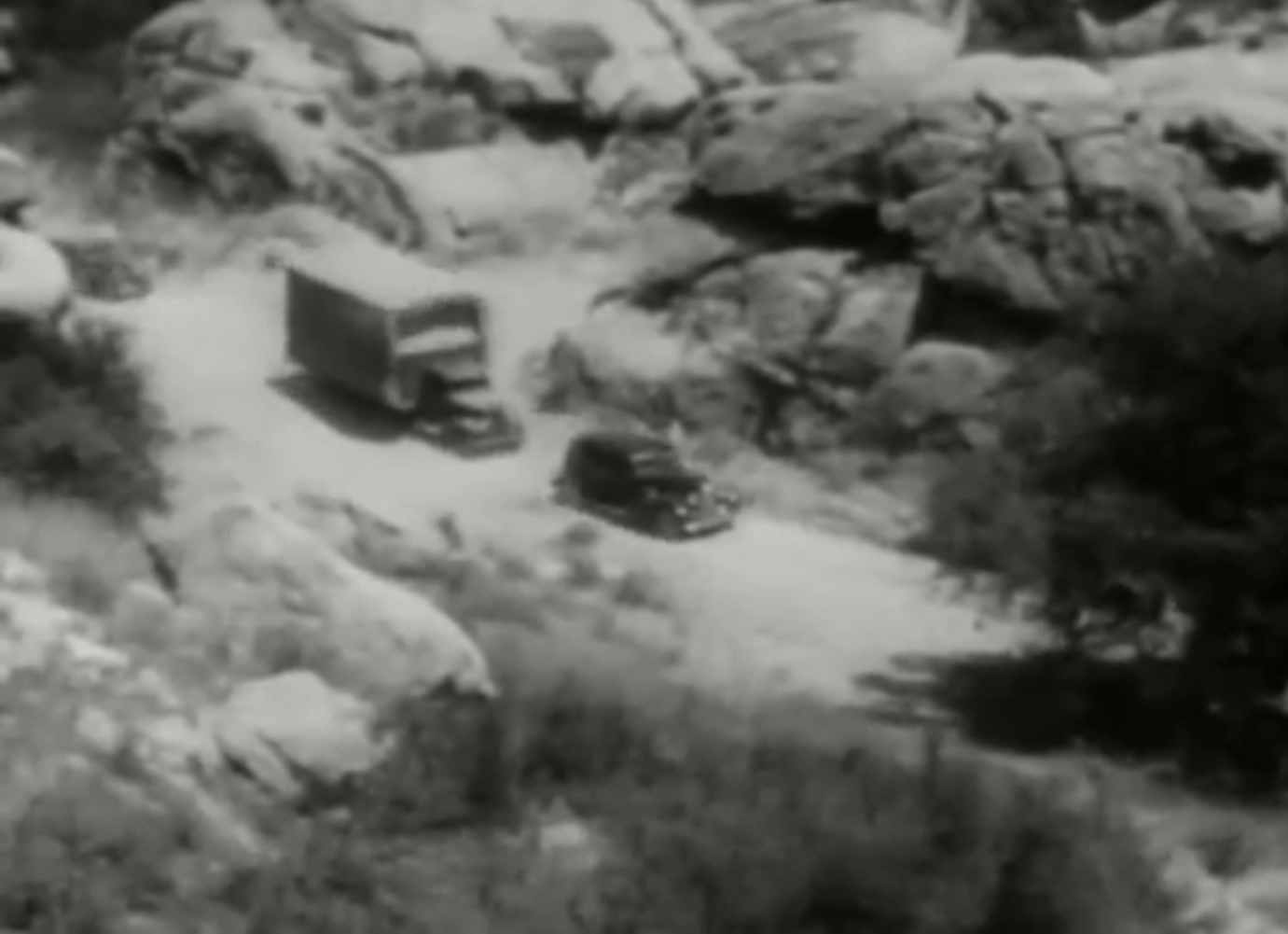
I recently got my first look at "Dick Tracy vs. Crime, Inc." and ran across a particularly compelling Iverson sequence — including the above view of a dynamic rock I call Hangdog. The rock was at the center of a big shootout sequence, with one guy picking people off from on top of the rock and a bunch of other guys shooting at him from behind cars, as seen above. The shot really shows the scale of the rock, with a normal-sized man positioned atop Hangdog and dwarfed by the rock.

Hangdog is still intact, and looks like this today. Other views of the rock give a better idea of why it's called Hangdog. Click here to see a previous blog entry featuring additional shots of Hangdog.

 Stunt jump off Hangdog, Part 1

Stunt jump off Hangdog, Part 2

Stunt jump off Hangdog, Part 3

Stunt jump off Hangdog, Part 4

Included in the sequence is the above stunt jump off Hangdog — off a rock that looks to me like a shoulder — into the covered bed of a truck.

Here's what that same "shoulder" of Hangdog looks like today.

Scene from "Spy Smasher" (1942)

In a mildly amusing example of cross-promotion, the above shot from the 1942 Republic serial "Spy Smasher" includes a plug for "Dick Tracy vs. Crime, Inc." in the form of a set of posters on a gate.

Here's another shot of Hangdog in recent times, which I think shows the rock's two main "faces" — I tend to see it as a lion on the left and a Scooby-Doo-type dog on the right. Or another lion.

Ruh-roh! (Catch phrase often attributed to Scooby-Doo, 
above, but in fact originated by Astro on "The Jetsons")

The thing that really elevates the "Dick Tracy vs. Crime, Inc." shootout sequence, in my opinion, is its bird's-eye views, including the above shot of a frequently filmed area known as Devil's Pass or Vultura's Pass. That's Hangdog again at top right, above the car, although the angle makes it hard to recognize. The pass itself starts to the right of the truck and continues east, behind Hangdog.

Vultura's Palace, in "Perils of Nyoka" (1942)

The same site turns up again the following year as the location of Vultura's Palace in the seminal Republic serial "Perils of Nyoka." That's a portion of Hangdog — including the shoulder, again — at the right in the above shot. You may notice the similarity between the rock directly above the palace entrance (at top center in the above shot) and the one seen in the "two-faced" shot of Hangdog a few shots up (above the Scooby-Doo cartoon), in the top-left corner. That's because it's the same rock in both shots. For more about this location, click here.

Another bird's-eye view from the "Dick Tracy vs. Crime, Inc." sequence, this one shows the guy posted atop Hangdog in the foreground, with an unusual angle on Bill Rock, the large rock at left center, near the car. The road where the vehicles are parked, which would pass by the front of Vultura's Palace the following year in "Perils of Nyoka," is sometimes called Vultura's Trail. Also visible here, in the background — and not in much detail — are the Devil's Doorway Cluster and Devil's Doorway Wall, in the top-left corner. The low, horizontal rock all the way in the corner is Devil's Doorway Wall.

This shot shows the same general area from a lower angle, with a portion of Bill Rock again seen at the left, the cars parked along Vultura's Trail, and Cactus Hill in the background. The flat area below Cactus Hill is where much of the Cal West Townhomes development now stands.

Reggie Lanning, at far right, operating the camera 
for the 1930 movie "The Big House"

The cinematographer on "Dick Tracy vs. Crime, Inc." was the great Reggie Lanning, a Republic stalwart who was responsible for some of the best camera work at Iverson from the late 1930s through the 1940s — not the least being the serials "Zorro's Fighting Legion" (1939), "Jungle Girl" (1941) and "Perils of Nyoka" (1942). He also did some nice work at Iverson for the Roy Rogers movies "Cowboy and the Senorita" (1944) and "Song of Arizona" (1946). For more about Lanning's incredible track record at Iverson, please read this blog entry. And please click here for more about the forgotten legacy of the great cinematographers of the B-movie era.

In the above promo still for the 1930 movie "The Big House," Lanning — who was uncredited on the production — works alongside cinematographer Harold Wenstrom shooting the film's star, Chester Morris. It's a rare glimpse of Lanning at work.


If you're interested in getting your own copy of "Dick Tracy vs. Crime, Inc." on DVD, you should be able to buy it off Amazon by clicking on the image above.

Tuesday, November 9, 2010

I am searching for information on the great cinematographers of the B-movie era

I want to honor the legacy of the cinematographers and other production people who worked in relative obscurity during the heyday of the B-Western and the Saturday matinee serial. If you have information about DPs, directors, production managers or other behind-the-scenes people involved in making B-movies, serials or early TV shows from the silent era through the 1950s — especially those involved in location work and anyone who may have worked at the Iverson Movie Ranch — I would love to hear from you.


With the exception of the most high-profile figures from this period — movie stars and prominent directors, mainly — I have been able to dig up precious little information on the talented people who shaped our movie history and our culture through low-budget, independent productions. I think it would be tragic to allow their legacies to fade from memory while there are still people around who can tell their stories.

I would especially like to hear from the survivors — spouses, friends, co-workers, children, grandchildren and beyond — of those who played a role in making movies at Iverson, as well as anyone who is around who has memories of Iverson.

I am especially interested in hearing about the cinematographers — the men who aimed their cameras at Iverson's dramatic rock formations, among other things, and thereby recorded the ranch's legacy for posterity. I hope to hear from anyone who might be able to help flesh out their biographical information and gain insights into what made them tick.

Here are some of the cinematographers I would like to find out more about:

George Meehan
Bud Thackery
Jack Greenhalgh
Jack Marta
Mack Stengler
Marcel Le Picard
Benjamin Kline
Gilbert Warrenton
Ira H. Morgan
George Kelley
Rex Wimpy
William Hyer
James S. Brown Jr.
Edward Kull
Ellis W. Carter
Harry Neumann
... and others who may not yet be on the radar

Please contact me by commenting on any of the blog entries or by e-mailing me at iversonfilmranch@aol.com.

Tuesday, September 7, 2010

Have you seen this rock?


"Perils of Nyoka" (1942): "Kinda Like Doglips"

This shot from the Republic serial "Perils of Nyoka," filmed by master Iverson cinematographer Reggie Lanning, shows a rock I call Kinda Like Doglips because it is reminiscent of, well, Doglips — a familiar rock on the Lower Iverson, near Lone Ranger Rock.

"Hannah Lee: An American Primitive" (1953): The real Doglips

Early in my research, I operated for a while under the misconception that Doglips, seen here, and the then-unnamed rock at the top were the same rock. Once I came to terms with reality — that they were two different rocks with a few strongly imitative characteristics — the new rock name "Kinda Like Doglips" sprang up.

"Son of Paleface" (1952): Kinda Like Doglips

I never found Kinda Like Doglips, and initially I didn't know whether it was at Iverson or somewhere else. Eventually I narrowed it down — yes, it would have once stood at Iverson, in an area known as Silverland (not to be confused with Silvertown, which was the name of the Western town at Corriganville).

"White Squaw" (1956): Kinda Like Doglips in background

Sadly, Kinda Like Doglips doesn't exist anymore. It was destroyed years ago to make room for a concrete basin that still remains on the site. I'm unclear on just what the function of the basin was, but I've heard a rumor that the project in that area was a failed attempt to build a sewage facility.

Bird's-eye view: former Silverland area in bottom right corner

The concrete basin, and the former site of Silverland, is adjacent to the southwest corner of the Indian Hills Mobile Home Village Some of the mobile home village's famous movie rocks are also seen here — the ones surrounding the swimming pool in particular were widely filmed.

"From Here to Texas" (1958): Silverland

Silverland was a beautiful section of Iverson in the filming era, and it showed up quite a bit in the movies. These days the place is fenced off and can't easily be accessed, besides which not much remains of the landmark rocks from the filming days — Kinda Like Doglips (not seen here) and most of its neighbors were destroyed.


Here's a shot of Doglips in recent times. Not the best photo, but maybe you get the idea. Again, Doglips and Kinda Like Doglips are not the same rock.

 Here's another look at Doglips as it appears today.

Wednesday, September 1, 2010

Classic Rock: Hawk Rock

This blog entry is part of a series on "Classic Rocks" — rocks located on the Iverson Movie Ranch in Chatsworth, Calif., that were featured in old movies, cliffhanger serials and early TV shows.


Hawk Rock, in modern times, as seen from Garden of the Gods

Hawk Rock, named for its appearance in "The Hawk of Powder River" (1948), is a cool rock, and another one that displays a range of personalities when seen from various angles. It's one of the easiest Iverson Movie Ranch rocks to find, located right beside Redmesa Road just north of Santa Susana Pass Road. Above is the "fierce side" of Hawk Rock, as seen from inside Garden of the Gods.

Hawk Rock, in modern times, as seen from Redmesa Road

Here's a look at Hawk Rock from the opposite side, as it appears from Redmesa Road. This is the more common view, and the first side most people would see of the rock on a visit to Iverson. When I first spotted it there I thought it looked goofy, and I initially called it Goofyhead. I later learned it already had a name, Hawk Rock, which now seems more fitting.

"Stagecoach" (1939)

Sadly, this is the aspect of Hawk Rock that was captured in one of its most high-profile film appearances — little more than an anonymous pillar. It's the tower sticking up at the top of the shot, near the center, just to the left of the rider holding up a rifle. When I first spotted this image in the John Ford classic "Stagecoach," something about that tower resonated. It occurred to me that it might be Hawk Rock (I was still calling it Goofyhead then) because I had seen the rock from more or less that angle while walking on the sidewalk along Redmesa Road. I tried to duplicate the angle in a photo but initially was unable to convince myself the "Stagecoach" shot was Hawk Rock.

This is the "Stagecoach" shot again, with Hawk Rock pointed out.

"King of the Cowboys" (1943)

Things came together when I found this similar image, taken essentially from the same "Stagecoach" angle, in the Roy Rogers B-Western "King of the Cowboys." The Republic production, directed by Iverson regular Joseph Kane and filmed by one of the great Iverson cinematographers, Reggie Lanning, contains only a tiny bit of Iverson footage. But this was an important clip, as it provided a better look at the surrounding rocks.

Hawk Rock in modern times, from the "King of the Cowboys" angle

Here's my attempt to shoot Hawk Rock in recent times from the approximate angle used in "King of the Cowboys" and "Stagecoach." On close examination the rocks to the left of Hawk Rock match those in the two movies, which erased any remaining doubts.

The list below provides a sampling of the productions in which Hawk Rock appears:

"The Gambling Terror" (1937)
"Stagecoach" (1939)
"Zorro's Fighting Legion" (1939)
"Southward Ho" (1939)
"King of the Cowboys" (1943)
"Raiders of Ghost City" (1944)
"The Hawk of Powder River" (1948)
"The Lone Ranger" (TV series, 1949-1957)
"The Roy Rogers Show" (TV series, 1951-1957)

Monday, July 12, 2010

The great Iverson cinematographers: Reggie Lanning

born October 1893, Arizona
died December 1965, Woodland Hills, Calif. (age 72)


Reggie Lanning spent virtually his entire film career at Republic Pictures before capping off his resume with a successful stab at television in the mid- to late 1950s, shooting 56 episodes of Alfred Hitchcock Presents. Born in 1893 and hailing from out West in Arizona, his early credits go as far back as the 1920s. But his run as a cinematographer got under way in earnest in the early days of Republic, which opened shop in 1935. His DP credits there span 1936-1955, coinciding with the two decades in which Republic was a powerhouse in serials and B-movies.


Lanning filmed a variety of productions at Republic but made an impact in B-Westerns and eventually became something of a serial specialist. Besides shooting a number of the company’s most important Iverson serials — Jungle Girl (1941), Perils of Nyoka (1942) and Zorro’s Fighting Legion (1939) among them — he got his share of featured B-Western assignments, working with Republic’s front-line roster of stars: John Wayne, Roy Rogers, Gene Autry, Allan “Rocky” Lane, Wild Bill Elliott, Rex Allen, Bob Steele, Don “Red” Barry, Sunset Carson and Monte Hale. He learned the ropes in B-Westerns with a string of entries in the company’s high-profile Three Mesquiteers series — then featuring John Wayne — in 1938 and 1939, and continued to work on the long-running series sporadically over the years as the cast evolved. He also dabbled in various incarnations of Republic’s popular Red Ryder series.

Turtle Rock, a fixture in the widely filmed South Rim area of the Upper Iverson, looms in the background in a scene shot by Reggie Lanning for the landmark 1942 Republic serial The Perils of Nyoka.

While not nearly as prolific as Republic stablemate Ernest Miller, Lanning produced a respectable volume of work in the heyday — he’s listed as a DP on a total of 129 productions, a number that doesn’t take into account the extra work involved in shooting serials, and one that would be still higher if his individual TV episodes were added up.

His Iverson work caught my eye early on, before I knew his name, with Perils of Nyoka still standing as one of the most important Iverson productions. He was an early entry in my Iverson cinematographers’ pantheon, earning that spot on the basis of his landmark serial work as well as the Roy Rogers Iverson spectacle Cowboy and the Senorita (1944).


Lanning lived into his 70s, something a number of the DPs of his era did not manage. He died in Woodland Hills in 1965.

Sunday, July 11, 2010

Half-gone but not all-forgotten: The D-Train — an iconic rock from the movies that was "defaced" to build condos


"Perils of Nyoka" (Republic serial, 1942)

The D-Train became a fixation of mine during my first year of research into the Iverson Movie Ranch. I fell under its spell after spotting it in "Perils of Nyoka," filmed by the great Iverson cinematographer Reggie Lanning.

Redmesa Road: The "frontier" between movie rocks and condos

I searched for the D-Train for months, eventually determining — incorrectly, as it turned out — that it must have been destroyed to make way for the Cal West Townhomes off Redmesa Road, just north of Lone Ranger Rock. I later discovered that more of the D-Train had survived than I first thought.

The D-Train is the large, eel-like character that fills up much of the right half of the screen. The "cave entrance" attached to the left side of the D-Train, consisting mainly of three large boulders, is fake.

The boulders highlighted here are manmade movie props used to create the illusion of a cave entrance. However, the darker boulder above the D-Train is real, and is part of a formation known as Three Ages Rock because of a high-profile appearance in the silent movie "Three Ages," starring Buster Keaton.

I've referred in the past to the small rock on top of Three Ages Rock as the "Luggage Carrier," because its shape reminded me of one of those cargo haulers that sit on the roof of a car. While  the "Luggage Carrier" part of the rock formation remains intact today, the D-Train wasn't as fortunate — it took a hard hit when the condos went in. Essentially, it had its face blown off.

The name "Three Ages Rock" is generally applied to the overall rock formation, which includes not only the "Luggage Carrier," but also the "D-Train."

Three Ages Rock and the D-Train, in recent times

This is what's left of the D-Train — just enough of it remains that I was able to find it and make a positive ID. The film historian seen in this recent photo is leaning on the "Luggage Carrier" section of Three Ages Rock, with the surviving portion of the D-Train in the foreground.

The lighter-colored rock surface area toward the right shows where the rest of the rock was removed — either chipped away or blasted away. The original "face" of the D-Train seen in the "Perils" shot above — with its slanty eye and open mouth — is gone.