Why we love old movie locations — especially the Iverson Movie Ranch

For an introduction to this blog and to the growing interest in historic filming locations such as the Iverson Movie Ranch — the most widely filmed outdoor location in movie and TV history — please read the site's introductory post, found here.
• Your feedback is appreciated — please leave comments on any of the posts.
• To find specific rock features or look up movie titles, TV shows, actors and production people, see the "LABELS" section — the long alphabetical listing on the right side of the page, below.
• To join the MAILING LIST, send me an email at iversonfilmranch@aol.com and let me know you'd like to sign up.
• I've also begun a YouTube channel for Iverson Movie Ranch clips and other movie location videos, which you can get to by clicking here.
• Readers can email the webmaster at iversonfilmranch@aol.com
.

Showing posts with label Nyoka area. Show all posts

Tuesday, September 7, 2010

Have you seen this rock?


"Perils of Nyoka" (1942): "Kinda Like Doglips"

This shot from the Republic serial "Perils of Nyoka," filmed by master Iverson cinematographer Reggie Lanning, shows a rock I call Kinda Like Doglips because it is reminiscent of, well, Doglips — a familiar rock on the Lower Iverson, near Lone Ranger Rock.

"Hannah Lee: An American Primitive" (1953): The real Doglips

Early in my research, I operated for a while under the misconception that Doglips, seen here, and the then-unnamed rock at the top were the same rock. Once I came to terms with reality — that they were two different rocks with a few strongly imitative characteristics — the new rock name "Kinda Like Doglips" sprang up.
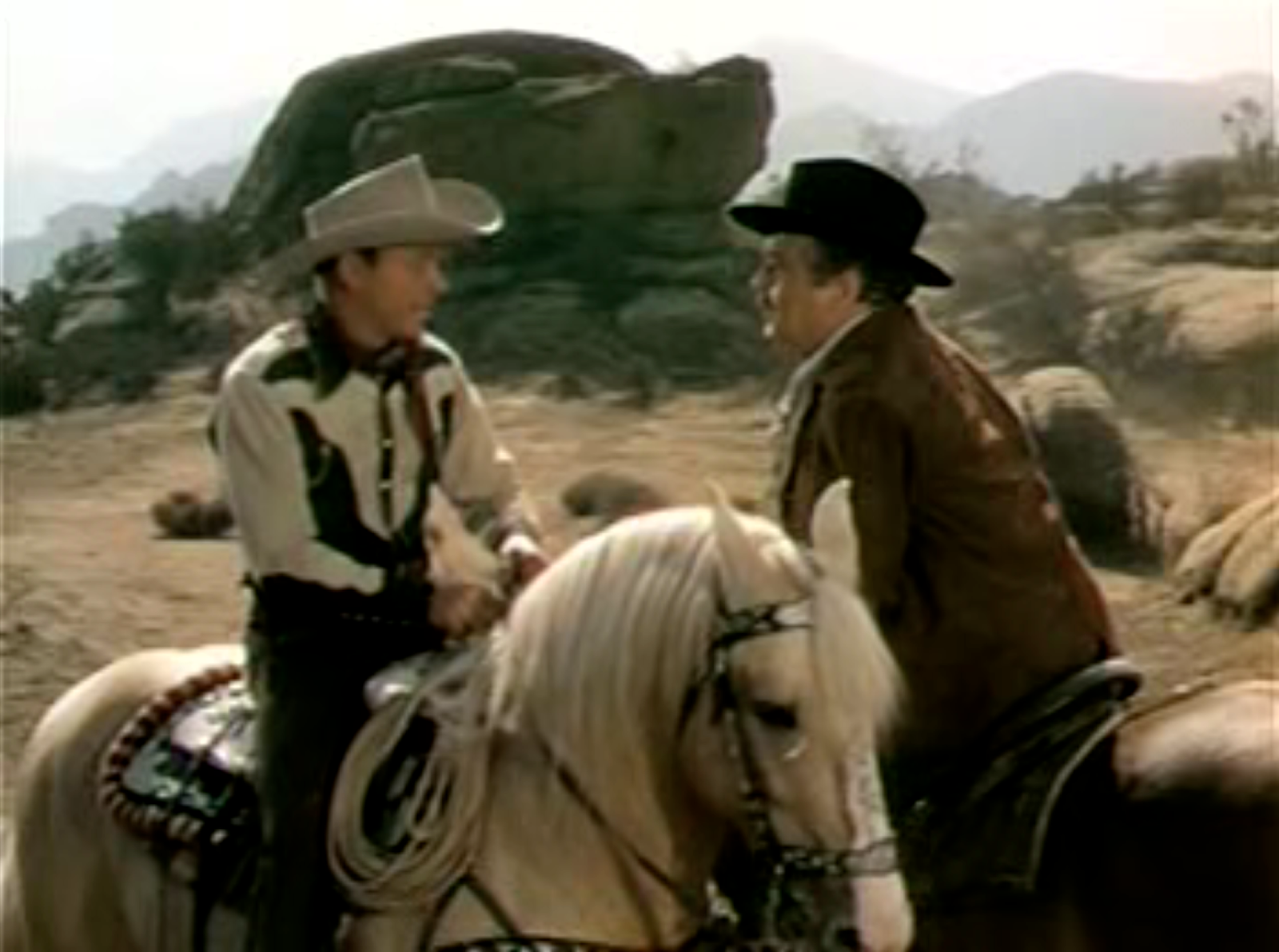
"Son of Paleface" (1952): Kinda Like Doglips

I never found Kinda Like Doglips, and initially I didn't know whether it was at Iverson or somewhere else. Eventually I narrowed it down — yes, it would have once stood at Iverson, in an area known as Silverland (not to be confused with Silvertown, which was the name of the Western town at Corriganville).

"White Squaw" (1956): Kinda Like Doglips in background

Sadly, Kinda Like Doglips doesn't exist anymore. It was destroyed years ago to make room for a concrete basin that still remains on the site. I'm unclear on just what the function of the basin was, but I've heard a rumor that the project in that area was a failed attempt to build a sewage facility.

Bird's-eye view: former Silverland area in bottom right corner

The concrete basin, and the former site of Silverland, is adjacent to the southwest corner of the Indian Hills Mobile Home Village Some of the mobile home village's famous movie rocks are also seen here — the ones surrounding the swimming pool in particular were widely filmed.

"From Here to Texas" (1958): Silverland

Silverland was a beautiful section of Iverson in the filming era, and it showed up quite a bit in the movies. These days the place is fenced off and can't easily be accessed, besides which not much remains of the landmark rocks from the filming days — Kinda Like Doglips (not seen here) and most of its neighbors were destroyed.


Here's a shot of Doglips in recent times. Not the best photo, but maybe you get the idea. Again, Doglips and Kinda Like Doglips are not the same rock.

 Here's another look at Doglips as it appears today.

Friday, July 30, 2010

More about the not-so-mysterious disappearance of Rock Island


I've posted about Rock Island before, but I wanted to add some perspective. Above is a screen shot from the Republic serial "The Perils of Nyoka" (1942) that shows Rock Island in the background (near the top of the photo, just left of center), apparently filmed from somewhere near the top of Nyoka Cliff. The prominent rock figure near the center of the photo is Doglips. Not quite as easy to spot, toward the left side of the photo, is Lone Ranger Rock, at about the same height as Doglips. The top of Lone Ranger Rock is dark, and it has a round, lighter-colored rock that looks as if it's right on top of it but is actually an unrelated rock that was behind it. The juxtaposition of Doglips, Lone Ranger Rock and Rock Island gives some idea of where Rock Island should be.

This is what the area looks like today, not from the exact same spot as the "Perils of Nyoka" shot but as close as we could get. Click on the photo to see a larger version. Again Doglips and Lone Ranger Rock are the key markers, with both of them near the center of the photo. Today Redmesa Road runs through the area, providing access to a condominium community, the start of which can be seen in the top right corner. We've gone over the area many times trying to pinpoint Rock Island, and it's not as easy as it looks. I first suspected that some of the rock fragments on the west side of Redmesa, visible at the top of this photo, just right of center, were what's left of Rock Island. But a subsequent theory puts some of Rock Island in what is now the swimming pool area of the condos (not visible in this photo, but just beyond the top right corner). The 1952 aerial photo pretty much substantiates this theory.


This post provides a little better look at Rock Island.


Enhanced by Zemanta

Sunday, July 11, 2010

Half-gone but not all-forgotten: The D-Train — an iconic rock from the movies that was "defaced" to build condos


"Perils of Nyoka" (Republic serial, 1942)

The D-Train became a fixation of mine during my first year of research into the Iverson Movie Ranch. I fell under its spell after spotting it in "Perils of Nyoka," filmed by the great Iverson cinematographer Reggie Lanning.

Redmesa Road: The "frontier" between movie rocks and condos

I searched for the D-Train for months, eventually determining — incorrectly, as it turned out — that it must have been destroyed to make way for the Cal West Townhomes off Redmesa Road, just north of Lone Ranger Rock. I later discovered that more of the D-Train had survived than I first thought.

The D-Train is the large, eel-like character that fills up much of the right half of the screen. The "cave entrance" attached to the left side of the D-Train, consisting mainly of three large boulders, is fake.

The boulders highlighted here are manmade movie props used to create the illusion of a cave entrance. However, the darker boulder above the D-Train is real, and is part of a formation known as Three Ages Rock because of a high-profile appearance in the silent movie "Three Ages," starring Buster Keaton.

I've referred in the past to the small rock on top of Three Ages Rock as the "Luggage Carrier," because its shape reminded me of one of those cargo haulers that sit on the roof of a car. While  the "Luggage Carrier" part of the rock formation remains intact today, the D-Train wasn't as fortunate — it took a hard hit when the condos went in. Essentially, it had its face blown off.

The name "Three Ages Rock" is generally applied to the overall rock formation, which includes not only the "Luggage Carrier," but also the "D-Train."

Three Ages Rock and the D-Train, in recent times

This is what's left of the D-Train — just enough of it remains that I was able to find it and make a positive ID. The film historian seen in this recent photo is leaning on the "Luggage Carrier" section of Three Ages Rock, with the surviving portion of the D-Train in the foreground.

The lighter-colored rock surface area toward the right shows where the rest of the rock was removed — either chipped away or blasted away. The original "face" of the D-Train seen in the "Perils" shot above — with its slanty eye and open mouth — is gone.

Thursday, June 24, 2010

Chinless Wonder: Isn't it ironic? (The Classic Rock that started this whole thing)

"Overland Stage Raiders" (1938)

The fuzzy black-and-white shot above is from a VHS tape of Republic's Three Mesquiteers B-Western "Overland Stage Raiders," starring John Wayne, Ray "Crash" Corrigan, Max "Alibi" Terhune and Louise Brooks. While the picture quality, especially on my screen shot, leaves much to be desired, it's an important movie to me, and an important scene: This was the first time I spotted an Iverson Movie Ranch setting in a movie.

What gave it away was the Elders — the line of light-colored, vertical structures seen in the background just above the center of the photo. The Elders themselves technically aren't at Iverson — they're a short distance south of the former movie ranch, across Santa Susana Pass Road, in the hills above Chatsworth Park. But they appear in the background in countless scenes shot at Iverson, and they have proved to be useful markers for Iverson shots, thanks to their distinctive shapes.

Closer to the foreground of the movie shot is Chinless Wonder, the dark figure on the left. Chinless turned out to be elusive, taking almost a year to track down. For most of that time my leading theory was that it had been destroyed to make way for Redmesa Road and condo development. Sadly, a number of important rocks in that area were in fact destroyed when the development took place, but it turns out that Chinless Wonder survived.

Doglips: Chinless Wonder from a different angle

Eventually a lightbulb went off and I discovered that not only was Chinless Wonder still around, it was simply an unusual angle on a rock that I already knew well — one I had come to call Doglips, which you can read more about by clicking here.

Chinless Wonder as it appears today

Unfortunately, because of a thick growth of trees where the camera would have to go, it is not possible to accurately re-create the angle that produces Chinless Wonder. But I've come as close as I could in the shot above, peering out through some foliage to the north of the rock. I know it's not easy to see that they're the same rock. For one thing the lighting is just about opposite: The movie shot was taken in the morning and my shot was taken in the evening. But if you look closely and compare whatever little details you can spot, it works out.

I generally avoid calling things "ironic," because it's an often-misused label and it seems as though most of the time it's just flat-out wrong. But in this case, I'll make an exception. Given that Chinless Wonder, as it appears in the above shot, seems to be making a point of proudly pushing out its prominent chin ... OK, it's ironic.

This post is part of a series on "Classic Rocks" — sandstone giants located on the former Iverson Movie Ranch in Chatsworth, Calif., that became a part of not only America's physical landscape but also its cultural heritage, through featured roles in old movies, cliffhanger serials and early TV shows. Other entries in the series can be seen by clicking here.

The links below should take you to various Amazon listings for items related to "Overland Stage Raiders," including the DVD and Blu-ray versions of the movie:

Monday, May 24, 2010

Classic Rock: "Doglips," aka "Chinless Wonder" — This strange rock formation on the Iverson Movie Ranch starred in countless Westerns in the 1930s-1950s


The rock formation "Doglips," on the Iverson Movie Ranch in Chatsworth, Calif.

Doglips is something Salvador Dali might have conjured up. It's so weird it's hard to believe it happened naturally. Not only is it weird from the angle seen here, which is the "common" view, as seen from Redmesa Road, but it's also weird from just about every other angle.

The same rock from another angle, getting its "Chinless Wonder" on

The rock hid one key element of its personality from me for months, until I was finally able to determine that Doglips was also Chinless Wonder, a rock I had been searching for from the beginning and couldn't find even though it was right under my nose. I love this view of Chinless Wonder/Doglips looking like some kind of cocky cartoon character.


"Jungle Girl" (1941)

Here's another look at Chinless Wonder — in other words, Doglips — as it appears in the old Republic serial "Jungle Girl." It's the dark, sort of monkeyhead-shaped figure that dominates the left half of the shot. You can also catch a glimpse of the Elders just to the right of it, in the background, the light-colored rock more or less in the center of the shot. I've highlighted both of these landmarks in the shot below.

The "Jungle Girl" shot again — with two key features noted

For more on the Chinless Wonder aspect of Doglips, check out this post. And you'll find more about Doglips/Chinless wonder by clicking here or by finding Doglips (or Chinless Wonder) in the long index of labels at the right side of this page.

Here's a partial list of movies, TV shows and serials in which Doglips appears — just a fraction of the total:

Undersea Kingdom (1936)
Ghost-Town Gold (1936)
Zorro Rides Again (1937)
Overland Stage Raiders (1938)
Wall Street Cowboy (1939)
Frontier Pony Express (1939)
Jungle Girl (1941)
King of the Texas Rangers (1941)
The Perils of Nyoka (1942)
Raiders of Ghost City (1944)
Son of Zorro (1947)
The Hawk of Powder River (1948)
Lone Ranger (TV series) (1949-1957)
The Invisible Monster (1950)
Don Daredevil Rides Again (1951)
Sky King (TV series) (1951-1962)
The Roy Rogers Show (TV series) (1951-1957)
Zombies of the Stratosphere (1952)

This post is part of a series on "Classic Rocks" — sandstone giants located on the former Iverson Movie Ranch in Chatsworth, Calif., that became a part of not only America's physical landscape but also its cultural heritage, through featured roles in old movies, cliffhanger serials and early TV shows. Other entries in the series can be seen by clicking here.