Why we love old movie locations — especially the Iverson Movie Ranch

For an introduction to this blog and to the growing interest in historic filming locations such as the Iverson Movie Ranch — the most widely filmed outdoor location in movie and TV history — please read the site's introductory post, found here.
• Your feedback is appreciated — please leave comments on any of the posts.
• To find specific rock features or look up movie titles, TV shows, actors and production people, see the "LABELS" section — the long alphabetical listing on the right side of the page, below.
• To join the MAILING LIST, send me an email at iversonfilmranch@aol.com and let me know you'd like to sign up.
• I've also begun a YouTube channel for Iverson Movie Ranch clips and other movie location videos, which you can get to by clicking here.
• Readers can email the webmaster at iversonfilmranch@aol.com
.

Showing posts with label Built at Iverson. Show all posts

Monday, October 6, 2014

Nailing down the location of the Snakeskin Mine Shack in the George Montgomery movie "Gun Belt"


The 1953 Western "Gun Belt" shot virtually all of its outdoor action on the Iverson Movie Ranch. The scene depicted in the above promotional still for the movie, featuring George Montgomery on the left with a young Tab Hunter, was filmed in Central Garden of the Gods.

"Gun Belt" (1953) — Snakeskin Mine Shack

The movie contains a few Iverson rarities, notably this small cabin located in the Rooster Foot area near the northern edge of Cactus Hill. The cabin is presumed to be a facade, as this view of it is the only one that appears in the movie. But it's noteworthy nonetheless, because it was extremely rare to find any manmade structures on Cactus Hill during the filming era.

I call the structure the Snakeskin Mine Shack because of this sign that appears early in the film, pointing the way to what turns out to be the shack.

Cactus Hill, on the former Iverson Movie Ranch

Cactus Hill, seen from the north in this Bing bird's-eye view, is a large hill that separated the Upper Iverson and Lower Iverson. Today it is home to a couple of water tanks, and construction of residential estates has recently begun at its eastern end. This shot and the additional bird's-eye views that follow can be seen in greater detail by clicking on them to enlarge them.

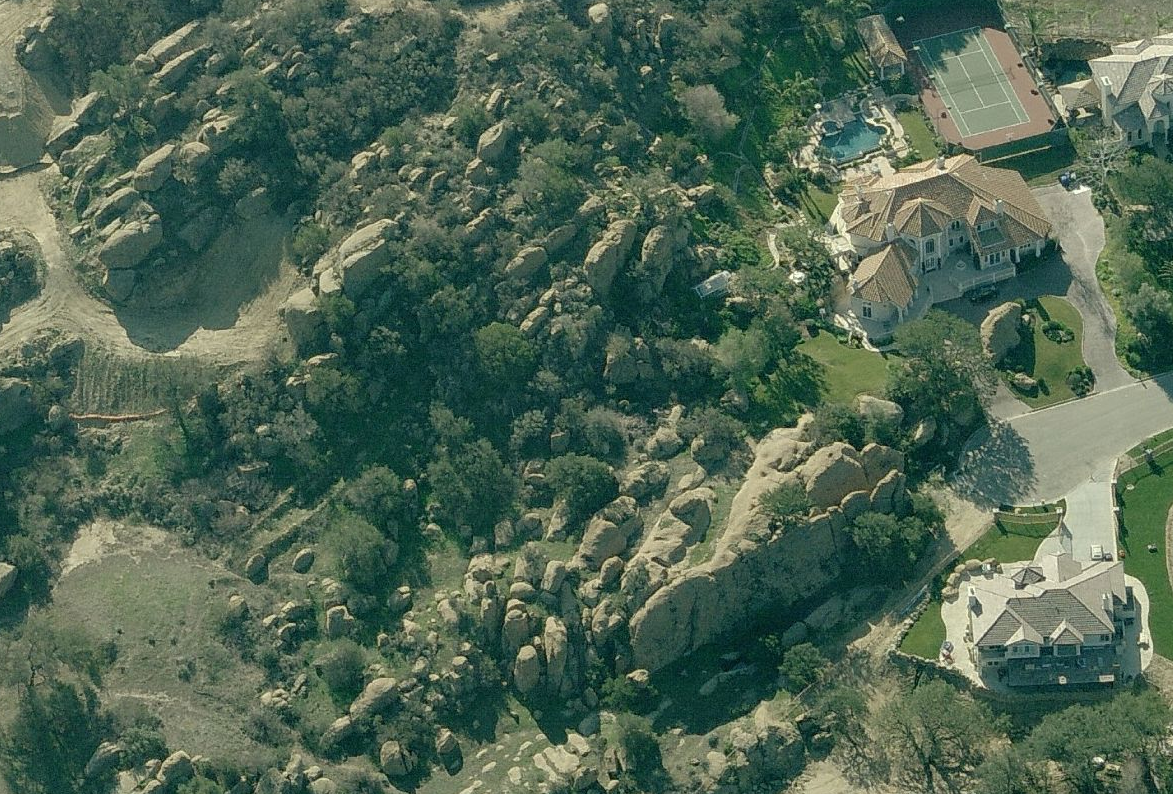
Much of the northern edge of Cactus Hill is strewn with heavily filmed movie rocks, appearing in this shot as a diagonal band of rocks stretching from bottom left to top right. Most of the former Upper Iverson has been taken over by large residential estates, a few of which can be seen in the bottom half of the shot. It should be noted that, because these shots look at Cactus Hill from the north, the shot is "upside-down," with the former Upper Iverson appearing at the bottom of the frame.

Of particular interest for examining the shack location in "Gun Belt" is this zoomed-in portion of Cactus Hill, again seen in a Bing bird's-eye view. This shot offers a better look at a large rock formation I call Rooster Foot, near the bottom of the frame.

This is the large rock feature I'm talking about when I refer to Rooster Foot.

Zooming in further on the Rooster Foot area we can pinpoint the location of the Snakeskin Mine Shack.

This shot points out the rocky background area that appears behind the mine shack in the movie shot.

Here's another look at the shack in "Gun Belt." Notice the rocks in the background.

This is what those rocks look like today. The shot was taken by photographer and film location researcher Jerry Condit, who discovered the location of the shack.

"Gun Belt" (1953) — Platypus Shack

"Gun Belt" contains a few other interesting Iverson structures as well, including an upgraded version of the Platypus Shack, seen in this screen shot. As modest as this building may appear, an earlier version of the Platypus Shack wasn't nearly as fancy. It was also located in a slightly different spot, sitting just a bit farther away from the rock Platypus, seen at the left of the shot. I've blogged previously about the Platypus Shack, and you can read that entry by clicking here.

"Gun Belt" lobby card showing action on the Upper Iverson

You can click on the Amazon link below to check out a four-movie DVD set that includes "Gun Belt" along with another nice Iverson movie, "The Lone Gun," from 1954. The set also contains two non-Iverson movies, "Gunsight Ridge" and "Ride Out for Revenge."

Wednesday, March 26, 2014

Monogram commits to Harry Carey

 "China's Little Devils" (1945)

I'm about as hard to convince as anyone that a building actually existed where the filmmakers want us to think it did — rather than being "placed" there through special effects. But it appears that they actually did put up a building on the Upper Iverson for Monogram Pictures' barely seen World War II movie "China's Little Devils," starring Harry Carey. In the above shot the building appears in front of Cap Rock, one of the most familiar Upper Iverson features due to its prominent role in countless B-Western chase sequences.

The building is shot from a number of angles in the movie, and appears with a variety of the Upper Iverson's known rock features. In this screen shot the rock known as the Molar appears at top left, with the building at top right.

Here's another shot of the Molar from the same movie, with Harry Carey, as Doc Temple, lining up a group of Chinese youngsters. The shot is taken from a different angle from the previous shot, and Cactus Hill can be seen in the background.

Harry Carey and a young actor in "China's Little Devils" (1945)

The movie was one of the last for Harry Carey, who spent much of his career in the silents. Some readers may be more familiar with the work of his son, actor Harry Carey Jr., who segued from B-Westerns in the 1940s and 1950s to a long career in television. But Carey Jr.'s dad, Harry Carey Sr., had an even more prolific acting career. Besides being one of the top stars of the silent movie era, he transitioned successfully to the talkies and was nominated for an Oscar in 1940 for "Mr. Smith Goes to Washington."

Here's another shot that includes the building — I'll call it "Carey's Cabin." In this shot the background includes Rock in the Field, as noted in the next photo.

This is the same shot with Rock in the Field highlighted.

Rock in the Field, as seen in "The Lowest Bidder," a 1954 episode of the TV series "The Cisco Kid"

For comparison, here's a shot of Rock in the Field from a different production — an episode from season five of the "Cisco Kid" TV series that first aired Oct. 30, 1954. Rock in the Field is at the center of the shot. Notice the positions and shapes of the trees behind the rock — the tree at far left, and the one just behind the rock. If you compare these to the trees near Rock in the Field in the "China's Little Devils" shot above, you can tell they're the same trees, and the angles used in the two productions are similar.

"China's Little Devils," left, and "The Cisco Kid," right

The above shot compares the two productions, showing how the trees, even nine years apart, retain enough of their shape to help make a positive ID on Rock in the Field, in turn helping to pinpoint the location of the building in "China's Little Devils."

Another angle on Carey's Cabin. I have yet to spot the building anywhere other than in "China's Little Devils."

Recessed central area of Carey's Cabin in "China's Little Devils"

All indications are that Carey's Cabin was built specifically for "China's Little Devils" — the indications being mainly (1) it's not showing up anywhere else, and (2) it's used extensively in the movie. Given the tight budgets that were standard at the Poverty Row studios, including Monogram, the structure reflects an unusual level of commitment on the part of the company to the movie and Harry Carey.

Harry Carey Jr., left, and Harry Carey Sr., right

Them fightin' Carey boys.

Saturday, March 10, 2012

Built at Iverson: Lone Ranger Rock Shed

In addition to the more widely documented "permanent" structures that were in place at the Iverson Movie Ranch during the peak filming years — the Western street (Iverson Village), Middle Iverson Ranch Set, two relay stations (Saddlehorn and Grove), the Fury Set and a number of key cabins and shacks (Grove Cabin, Gorge Cabin, Hidden Valley Cabin, Hangover Shack) — a series of lesser-known buildings came and went over the years. I'm always glad to spot new ones, even if they were only around for one movie or TV episode. Two other examples that I wrote about previously can be seen at the bottom of this earlier post.

"Have Gun — Will Travel" (1960)

Here's a temporary building that turned up during season three of "Have Gun — Will Travel" in an episode called "Jenny," which first aired Jan. 23, 1960. This shed would have been in place during production of that episode in 1959. It's obviously a really minor structure, just a simple shed, and it looks portable. But what's interesting about it here is where they put it: right below one of the most famous rocks at Iverson, Lone Ranger Rock. For that reason I've been referring to it as Lone Ranger Rock Shed — the obvious names tend to be easiest to remember. In the shot above, which looks toward the west, Lone Ranger Rock isn't especially clear but that's it above and to the right of the shed. The big cluster of rocks that dominates the top-center of the photo is in Garden of the Gods, and includes Tower Rock (also known as Indian Head).

A closer look at Lone Ranger Rock Shed gives a better idea of its proximity to Lone Ranger Rock, which appears in the top right corner. Many of you will probably recognize the rider from his back, but of course that's Paladin, the "Gun" in "Have Gun Will Travel," always in black, played by Richard Boone.

A still closer look at the shed spotlights its simple appointments — sterile enough that if we didn't know any better it might look like a studio set. But what gives it away here is the glimpse of the southeastern corner of Garden of the Gods at top left. These rocks can still be found off Redmesa Road in Chatsworth, and can be accessed by a fairly easy hike through the portion of the former Iverson Movie Ranch that has been preserved as Garden of the Gods Park.

I was just about finished with this post when I realized the same shed — or one just like it — also appears in another episode of "Have Gun — Will Travel," later in the season, relocated to a different part of Iverson. These days I suppose our first impression would be that it's something prefab and they may have stamped out a bunch of them, but the likelihood is that it's the same shed. The above screen shot is from the episode "The Trial," which aired June 11, 1960. The shed looks a lot more beat-up here but still appears to be the same one, based on its windows, door and roofline. It shows up this time in the Cave Rocks area, which is now the swimming pool area of the Indian Hills Mobile Home Village. I'm sticking with the name "Lone Ranger Rock Shed," as the earlier placement of the shed near Lone Ranger Rock is just so iconic (and what else would it be called anyway).

I've included a link below to the complete Season 3 DVD release of "Have Gun Will Travel," available on Amazon.com. The series is a good one for Iverson sightings, and Season 3 is among the best seasons. I found Iverson content in eight of the 39 episodes, including the two episodes mentioned above, and I still have a few left to scan. The show produces a lot of "Iverson surprises" — and besides, it's a good show.