Why we love old movie locations — especially the Iverson Movie Ranch
For an introduction to this blog and to the growing interest in historic filming locations such as the Iverson Movie Ranch — the most widely filmed outdoor location in movie and TV history — please read the site's introductory post, found here.
• Your feedback is appreciated — please leave comments on any of the posts. • To find specific rock features or look up movie titles, TV shows, actors and production people, see the "LABELS" section — the long alphabetical listing on the right side of the page, below. • To join the MAILING LIST, send me an email at iversonfilmranch@aol.com and let me know you'd like to sign up. • I've also begun a YouTube channel for Iverson Movie Ranch clips and other movie location videos, which you can get to by clicking here. • Readers can email the webmaster at iversonfilmranch@aol.com.
Showing posts with label Republic Pictures. Show all posts
Showing posts with label Republic Pictures. Show all posts
John Wayne courts Louise Brooks on the Upper Iverson in "Overland Stage Raiders" (1938)
It's a little surprising that John Wayne, probably the biggest Western movie star of them all, only rarely worked on the Iverson Movie Ranch, the most heavily filmed Western movie shooting location by a long stretch. I know of only two Westerns in which the Duke put in time at Iverson: his breakthrough role in John Ford's 1939 masterpiece "Stagecoach," and a much lower-profile appearance the previous year in "Overland Stage Raiders." He also made a high-profile war movie, "The Fighting Seabees," at Iverson in 1944.
"Overland Stage Raiders" was made before Wayne became a big star, when he was still paying his dues playing Stony Brooke in Republic's low-budget Three Mesquiteers series. Wayne did get top billing over fellow Mesquiteers Ray "Crash" Corrigan and Max "Alibi" Terhune, but not by much.
Four of the key players in "Overland Stage Raiders" appear in a publicity shot for the movie. In the back row, from left, are John Wayne, Louise Brooks and Ray Corrigan, with Max Terhune in front. Wayne appeared in a total of eight of Republic's Three Mesquiteers features in the span of a little more than a year, from 1938-1939.
John Wayne leads the charge across the Upper Iverson in a blurry screen shot from "Overland Stage Raiders."
Here Wayne and his fellow Mesquiteers work the Gorge on the Lower Iverson.
A still shot offers a better look at Ray Corrigan, left, and John Wayne at work on the Lower Iverson in "Overland Stage Raiders" in 1938. Corrigan was already setting up his own movie location ranch at the time, having bought property in Simi Valley in 1937 and beginning construction on what would become Corriganville — one of the few location ranches to rival the success of Iverson during the heyday of the B-Western.
Wayne and Brooks continued to connect at the wrap party for "Overland Stage Raiders."
A later poster for the movie gives greater heft to its star, John Wayne, after his career began to take off.
"Santa Fe Stampede" (1938) — Upper Iverson in the background, via rear projection
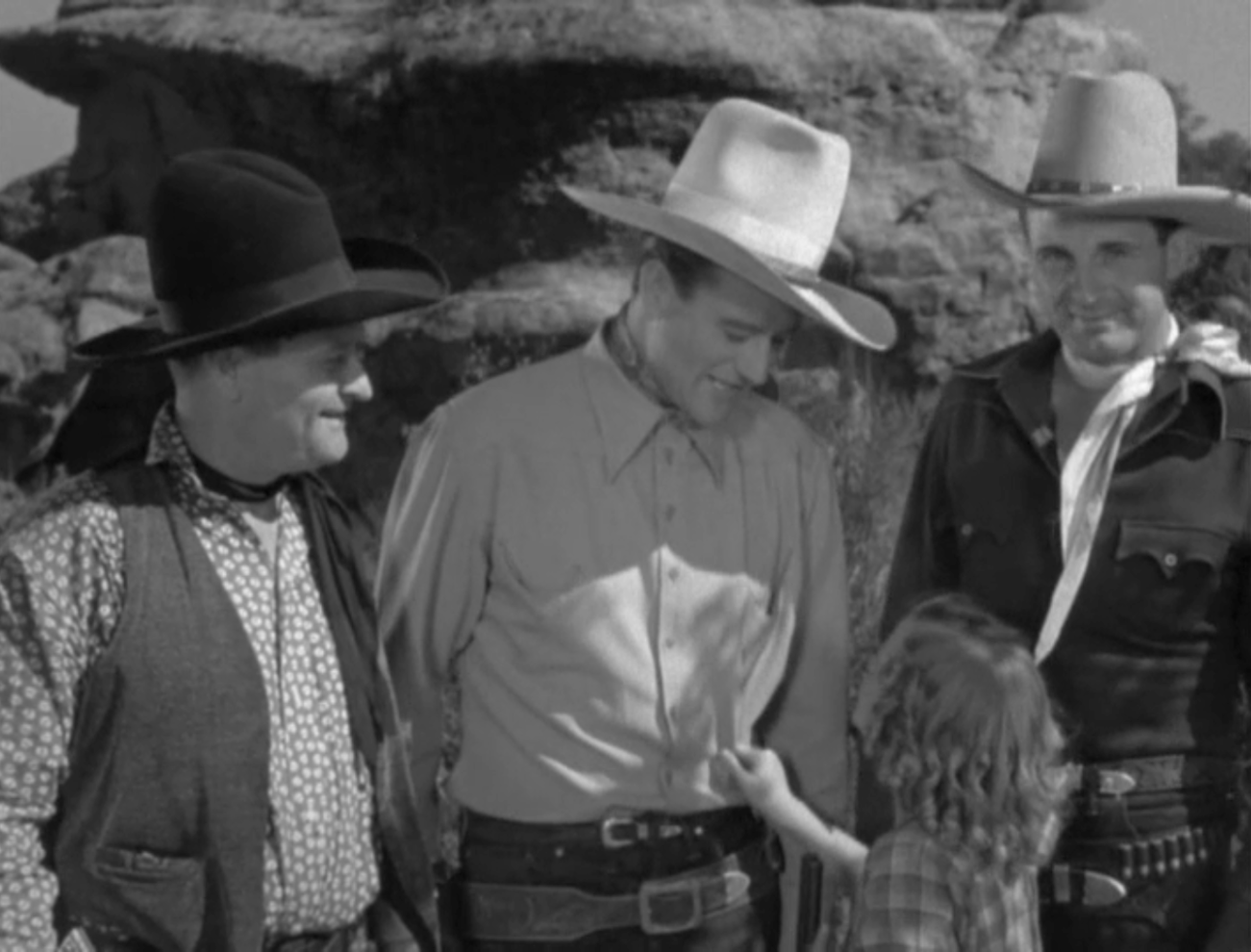
John Wayne does appear in a couple of other Three Mesquiteers movies that contain some Iverson footage, but as far as I can tell neither of these would have required the Duke to show up at Iverson. The "Santa Fe Stampede" shot above features the Upper Iverson in the background, but the lighting makes it pretty obvious the shot is done in the studio using rear projection. That's silent movie great William Farnum on the left, in one of his later roles, with child actress Genee Hall at center, jammed between the once and future legends.
"Santa Fe Stampede" — The Duke, center, on Brandeis Ranch in Chatsworth, Calif., interacting with young Genee Hall. The other Mesquiteers are again Max Terhune, left, and Ray "Crash" Corrigan.
The Duke did make his way to Chatsworth during filming for "Santa Fe Stampede" — and in fact, probably had to drive across the Iverson Ranch to get to work. That's because some of the location filming on the movie was done at Brandeis Ranch, Iverson's immediate neighbor to the west — and the entrance road to Brandeis ran through Iverson.
"Santa Fe Stampede": Brandeis Movie Ranch, with portions of the Upper Iverson in the background
With Brandeis and Iverson adjacent to each other, the two filming locations frequently appeared in the backgrounds of each other's movies, as in the example above. This scene prominently features a rock I call the Brandeis Toad, nearest the center of the frame. A little bit of the Upper Iverson is visible in the background, along with some familiar features to the east of Iverson.
Here's the same shot with some key features spotlighted. Cactus Hill and the rocks just below it are on Iverson property, while Two-Humper and Notch Hill are located east of Iverson and show up regularly in the backgrounds of productions filmed on the ranch. Brandeis, which was also known during the late 1930s as the Lazy A Ranch, operated as a filming site for only a short time, with the bulk of the production taking place from 1935 to 1942.
Corriganville, in a scene from "Santa Fe Stampede"
Additional location work for "Santa Fe Stampede" took place a few miles to the west at Corriganville in Simi Valley, where Ray Corrigan's location ranch was now up and running. The large rock face in the background at right later became known as Fort Apache Rock, as it appeared regularly in scenes with Corriganville's widely used Fort Apache set.
Both Fort Apache Rock and the much smaller, but equally distinctive, beetle-shaped rock toward the left, which I've nicknamed "the Scarab," became familiar sights in the movies as Corriganville developed into a busy filming location during the 1940s and 1950s. The Scarab can still be found at the site, but Fort Apache Rock was partially destroyed in the 1960s to make way for the 118 Freeway — the same freeway that dealt a severe blow to filming at Iverson, several miles to the east.
The only other Western on my list of John Wayne's Iverson productions is
another Three Mesquiteers feature from Republic, "Three Texas Steers," released in1939. The Iverson material in this one is minimal, consisting of barely visible archival footage, again inserted through rear projection. In all, Republic cranked out 51 installments of its Three Mesquiteers franchise, spanning 1936-1943, with John Wayne featured in eight of those efforts.
Below I've included a few links to Amazon offerings of the movies discussed in this entry, including DVD and Blu-ray, along with a streaming version of "Santa Fe Stampede."
Theodore Lydecker, left, and brother Howard Lydecker
Brothers Howard Lydecker and Theodore Lydecker were old-school special-effects wizards who worked together at Republic Pictures for the studio's entire run, from the mid-1930s well into the 1950s, using low-tech artistry to elevate Republic's serials and B-movies beyond what the studio's Poverty Row rivals were capable of pulling off.
"Commando Cody" (1953): A Lydecker brothers mini-space ship "lands" on the Upper Iverson
They were masters of the miniature model, whether it was space ships, buildings, trains, automobiles, stagecoaches — many a car or covered wagon went over a cliff under their watchful eyes. The above example of a Lydecker miniature comes from the Republic serial "Commando Cody: Sky Marshal of the Universe," and shows a model space ship "landing" in a setting composed of some actual Upper Iverson footage in the background along with a miniature fence and fake rocks in the foreground.
Lydecker brothers model of the Grove Relay Station, from "Zorro's Black Whip"
On a number of occasions the Lydeckers replicated actual structures at the Iverson Movie Ranch — only to see their creation ultimately destroyed by fire, crushed by avalanche or otherwise mutilated. It was all good fun, and now, through the magic of screen shots and our own low-tech special effects — especially slow-motion and pause — we're able to appreciate their craftsmanship on a whole other level.
The actual Grove Relay Station on the Iverson Movie Ranch, also from "Zorro's Black Whip"
The Lydeckers' work in the 1944 serial "Zorro's Black Whip," where the brothers created a realistic replica of Iverson's Grove Relay Station and then crushed it in an avalanche set off by the bad guys, is a good example of their connection to the Iverson Movie Ranch. It's pretty hard to tell the real relay station from the model, but the best clue comes when the place starts being destroyed by the avalanche — at that point, you know it's the model.
Down comes the mountain ...and the model begins to collapse.
The 1962 Cold War movie "Panic in Year Zero," starring and directed by Ray Milland, with Jean Hagen, Frankie Avalon, Mary Mitchell and Joan Freeman, tells the story of the Baldwins, a family that escapes Los Angeles just before a nuclear attack and starts a new life in the wilds of what we now know was the Iverson Movie Ranch. The movie features some of the more interesting shots of Iverson to survive from its later years as a working movie location.
The adventure begins innocently enough ...
The above shot is taken on the former Republic Pictures backlot in Studio City, Calif., where countless B-Westerns were also shot. It shows the start of what was supposed to be a normal family vacation — this was before the bomb fell — and we can see that the neighbor's house, at the left in the above shot, is a converted barn. The same barn, formerly known as Melody Ranch, was seen in a number of Gene Autry's Republic movies along with many other Westerns. (Gene later used the name Melody Ranch for his own movie ranch in Newhall.) As it appears here, converted to something like a large suburban house, the same building also reportedly functioned as the family home on the TV show "My Three Sons." The Republic lot went through many incarnations over the years — it was originally the Mack Sennett-Keystone lot, then home to Mascot Pictures before Republic took over — and eventually became CBS's Radford lot, which it remains today. (The barn, however, is long gone.)
In a pivotal sequence in "Panic in Year Zero," the Baldwin family looks back on L.A. and gets the bad news in the form of a massive mushroom cloud. The shot is taken from Santa Susana Pass Road between the San Fernando Valley and Simi Valley, which was the main road between the two valleys before the 118 Freeway went in. (The 118, completed around 1969, effectively wrote the epitaph for both Iverson and Corriganville, two of the most important movie ranches of the old Hollywood era.)
Another view of the mushroom cloud, without the family in the picture, reveals a distinctive rock at the bottom of the shot, which is a key to finding the location today. While it's hard to make out in the distance, much of the Lower Iverson Movie Ranch appears in the shot, just above and to the right of the large rock near the bottom center of the photo. The shot is taken from a short distance west of Iverson.
Here's another shot from the movie with the same general view before the bomb hits, where it's a little easier to make out the Lower Iverson in the background, along with a portion of the still relatively undeveloped San Fernando Valley, circa 1962. You may be able to spot Garden of the Gods and other Iverson features. (Click on the photo to enlarge it if needed.)
Here's what the site looks like today. The spot can be easily found — thanks to that one distinctive rock — and is viewable from a turnout along the side of the road. Here again, Iverson is visible near the center of the shot. The Rocky Peak Church also appears in this shot — the white complex with a red roof, just above that distinctive rock — and some of the condos and other features of the modern-day Iverson Ranch are also seen.
As the bomb turns loose millions of panic-stricken Angelenos on the highways, the Baldwin family seeks refuge in the wilderness, which means Iverson. Here they arrive at a secret camping area, through a gate marked by a couple of formidable boulders that can still be found on the Upper Iverson. In other movies this pair of boulders had horses and stagecoaches riding between them on a regular basis.
Here's a better look at the rock on the right. To me it looks kind of like a duckbill. Today these same two rocks frame a private driveway, shown in the photo below.
I don't have the right angle, but this rock — the one that fills much of the right half of the shot — is the same "duckbill" seen in the shot above. I'm sorry to report that the duck's bill was shaved off to allow for a wider driveway. (You can see in the shot of the trailer above that it's a tight fit.)
Deeper into the backcountry, the Baldwins drive past a familiar rock formation, at the top left in the photo, seen in many old Republic serials and B-Westerns. I call it Smiling Lion. An interesting touch here is the bridge, which apparently was just a temporary construction for this movie that was then quickly torn down. It appears to cross the tiny creek that traverses the Upper Iverson. (I've been calling it Iverson Creek, because what else would it be. But I have since learned that some of the hikers and other people who are familiar with the area call it Fern Ann Creek or Fern Ann Falls Creek.)
Here's a modern view of Smiling Lion, again not exactly the right angle — it looks more like a grouchy lion from this angle. But you get the idea.
In a twist that's either ironic or coincidental, depending on how you define those terms (a lot of people get it wrong, so I won't even try), this shot of the family car and trailer continuing the journey across the Upper Iverson contains a barely visible and yet significant sighting. In the background, at the very top of Oat Mountain, toward the left of the photo, is a tiny white circle. (You can see it better if you enlarge the photo by clicking on it.) This is believed to be a radar dish, part of the Nike missile base that is known to have occupied much of the top of Oat Mountain during the Cold War. The base, known to insiders as LA-88, was operational from 1956 through 1974 as part of the nationwide Nike missile defense system. A detailed history of the Oat Mountain Nike facility can be found here.
Here's a shot of more or less the same section of Oat Mountain in more recent times. The radar dish is no longer seen, although other electronic equipment is visible. During the years since things cooled off with the Soviets, much of the area atop Oat Mountain has been converted to microwave towers for use by cell phones and other mobile devices. If anyone is feeling nostalgic for the "good old days" of Nike missile bases in the hills above L.A., don't be. The Nike base atop Oat Mountain was an artifact of the period before even the 1980s-era Strategic Defense Initiative, when the prevailing doctrine of nuclear defense was "mutually assured destruction" — the same nightmare scenario that plays out in "Panic in Year Zero."
Here's another section of Oat Mountain, just to the west of the shot above. This shot provides a pretty good look at some of the equipment in place today atop the mountain, presumably mostly microwave towers. However, the white building that is the most prominent feature at the top of the hill, seen to the left of center, has been there for decades and does show up sometimes in the productions. I'll post some examples later, but I've seen it in the TV show "Bonanza," among others. I've traditionally assumed it was part of the base, but I don't know what its function is today. I do know that at least part of the property atop Oat Mountain remains in military hands. I've seen a few videos of the former Nike site in recent years (here's one of them) and it appears to be completely dismantled. But I wouldn't be surprised to find out they're still keeping track of things from up there — even if they're no longer ready to fire off a nuclear warhead in the blink of an eye.
One last shot from "Panic in Year Zero": Later in the "camping trip from hell," dad and his teenage son — Ray Milland and Frankie Avalon — go hunting, with the rock wonderland that is the Lower Iverson's Upper Gorge in all its glory in the background. This shot is taken from the camera mount in Garden of the Gods.
The Middle Iverson Ranch Set also appears in "Panic in Year Zero," and those shots can be seen here. (Scroll down to about the 14th and 15th photos to see the "Panic in Year Zero" stuff.)
Here's a screen shot from the 1948 Rocky Lane movie "Sundown in Santa Fe," from Republic Pictures. Visible in the background is a cluster of fairly obscure rocks found on the Upper Iverson Movie Ranch, the focal point being the one with a large, flat "forehead" seen toward the right side of the shot.
Not nearly as flashy as some of the other landmarks of the Upper Iverson, this little group of relatively unknown rocks nonetheless got its share of screen time in the backgrounds of chase sequences during the heyday of the B-Western. They were (and still are) located below and between some of the larger and more iconic chase rocks found in the Upper Iverson's widely filmed South Rim area, such as Prominent Rock (also known as Medicine Rock) and Eagle Beak Rock. I started calling this cluster the Frankenstein Group a while back, because the large forehead on that one rock seemed to be asking for it.
I stumbled upon "Frankenstein" in real life on a 2009 visit to Iverson. I was intrigued by the look of the rock but did not immediately recognize it from the movies. I just thought of it as an interesting character, and I snapped a few photos. Here's one of them:
It wasn't until sometime later — just the other day, while sifting through photos — that it occurred to me there might be a connection between "Frankenstein" and my South Rim denizen. Sure enough, they turned out to be the same rock.
The rock doesn't look much like Frankenstein in real life — it's uglier than Dr. F's man in green. But then, that's a part of what makes it beautiful. Iverson's "Frankenstein" has also probably been in more movies than the famous movie monster — although admittedly, it could be a close call.