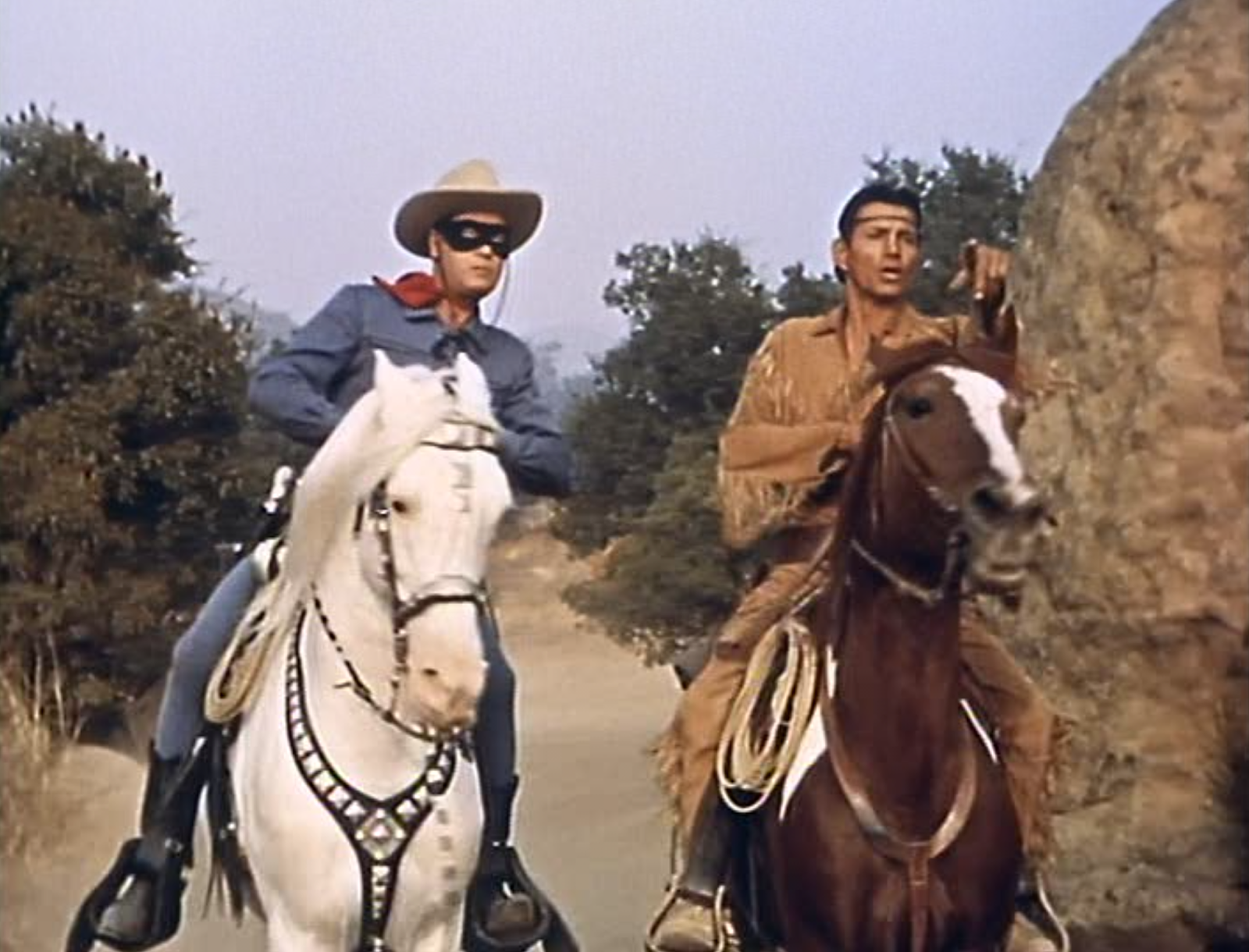
"The Lone Ranger" (1957): Clayton Moore and Jay Silverheels on the Lower Iverson
The TV show "The Lone Ranger" aired just one season in color — the final year of its five-season run on ABC. The 39 color episodes that made up season five aired from 1956-1957.
"The Sheriff of Smoke Tree" (premiered Sept. 20, 1956)
Much of the show's location footage during season five was filmed on
the Iverson Movie Ranch, producing memorable color images of the ranch
during one of its most productive periods.
Tonto playfully lassoes the Lone Ranger outside the Cottage on the Middle Iverson Ranch Set
in "Decision for Chris McKeever" (Dec. 6, 1956)
Season five marked a homecoming for series stars Clayton Moore and Jay Silverheels, as the show took on its most ambitious Iverson shooting schedule since production on season one in 1949-1950.
"Quarter Horse War" (Nov. 8, 1956)
The saddle pals take a break at a "water feature" — probably just a puddle left behind by the rain. The scene takes place on a lightly filmed patch of land near the eastern boundary of the Lower Iverson. This land no longer exists, having been demolished in the 1960s to put through Topanga Canyon Boulevard.
The "Topanga Cut," as it appears today (looking east)
This recent bird's-eye view diagrams approximately where the water feature (or puddle) in the previous shot would have been located — somewhere in the middle of the "Topanga Cut." The demolition required to extend Topanga to the 118 Freeway resulted in the loss of a substantial chunk of scenic terrain.
The Topanga Cut, looking west
This bird's-eye highlights the scale of the Topanga Cut, including the enormous change in elevation between the original Iverson Movie Ranch property at the top and the current level of the road far below. Notice how the cars are dwarfed by the "slice" that was carved through the terrain.
John Beradino as stage holdup specialist Lem Crater in "The Sheriff of Smoke Tree"
In "The Sheriff of Smoke Tree," former Major League infielder Johnny Beradino — who went by "John" after he transitioned to acting — led a crew of outlaws who terrorized the Lower Iverson holding up stagecoaches. Beradino would resurface in a variety of bad-guy roles throughout season five.
The shot of Beradino includes a couple of Iverson-area landmarks, noted here. The Football can be found today among the condos, as I've
discussed in previous posts. Elders Peak, also known as Rockridge, Sunset or Retz Peak, is situated south of the movie ranch.
Maurice Jara as Red Cloud — "The Courage of Tonto" (Jan. 17, 1957)
Much of the episode "The Courage of Tonto" was filmed in Iverson's Garden of the Gods, including this sequence set in the Central Garden of the Gods. The camera is pointed toward the west, with Getaway Rock featured prominently behind Maurice Jara and Green Hill in the distance.
Getaway Rock in modern times — Central Garden of the Gods
Getaway Rock and Green Hill remain in place today, as seen in this photo from a visit to the ranch in 2014.
"The Courage of Tonto"
For this part of the sequence the camera remains in roughly the same place, but is turned around and aimed toward the east. Visible between Maurice Jara and Jay Silverheels is part of the
Harum Scarum Cluster.
"The Avenger" (Jan. 10, 1957): Central Garden of the Gods
This shot taken in the same area appears in the episode "The Avenger," which premiered one week before "The Courage of Tonto." A portion of the Harum Scarum Cluster can again be seen, along with the Old Yeller Tree.
"Old Yeller" (released Dec. 25, 1957)
When the Old Yeller Tree appeared about a year later in the Disney movie "Old Yeller," the tree was embellished with prosthetic limbs and a few fake rocks were added to the Harum Scarum Cluster.
The tree and rock cluster were featured in the dramatic feral pigs sequence in "Old Yeller" — a tearjerker that left many a young movie goer emotionally scarred.
This shot offers a rough idea of which of the rocks were real and which were fake in "Old Yeller." The rock highlighted in yellow is pretty easy to spot between Red Cloud and Tonto in the "Lone Ranger" photo up above.
"Tennessee's Partner" (1955): John Payne and Ronald Reagan in Central Garden of the Gods
The same setting — including the Harum Scarum Cluster and the Old Yeller Tree — can be seen during the climactic sequence in the Western
"Tennessee's Partner," which you can read about by clicking here.
The Harum Scarum Cluster in recent times (Central Garden of the Gods)
The Harum Scarum Cluster remains in place today in Central Garden of the Gods. However, the Old Yeller Tree no longer exists.
"Outlaw Masquerade" (Jan. 3, 1957)
The Ranger pursued bad guys on the decaying Iverson Western street in "Outlaw Masquerade," which was filmed in 1956 for its premiere in early 1957.
"Outlaw Masquerade" — The Iverson Western street
The poor condition of the town set in 1956 was partly by design, as the set was frequently used as a ghost town. However, the town, built in 1945, was in fact falling apart, and would soon be demolished.
The Barn, as seen in "Outlaw Masquerade"
The Barn, part of the Western street set, was in especially bad shape in late 1956.
"Outlaw Masquerade"
Additional deterioration can be seen in a wide shot of the town from the same episode — especially on the Livery Stable, to the left of the riders. For additional photos of the town set, including more "Lone Ranger" shots,
please click here to see my in-depth series of blog posts on the Iverson Western street from early 2015.
"The Avenger" — A shootout is brewing in Garden of the Gods
A big shootout takes place near Overlook Point in "The Avenger," pitting the Lone Ranger, with help from Tonto, against a bad guy known as Dave Spence.
Dave Spence sets his sights on the Ranger
Oddly, even though Dave Spence plays a large role in "The Avenger," the actor who played him is uncredited — and nobody seems to know who he was. If you recognize him, please give us a heads-up.
The Ranger tries to hold off Spence, who has the high ground. My guess is the mask made this sort of thing that much more difficult.
Meanwhile, Tonto circles around behind the bad guy. (Never saw that coming!)
Tonto gets the drop on Spence from above and behind him, even though the rock he's really behind is right next to where he was in the first place — and nowhere near where he's supposed to be. Based on his position here, he would be shooting into the ground.
One bad guy vs. two of the most legendary crimefighters of the Old West? Spence never had a chance. Especially once Tonto was magically transported to a strategically superior position.
"The Return of Don Pedro O'Sullivan" (Oct. 25, 1956)
Silver and Scout do some synchronized rearing up with the Lone Ranger and Tonto aboard during an extensive shoot on the Upper Iverson for "The Return of Don Pedro O'Sullivan."
"The Return of Don Pedro O'Sullivan"
The team charges across the Fern Ann Creekbed, with the Cliff, a prominent feature of the Upper Iverson's South Rim, looming at top left.
The episode showcases the Upper Iverson chase roads — including a few tire tracks that probably technically wouldn't have been there in the Wild West days. Also visible here are those pesky
fenceposts.
"Quarter Horse War"
Both the Lone Ranger and Silver were ready for their closeup in "Quarter Horse War." The shot is part of the same sequence mentioned near the top of this post that was filmed in what's now the Topanga Cut.
"No Handicap" (Oct. 4, 1956)
Jay Silverheels and Scout work the area north of Garden of the Gods. Immediately to the right of Silverheels' leg is a rock I call
the Toucan. Silverheels, who was born Harold J. Smith, reportedly rode a number of different "Scouts," all paint horses, during his five seasons on the TV series.
"Decision for Chris McKeever"
Iverson shoots for "The Lone Ranger" typically included plenty of pointing and neck craning for Clayton Moore and Jay Silverheels. This example is filmed between Strange Rock, on the left, and Tom Mix Rock, on the right.
"The Letter Bride" (Nov. 15, 1956) — Sheep Flats and Fireplace Rock
Fireplace Rock looms in the background during a stagecoach sequence in "The Letter Bride."
Here's a breakdown of the key components of Fireplace Rock, which I've referred to in the past as "Bugeye & Trapezoid," or "B&T."
Bugeye and Trapezoid are easy to spot today, still positioned atop Fireplace Rock but now part of the decor of the Indian Hills Mobile Home Village. The "fireplace" that gives the rock its name is impossible to see in modern times, but you can
get a good look at it in the movies by clicking here.
Rooster Foot Gulley, in the episode "Journey to San Carlos"
Left to right: Clayton Moore, Melinda Byron, Joseph Sargent and Myron Healey
"Journey to San Carlos," which premiered May 9, 1957, featured a sequence filmed in "Rooster Foot Gulley" along the northern ridge of Cactus Hill. The camera is aimed east, and some rock features of the Upper Iverson's South Rim are seen in the background — including Turtle Rock, above Clayton Moore's shoulder.
Rooster Foot Gulley in 2016 (photo by Jerry Condit)
Location hunter and photographer Jerry Condit tracked down the site earlier this year and took this photo duplicating the frame from "The Lone Ranger."
"The Courage of Tonto" — Garden of the Gods
In "The Courage of Tonto," Tonto was tied to a tree on the north wall of the Sphinx. Notice how the artificial lighting casts multiple shadows — especially noticeable with the shadows of the tree and the character at far right.
The tree and rock wall can still be identified, as Jerry documented on a recent visit.
Lone Ranger Rock (opening to the TV show, filmed in 1956)
Lone Ranger fans know this shot well, as it's part of the opening to the TV series.
A number of versions of the opening were filmed, as detailed in a previous post. This shot is from the most widely seen
opening, filmed in 1956. Although the sequence was filmed in color, it
is usually seen in "retrofitted" black-and-white.
"Breaking Point" (Jan. 24, 1957) — Lone Ranger Rock
A
less familiar appearance by Lone Ranger Rock in the TV series has both
the Lone Ranger and Tonto riding by in the episode "Breaking Point." The horse Tonto is riding here is believed to be the original "Scout."
The most
popular attraction on the former Iverson Movie Ranch, Lone Ranger Rock remains in place and can be seen from
Redmesa Road — appearing on the right side of the road before visitors even get out of the car.