Why we love old movie locations — especially the Iverson Movie Ranch

For an introduction to this blog and to the growing interest in historic filming locations such as the Iverson Movie Ranch — the most widely filmed outdoor location in movie and TV history — please read the site's introductory post, found here.
• Your feedback is appreciated — please leave comments on any of the posts.
• To find specific rock features or look up movie titles, TV shows, actors and production people, see the "LABELS" section — the long alphabetical listing on the right side of the page, below.
• To join the MAILING LIST, send me an email at iversonfilmranch@aol.com and let me know you'd like to sign up.
• I've also begun a YouTube channel for Iverson Movie Ranch clips and other movie location videos, which you can get to by clicking here.
• Readers can email the webmaster at iversonfilmranch@aol.com
.

Showing posts with label Utah Kid. Show all posts

Sunday, September 3, 2017

George Arliss and the cast and crew of the early Warner Bros. soundie "The Green Goddess" travel deep into the Iverson Gorge

"The Green Goddess" (Warner Bros., 1930)

Some terrific Iverson Movie Ranch footage surfaced in a few clips that turned up on the TCM website from the VERY early Warner Bros. sound movie "The Green Goddess," starring Oscar winner George Arliss.

The movie was completed in 1929 but was held back for a while before its release in February 1930. This was right at the advent of sound in Hollywood, and the studio produced both a silent version and a sound version.

This shot features a column of people marching up the Iverson Gorge, with a fairly large cast assembled for the shoot. You'll notice that the column extends up the hill and off the frame at top left.

It's a hard movie to find all in one piece, but TCM.com features three short clips from "The Green Goddess," all of which contain at least a little Iverson Movie Ranch footage. Click here to get right to the clips.

Tornado's Mine Rocks (Iverson Gorge)

Jerry Condit snapped this shot in the Iverson Gorge in 2014. I call this small rock cluster the Tornado's Mine Rocks because they point to the rocky alcove where Tornado's Mine, named for Zorro's horse, used to stand.

The same cluster of rocks appears in the "Green Goddess" shot, as noted here. Jerry's photo above closely matches this angle, although the movie shot is taken from a little higher.

If you wanted to find that same spot today — and it's on public land, having been preserved as part of the Garden of the Gods Park — you could take the 118 to Topanga and head south.

Turn right at Santa Susana Pass Road, then right on Redmesa Road. You'll probably notice Lone Ranger Rock on the right, which is your cue to park — anywhere on Redmesa, below the condos.

Find your way down into the Gorge and east to the Tornado's Mine Rocks — there are several possible routes. I usually take a direct route down the embankment, cutting across just south of Lone Ranger Rock.

The spot where Lone Ranger Rock is marked on Google Maps is a little off. The actual rock is a short distance south of where Google says it is.

Here's a zoomed-in version of the Google Map so you can read the erroneous labeling of Lone Ranger Rock. It's only off by a little, but it's enough to matter.

Be careful if you go there because that embankment is slippery and the whole Gorge tends to be riddled with rattlesnakes and poison oak. Avoid the condos too, as they're private property.

Getting back to "The Green Goddess" and that shot at the top of this post, it's a not-so-subtle composite that places a fake building in the background, along with a painted version of the "Himalayas."

This image sums up in the most general terms what's going on in the shot.

The rocks, people and trees in the bottom section of the shot are real, and are filmed on the Iverson Ranch. I was able to identify Hawk Rock, which helps pinpoint where the location shoot took place.

The people in the bottom left corner are the same ones marching up the Gorge in the shot with the Tornado's Mine Rocks. That part of the frame is filmed live on location.

"The Green Goddess": Plane crash in the "Himalayas"

A key plot point in the movie involves a plane crash in the Himalayas. The crashed plane was filmed in Iverson's Upper Gorge, with the familiar Hole in the Wall rocks visible in the background.

Same rocks seen in the plane crash shot above

The people who live in the Cal West Townhomes know those rocks well — they're still holding down the Hole in the Wall area at the end of Sierra Pass Place, the first of the driveways into the condos off Redmesa Road.

This shot indicates the specific rocks that are visible in the shot above taken among the condos.

Alice Joyce and H.B. Warner meet "The Raja," played by George Arliss,
in "The Green Goddess"

The crash survivors meet The Raja in a sequence I initially assumed was filmed in the studio. I soon learned that appearances can be deceiving in "The Green Goddess."

The Gorge Arch and a portion of the "Green Goddess" set

The "meeting the Raja" sequence turns out to be filmed on a large set that was built in the Iverson Gorge. This shot, with the Gorge Arch rock formation at top right, pinpoints the location.

"The Silent Man" (1917): The Gorge Arch, 12 years earlier

The arch was already a "veteran movie rock" by the time "The Green Goddess" filmed at the site in 1929. The unusual rock formation's film resume goes back at least to 1917, when it was part of a massive shoot on the Lower Iverson for the William S. Hart movie "The Silent Man."

A portion of the "Green Goddess" set in the Iverson Gorge

The "Green Goddess" set may have been the first major set built on the Iverson Ranch in the sound era. The ranch was about to experience a boom as the arrival of the talkies fueled a surge in film production.

"The Utah Kid" (1930): early set in Iverson's Garden of the Gods

During the same period, a small Western town set stood a short distance to the west, just across the Gorge, in the Garden of the Gods. This set, seen in "The Utah Kid," may have been left over from the silent era.

"The Utah Kid": three adobe buildings beneath the Garden of the Gods behemoths

While the "Green Goddess" and "Utah Kid" sets appear unrelated from a production standpoint, they are linked historically, standing on nearby sections of the Iverson Ranch circa 1929-1930, during the transition to sound.

It was a dynamic time for Hollywood as it braced for the boom that the talkies would bring. I broke down the "Utah Kid" set in a post a couple of years back, which you can read by clicking here.

The 1923 version of "The Green Goddess" — not filmed at Iverson

It's easy to mix up 1930's "The Green Goddess" with Goldwyn's silent version, released in 1923. The 1923 movie also starred George Arliss and Alice Joyce, but appears to have been filmed mainly on the East Coast.

Plane crash scene from the 1923 movie — filmed on an indoor set

The 1923 version of "The Green Goddess" also features the staging of a plane crash — considered spectacular at the time. But a careful look at the background reveals that the scene was created in the studio.

For the period, the production team did a good job of creating a wall of fake rocks. Even so, upon close examination it becomes apparent that these "rocks" are a studio concoction.

Poster for the 1930 Warner Bros. version of "The Green Goddess"

By 1929, when the Warner Bros./Vitaphone/Iverson Movie Ranch version of "The Green Goddess" was filmed, virtually all of the studios had set up headquarters in Southern California.

1930 "Green Goddess" set, Iverson Gorge

Both the Iverson property — still not yet formally known as the "Iverson Movie Ranch" — and the film industry as a whole were poised by 1930 to experience a huge boom, with Hollywood's "Golden Age" just around the corner.

Saturday, December 26, 2015

The Year in Review: Top 10 Iverson Movie Ranch finds of 2015


2014 was a tough act to follow, but as the dust settles on 2015, it becomes clear that this has been a year of even bigger milestones in Iverson Movie Ranch research — highlighted by discoveries dating back to the silent movies and by greater collaboration than ever among a dedicated community of researchers. Here's a look back at some of my personal favorites among the finds I've been privileged to be a part of in 2015 ...


No. 10:
The Lew Murdock inscription from "Have Gun — Will Travel"

Lew Murdock Rock, on the Upper Iverson's South Rim

In a terrific example of collaborative research, Cliff Roberts spotted this beautiful artifact during an expedition on the Upper Iverson, and I was able to find the source of the inscription in an episode of "Have Gun — Will Travel" from 1959. It's always exciting when we can uncover a well-preserved relic of the filming era in all its glory — especially when we're able to figure out its origin.

• Click here to go to the original post with all the details about the Lew Murdock carving and Lew Murdock Rock, from May 2015.

No. 9:
Location of a cabin that stood in Central Garden of the Gods in 1935, seen in "Song of the Saddle"

"Song of the Saddle" (filmed in 1935, released in 1936)

We were able to identify rock clues in the background to pinpoint the location of this cabin seen in the Dick Foran Western "Song of the Saddle." It turns out the cabin was positioned in a historically significant area in Central Garden of the Gods, near where the Phantom Shack would be built a few years later.

• Click here to read the original post from earlier this month about the cabin seen in "Song of the Saddle."

No. 8:
"Ghost images" of Rock Island surface amid the foliage next to the swimming pool in the Cal West Townhomes

"RI-4," part of Rock Island, as seen in 1960 in "Have Gun — Will Travel"

Two major research threads crossed paths in 2015 as an examination of Elvis Presley filming locations at Iverson led us to Rock Island just as our in-depth examination of Rock Island was producing the first detailed picture of what happened to this key formation of movie rocks.

The hidden location of "RI-4," one of the five main features of Rock Island

In a strange way, Rock Island remains intact — depending on one's definition of "intact." Today Rock Island is mostly buried underground, and the small portion of the formation that remains above ground — the tips of what was once a cluster of large columns of rock — is mostly covered with ivy.

• Click here to revisit our in-depth exploration of Rock Island, then and now, from May 2015.
• Click here to see a post focusing on the Elvis Presley connection to Rock Island.

No. 7:  
An old Western "town" set in Garden of the Gods in 1930, seen in "The Utah Kid"

"The Utah Kid" (1930): Early village in Garden of the Gods

Film location historian Tinsley Yarbrough spotted this early-sound-era cluster of buildings in the old Rex Lease Western "The Utah Kid." The buildings, which form a sort of adobe village, may date back to the silent era.

• Click here to read more about this amazing find, in an entry posted back in May 2015.

No. 6:  
Siedry-Bert Inscription near the base of Sphinx, from the TV show "The Loner"

Burgess Meredith at the Siedry-Bert inscription in "The Loner" (1965)

The origin of the "Siedry-Bert" inscription in Central Garden of the Gods has remained a mystery for years, and this year we finally solved the mystery. Iverson explorer Cliff Roberts and I put our heads together to delve into the carving's backstory, and we hit pay dirt, figuring out that the carving originated in an episode of the Lloyd Bridges Western TV series "The Loner," featuring guest star Burgess Meredith as Siedry.

• Click here to read the blog post from March 2015 telling the story of the Siedry-Bert carving.

No. 5:
Elvis Presley filming location in Central Garden of the Gods, from "Harum Scarum" (1965) 

Elvis Presley and Fran Jeffries in Garden of the Gods: the original tent scene for "Harum Scarum"

Elvis Presley's connections with the Iverson Movie Ranch came into much sharper focus during 2015, with much of the progress attributable to a collaboration with Elvis location researcher Bill Bram. A key development was the identification of the "Harum Scarum Cluster," seen in the background of the above promo still.

• Click here for a detailed report on the Elvis shoot at the Harum Scarum Cluster in Central Garden of the Gods, from March 2015.

No. 4:
Footholds in the Boots Rock area near Garden of the Gods

Two of the many footholds in the rocks of the "Footholds Region"

Mysterious manmade holes, apparently dating back to early in the filming era, were discovered in an area located a short distance north of Garden of the Gods. The origins of these possible footholds and anchor points for sets, camera towers and other construction remain largely a mystery.

• Click here to read our in-depth report on the Footholds area, published in June 2015.

No. 3:  
Fake cave house that stood north of Garden of the Gods for much of the 1920s

"Three Ages" (Buster Keaton, 1923): Fake cave house near Garden of the Gods

A fake cave house on the Lower Iverson is seen in screen shots and behind-the-scenes production shots for silent movies filmed at least from 1920-1926, meaning it may have been built for an even earlier production.

• Click here for a full report on the cave house published on the blog in August 2015.

No. 2:  
"The Silent Man": A 1917 silent Western containing the earliest known film images of the Iverson Movie Ranch

William S. Hart and Vola Vale in the Iverson Gorge: "The Silent Man" (1917)

The discovery of the silent Western "The Silent Man" — probably not the earliest movie filmed on the Iverson Ranch, but the earliest that I've been able to identify positively — was something of a miracle. Most of the movies from this period have been destroyed, along with much of the documentation of film production at Iverson during the silent era. "The Silent Man" survives as one of the most important documents of the ranch's earliest days.

• Click here to read the December 2015 post revealing the many Iverson Movie Ranch treasures contained in the 1917 Western "The Silent Man."

No. 1:
Location of the Chinese Bridge in "Tell It to the Marines," including anchor points for the struts

Production shot for "Tell It to the Marines" (1926)

The above production shot, unearthed by Iverson Movie Ranch aficionado Ben Burtt, played a key role in solving the mystery of the Chinese Bridge seen in the 1926 silent movie "Tell It to the Marines."

• Click here to see the blog item from September 2015 pinpointing the spot on the Lower Iverson Movie Ranch where the Chinese Bridge was located.


We had a number of other noteworthy finds in 2015 that just missed making the Top 10. Here are the best of the rest, in no particular order, with links to posts containing photos and details about each find:

• New details surface about the 1920 shoot in the Garden of the Gods for the silent spectacle "Man-Woman-Marriage."

• Strange Rock is identified — the spot where Glenn Strange positioned himself in the ambush of Texas Rangers that launched the story of "The Lone Ranger."

• The location of the Grapes of Wrath truck-pushing sequence is found.

• Disaster at Overlook Point on the set of the 1938 Gary Cooper movie "Adventures of Marco Polo."

• Lower Iverson's East Gate is identified, along with a fire station that was the movie ranch's closest neighbor.

• A previously unknown fake cave turns up in the TV show "The Life and Legend of Wyatt Earp," located on the south side of the Phantom in Central Garden of the Gods.

• The Crouching Cat Walkway area is identified after blog reader David King matches it up with a shot in the 1949 Columbia serial "Batman and Robin."

• The exact spot is pinpointed where Fuzzy Knight placed the dynamite on the Upper Iverson's South Rim in "Boss of Bullion City."

• The proximity of the Iverson Ranch to a notorious nearby movie ranch is spotlighted by the appearance of Iverson's Garden of the Gods in "Linda and Abilene, a "Naughty Western" filmed on the Spahn Ranch.

• In a welcome trend, foliage is being peeled back all around the Lower Iverson, revealing more of the original movie rocks. Naked rocks appear in several locations, thanks to tree removal in Garden of the Gods, the stripping away of ivy concealing Rock Island, and the removal of brush covering Mushroom Rock.


Click here to see the Top 10 Iverson Movie Ranch finds of 2014.

Thursday, May 28, 2015

Terrific find: An old Western "town" set near Garden of the Gods — and Boris Karloff working at Iverson, one year before "Frankenstein"

"The Utah Kid" (1930): A rare early adobe in front of the Phantom, near Garden of the Gods

I recently found out about a group of buildings that stood near Garden of the Gods, on the Iverson Movie Ranch, all the way back in 1930. Film location researcher Tinsley Yarbrough brought the discovery to my attention after he spotted the structures in the early sound Western "The Utah Kid," starring Rex Lease.

The set appears to consist mainly of three "adobe" buildings. That is, they're adobe in appearance, although in all likelihood they were made of something more flimsy — and cheaper.

It's possible that other buildings were included in the set, but these three are the only ones I was able to find in "The Utah Kid." For research purposes, I've labeled them Adobes A, B and C. I have begun to think of the set as what may be the earliest Western "town" set built on the Iverson Ranch — although it's a stretch to call it a town.

The buildings are tucked in just north of some of the most familiar sandstone giants on the Lower Iverson, including the Garden of the Gods mainstays Tower Rock, Sphinx and Phantom.

Inside the Saloon at "Robber's Roost" (studio shot)

The set appears in "The Utah Kid" as "Robber's Roost," a gathering place for bad guys where they can enjoy many of the comforts of the law-abiding world — including a busy saloon — while they're hiding out.

The giant sandstone boulder known as the Phantom looms over Adobe A

Much of the focus in the movie is on Adobe A, the fanciest of the three buildings, by far. The building, distinguished by its unusual angled roof, serves as the exterior for the Robber's Roost saloon.

Adobe B

The much smaller Adobe B also gets a fair amount of screen time in "The Utah Kid," with a role as a honeymoon hideaway of sorts.

In this shot of Rex Lease in front of Adobe B, we get a more detailed view of the building.

Boris Karloff lurks outside Adobe B

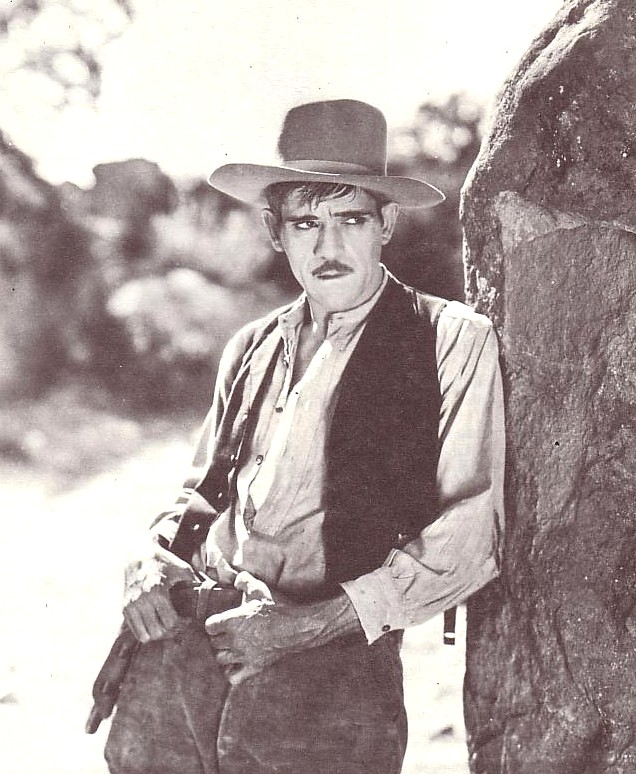
One of the many surprises in "The Utah Kid" is that it features Boris Karloff in a rare Western role, playing a henchman. The release of "Frankenstein" a year later — with Karloff in the role of "The Monster" — would make the actor a household name.

Boris Karloff on the Iverson Ranch — promo still for "The Utah Kid"

Here's a promotional photo of Karloff taken for "The Utah Kid," which offers a clearer look at the actor. The print we have of "The Utah Kid" isn't horrible, but it's pretty heavily scored in some places, as you may have noticed.

Lobby card for "The Utah Kid" — where's Karloff?

I found it interesting that Karloff, who had already spent more than a decade honing his acting chops in the silent movies, wasn't big enough yet to crack the movie's "top five" and find his way onto the lobby card. His role in "The Utah Kid" was larger than those of some of the actors who did get their names on the card.


An ad for the movie, apparently from a newspaper published around the time of the film's release, misspells the name of the leading lady, Dorothy Sebastian.

Adobe C

Adobe C, the smallest of the three buildings, is barely used in the movie. But it does appear on screen, albeit a bit blurry, as Rex Lease and Sebastian, his leading lady, ride past.

Adobe A — the Robber's Roost saloon — under siege

Adobe A, the saloon, becomes the focal point of a climactic siege on Robber's Roost by the sheriff and his men. In this shot the building is obscured by gunsmoke as the firefight rages.

Head bad guy Tom Santschi, center, and his henchman, Boris Karloff, leave the Saloon

While "The Utah Kid" makes good use of the Robber's Roost set, it is unlikely that the set was built for the movie. The studio behind the picture — Tiffany Productions, a notoriously low-budget Poverty Row studio — would have been reluctant to spend the kind of money needed to build even a flimsy version of the relatively elaborate set.

"The Utah Kid" — shootout filmed from the interior of Adobe A

Some of the camera angles seen in the big shootout were filmed from the interior of Adobe A, with the view outside the door — including a wispy tree, presumably a fake — matching the actual location as it appears in exterior shots.

This version of the shot points out the wispy tree.

A wide shot of the Robber's Roost set area includes the same wispy tree, seen from the reverse angle.

Here's another shot taken from the interior of Adobe A. The inclusion of these shots means the building was designed with sufficient room inside for the clunky filming equipment in use at the time — adding fuel to the theory that the set construction would have been too expensive for Tiffany Productions.

A minor set that also turns up in "The Utah Kid" is this corral area, situated not far from where the adobes were built. The location of this set, just south of the Phantom in Central Garden of the Gods, is pinpointed by Getaway Rock, the large rock that dominates the background of the shot.

"Tennessee's Partner" (1955) — Getaway Rock, in Central Garden of the Gods

Getaway Rock gets its name from its appearance in the 1955 John Payne-Ronald Reagan Western "Tennessee's Partner," where the rock marks the getaway route of the villainous Turner in the film's climactic sequence. You can read a detailed account of the location shoot for this sequence by clicking here.

Getaway Rock as it appears today

Getaway Rock can still be found easily today. It's in Central Garden of the Gods, at the west end of the open area south of Phantom and Sphinx.

Rex Lease outside Adobe B in "The Utah Kid"

Rex Lease, the star of "The Utah Kid," may not be among the best-known cowboy heroes, but he had a prolific and durable movie career, mostly in low-budget Westerns — many of them filmed at Iverson.

"Rough Riding Ranger" (Superior, 1935)

He played his share of bit parts, going all the way back to 1924, eventually working his way up to lead status and starring in a string of B-Westerns for Poverty Row studios such as Superior and Argosy, as well as Tiffany.

"Custer's Last Stand" (Stage and Screen, 1936)

Like many cowboy heroes of the '30s, Rex also put in his time in the matinee serials. One of his most high-profile cliffhangers was "Custer's Last Stand," which once again had Rex riding the Iverson Ranch.

Rex Lease with actress Charlotte Merriam, his first wife (1928)

In all, Lease appeared in about 250 movies in a career spanning more than 35 years. Capping off his career, he played a series of "henchman"-type roles in the late '50s on the TV series "The Life and Legend of Wyatt Earp," before hanging up his spurs in 1960. The West Virginia native died in Van Nuys, Calif., in 1966 at age 62.


Given that it's unlikely the adobe set was built for "The Utah Kid," we're left with an obvious question: Who, then, did build the set? For now, that question remains unanswered, and it could prove challenging to answer. In fact, given the scarcity not just of records from this period, but also of movies from the era — with many films from the '20s having dissolved into piles of nitrate dust — we may never know. But let's not let that keep us from trying.