Why we love old movie locations — especially the Iverson Movie Ranch

For an introduction to this blog and to the growing interest in historic filming locations such as the Iverson Movie Ranch — the most widely filmed outdoor location in movie and TV history — please read the site's introductory post, found here.
• Your feedback is appreciated — please leave comments on any of the posts.
• To find specific rock features or look up movie titles, TV shows, actors and production people, see the "LABELS" section — the long alphabetical listing on the right side of the page, below.
• To join the MAILING LIST, send me an email at iversonfilmranch@aol.com and let me know you'd like to sign up.
• I've also begun a YouTube channel for Iverson Movie Ranch clips and other movie location videos, which you can get to by clicking here.
• Readers can email the webmaster at iversonfilmranch@aol.com
.

Showing posts with label Cave Rocks. Show all posts

Sunday, April 3, 2016

Range Rider Rock, Fireplace Rock and the Ottoman — three rocks that have caused more than their share of trouble

Three neighboring rocks with remarkably similar silhouettes

These screen shots show three different rocks that were situated near each other on the Iverson Movie Ranch. Similarities in their shapes have posed a number of research challenges.

As marked here in blue, all three rocks have a gentle "S"-curve along the left edge, then tuck in toward the bottom to form a curved overhanging ledge. The darker appearance of the rock on the right is due to variation in lighting.

"Man From Sonora" (Johnny Mack Brown, 1951)

Remarkably, all three rocks are positioned in the same direction, with their matching edges found at the northwest corner of each rock. Two of these edges can be seen in this screen shot from the B-Western "Man From Sonora."

The names I've adopted in my research for these two rocks are Fireplace Rock and the Ottoman. Fireplace Rock is still in place today, but the "fireplace" near the bottom of the rock feature is almost impossible to see.

Here's a better look at Fireplace Rock in "Man From Sonora" in which the recessed "fireplace" area can be clearly seen toward the right of the frame, behind the horse and rider. Today the fireplace is concealed behind a home in the Indian Hills Mobile Home Village.

In the original composite shot, Fireplace Rock appears on the left, the Ottoman is in the center and the panel on the right contains Range Rider Rock.

"Atom Man vs. Superman" (Columbia serial, 1950)

The shot of Range Rider Rock comes from "Atom Man vs. Superman." The image of the corner of the rock looming along the right edge of the frame is typical of how all three rocks at times appeared in the movies.

"When the Daltons Rode" (Universal, 1940)

Another interesting use of that "S"-curve edge of Range Rider Rock can be found in the Randolph Scott Western "When the Daltons Rode," where a bushwhacker atop the rock awaits his prey.

"Man From Sonora" — Range Rider Rock

Range Rider Rock had a number of other profiles that were also often seen in productions. This shot from "Man From Sonora" shows the full length of the rock, and is probably its most common angle.

This photo highlights the corner of Range Rider Rock seen in the shots higher up in this post. "Man From Sonora" is one of the best showcases for all three of the rocks featured in this post. I published a detailed post about "Man From Sonora" last year, and you can see that post by clicking here.

"Shut My Big Mouth" — Joe E. Brown (1942)

Range Rider Rock is featured in colorized form in this lobby card for the Joe E. Brown movie "Shut My Big Mouth."

"The Roy Rogers Show": "The Scavenger" (Nov. 27, 1955) — "Brainiac"

Viewed from this angle, the north end of Range Rider Rock presents a profile I've always found amusing, which I call "Brainiac." I broke down the elements of Brainiac in a post back in 2010 that you can see by clicking here.

Range Rider Rock/Brainiac in modern times

Range Rider Rock survives today as part of the mobile home park, but the rock is hard to access and I have been unable to replicate the "Brainiac" angle. The above shot is about as close as I could get, but it clearly has none of the original Brainiac charisma.

Range Rider Rock's contemporary setting

Another partial view of Range Rider Rock can be seen by looking over the roof of a mobile home. This angle, with the camera pointed southeast, doesn't quite match any productions I've seen.

"The Lone Rider in Ghost Town" (PRC, 1941)

Range Rider Rock was frequently filmed from the north, as in this example from the George Houston B-Western "The Lone Rider in Ghost Town." Range Rider Rock appears on the left, with a portion of the Lash LaRue's Arch formation visible in the background, above the riders.

Identifiers on the rock, including the three bumps noted here, help match up the rock with its screen appearances.

Here's a better look at the three bumps as they appear today.

"Gold Raiders" (1951)

It can be a challenge to find these bumps in productions, but they're visible in this shot from the Three Stooges movie "Gold Raiders."

"The Virginian": "The Mountain of the Sun" (April 17, 1963)

The bumps can be found again in this unusual shot from the TV show "The Virginian." Unfortunately, that side of the rock is in shadow, once again making the bumps a little hard to see.

"The Fighting Seabees" (1944)

An interesting shot of Range Rider Rock appears in the John Wayne war movie "The Fighting Seabees," with the rock filling much of the bottom left corner of the frame. The rocks near the top of the frame are still in place as well, and today decorate the area around the swimming pool in the Indian Hills Mobile Home Village.

I'm unable to make out the three bumps in this shot due to the shading on the rock, but if we could see them, they would be approximately in the area designated here in green.

Notice this curved indentation in Range Rider Rock.

The same indentation can be seen in the shot from "The Virginian," although the shading again hampers visibility. You may want to click on the photo to see it in a larger format.

The indentation is also clearly visible in recent shots of Range Rider Rock's north end.

"The Rawhide Trail" (1958)

The relationship between Range Rider Rock and Fireplace Rock can be seen in this shot from the Allied Artists B-Western "The Rawhide Trail," which starred Rex Reason.

The two rock features are identified here. The Ottoman, which was located between Range Rider Rock and Fireplace Rock, is hidden behind Range Rider Rock in this shot and cannot be seen.

The "S"-shaped curves at the northwest corners of both Fireplace Rock and Range Rider Rock are noted here.

Two distinctive rocks, Bugeye and Trapezoid, are situated at the top of Fireplace Rock, as noted in this version of the "Rawhide Trail" screen shot. I've also noted the "Fireplace" area at the base of Fireplace Rock.

"Lawless Cowboys" (Monogram, 1951)

In the Whip Wilson movie "Lawless Cowboys," we get a better look at Bugeye and Trapezoid atop Fireplace Rock. The shot is taken from Sheep Flats looking southeast.

Also appearing in the "Lawless Cowboys" shot is the Ottoman.

In modern times Bugeye and Trapezoid loom above the streets of the Indian Hills Mobile Home Village. They're still positioned atop Fireplace Rock, but the "fireplace" area is now hidden from view.

"Overland Trail" TV series: "Westbound Stage" (March 6, 1960)

The Ottoman can be seen in the top left corner of this shot from the TV show "Overland Trail." The one-hour Western series, which starred Doug McClure and William Bendix, lasted just one season on NBC.

Seventeen episodes of "Overland Trail" were produced, with most of the location work done on the Iverson Ranch.

The Ottoman's "S"-curve is seen again here, albeit from a different angle than in previous shots.

Example of an actual ottoman

It may go without saying, but to illustrate why I've been calling the rock the Ottoman, here's a picture of an actual Ottoman. While the name is related mainly to the ottoman-like shape of the rock, I also like the suggestion of a cushy rock that one could put one's feet up on.

"Man From Sonora"

The rock feature the Ottoman is on the obscure side, as famous Iverson Movie Ranch rocks go. "Man From Sonora" includes one of the better looks at the rock, but even here it tends to blend in.

"The Virginian" — "Mountain of the Sun"

This is probably the most striking appearance by the Ottoman, from the same "Virginian" sequence noted above. The sequence marks one of the few times the east side of the rock was filmed.

The "Virginian" shot also features a view of other rock features in the neighborhood, including another glimpse of two of the main rocks in the swimming pool area, known as the Cave Rocks.

The fake cave entrance that gives the Cave Rocks their name can be seen in the photo, along with a strategically placed fake bush hiding the opening to the cave.

Indian Hills Mobile Home Village — swimming pool area

Some of the same rocks can be seen in this recent shot of the swimming pool area. The original location of the fake cave would have been near the left of the frame, in the dark area above the white table.

"Atom Man vs. Superman" — the Ottoman

 The Ottoman can be seen at the far left of the frame in this screen shot from "Atom Man vs. Superman."

"Motorcycle Gang" (American International, 1957)

On a rare occasion when horses and old gangster sedans gave way to motorcycles on the Iverson Ranch, the Ottoman lurked in the background during filming of the oddity "Motorcycle Gang."

The fate of the Ottoman is not clear. It's likely that the rock was buried during development of the mobile home park, but the area is inaccessible today and the rock's status remains a question mark.

Indian Hills Mobile Home Village (Bing bird's-eye view)

A recent overview of the Indian Hills Mobile Home Village, at Topanga and the 118 in Chatsworth, Calif., notes the location of two of the main rock features highlighted in this post — Fireplace Rock and Range Rider Rock.

Friday, July 3, 2015

The Iverson Movie Ranch under attack: A fond look back at John Wayne's World War II movie "The Fighting Seabees"

"The Fighting Seabees" (1944) — Upper Iverson under attack

The John Wayne movie "The Fighting Seabees" is one of the most high-profile productions shot on the Iverson Movie Ranch during the 1940s — and the World War II movie also must have been one of the loudest shoots in the history of the location ranch, sustaining a number of bombing raids during production.

To be clear, these were "movie bombing raids" and not real-world bombing raids. Even so, the explosions were real. The area under siege in the above shot includes Cactus Hill and the South Rim of the Upper Iverson; the landmark Eagle Beak Rock is noted here.

Eagle Beak Rock appears again in this shot taken from a much closer angle, partially obscured behind a bomb blast. Also visible, near the center of the shot, is the nearby rock feature known as the Molar.

The palm trees appearing in the shot are all fake, part of the elaborate construction done on both the Upper and Lower Iverson for "Fighting Seabees."

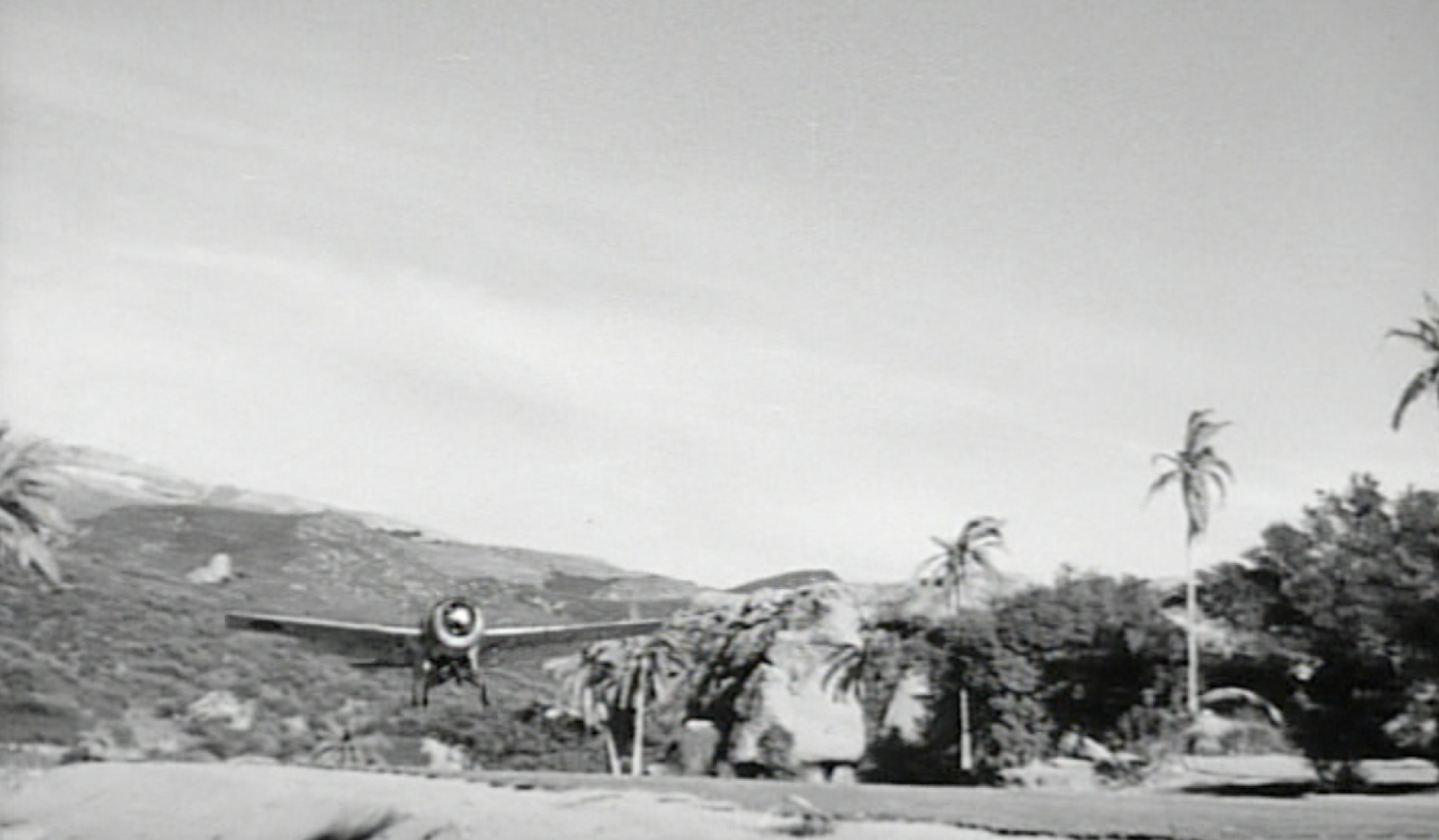
Fake "landing strip" put in for "The Fighting Seabees"

The smooth surface at the bottom of the shot is a huge fake landing strip installed over much of the Upper Iverson as part of the shoot for "Fighting Seabees." The movie tells the story of the U.S. Navy construction teams that worked alongside combat units during the war. (Construction Battalion = CB = Seabee.)

Construction of the landing strip was part of the plot of the movie, set in the Pacific Front during World War II. This shot again shows the Molar, in the top left corner, along with a nearby observation tower built for the movie.

The Molar and the observation tower are identified here, along with some of the material being brought in for construction of the landing strip.

A bomb hits behind the Molar, and the observation tower is looking a little shaky.

Shots of warplanes flying over the Iverson Ranch are among the many highlights in "The Fighting Seabees."

Eagle Beak Rock, one of the most prominent features of the South Rim, appears again during this sequence, lurking at the far right of the frame.

Despite the frequent bombing, a massive landing strip was built. But even though the Upper Iverson Movie Ranch covered a significant expanse, it was not wide enough in reality for planes to land or take off.

In "The Fighting Seabees," as on other occasions during the filming era, takeoffs and landings were faked.

Planes could touch down, but they didn't have room to come to a stop.

After a plane was filmed "landing," it would have to take off again.

Even in this blurry shot, Eagle Beak Rock is easily identifiable. The rock can also be found in the backgrounds of countless chase scenes in B-Westerns, old serials and early TV shows.

For shots of aircraft on the ground at Iverson, the planes would have to be trucked in. A number of planes were filmed on the ground on the Upper Iverson for "The Fighting Seabees."

This early sequence takes place in the same area where the landing strip would be built — near the cul de sac, on the South Rim of the Upper Iverson.

The location is pinpointed by the presence of a rock I call either Diplodocus or Grumpy, depending on which side is seen. From this side it's Diplodocus.

Blammo! Like much of the Upper Iverson, the Diplodocus area takes a hit during a bombing raid. Luckily, Diplodocus came through it unscathed — although years later the rock would become a casualty of development.

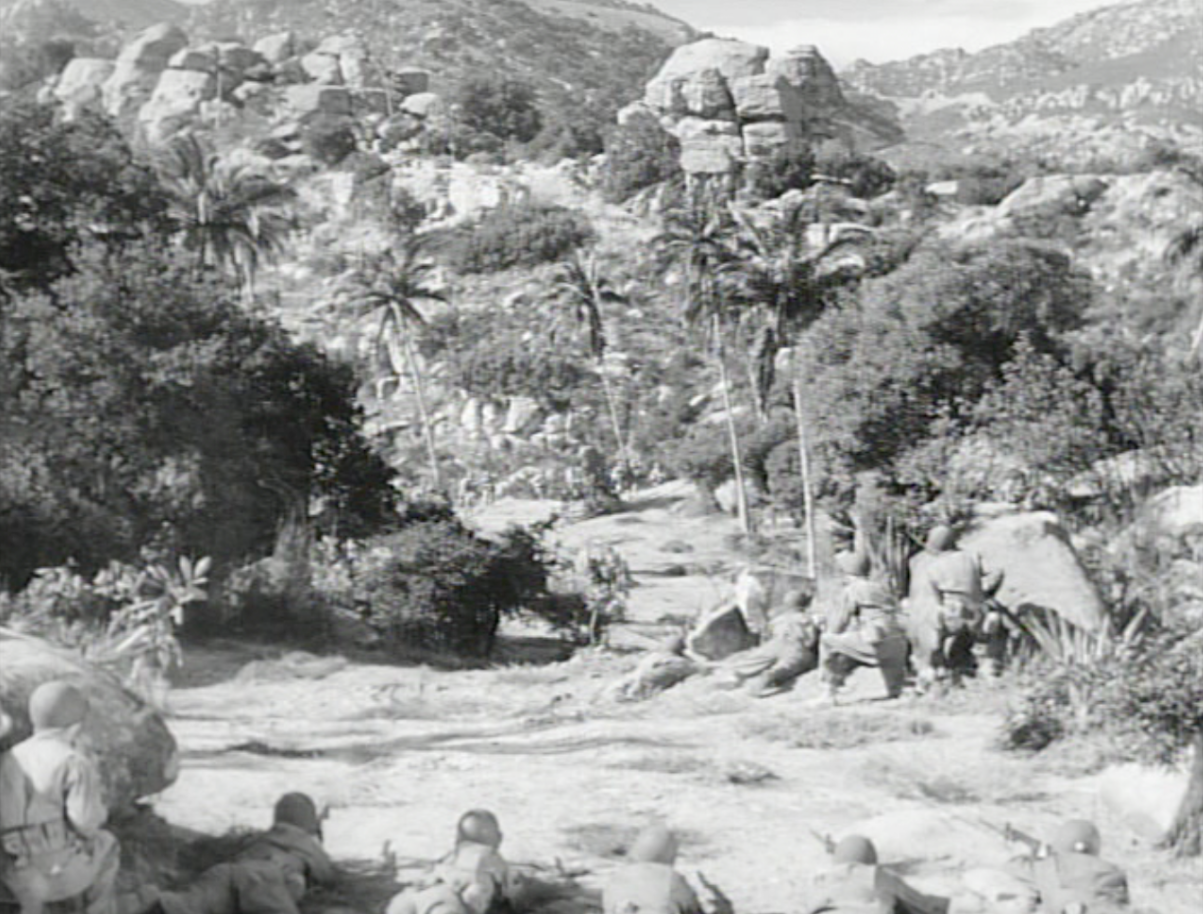
The action in "The Fighting Seabees" takes place on the Lower Iverson as well, including shots depicting brutal hand-to-hand combat. This scene is filmed in front of Bill Rock.

Much of the combat is set in the Iverson Gorge, on the Lower Iverson. In this shot U.S. troops are positioned in the Upper Gorge, with a portion of Garden of the Gods visible in the background.

A few of the noteworthy Garden of the Gods features are highlighted in this version of the shot.

Here's the scene as it appears in modern times. This photo, taken on a visit to the site in 2011, shows approximately the same area as the "Fighting Seabees" shot above this one.

The topography has been significantly altered, with Redmesa Road now slicing horizontally through the center of the frame. However, the major rock features toward the top of the photo remain in place.

"The Fighting Seabees": John Wayne on the Nyoka Summit

The movie includes a nice sequence filmed on the summit of Nyoka Cliff in which John Wayne can be seen hanging onto the famous tree that used to stand atop the cliff.

This tree appeared in countless movies and TV shows. It has since been replaced by a different tree at the summit of Nyoka Cliff — something I talked about in a recent post that can be found by clicking here. (Much of that post talks about the Crouching Cat Tree, which is a different tree altogether; the information about the two different Nyoka Trees appears near the end of the post.)

Wayne and some of his men take shelter inside a pit that can still be found at the top of the cliff. John Wayne fans who felt strongly enough about it could go to the same spot today and strike a heroic pose in the same pit.

The Duke also put in time in Garden of the Gods during filming for "Fighting Seabees." In this shot of Wayne, at right, giving commands to his men, the iconic rock feature Sphinx appears in the background. You may recognize the man next to Wayne as William Frawley, best known for playing Fred Mertz on "I Love Lucy."

A Japanese sniper, complete with his own fake palm tree, is posted atop the Devil's Doorway Cluster, although it would be hard to ID the spot based solely on this shot.

When the sniper is taken out, we get a wider view of the setting, making it possible — though still not easy — to identify Devil's Doorway in the Upper Gorge. One reason it's relatively difficult to pinpoint the spot is that these rocks today are hidden beneath a tree.

Rock Island and Crown Rock in "The Fighting Seabees"

A short distance away, troops advance on Rock Island along the Stagecoach Road. Rock Island appears in the top right corner, with Crown Rock at center left. The large fuel tank seen in the foreground — one of two such tanks built in the Gorge for the movie — figures into a major explosion later in the movie, which I talk about below.

I recently discussed this sequence in a post focusing on Rock Island, which you can read by clicking here.

The Lower Iverson took its share of bomb hits during filming on "The Fighting Seabees," including this one that landed in the Upper Gorge. Some of the rocks of the Hole in the Wall area can be seen at top right.

A relatively small blast hits midway between Bill Rock, at top right, and Stegosaurus, at top left. The proximity of soldiers to the explosion suggest that this one may have been added in post-production, but who knows?

I've noted the two main rock features in this version of the shot. We get a slightly better look at Stegosaurus in the next sequence.

An artillery team takes aim at a U.S. Navy medical vehicle, with the Zorro's Cave area in the background.

When the truck is hit, we get a look at Stegosaurus, at top right.

Here's the same shot with Stegosaurus identified. The rock feature's "face" can be elusive.

An unusual feature — a large fake rock — appears during some of the scenes filmed in the Gorge. In this shot the fake rock can be seen at the left of the frame. The fake rock was not installed for "Fighting Seabees," but was already in place at the site.

I call the large fake rock "Perils Tower," because one of its most high-profile appearances is in the 1942 Republic serial "Perils of Nyoka."

"The Fighting Seabees" — Perils Tower, center

The fake rock's origin is unclear, but it remained in place in the Gorge for a few years. It can be found in movies released from 1941-1944.

The fake rock tower is typically seen from a distance, as in this example from "Fighting Seabees." It appeared to move around, within a limited range, during its brief lifespan, but was generally located near the rock features The Wall, Crown Rock and Devil's Doorway.

The fake tower, seen beneath the crane — again near the center of the shot — was right at home among the real rock features of the Iverson Gorge. It may help to click on the photo to enlarge it for a better view.

Perils Tower appears midway between the major features Nyoka Cliff and The Wall.

A closer shot of Perils Tower shows the position of the fake rock, at top left, relative to Three Ages Rock at top center and The Wall at top right.

This version of the shot identifies the major rock features, including the fake tower.

In a famous scene near the end of "Fighting Seabees," a bulldozer driven by one of the Seabees pushes an enemy tank off Nyoka Cliff into the Iverson Gorge.

And down it goes. It has been reported that the prop tank used in filming was made of balsa wood to avoid damaging any of the rocks. Considering how many explosions went off during production, it's interesting to hear that people were concerned with protecting the filming location.

Another shot of Nyoka Cliff in "Fighting Seabees" includes the Crouching Cat Walkway area, which was recently discovered and was featured in a recent post.

You may also have spotted the tree at the top of Nyoka Cliff — the same tree that John Wayne is hanging onto in a sequence featured higher up in this post.

Some distance to the east of the Gorge, near the Cave Rocks — where the swimming pool for the Indian Hills Mobile Home Village was later put in — Quonset huts were filmed being built in "Fighting Seabees."

In this area, too, a number of fake palm trees were brought in to create the needed island flavor.

An army of extras, literally, was assembled during production on "Fighting Seabees." The Cave Rocks can be seen again in the background in this scene, which takes place after construction was completed on the Quonset huts.

Mushroom cloud in the Iverson Gorge in "The Fighting Seabees"

Near the end of the movie, the producers appear to exercise the "nuclear option" — although the mushroom cloud is produced by a fuel tank explosion. Some observers have noted that this explosion "mirrors" the U.S. use of the atom bomb at Hiroshima and Nagasaki to help bring an end to World War II. However, the movie was released in January 1944, well ahead of the August 1945 bombing raids over Japan.

Even though the mushroom cloud shot features rocks found in the Iverson Gorge — including a portion of Devil's Doorway, as noted here — it appears that in this case the explosion was added using special effects.

"The Fighting Seabees" was a high point for Republic Pictures, which stepped up to create a movie well beyond the company's usual low-budget fare. By loosening the usually clam-tight Republic purse strings for a change, the company produced not just one of its many "great Iverson movies" — with plenty of cool rocks — but also a movie that holds up pretty well as a movie.