Why we love old movie locations — especially the Iverson Movie Ranch

For an introduction to this blog and to the growing interest in historic filming locations such as the Iverson Movie Ranch — the most widely filmed outdoor location in movie and TV history — please read the site's introductory post, found here.
• Your feedback is appreciated — please leave comments on any of the posts.
• To find specific rock features or look up movie titles, TV shows, actors and production people, see the "LABELS" section — the long alphabetical listing on the right side of the page, below.
• To join the MAILING LIST, send me an email at iversonfilmranch@aol.com and let me know you'd like to sign up.
• I've also begun a YouTube channel for Iverson Movie Ranch clips and other movie location videos, which you can get to by clicking here.
• Readers can email the webmaster at iversonfilmranch@aol.com
.

Showing posts with label Eucalyptus Grove. Show all posts

Sunday, December 11, 2016

You know that little building in the Eucalyptus Grove — the one with the giant blueberry muffin behind it?

"Bells of Rosarita" (Roy Rogers, 1945) — Grove Cabin

If you're an aficionado of the Iverson Movie Ranch, you may already be familiar with the small building seen here, known as the Grove Cabin. And you may have noticed the muffin-shaped rock behind it.

"Bells of Rosarita"

The cabin stood for at least three decades on the Lower Iverson. Located in the Eucalyptus Grove, the small building was a common set used in movies and TV shows from the late 1930s into the 1960s.

Pear Rock, next to the Grove Cabin, in "Bells of Rosarita"

The cabin was positioned immediately west of Pear Rock, which looms in the background here as Roy and his compadres arrive for a good old-fashioned shootout at the cabin.

Pear Rock in recent years

Pear Rock is still around. In this recent shot, taken from close to the same angle seen in "Bells of Rosarita" (above), it's possible to match up some of the markings on the rock.

Specifically, notice the lighter surface area, curved mark and indented base area highlighted here.

The same features can be found in the "Bells of Rosarita" shot. The variation in the lighting for the two shots gets in the way, but other common markings can also be found if you're so inclined.

"Bells of Rosarita" — Pear Rock, left, and Grove Cabin

With Roy already in position behind a rock, Gabby Hayes and some other guy scramble to take cover. Pear Rock, on the left, continues its prominent role in the sequence.

Once again, there's the muffin-shaped rock just behind the cabin.

Also visible behind the cabin, below the Muffin Rock, was a more "normal"-shaped rock, with just the rounded top peeking out above the cabin.

Pear Rock, left, and the "normal" Grove Cabin locator rock, right (2016)

Today this "normal" rock can still be found at the site. While it's now partially concealed behind a small tree, this rock, seen here on the right, helps pinpoint the former location of the cabin.

Here's a closeup of the "locator rock" that was previously positioned directly behind the Grove Cabin.

The former Grove Cabin location in modern times

The approximate spot where the Grove Cabin once stood is noted here. Pear Rock appears in the left half of the frame, with the "normal-shaped rock" just above the dotted rectangle.

One feature that appears to be missing from the present-day setting is the Muffin Rock. While a taller rock can be seen behind the "normal" rock, the taller rock lacks the distinctive muffin shape.

The Grove Cabin site in 2016

Viewing the same setting from a slightly different angle, we get a better look at that taller rock — and learn what happened to the Muffin Rock.

The tall rock is in fact the Muffin Rock — but it has dropped its muffin. At some point over the years the rock's defining muffin top apparently decided to emancipate itself, which I'm guessing was an abrupt decision.

When the large chunk of the once top-heavy rock gave way, it left behind a flat, lighter-colored area of unweathered surface along the eastern face of the rock.

Unknown production, 1957: Grove Cabin and neighboring rocks

A behind-the-scenes shot from an unknown production filmed in 1957 offers another look at the Grove Cabin, the Muffin Rock and the "normal" rock.

Sign reads "Golden Luck Mine"

While the 1957 production is unknown, the sign on the Grove Cabin reads "Golden Luck Mine." Maybe a blog reader will recognize the reference and can help ID the movie or TV show in which it appears.

"Spy Smasher" (1942): early version of the Grove Cabin

An early Grove Cabin that did not yet have the building's distinctive roof in place can be seen in the 1942 Republic serial "Spy Smasher." This footage was recycled from an earlier shoot.

The familiar rock features are all to be found. The angle has shifted, altering the perception of distances between rocks.

"The Lone Ranger Rides Again" (Republic serial, released in 1939)

Footage of the Grove Cabin used by Republic in "Spy Smasher" was probably borrowed from the shoot for the studio's 1939 serial "The Lone Ranger Rides Again."

The Lone Ranger at Grove Cabin in "The Lone Ranger Rides Again"

"The Lone Ranger Rides Again," starring Robert Livingston as the Masked Man, was filmed in December 1938 and January 1939 for release on Feb. 25, 1939.

"Riders of the Badlands" (Columbia, 1941)

By 1941, the cabin's new roof was in place, as seen in the Charles Starrett B-Western "Riders of the Badlands," released Dec. 18, 1941.

Grove Cabin and Mine, circa 1950-1951 (Joe Iverson collection)

A family photo from the early '50s provides a clear view of the Muffin Rock in its original state. The man in the photo is believed to be Bill Boyd, Joe Iverson's brother-in-law. (He's not the same person as actor William Boyd, who played "Hopalong Cassidy.")

The photo shows a portion of the Grove Cabin, a wall that was in place at the time and a fake mine, along with a partial view of the Muffin Rock.

The remarkable clarity of the old family photo enables us to make out a "fault line" in the top section of the Muffin Rock.

The fault line matches the line where the piece broke loose.

"Annie Oakley" TV series (1954)

This photo of Gail Davis on the roof of the Grove Cabin, which ran in a recent post about the "Annie Oakley" TV show, again captures what I believe to be the "fault line."

The Muffin Rock's fault line?

This appears to be where the hairline crack runs through the "muffin top" area, predicting how the rock would fall apart years later. My guess is that the break happened in the 1994 Northridge Earthquake.

Muffin Rock and mine rock in 2016

A shot from a recent expedition into the Grove features not only the Muffin Rock, but also the low, angular rock that became a part of the fake mine.

The broken-off "muffin top" and real rock that was incorporated into the fake mine are noted here.
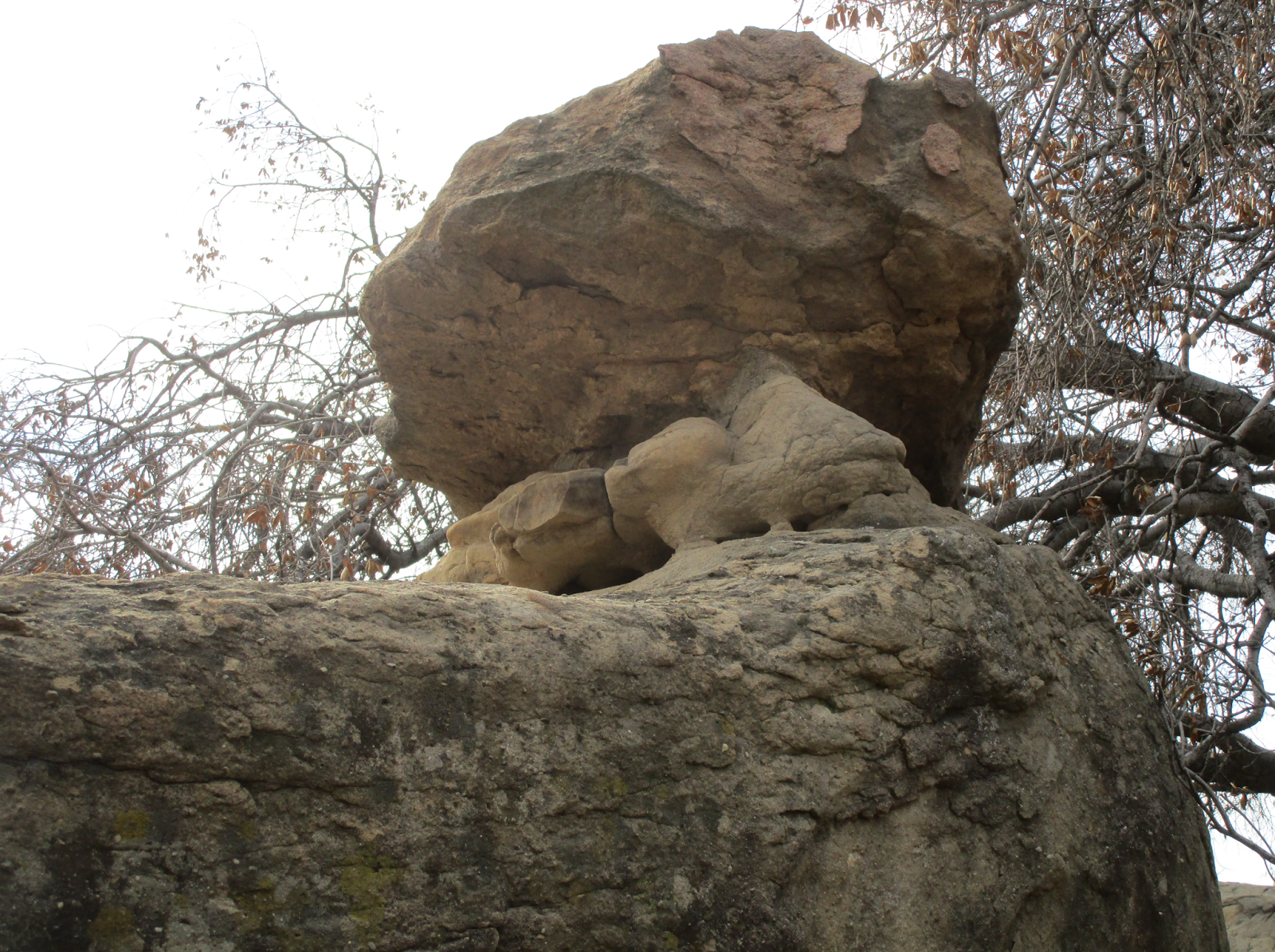
Taking another look at the old family photo, we can identify some key features that can be matched up with the recent photo.

The same features are highlighted here in the 2016 photo.

This shot identifies the approximate section of the rock that fell off.

The rocks in this area hold fast to their secrets. The former Grove Cabin site is on private property and opportunities to explore it are few, but I will continue to provide updates when anything new turns up.

Friday, November 25, 2016

Joe Iverson's "Garden of Stacked Rocks" on the Lower Iverson Movie Ranch

Joe Iverson builds a road through the Gorge, circa early 1930s

Joe Iverson, who ran all or part of the Iverson Movie Ranch for more than 60 years, was known to take it upon himself to "fine-tune" the ranch's rocky landscape.

"The Miracle Rider" (1935): Freddie Frog in foreground

One of Iverson's favorite techniques for changing the look of the place was to cement one rock on top of another — creating a "stacked rock" formation.

Freddie Frog, an early Iverson Ranch "stacked rock"

The earliest known example of a manmade stacked rock at Iverson is a feature I call Freddie Frog, which was in place as early as 1926.

Promo still for "Tell It to the Marines" (1926)

While it's relatively small and would be easy to miss in this early promo still, a careful examination of the shot reveals that Freddie Frog had already been created in 1926.

Remnants of Freddie Frog as found today

We know Freddie Frog was a manmade formation because remnants of the rock, including the cement that once held it in place, can be found today at the site.

I blogged about Freddie Frog back in February 2014, including getting into the nitty gritty about chunks of cement that remain from the formation's movie days.

"Range Beyond the Blue" (PRC, 1947)

This shot from the Eddie Dean movie "Range Beyond the Blue" shows Freddie at its most "frog-like." For more of the Freddie Frog story, please click here to read my blog post from 2014.

"Gold Raiders" (1951): Gold Raiders Rock appears at left

The Iverson Ranch was sprinkled with these "stacked rocks" throughout its filming era, and many of the stacks found their way into movies and TV shows. One of the best-known of the Iverson rock stacks is Gold Raiders Rock, seen above in the movie role that gives the rock its name.

"Ghost Town Renegades" (1947): Al "Fuzzy" St. John
rides past the future Gold Raiders Rock

Gold Raiders Rock, as it would later come to be known, also appeared in productions before it became a stacked rock. This is what it looked like before it had the smaller rock cemented on top of it.

Gold Raiders Rock today (photo by Jerry Condit)

A number of the original Iverson Movie Ranch stacked rocks have survived and can still be found on the former movie ranch. This is what Gold Raiders Rock looks like today.

"Five Guns West" (1955): "The Head" makes a rare appearance

An unusual stacked rock can be found near the west end of Cactus Hill. "The Head," as I call it, was rarely filmed, but did show its, um, head, in Roger Corman's terrific Western "Five Guns West."

The Head in modern times

The Head has survived and can still be found today next to the trail the riders used in "Five Guns West."

A closeup reveals the cement work that was done to hold the "head" in place.

A small bird rests on "The Head" as dusk approaches 

The Head may have had a limited film career, but it continues to make itself useful to the local wildlife.

Joe Iverson's "Garden of Stacked Rocks" in 2016

Joe Iverson outdid himself in one particular section of the former movie ranch, creating what amounts to a "garden of stacked rocks."

Contained within a small area are three distinct stacked-rock formations. The "garden" is located in a rarely explored private section of the former Lower Iverson, near Flat Rock and what remains of the Iverson Ranch Eucalyptus Grove.

For research purposes, I refer to the three stacked-rock formations as Grove Stacks A, B and C. The most familiar of the three is the triple stack identified here as "A."

"The Life and Legend of Wyatt Earp" (1960)

Grove Stack A is easy to spot in this scene from the "Wyatt Earp" TV series. The shot comes from an episode called "John Clum, Fighting Editor," which premiered April 12, 1960.

The key features of the "Wyatt Earp" shot are identified here. The camera is shooting northeast toward the nearby Eucalyptus Grove.

The same area is seen in this shot from a recent expedition to the site. A few new trees are in place, but the rock features are immediately recognizable.

"Escort West" (United Artists, 1959)

Another view of Grove Stack A, this time with the camera shooting south, appears in the Victor Mature movie "Escort West." The stacked formation can be seen at the left of the frame.

Grove Stack B in 2016

Grove Stack B, which is tucked in between Grove Stacks A and C, is the least frequently filmed of the three formations in Joe's "Garden of Stacked Rocks."

"The Roy Rogers Show" episode "Ghost Town Gold" (premiered May 25, 1952)

This rare shot from "The Roy Rogers Show" comes from one of the few scenes where it's possible to identify Grove Stack B in a production.

A portion of Grove Stack B appears at the far right in the "Roy Rogers Show" screen shot.

In fact, all three of Joe's Grove-area creations can be identified in the "Roy Rogers" shot, including a little bit of Grove Stack C hiding behind Grove Stack B.

"Hannah Lee: An American Primitive" (1953)

We get a better look at Grove Stack C in the John Ireland Western "Hannah Lee: An American Primitive."

The "Hannah Lee" shot also shows the stacked formation's proximity to Flat Rock.

"The Roy Rogers Show" episode "End of the Trail" (premiered Jan. 27, 1957)

Grove Stack C shares the screen with Roy Rogers in an episode from the final season of "The Roy Rogers Show."

Grove Stack C as it appears now, at left, and in "The Roy Rogers Show"

Here's a side-by-side comparison of the rock's profile in the "Roy Rogers" episode and in recent times.

Grove Stack C shows off its duck-shaped body in this modern-day photo.

A closeup of Grove Stack C shows the area where the "head" attaches to the body.

Zooming in further, we get a look at the cement work that helps hold the head in place.

Grove Stack B

Grove Stack B, too, is put together with the help of cement.

This closeup of Grove Stack B provides a look at some of the cement work holding the rock together.

Grove Stack A

As a classic "triple stack," Grove Stack A would have necessarily been slathered in cement.

Cement is used not only to fasten the head of Grove Stack A to the middle section, but also to hold the middle section in place atop the feature's large base rock.

Here's a closer look at the cement holding the head in place on Grove Stack A.

The finished product: Grove Stack A, in "Cole Younger, Gunfighter" (1958)

Joe Iverson's handiwork, Grove Stack A, can be seen in the lower right corner of this shot from the Allied Artists Western "Cole Younger, Gunfighter."

Joe Iverson's "Garden of Stacked Rocks" in 2016

Today the "Garden of Stacked Rocks" stands as a cement and sandstone testament to a man who knew a lot about rocks, earned his living from them — and even on occasion made his own.