Why we love old movie locations — especially the Iverson Movie Ranch

For an introduction to this blog and to the growing interest in historic filming locations such as the Iverson Movie Ranch — the most widely filmed outdoor location in movie and TV history — please read the site's introductory post, found here.
• Your feedback is appreciated — please leave comments on any of the posts.
• To find specific rock features or look up movie titles, TV shows, actors and production people, see the "LABELS" section — the long alphabetical listing on the right side of the page, below.
• To join the MAILING LIST, send me an email at iversonfilmranch@aol.com and let me know you'd like to sign up.
• I've also begun a YouTube channel for Iverson Movie Ranch clips and other movie location videos, which you can get to by clicking here.
• Readers can email the webmaster at iversonfilmranch@aol.com
.

Showing posts with label Devil Horse (The). Show all posts

Sunday, April 25, 2021

When movie location research goes wrong: The Iverson Ranch's famed "Yakima Oak" is falsely accused of being the "Bat Tree"

Photos from recent Facebook post incorrectly "matching" two different trees

A recent series of Facebook posts illustrates how easy it is to get stuff wrong when researching old filming locations — especially when the research involves trees.
 
"Batman and Robin" (1949): The so-called "Bat Tree" (Facebook post)

This screen shot from the 1949 serial "Batman and Robin" was posted to a Facebook group for fans of old movie serials, with the Facebook user naming the tree the "Bat Tree" and declaring that he had found it in the real world.
 
The Iverson Movie Ranch's "Yakima Oak" — NOT the same tree seen in "Batman and Robin"

That would have been pretty cool, if it were true. Unfortunately, the tree he found is a different tree. The real-world tree happens to be a heavily filmed and relatively well-recognized oak tree located on the Iverson Movie Ranch, known to insiders as the "Yakima Oak."
 
"The Devil Horse" (1926): Yakima Canutt, Rex and a very young Yakima Oak

We've discussed the Yakima Oak previously on this blog — you can click here to learn more about the tree, including its relationship not only to famed stuntman Yakima Canutt, but also to the legendary movie horse Rex.
 
Tobacco card for Rex the Wonder Horse (ca. 1924)

Rex, who was often billed as "Rex the Wonder Horse" and sometimes as "the King of Wild Horses," starred in a string of silent Westerns in the '20s, but the animal became notorious for having a bad disposition.
 
"The Devil Horse" (Hal Roach Studios, 1926): Rex is typecast as a problem horse

Hal Roach cashed in on Rex's rowdy reputation in 1926, casting the horse in the title role of his own Western. "The Devil Horse" also starred Yakima Canutt, and much of the action was filmed on the Iverson Movie Ranch.
 
The Yakima Oak: Barely a sapling back in 1926

Old oak trees can sometimes be used as a way of tracking time in movie location research, because as they get older they get fatter and taller, even while the major limbs and branches pretty much stay in the same place.
 
The Yakima Oak in the 21st century: Older, wiser and fatter, just like the rest of us

The Yakima Oak is a good example, because we have photos not only of the tree in its natural setting, but also of its "career" in the movies — a record that spans about 100 years.
 
The Yakima Oak's trademark: Its horizontal branch

As luck would have it, the Yakima Oak has a unique feature that makes it relatively easy to recognize. Its trademark horizontal branch, pointing toward the west, can be seen even in the tree's earliest photos.
 
"The Pinto Kid" (Columbia, 1941): The Yakima Oak and its horizontal branch

The horizontal branch turns up repeatedly throughout the Yakima Oak's many film and television appearances.
 
No mistaking that branch

Thanks in part to the horizontal branch, it's easy to identify the Yakima Oak in this lobby card for the Charles Starrett B-Western "The Pinto Kid."
 
The tree's backdrop: The north side of the Sphinx

It's also worth noting the rocky background behind the tree, because there's only one rock surface anywhere near the Yakima Oak, and whenever we see that background we know we're looking at the north face of the Sphinx.
 
"Beauty and the Bandit," 1946 (Jerry England collection)

Here's another nice shot of the Yakima Oak with its horizontal branch, in a promo still for the Cisco Kid movie "Beauty and the Bandit," starring Gilbert Roland. Here again the rocky background is the base of the Sphinx.
 
The Sphinx, the Yakima Oak and Tower Rock in modern times

To put the tree's location in perspective, here's a recent shot of the area. You might recognize the northern profile of the Sphinx immediately above the Yakima Oak, along with Tower Rock on the left.
 
The Yakima Oak in 2021, with several broken branches

The drought years have been tough on the Yakima Oak, as they have on oak trees throughout the Southwest. Around the former Iverson Ranch a number of historic trees have died, while others are barely hanging on.
 
Telltale signs of drought and old age

Sometime around 2017, the Yakima Oak's famous horizontal branch broke off — but enough of it remains intact that it can still be recognized.
 
Drought victims near the Yakima Oak

Other old movie trees in the vicinity have not fared nearly as well. Just a few yards north of the Yakima Oak we see the skeletal silhouettes of trees that were thriving 10 years ago but now appear to have lost the fight.
 
Facebook post: The two trees can't possibly be a match

For what it's worth, the Yakima Oak's broken horizontal branch made it into the Facebook post, where the Yakima Oak is "matched" in error with the tree seen in the Batman serial.
 
Both the Yakima Oak and the "Bat Tree" have horizontal branches — but they're not a match

As luck would have it, the so-called "Bat Tree" also has a horizontal branch — at least in this stunt shot. However, it points in the opposite direction from the one attached to the Yakima Oak.
 
The comparison makes no sense

We know it's pointed in the wrong direction because once again we see the rocky background, which confirms that we would have to be looking at the north side of the Sphinx — and the branch should be pointing toward the right.
 
The two mismatched trees, with the shot on the right now horizontally flipped

If we try flipping the shot, it still doesn't work. The flipped version of the "Bat Tree," on the right, may actually match the Yakima Oak slightly better than the original version, but we can still find plenty of markers that don't match up.
 
Don't be fooled! These limbs don't match at all

These two limbs "kind of" look similar when the "Batman" shot is reversed — at least the limbs jut out to the left at similar angles. But the match doesn't hold up to scrutiny, as neither the shape nor the size of the limbs is right.
 
The differences just keep coming

All of the differences between the two trees have the same simple explanation: They're two different trees.
 
Another non-matching "match" from Facebook

If we didn't already have sufficient proof, the Facebook user who posted the photos put up three separate posts, each of which adds to the pile of evidence that the trees don't match.
 
Two trees with two different-shaped trunks

Based on how he juxtaposed these two shots, they're apparently supposed to show the tree from the same angle. Why, then, would the trunk of the tree be curved in 1949 and then later grow straight? Oak trees don't work that way — if anything, they go in the opposite direction, from straight to bent and gnarled.
 
Oops! These are not the same rock wall

Even more telling in these two shots, however, is the background rock, which just doesn't match at all. Where are any of the markers in the rock wall — Batman couldn't possibly be blocking the view of all of them.
 
Not buying it

I can see how one might be seduced by these similar curved indentations in the two rock walls. But on close examination, the two sets of markings don't match.
 
Hey, Batman, could ya move over just a smidge?

Besides, even if the two curved markings did happen to match, wouldn't we kinda have to see a huge hole in the rock just below them in both shots?
 
More false equivalency on Facebook

Another set of mismatched shots from the Facebook posts may provide the best evidence of all. Here we again see the disparity in the trunks of the two trees: one with a pronounced curve to it, the other perfectly straight.
 
The smoking gun: No horizontal branch in "Batman and Robin"

We also plainly see the surviving horizontal branch as it exists in 2021, on the left, with nothing remotely like it seen in the 1949 shot on the right. This alone should be enough to prove that these are two different trees.
 
Two different rock walls

But there's more. Once again, the rock walls in the background of the two shots don't match at all. There's not a single marker on either wall that connects the two shots.
 
More curvy lines that seem like they want to match ... but don't

Here again there's some temptation to try to match up curved markings on the rocks — including one in the "Batman" shot that looks kind of like a fish. However, if you'll pardon the expression, it's another red herring.
 
"Batman and Robin": A clear view of the "Bat Tree's" main limbs

Here's a screen shot from the 1949 serial that provides an unobstructed view of the midsection of the "Bat Tree," so we can do one last comparison between the two trees.
 
The Yakima Oak in 2021

This is a shot of the Yakima Oak that I took on a recent visit to the Iverson Ranch. I can see how someone might get the two trees mixed up, as they do have some similarities.
 
The Yakima Oak's lopsided structure

But even if the two trees seem similar on first impression, they're really quite different. For example, the Yakima Oak has a decided lean to it, with most of the large limbs grouped together on one side of the tree.
 
The "Bat Tree": Much more balanced than the Yakima Oak

The "Bat Tree" is much more balanced, with three fairly equivalent main limbs, each stretching out in its own direction and fairly evenly spaced apart.
 
The Yakima Oak's unique claim to fame

But the most convincing of all the clues, as we discussed previously, is that we know the Yakima Oak has always had that horizontal branch reaching westward — going back at least to the 1920s.
 
The "Bat Tree": You're no Yakima Oak!

There's just no way to explain away the lack of a horizontal branch on that side of the "Bat Tree."
 
The "Bat Tree": Whereabouts unknown

OK, so we know the Yakima Oak is not the Bat Tree. The obvious question, then, is where IS the Bat Tree? The answer to that question is a simple one, but not very satisfying: Nobody knows.
 
Find this rock wall, find the tree ... but did it survive?

I presume it's somewhere on the former Iverson Movie Ranch — if it survived. Maybe someone who's reading this will join in the fun and go look for it. If you do, and if you happen to find it, I hope you'll let us know. Happy hunting!

Tuesday, July 4, 2017

"The Devil Horse" (1926), starring Yakima Canutt, Rex the Wonder Horse ... and the Iverson Movie Ranch

Lobby card for "The King of Wild Horses" (1924), featuring Rex the Wonder Horse

Fans of old Westerns — and I mean really old Westerns — speak of a legendary horse from the silent movie days named Rex, who was often billed as "Rex the Wonder Horse" or "Rex, the King of Wild Horses."

Rex, who had a reputation for being mean, worked the Iverson Movie Ranch on a number of occasions. With his casting in the title role of "The Devil Horse" in 1926, Rex's ornery nature became a centerpiece of the plot.

Ad from 1926 for "The Devil Horse"

An ad that was used at the time to promote "The Devil Horse" described Rex in terms that modern audiences might consider racist, singling him out as "the horse who hates Indians." (You can read the blurb below.)

The colorful language in the 1926 blurb portrays Rex as a lover, a fighter, "a very devil of rage," and more.

"The Devil Horse" (1926): Yakima Canutt and Rex on the Lower Iverson

But as wild as Rex was, it turned out he had a soft spot for legendary stuntman Yakima Canutt, who stepped up to a starring role alongside Rex in "The Devil Horse."

"Look Ma, no hands!" — Yakima celebrates breaking Rex ... or so he thinks

Rex even permits Yakima to ride him, eventually — although Rex never fully warms up to the saddle.

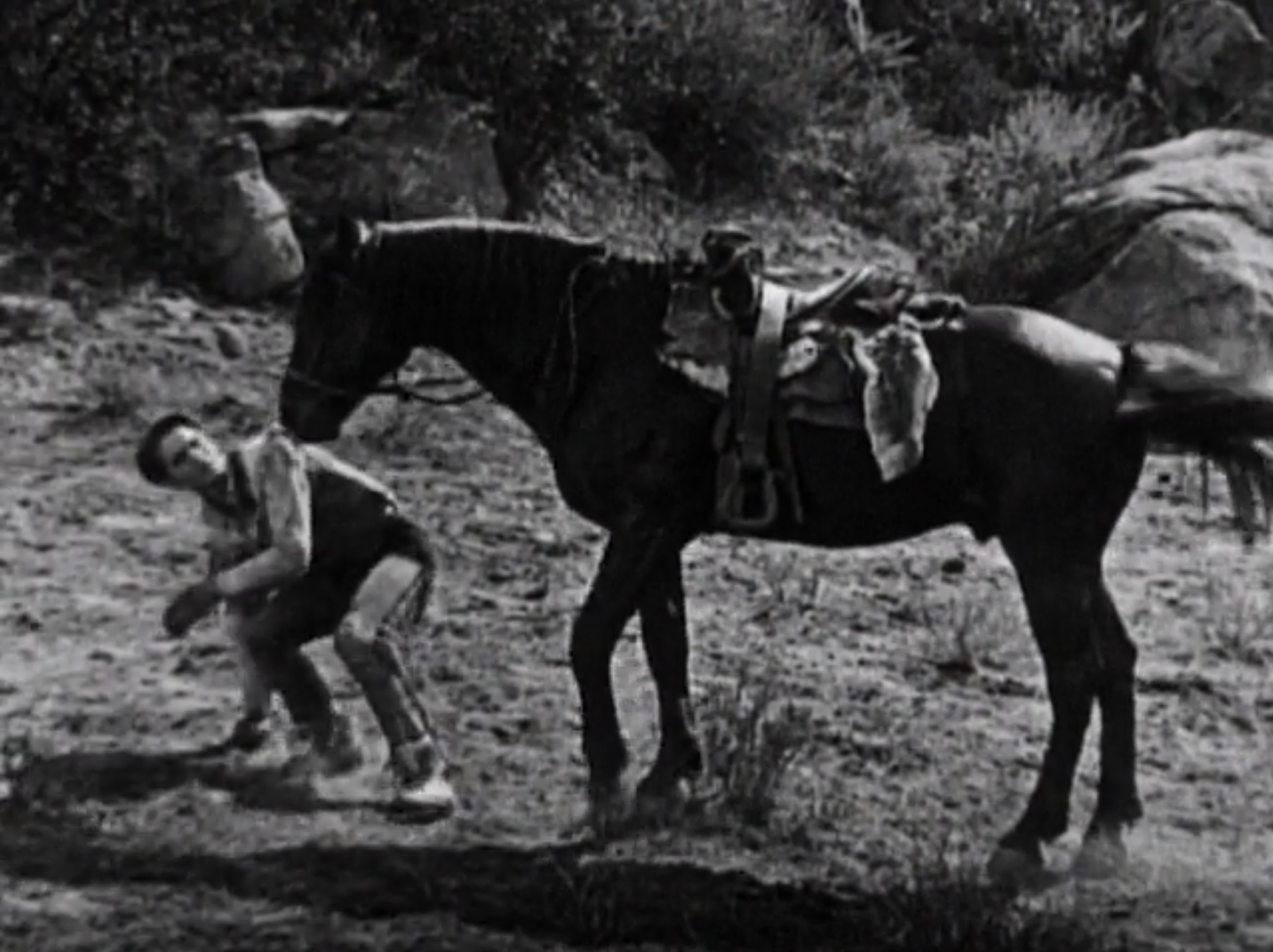
Yakima learns the hard way that Rex isn't quite broken yet

The bumpy relationship between Rex and Yakima forms one of the main plot threads running through the movie — and parallels real-world challenges filmmakers faced in working with the notoriously moody Rex.

Yakima picks himself up after being thrown by an angry Rex

Most of the key scenes involving Yakima and Rex were filmed on the Iverson Ranch, and on a recent expedition into the Garden of the Gods, I was able to locate a number of shooting sites for "The Devil Horse."

An early sequence in the movie features a group of Indians out on a pointed ledge. "The Devil Horse" is one of the many early Westerns in which good and bad are essentially defined as Indians bad, white people good.

Sunset Peak in the background, located a short distance south of Iverson, helped narrow down the location. The position of the peak suggested that the sequence was filmed along the western edge of the Garden of the Gods.

Soon after arriving in the general area, I spotted some of the rocks seen in the movie. Notice the rocks marked here as "A," "B" and "C."

The same rocks can be identified in the movie shot. The key rock, however — the pointed ledge itself — is missing from the recent photo.

That's because the pointed ledge is now hidden behind a big tree and is no longer visible from the camera angle used in "The Devil Horse."

The pointed ledge in 2017 — hidden in a tree

A short hike south from the camera location reveals that the pointed ledge is still in place. I found it right where I expected it to be, although today only a small portion of the ledge protrudes from its hiding place in the tree.

Google aerial view of Garden of the Gods from the west

The bulk of the Iverson Movie Ranch location shoot for "The Devil Horse" took place on what is now public land, with the Garden of the Gods preserved as a park. This Google map shows where the pointed ledge can be found.

Dave Carson (Yakima Canutt) and Prowling Wolf (Bob Kortman) clash near a fake rock arch

Another scene in "The Devil Horse" features what appears to be a rock arch. I know most of the arches at Iverson, and when I saw this one I thought it must be fake.

Present-day location of the fake arch seen in "The Devil Horse"

From the context in the movie, I was able to determine that the fake arch was built on top of two existing rocks.

In my research I refer to these rocks as "Desert Tortoise" and "Flounder." They're located due west of the massive Garden of the Gods landmark known as Sphinx, and are just a short distance north of the pointed ledge.

Galapagos tortoise — note the high shell

I'll try to explain why I call the rock "Desert Tortoise." I've always thought the coolest of the giant tortoises are the ones with a really high shell, like the Galapagos and certain varieties of the desert tortoise.

"The Lone Ranger" TV series (1949): "Desert Tortoise"

I think I first made the connection between the rock and the high shell of the desert tortoise in this shot from one of the earliest episodes of the "Lone Ranger" TV show.

If you were to exaggerate the height of a really high tortoise shell just a bit, you might get something like this. As usual, the image probably won't work for everyone, but I'm kind of stuck with the name.

"Flounder," as it appears from the north

With regard to "Flounder," I believe from this angle it's self-explanatory.

The spot where Desert Tortoise and Flounder come closest together was used to create the base for the rock arch in "The Devil Horse."

The yellow line marks the approximate delineation between the fake arch material above and the real rocks below.

As I scoured the rocks for any artifacts that might remain from the 1926 shoot, I found something interesting: a manmade indentation carved in the rock, similar to those found in the "Footholds" area northeast of here.

"The Devil Horse": The carving can be seen in 1926

I initially assumed the indentation was used to help anchor the fake arch. However, after going back over the movie sequence I realized the carved hole is located outside the area where the arch was positioned.

"The Devil Horse": Prowling Wolf arrives at the fake arch

Then I discovered the reason the indentation was carved into the rock. It was used to help set up the climactic confrontation between Yakima's Dave Carson and his bitter enemy, Prowling Wolf.

Prowling Wolf plots his ambush of Dave Carson

In full war bonnet, and with an ambush in mind, Prowling Wolf takes a look at the rock before he tries to climb it. I wonder whether he already has his eye on the carved indentation at this point.

This shot also provides a pretty good look at most of the fake arch. As fake arches go, it's a nice one.

Prowling Wolf climbs up on "Flounder"

As Prowling Wolf climbs up the rock holding his bow in one hand, he could use a little help getting all the way up. My guess is a stuntman was brought in to do the actual climb, although actor Bob Kortman, already a veteran of many Westerns by 1926, may well have done the stunt himself.

Prowling Wolf finds just what he needs when he reaches the foothold. Here he keeps both feet in the hole as he turns to peer over the arch. Of course, audiences at the time would be unaware of the strategically placed foothold.

Prowling wolf really gets his money's worth out of that foothold. Here he appears to be standing on tiptoes in the indentation as he raises up to look over the fake arch.

While he waits for his victim to arrive, Prowling Wolf keeps both moccasins firmly planted in the handy foothold.

Here's a closeup of Bob Kortman on the rock as Prowling Wolf, lying in wait. Kortman played henchmen, Indians and other roles, usually uncredited, in about 300 movies going all the way back to 1914.

When Dave Carson finally arrives through the fake arch, Prowling Wolf uses his solid footing in the carved foothold as the launching pad for his ambush.

Prowling Wolf — the stuntman again, presumably — flies off the rock and catches Carson off-guard, using a "bulldog" move to wrestle him to the ground. (Technically, Yakima appears prepared to go voluntarily.)

A life-or-death struggle then takes place — I don't want to give anything away, but some of the screen shots higher up in this post may or may not hold clues to the outcome.

Needless to say, Yakima Canutt, the most legendary stuntman of all time, did his own stunts.

Directions to the rock arch location (Bing bird's-eye view)

This map provides directions to the location of the fake rock arch. Start by finding your way to Chatsworth, Calif., then take Redmesa Road north off Santa Susana Pass Road. (Click on the map for a larger view.)

Zooming in on the above map, we get a better look at the approximate location of the fake arch.

Notice the tree adjacent to the Sphinx, a short distance east of where the fake arch was located. This tree has been filmed many times over the years, and also had a role in "The Devil Horse."

Sphinx and the tree on its north face (2017)

Moving to ground level, this shot from a recent visit to the Garden of the Gods shows the tree as it appears today. Like many of the old trees in the area, it has struggled to survive during the recent drought years.

A number of features are noted in this version of the shot — including a big patch of poison oak, one of the main hazards to watch out for when visiting the former Iverson Movie Ranch.

Trunk of the tree on the Sphinx's north face (2017)

Moving inside the canopy of the old tree, we get a look at its formidable trunk. We can also see just how close the tree sits to the base of the mighty Sphinx.

"The Devil Horse": Yakima and Rex at the tree in 1926

Here's the same tree more than 90 years ago, when "The Devil Horse" was being filmed. The tree was little more than a sapling at the time, but this shot and others like it prompted me to start calling it the "Yakima Oak."

"Bullet Code" (1940): One of countless movie appearances for the Sphinx and the tree

These two prominent Iverson Movie Ranch features — the Sphinx and the nearby Yakima Oak — have coexisted for decades, appearing in hundreds of movies and TV shows.

The old oak tree has lost a number of major branches in just the past year, most notably its distinctive horizontal branch, which broke off in 2016. The branch was one of the tree's defining characteristics throughout the filming era.

"The Devil Horse": The Yakima Oak begins to branch out

Even back in 1926, the horizontal branch was easy to spot — in its early stages, but already reaching westward.

"The Lone Ranger" TV series: Tonto faces an ordeal at the tree 

In later years, the branch would show up again during filming. This shot comes from an episode of "The Lone Ranger" called "The Courage of Tonto," which was filmed in 1956 and first aired Jan. 17, 1957.

As recently as early 2016, when photographer and film historian Jerry Condit snapped this photo from an angle similar to the one seen in the "Lone Ranger" shot, the branch remained intact.

I originally ran the Tonto shot and Jerry's matching shot as part of an in-depth collection of Iverson photos from the color season of "The Lone Ranger." I encourage readers to click here to see that post.

The Yakima Oak in fall 2016: The horizontal branch has broken off

When Jerry revisited the site about six months later, in the fall of 2016, he noticed that the branch had broken off.

The tree's problems continue in 2017

More recently, another major branch has broken off from the struggling oak tree and is currently lodged among the Yakima Oak's main limbs.

"The Devil Horse": Landmark rocks remain at the site

Even with the tree's issues, a number of landmarks can be tracked from 1926 that remain a part of the contemporary landscape. For example, notice rocks A, B, C and D, seen here in "The Devil Horse."

The same rocks in 2017

Rocks A, B, C and D are still easy to identify, right in the same positions where they've been all along.

"The Devil Horse": Yakima Canutt at the base of the Sphinx

In another shot from the same sequence, Yakima Canutt sits in front of a distinctive "cave" — a small opening at the base of the Sphinx, below the tree, along the rock's north face, Notice the black space behind Yakima's head.

The same location in 2017

This small "cave" at the base of the Sphinx, next to the Yakima Oak, is still easy to find and easy to match up.


There's much more to be said about "The Devil Horse," one of the true gems in the early history of the Iverson Movie Ranch. I have a feeling it will come up again in future posts. In the meantime, you can stream it on Amazon Prime, where it's listed as "Rex the Devil Horse" — click on the link above to find it on Amazon.