The 1936 musical Western "The Big Show" was an early showpiece for Republic Pictures, produced during the first year the studio was in business. Republic released the film as a "special" and rented it to exhibitors at higher rates than the company charged for its standard B-Western fare.
"The Big Show" — Gene Autry in the Iverson Gorge
The
movie showcases the talents of Gene Autry, still a rising star in 1936
but already one of the crown jewels in Republic's stable of stars. By
the end of the year, Autry was voted the movies' No. 1 Western star — a
title he held every year until 1942, when he took a hiatus from acting to join the war effort, becoming an Army Air Corps pilot.
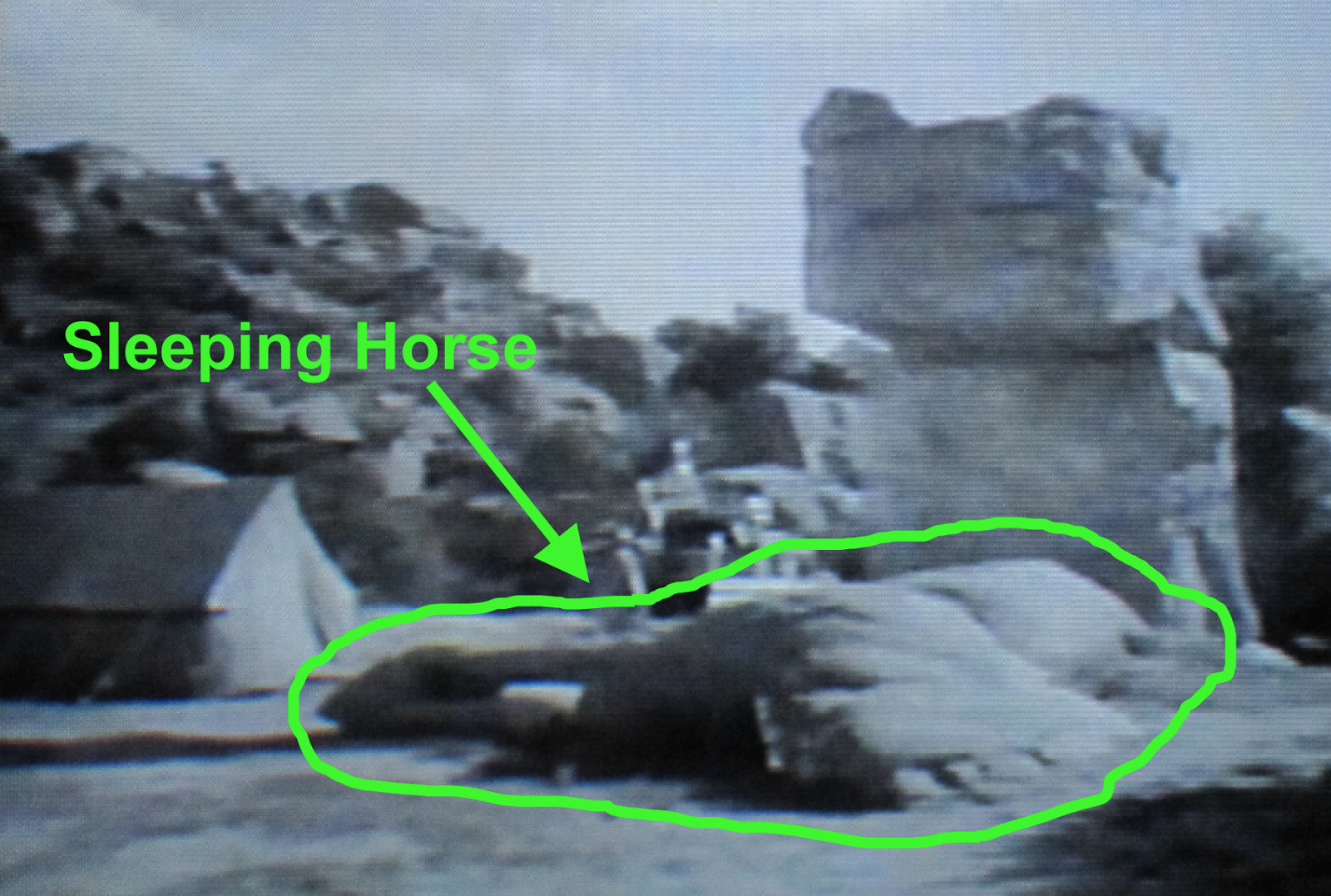
Filmed in part on the Iverson Ranch, "The Big Show" includes terrific shots of The Wall, a stunning rock edifice that stood in the Upper Gorge. Sadly, The Wall was destroyed in the late 1980s when the property was developed.
Of all the famous movie rocks that were lost to development, The Wall is probably the single rock feature I miss the most. The area seen here "went condo" and is now part of the Cal West Townhomes.
This sequence early in the movie has Autry, at right, sitting in with the Beverly Hillbillies. One of a number of cowboy bands featured in "The Big Show," the musical
group had no connection to the 1960s TV show of the same name about
Jed Clampett and all his kin.
In this shot Autry struggles with Champion in front of Crown Rock, which
was essentially part of The Wall — and is the only part of it that survived. Autry plays dual roles in "The Big Show," and in this scene he's Tom Ford, a famous movie cowboy with a bad attitude — which is why Champion's giving him a hard time.
You may have noticed what appears to be a lighting guy with a reflector who "accidentally" got in the shot. It's not a production error — "The Big Show" is a movie about making movies, and the crew is part of the story.
The Iverson Gorge: a "behind the scenes" shot from "The Big Show"
The "movie in a movie" element makes "The Big Show" something truly special from a location standpoint, because in filming a movie being made, even a fictional one, "The Big Show" captures what it would have in fact looked like to make movies at Iverson.
This may be the closest thing we'll ever see to a documentary about how movies were made on the location ranch. In shot after shot the audience is taken backstage on the set of a B-Western filmed among the rocks.
We also get a look at the camera trucks that were used to film all those great chase sequences. This shot from the movie was not filmed at Iverson, but I would be willing to bet that as part of the Republic fleet, this camera truck was a frequent visitor to the ranch. Republic made more movies at Iverson than any other studio.
Another movie truck — this one filmed in the Iverson Gorge — displays the slogan of the movie's fictional studio, Mammoth Productions.
In this behind-the-scenes shot — behind the scenes of the fictional movie, that is, but in front of the cameras on the real movie — leading lady Kay Hughes gives Champion a little TLC. In "The Big Show" the lines become wonderfully blurred between reality and make-believe.
A number of Iverson rocks turn up in the photo, including those noted here — all of which survived the development of the Gorge and remain at the site today.
Promo still for "The Big Show": Gene Autry seated on the "bench" next to Crown Rock
This photo catches Gene during a "break" from filming in the Iverson Gorge — really just part of a series of promo shots in which Autry is being snuck up on by a Native American. In the real world if a Native American wanted to sneak up on people, I have a feeling he wouldn't try to do it in full headdress.
The photo includes a number of Iverson Movie Ranch landmarks. All of the features I've noted here remain in place, with Crown Rock and "Crown Bench" today positioned among the condos that now occupy much of the Upper Gorge. The background hills are part of the Santa Susana Mountains to the west of Iverson.
Crown Rock and Crown Bench as they appear today
To passers-by who are aware of the area's movie history, Crown Rock and Crown Bench serve as reminders of the northwest San Fernando Valley's important role in creating the mystique of the American West. But I suspect some residents of the condo complex see these landmarks and think, "What's that stupid rock doing there?"
Here's another of those promo shots where Gene appears oblivious to a possible ambush. This time he's riding Champion through Devil's Doorway, emerging from the heavily filmed arch's south entrance.
Devil's Doorway as it appears today
Devil's Doorway is another rock feature that has survived and today is part of the condo complex.
This "backstage" shot from the movie spotlights a corner of the Upper Gorge that I find especially intriguing, from a rock standpoint — and it's an area that remains relatively undocumented. Much of this area has given
way to condos, and the rocks seen here include a mix of "survivors" and
"development casualties."
This area can be found today near the end of Sierra Pass Place, just below the Cal West Townhomes. Of the rocks I've noted here, only Evolution has survived — and it's pretty hard to find. You can
click here to read a blog post I put up about it back in June 2014.
Lancer Arch and
Wyatt Earp Rock have also been featured previously.
Gene Autry as Tom Ford in "The Big Show"
The mustache is the giveaway that this is a shot of the "evil" Gene Autry character in "The Big Show" — the egotistical movie cowboy Tom Ford. The rocks in the background can be easily found today — visitors can see them from the car along the west side of Redmesa Road in Chatsworth.
Ford's diva routine wears thin on the director and crew.
Even his leading lady — Kay Hughes, playing an actress named Marion Hill — is fed up with this version of Autry.
In the background are a couple of noteworthy features, including the "back side," or east side, of the heavily filmed Batman Rock.
It's harder to see that side of the rock today, as it's largely concealed behind a big tree.
Sons of the Pioneers (1936) — promotional still for "The Big Show"
Roy Rogers, who would eventually give Gene Autry some competition for the title of America's favorite
cowboy, also turns up in "The Big Show," in an uncredited role as backup guitarist in the Sons of the Pioneers.
Rogers,
who was 24 at the time "The Big Show" was filmed, was still going by his birth name, Leonard
Slye. Rogers and Autry would eventually become known by two non-competing nicknames, with Rogers making the rounds as the "King of the Cowboys" and Autry billed succinctly as "The Singing Cowboy."
The Roy Rogers: cola, grenadine syrup and a maraschino cherry
But it was Roy Rogers who ended up with a cocktail — or "mocktail" — named after him. Who doesn't have fond memories of ordering a delicious "Roy Rogers" as a kid — or for the girls, a delicious "Shirley Temple."
Gene Autry and a cast of notables in "The Big Show"
When
"The Big Show" was produced, Rogers was still waiting his turn. In the
movie he settles mainly for pickin' and grinnin' in the background as
Autry commands center stage.
The
movie featured a solid cast, including Kay Hughes, fresh
off a star turn in the Republic serial "The Vigilantes Are Coming";
comedic actress Sally Payne, in her film debut; and Three Mesquiteers
and Range Busters stalwart Max Terhune, who brought along his ubiquitous
dummy Elmer.
Here's a nice shot from "The Big Show" featuring 24-year-old Leonard Slye — Roy Rogers, at far right — with the Sons of the Pioneers.
"The Big Show" at the Texas Centennial Exposition in Dallas
One of the big attractions of "The Big Show" for some of the movie's fans is that, along with its Iverson Movie Ranch footage, the production filmed extensively at Fair Park in Dallas. The historic facility had recently been transformed into an art deco showcase for the 1936 Texas Centennial Exposition.
The movie includes numerous shots of Fair Park's newly minted art deco buildings, many of which remain in use today. These days the sprawling park hosts a number of annual events, including the State Fair of Texas.
Shots
of the old Republic lot also appear in the
movie, with the Studio City, Calif., facility dressed up as Mammoth Studios. Known today as the CBS Studio Center or the Radford Studio Center, the site, which is now owned by CBS, has remained a
busy production hub throughout the TV era.
A caravan of old movie vehicles returns to the studio lot after a day of shooting on location at Iverson.
For
some reason I like this shot from "The Big Show" with a bunch of vintage cars parked outside the old Republic lot. The area was less cluttered then than it is now.
I recently obtained a copy of the DVD set "Gene Autry Collection 1," which contains "The Big Show" along with the Autry movies "Melody Trail," "Boots and Saddles" and "Rhythm of the Saddle." The movies are remastered, and the picture quality on "The Big Show" is
dramatically improved from any previous versions I've seen. The movie is also restored to
its original running time of 71 minutes.
Here's a link to Amazon, where you can buy the Gene Autry Collection 1. Most of the photos in this post come from this DVD set, and I can recommend it to anyone who's interested in the Iverson Movie Ranch.