Ray Harryhausen was the king of the Hollywood special effects guys in the pre-CGI days, known for the classics "Mighty Joe Young" (1949), "The 7th Voyage of Sinbad" (1958) and "Jason and the Argonauts" (1963), among many other movies from the 1940s into the 1980s. His stop-motion monsters were his calling card — he called his process "Dynamation" — and as it turns out, at least one of those monsters went on a rampage at the Iverson Movie Ranch in Chatsworth, Calif.
It all went down in the 1957 sci-fi movie "20 Million Miles to Earth," which filmed at Iverson in late 1956.
In the monster's first appearance at Iverson, it surfaces in the Upper Gorge. The two rocks behind it can still be found at the site today: Crown Rock on the left and the Devil's Doorway Wall on the right.
Crown Rock appears again in this shot, where the hapless authorities are setting up to try to kill the monster with a flamethrower. That's Crown Rock filling up the bulk of the left half of the screen. You can also catch a glimpse of Minisub in the background, toward the right, directly above the guy in the suit. Both Crown and Minisub can still be found at Iverson. Well, technically, only about half of Crown Rock survived the Cal West Townhomes development that now fills the site — the same half seen here. The original rock extends farther to the left, as noted below.
Here's what's left of Crown Rock, which is now sort of a decoration among the condos. The rest of it was hacked away to make way for the driveway. You may notice the similarity in the shape of this rock and the one in the photo above it. The round part of the rock in the black-and-white shot, framing the guy with the flamethrower, is now concealed behind the foliage at the right of the above shot.
Detouring momentarily from the monster movie, this is what a hacked-up famous movie rock looks like. It's another view of Crown Rock in recent times, from what might be called the front of the rock. This view shows the pockmarks left when a portion of the rock was hacked away to make it fit the plan for the condo development. The rock is adjacent to one of the development's main driveways. (You may want to click on the photo to enlarge it for a better look at its hacked-up face.)
Sadly, they destroyed Crown's "twin," which was at least as interesting as the part that survived. Above is a shot of the two Crown Rock twins as they appeared in 1957 in the TV show "Have Gun, Will Travel" — each with its own Indian warrior on top. The shot is from the episode "The Yuma Treasure," which first aired Dec. 14, 1957. The twin on the right is the piece of the rock that remains today.
Back to the rampaging monster. This shot was probably one of the things the creature wound up rampaging about. The flamethrower scene takes place on the plateau at the top of Iverson's Upper Gorge, with the rock feature known as The Wall (not to be confused with the Devil's Doorway Wall) seen at the right, and Elders Peak in the background, to the right of the monster. The plateau in the foreground is now filled with condos, and The Wall was torn down to make room for them.
Another shot from the flamethrower showdown has the monster again positioned with its back to the Devil's Doorway Wall, center. At the left is Crown Rock, and the tall rock toward the right is part of the Devil's Doorway Cluster. In the background is Cactus Hill. All of these features remain in place today.
Fleeing the flamethrower, the monster emerges from the back side of Zorro's Cave, at the right. The tall rock toward the left is another familiar Iverson feature, which I call Heroes Tower because of its appearance in the NBC TV series "Heroes."
Here's a look at some of those same rocks in the summer of 2008 — including Heroes Tower and the rocks behind Zorro's Cave. This shot was taken when "Heroes" was being taped at the site, and the show's producers had added paintings to a number of the rocks.
Another pic from summer 2008 offers a better look at some of the rock paintings used in "Heroes," including the one on Heroes Tower at top right. The paint was all cleaned up as soon as the shoot was done, although I did find a couple of traces that hung around for a short time on some other rocks.
Click here to see more about the "Heroes" shoot.
The pursuit of the monster in "20 Million Miles to Earth" eventually leads to another part of the Iverson Movie Ranch, where the Indian Hills Mobile Home Village now stands. In this shot a helicopter closes in as the monster is enjoying a snack in the approximate spot where the mobile home park's swimming pool is now located. Flanking the chopper are End Rock, on the left, and Corner Rock, just to the right of the helicopter, with Smooth Hill in the background.
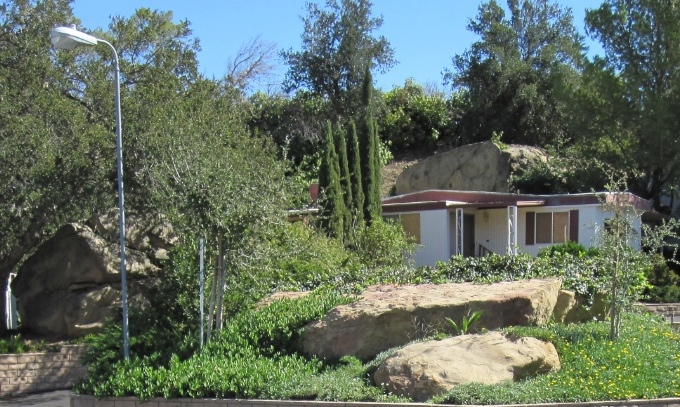
End Rock as it appears today, near the foreground (behind the smaller rock in front),
with Corner Rock in the shadows behind the lamp post at left
These days, End Rock is thought to be part of a planter setting at the mobile home park, while Corner Rock was partially lopped off to make way for a road. In the recent photo above, the rock that now passes for End Rock is the larger of the two rocks in the foreground, while Corner Rock is in the shadows at the left, behind a low brick wall. The positions are reversed because this shot is taken from the north, while the shot of the monster above is taken from the south. I've never been fully convinced that this flat rock in the planter is in fact End Rock, something I've talked about a little in a
previous blog entry. It has generally been "accepted" among researchers that it's End Rock, but I think everyone's at least a little suspicious.
This angle from "20 Million Miles to Earth" more closely approximates the recent shot, with Corner Rock on the left and End Rock on the right. The dirt road seen here follows the same path as the current asphalt road bordered by the low brick wall in the recent shot above, which leads to the mobile home seen above End Rock in the recent shot. The "bump" on the right side of Corner Rock, which protrudes over the dirt road, has been removed to allow for a wider road today.
Apartment complex atop the former Smooth Hill
Even Smooth Hill, an important landmark in hundreds of old movies and TV shows shot at Iverson, was destroyed. The top of the hill was lopped off when the 118 Freeway came through in the 1960s, and a large apartment complex now occupies the site, along with some condos. In the above shot looking northwest toward the two main buildings of the apartment complex, the freeway can be seen cutting through the center of the shot above Topanga Canyon Boulevard, with a glimpse of the condos at far left.
The monster's Iverson rampage ends when it is captured by dropping a steel net on it, with the capture taking place in what's now the mobile home park. However, as anyone who knows monster movies will tell you, we can expect it to come roaring back to life — and it does. For reasons that I presume are explained in the movie, the monster's next rampage takes place in the streets of Rome. I have heard that one reason the production went to Italy was because Ray Harryhausen wanted to vacation there.
One of the highlights of "20 Million Miles to Earth" is a brutal fight between the monster and a Dynamation elephant, with Harryhausen's fluid motion work seen in all its glory. (The still shots don't do it justice.) This sequence, along with the remainder of the movie, is set in Rome and no longer involves Iverson. But the Rome rampage is too cool not to post a bunch of screen shots of it anyway.
In contrast to the frustratingly brief appearances by star monsters in many 1950s monster movies, viewers get a "lot of monster" in this one.
The creature goes on a tour of Rome for a while, and kind of trashes the place. In some instances, as with the shot above, the modeling is pretty obvious.
In other shots the sets look real, as when things come to a head with a climactic stand atop the Roman Colosseum.
Ultimately, the odds are stacked against the monster ...
... which takes some hard hits from the gathered artillery ...
... and winds up in ruins, like much of the rest of Rome. Oh yeah: Spoiler alert. I mean ... but is this really the end of the monster?
The man behind the monster. Born in Los Angeles, Ray Harryhausen moved to London in 1960 and remained active in the movies through "Clash of the Titans" in 1981. Here he's seen with a model of one of his trademark skeleton warriors — a tribute to the classic battle scene in "Jason and the Argonauts" that featured seven of the hard-to-kill swordsmen. Harryhausen, one of the true legends of the movies, died today, May 7, 2013, at 92.