Why we love old movie locations — especially the Iverson Movie Ranch

For an introduction to this blog and to the growing interest in historic filming locations such as the Iverson Movie Ranch — the most widely filmed outdoor location in movie and TV history — please read the site's introductory post, found here.
• Your feedback is appreciated — please leave comments on any of the posts.
• To find specific rock features or look up movie titles, TV shows, actors and production people, see the "LABELS" section — the long alphabetical listing on the right side of the page, below.
• To join the MAILING LIST, send me an email at iversonfilmranch@aol.com and let me know you'd like to sign up.
• I've also begun a YouTube channel for Iverson Movie Ranch clips and other movie location videos, which you can get to by clicking here.
• Readers can email the webmaster at iversonfilmranch@aol.com
.

Showing posts with label Head (the). Show all posts

Friday, November 25, 2016

Joe Iverson's "Garden of Stacked Rocks" on the Lower Iverson Movie Ranch

Joe Iverson builds a road through the Gorge, circa early 1930s

Joe Iverson, who ran all or part of the Iverson Movie Ranch for more than 60 years, was known to take it upon himself to "fine-tune" the ranch's rocky landscape.

"The Miracle Rider" (1935): Freddie Frog in foreground

One of Iverson's favorite techniques for changing the look of the place was to cement one rock on top of another — creating a "stacked rock" formation.

Freddie Frog, an early Iverson Ranch "stacked rock"

The earliest known example of a manmade stacked rock at Iverson is a feature I call Freddie Frog, which was in place as early as 1926.

Promo still for "Tell It to the Marines" (1926)

While it's relatively small and would be easy to miss in this early promo still, a careful examination of the shot reveals that Freddie Frog had already been created in 1926.

Remnants of Freddie Frog as found today

We know Freddie Frog was a manmade formation because remnants of the rock, including the cement that once held it in place, can be found today at the site.

I blogged about Freddie Frog back in February 2014, including getting into the nitty gritty about chunks of cement that remain from the formation's movie days.

"Range Beyond the Blue" (PRC, 1947)

This shot from the Eddie Dean movie "Range Beyond the Blue" shows Freddie at its most "frog-like." For more of the Freddie Frog story, please click here to read my blog post from 2014.

"Gold Raiders" (1951): Gold Raiders Rock appears at left

The Iverson Ranch was sprinkled with these "stacked rocks" throughout its filming era, and many of the stacks found their way into movies and TV shows. One of the best-known of the Iverson rock stacks is Gold Raiders Rock, seen above in the movie role that gives the rock its name.

"Ghost Town Renegades" (1947): Al "Fuzzy" St. John
rides past the future Gold Raiders Rock

Gold Raiders Rock, as it would later come to be known, also appeared in productions before it became a stacked rock. This is what it looked like before it had the smaller rock cemented on top of it.

Gold Raiders Rock today (photo by Jerry Condit)

A number of the original Iverson Movie Ranch stacked rocks have survived and can still be found on the former movie ranch. This is what Gold Raiders Rock looks like today.

"Five Guns West" (1955): "The Head" makes a rare appearance

An unusual stacked rock can be found near the west end of Cactus Hill. "The Head," as I call it, was rarely filmed, but did show its, um, head, in Roger Corman's terrific Western "Five Guns West."

The Head in modern times

The Head has survived and can still be found today next to the trail the riders used in "Five Guns West."

A closeup reveals the cement work that was done to hold the "head" in place.

A small bird rests on "The Head" as dusk approaches 

The Head may have had a limited film career, but it continues to make itself useful to the local wildlife.

Joe Iverson's "Garden of Stacked Rocks" in 2016

Joe Iverson outdid himself in one particular section of the former movie ranch, creating what amounts to a "garden of stacked rocks."

Contained within a small area are three distinct stacked-rock formations. The "garden" is located in a rarely explored private section of the former Lower Iverson, near Flat Rock and what remains of the Iverson Ranch Eucalyptus Grove.

For research purposes, I refer to the three stacked-rock formations as Grove Stacks A, B and C. The most familiar of the three is the triple stack identified here as "A."

"The Life and Legend of Wyatt Earp" (1960)

Grove Stack A is easy to spot in this scene from the "Wyatt Earp" TV series. The shot comes from an episode called "John Clum, Fighting Editor," which premiered April 12, 1960.

The key features of the "Wyatt Earp" shot are identified here. The camera is shooting northeast toward the nearby Eucalyptus Grove.

The same area is seen in this shot from a recent expedition to the site. A few new trees are in place, but the rock features are immediately recognizable.

"Escort West" (United Artists, 1959)

Another view of Grove Stack A, this time with the camera shooting south, appears in the Victor Mature movie "Escort West." The stacked formation can be seen at the left of the frame.

Grove Stack B in 2016

Grove Stack B, which is tucked in between Grove Stacks A and C, is the least frequently filmed of the three formations in Joe's "Garden of Stacked Rocks."

"The Roy Rogers Show" episode "Ghost Town Gold" (premiered May 25, 1952)

This rare shot from "The Roy Rogers Show" comes from one of the few scenes where it's possible to identify Grove Stack B in a production.

A portion of Grove Stack B appears at the far right in the "Roy Rogers Show" screen shot.

In fact, all three of Joe's Grove-area creations can be identified in the "Roy Rogers" shot, including a little bit of Grove Stack C hiding behind Grove Stack B.

"Hannah Lee: An American Primitive" (1953)

We get a better look at Grove Stack C in the John Ireland Western "Hannah Lee: An American Primitive."

The "Hannah Lee" shot also shows the stacked formation's proximity to Flat Rock.

"The Roy Rogers Show" episode "End of the Trail" (premiered Jan. 27, 1957)

Grove Stack C shares the screen with Roy Rogers in an episode from the final season of "The Roy Rogers Show."

Grove Stack C as it appears now, at left, and in "The Roy Rogers Show"

Here's a side-by-side comparison of the rock's profile in the "Roy Rogers" episode and in recent times.

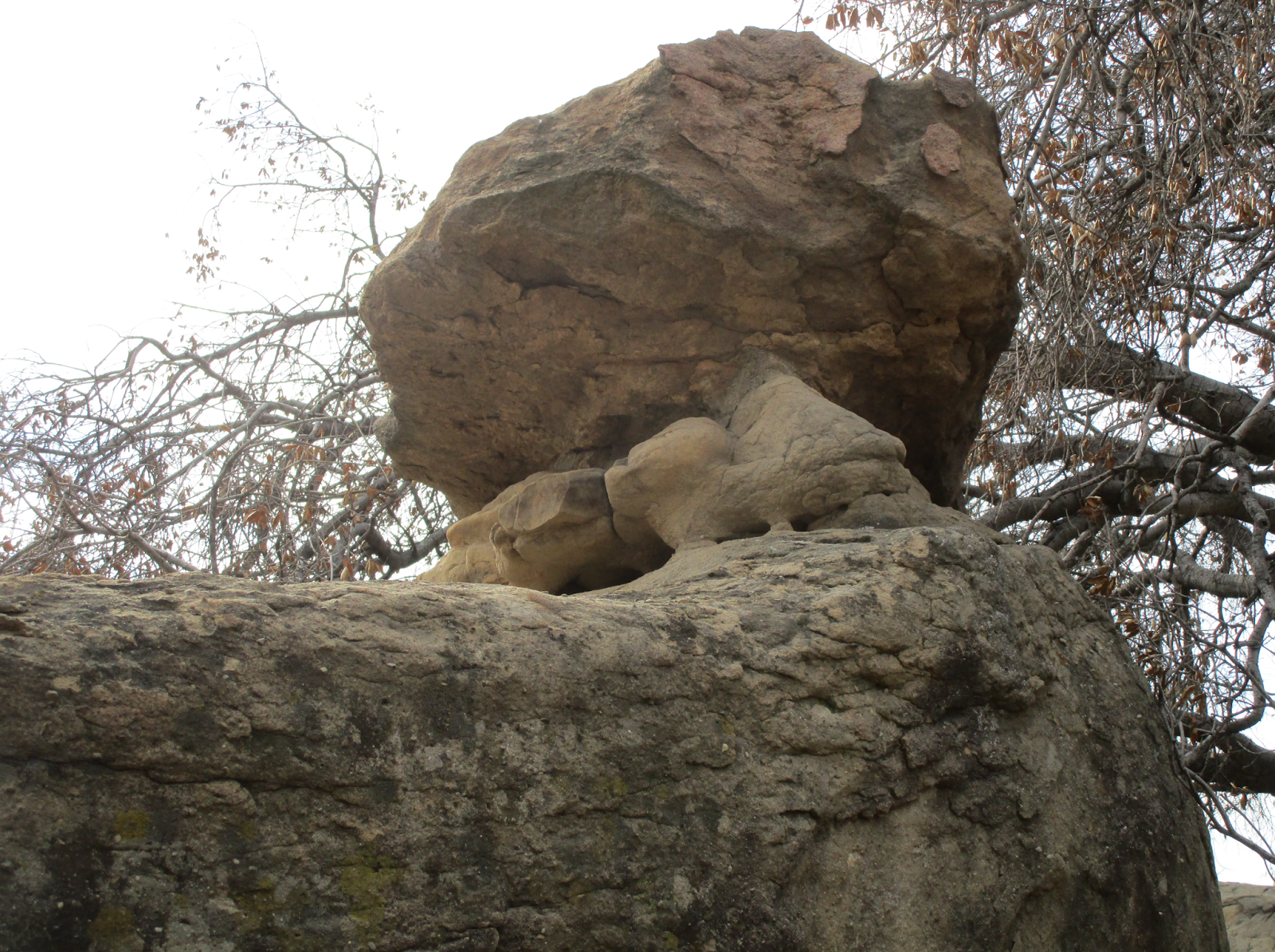
Grove Stack C shows off its duck-shaped body in this modern-day photo.

A closeup of Grove Stack C shows the area where the "head" attaches to the body.

Zooming in further, we get a look at the cement work that helps hold the head in place.

Grove Stack B

Grove Stack B, too, is put together with the help of cement.

This closeup of Grove Stack B provides a look at some of the cement work holding the rock together.

Grove Stack A

As a classic "triple stack," Grove Stack A would have necessarily been slathered in cement.

Cement is used not only to fasten the head of Grove Stack A to the middle section, but also to hold the middle section in place atop the feature's large base rock.

Here's a closer look at the cement holding the head in place on Grove Stack A.

The finished product: Grove Stack A, in "Cole Younger, Gunfighter" (1958)

Joe Iverson's handiwork, Grove Stack A, can be seen in the lower right corner of this shot from the Allied Artists Western "Cole Younger, Gunfighter."

Joe Iverson's "Garden of Stacked Rocks" in 2016

Today the "Garden of Stacked Rocks" stands as a cement and sandstone testament to a man who knew a lot about rocks, earned his living from them — and even on occasion made his own.

Monday, January 2, 2012

Roger Corman's Iverson Movie Ranch movies, Part 1:
Five Guns West

Roger Corman


One of the most interesting filmmakers to embrace the Iverson Movie Ranch as a shooting location over the years is Roger Corman, whose Iverson work goes all the way back to his first movie as a director.

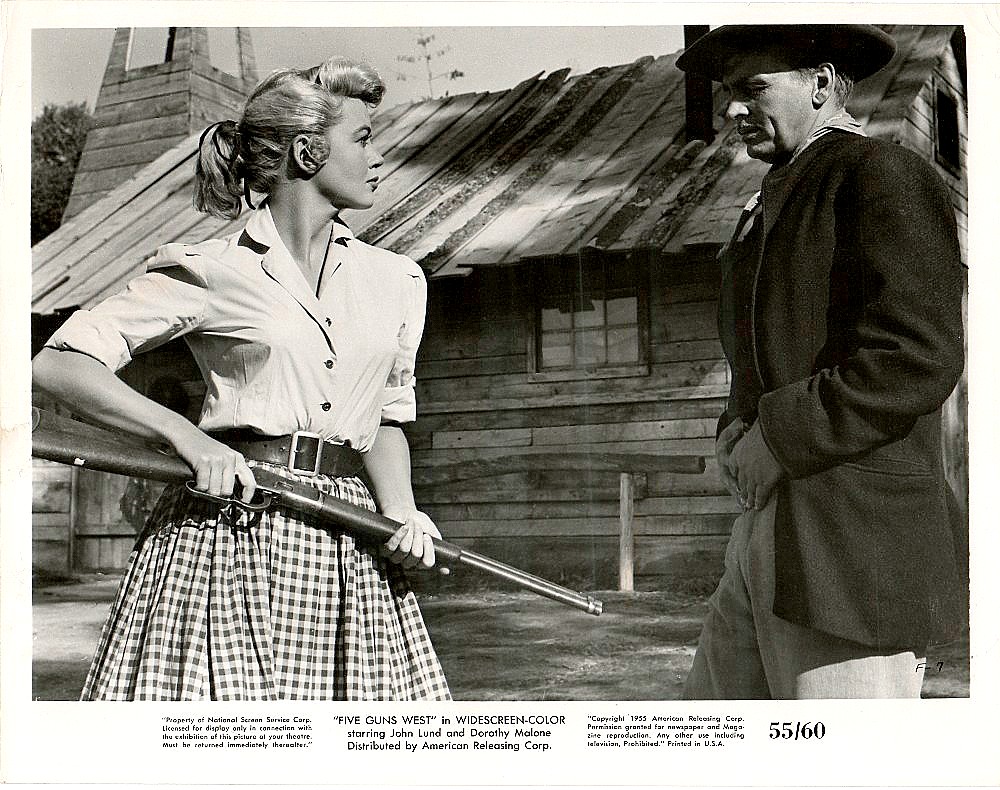
A traditional Western in many respects, the 1955 film "Five Guns West" — Corman's directorial debut, which he also produced — boasts better production values, a better script and better acting than the B-Westerns that inspired it, serving notice that the career of an important filmmaker was being launched.

Dorothy Malone and John Lund on the Ingram Ranch in "Five Guns West"

John Lund, best known for Billy Wilder's "A Foreign Affair" (1948), plays the male lead in "Five Guns West," opposite the potent screen presence of Dorothy Malone.

Promo still for "Five Guns West" featuring Dorothy Malone and Jonathan Haze

Malone is put to great use in the movie, tantalizing a series of outlaws with her raw sexuality.

"Five Guns West": Mike "Touch" Connors, center

The cast also includes Mike Connors — long before he became famous as TV's Mannix, back when he was still known as "Touch" Connors.

Ambush sequence using Wrench Rock, on the Upper Iverson Movie Ranch

Corman's ability to economize on production costs was already evident, with "Five Guns West" shot almost in its entirety at two locations: The first half-hour takes place at the Iverson Movie Ranch, with the rest of the movie set a few miles south of there at the Jack Ingram Ranch. (Jack Ingram, who was a B-Western regular for years before opening his location ranch, also has a role in the movie.) The above shot features the widely filmed Wrench Rock, sometimes called Indian Head. Even though the rock is a familiar feature in Iverson movies, it's unusual to see it used in this manner — as a perch for an ambush.

"Five Guns West": The view from Cactus Hill looking south

This shot offers a long-distance view of the movie ranch's most famous section, the Garden of the Gods (to the left of the riders), along with the western San Fernando Valley, at top left, and a familiar rocky hill at top center.

Sunset Peak, or Elders Peak, was (and remains) situated south of the Iverson Ranch, across Santa Susana Pass Road. The western San Fernando Valley was still rural at the time, and Chatsworth Reservoir still had water in it.


Corman's Iverson shoot for "Five Guns West" is an unusual one, taking place mostly on Cactus Hill — probably the most prominent single feature at Iverson, but one that was typically seen only in the background and was rarely used as a shooting location in its own right. Corman used that fact to his advantage, shooting heavily on Cactus Hill and getting unusual shots in the process. The above shot, looking north from Cactus Hill, provides a rare glimpse of a rock I call Gorilla, seen at the right of the photo, just above the halfway point.


Here's another view of Gorilla from a recent site visit, again looking north. You can also see Oat Mountain in the distance, along with some of the estates that now fill the former Upper Iverson. For the Iverson aficionados, that's the back end of Turtle Rock directly to the left of Gorilla.

Cactus Hill has traditionally been referred to anonymously by film location researchers (for example: "a large hill separating the Upper and Lower Iverson"), but it came to my attention recently that the Iverson family called it Cactus Hill, and it works for me. True to its name, Cactus Hill is loaded with impressive cactus. Above is an example from a recent visit. The hill also features a treasure trove of beautiful and underutilized movie rocks, if you're into that sort of thing (which I am).

Another shot from "Five Guns West" — looking toward the west this time — features another unusual Iverson rock located atop Cactus Hill. Between the trailing rider and the two leading riders is a spherical rock I call the Head, because when you first come upon it along the trail, it looks a lot like a human head.

"The Head" in modern times

Here's a shot of the Head that I snapped on a recent visit to the site. One intriguing thing about the Head is that it's manmade — the smaller rock on top of the formation was cemented onto the larger rock that forms the base.

Closeup of the Head — note the cement base

This closeup shows some of the cement work. Whenever I find a rock at Iverson that has been cemented, and there are a number of them, I find it significant because it had to be done specifically for the movies — the place was a working movie ranch, after all. I always want to know the answers to questions such as: What movie was this done for, and why? And where else does it appear?

"Apache Woman," 1955, directed by Roger Corman

In the case of the Head, I'm sure it wasn't done specifically for the Corman movie. It's not the kind of thing he would budget for, and besides, it was probably done a few years earlier. The bulk of the cement work at Iverson appears to have taken place around 1950-1951, indicating that the practice may have been associated with the transition from B-movies to early TV shows. It may be that the Iversons felt they had to "spruce up" the place to get it in shape for what would turn out to be extensive TV work in the 1950s. Oddly, most of the "stacked rocks" created during the "cement scare" of the early 1950s never ended up being used much — with a few noteworthy exceptions, which I will cover in a future post.

Jack Ingram Ranch, as seen in "Five Guns West"

For now, suffice to say that whatever the motivation was to create "the Head," the rock almost never turned up in any productions. I have my fingers crossed that it will eventually show up somewhere else, but at this time Corman's "Five Guns West" is the only movie I've found that features it.

"Viking Women and the Sea Serpent," 
1957, directed by Roger Corman

Roger Corman returned to Iverson a number of times, especially early in his career, and whenever he shot there — often with "Five Guns West" cinematographer Floyd Crosby — he typically found inventive ways to shoot it. The pair collaborated again on another Iverson Western, "Apache Woman," later in 1955, and Corman continued to shoot at Iverson even after moving on from Westerns to cult films — including "Viking Women and the Sea Serpent" (whose full title is much longer) in 1957 and "Teenage Caveman" in 1958. I'll feature more of Corman's Iverson work in Part 2.