Why we love old movie locations — especially the Iverson Movie Ranch

For an introduction to this blog and to the growing interest in historic filming locations such as the Iverson Movie Ranch — the most widely filmed outdoor location in movie and TV history — please read the site's introductory post, found here.
• Your feedback is appreciated — please leave comments on any of the posts.
• To find specific rock features or look up movie titles, TV shows, actors and production people, see the "LABELS" section — the long alphabetical listing on the right side of the page, below.
• To join the MAILING LIST, send me an email at iversonfilmranch@aol.com and let me know you'd like to sign up.
• I've also begun a YouTube channel for Iverson Movie Ranch clips and other movie location videos, which you can get to by clicking here.
• Readers can email the webmaster at iversonfilmranch@aol.com
.

Showing posts with label Grapes of Wrath. Show all posts

Thursday, October 29, 2015

Where did John Ford film the sequence in "The Grapes of Wrath" where the Joads get their first look at California's rich farmland?

Promo still for "The Grapes of Wrath" (1940): Overlook Point

A famous promo shot for John Ford's Depression-era classic "The Grapes of Wrath," taken on the Iverson Movie Ranch in Chatsworth, Calif., shows the Joads, a migrant family swept out of Oklahoma by the Dust Bowl, getting their first look at the lush farmland of California.

Screen shot from "The Grapes of Wrath": same location, different angle

The promo shot is significantly different from the corresponding shots that appear in the movie. The most obvious difference is that the promo shot includes the Chatsworth landmark Stoney Point, while the shots from the movie avoid Stoney Point, focusing instead on the farmland to the south and west of it.

The movie shot is taken from a higher angle, allowing for a view of a broader swath of farmland. The high angle of the movie shot hints that the camera crew filming the scene would have used a camera tower or crane.

Promo shot: Much lower angle

On the other hand, the still photographer, who would have been on the set to shoot promotional photos and behind-the-scenes material, settled for a much lower angle for his famous shot. I picture him climbing on a rock to get the minor elevation he used for the photo, but that's just conjecture.

The shots are taken from a vista point in Garden of the Gods known as Overlook Point or the Camera Mount. While the still photographer clearly appreciated the aesthetics of Stoney Point, the rocky outcropping did not fit thematically with the movie scene, which focused on the farmland and its promise of desperately needed jobs.

The camera mount at Overlook Point — still in place today

The name "Camera Mount" comes from the presence of a metal mount and circular rail setup located at the site. The rig appears to have been used for pan shots of the Iverson Gorge, but its exact origin is unknown.

Whatever the backstory on the camera mount, remnants of a circular rail and center mount remain in place today, as seen in these recent photos. The condos in the background were built in what was once Iverson's Upper Gorge, and a number of widely filmed movie rocks are visible in the top right corner.

View of the western San Fernando Valley from Overlook Point

The view of the western San Fernando Valley in recent years contains few traces of the old farmland, as the Valley has since grown into a major population center.

"The Grapes of Wrath": The truck sequence

The Joads' arrival in California's farm country in "The Grapes of Wrath" is put together from two separate location shoots at Iverson, which took place a short distance apart. The above shot — I call it the "truck sequence" — appears just before the Overlook Point sequence and is filmed to the northeast of Overlook Point.

The truck sequence has the Joad family pushing their broken-down truck the last few yards on their westward migration. The shot contains a number of Iverson landmarks, including Bald Knob and Minisub. Some readers may recall that Minisub played a big role in pinpointing the Chinese Bridge in "Tell It to the Marines."

Other landmarks seen in the truck sequence are located adjacent to the Iverson Ranch, south of Santa Susana Pass Road. The railroad cut and Sundial Rock are in an area west of what is now Chatsworth Park North.

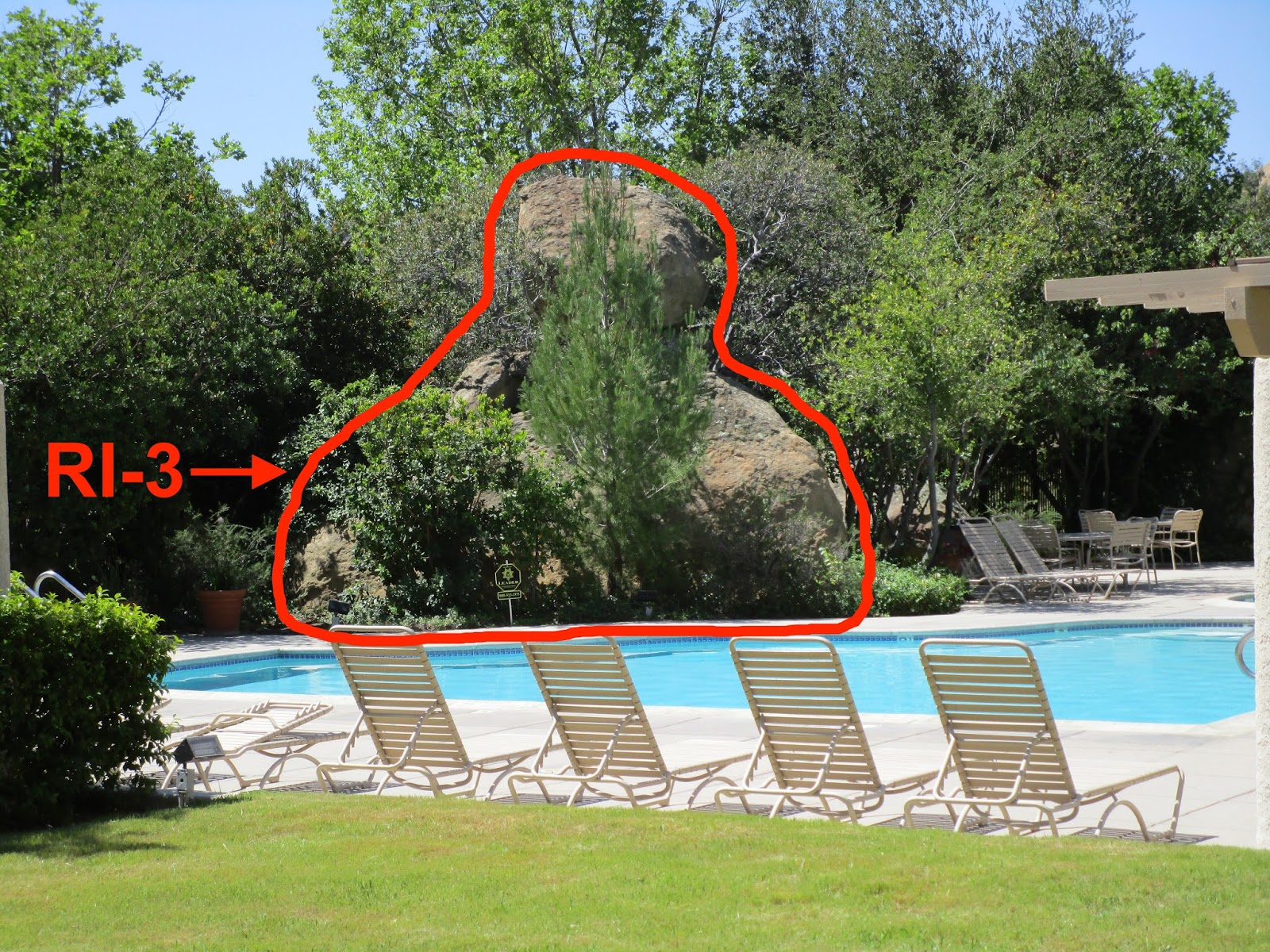
A more subtle feature of the truck shot is the shadowy presence of "RI-3," one of the main boulders of the Rock Island formation. By lining up RI-3 and Minisub — both of which remain in place at the site today — we can get a good idea of where the shot was taken.

RI-3 as it appears today

Today RI-3 and the rest of what was once Rock Island are largely buried, with the tops of the once formidable boulders now serving as decorations in the swimming pool area of the Cal West Townhomes.

Another clue that appears in the truck shot is a section of buttressing alongside the road. It would be easy to miss this relatively small feature of the shot, but on close examination it matches appearances by the stone buttressing in other productions.

"Doomed at Sundown" (Republic, 1937)

The same buttressing is seen from the other side, from the south, in the old Bob Steele B-Western "Doomed at Sundown." Even though the buttressing is pretty distant here, you might be able to spot one angular rock rising above the others. This rock can also be seen in "The Grapes of Wrath," pointing in the opposite direction.

Putting the clues together, we can pinpoint where the "Grapes of Wrath" truck sequence was filmed — in the area marked in light blue on this aerial photo from 1952. The shot takes place along the main entrance road to the location ranch, which the Iverson family called Iverson Ranch Road.

This recent Google aerial photo depicts roughly the same area, noting where the two "Grapes of Wrath" locations would be found today. The Overlook Point location has been preserved as parkland and remains pretty much intact. However, the road as it appears in the truck sequence no longer exists, having been buried during grading for the condos and replaced by a modern private road that sits at a higher elevation.

Sunday, August 24, 2014

Is Bald Knob real or fake? Some solid evidence surfaces

"The Grapes of Wrath" (1940)

Bald Knob has a long and illustrious film history, including a brief appearance in one of the most prestigious movies filmed on the Iverson Movie Ranch, John Ford's Dust Bowl classic "The Grapes of Wrath."

In this scene the migrant family the Joads, their overburdened truck on its last legs, struggle to reach California's mythic farmland, where the promise of jobs in the fields awaits. Bald Knob lurks in the shadowy background at left, playing the role it was born to play: a part of the rugged California landscape.

Russell Simpson, as Pa Joad, appears to be pointing at Nyoka Cliff, but in the movie he's pointing to the farm country that lies ahead.

And here's that lush California farmland, as it appears about midway through "The Grapes of Wrath." Looking out over a portion of the western San Fernando Valley, seen from an overlook above the Iverson Gorge, family members can't contain their excitement as they realize their long, difficult journey from Oklahoma is finally over.

"Harum Scarum" (1965)

A quarter-century after "The Grapes of Wrath," Bald Knob makes an appearance in the Elvis Presley movie "Harum Scarum" in 1965, as seen at the top-center of the frame in the above screen shot.

Here's the same shot with Bald Knob spotlighted.

"Have Gun — Will Travel" (1959): "Heritage of Anger"

With the rock's mighty overhang appearing to defy gravity, the question has to be asked: Is this thing for real? Or might Bald Knob in fact be some kind of manmade contraption? Following my recent blog post on Bald Knob, I did some digging in search of an answer to that question, and I found something interesting.

"The Virginian" (1963): "Run Quiet"

The above shot from season two of the Western TV series "The Virginian" tells a part of the story, as a bolt can be seen pretty clearly at top left. I doubt the show's producers realized that the shot revealed a bolt in the rock, but I'm glad it slipped through because it provides a major clue to the nature of Bald Knob.

The bolt, spotlighted here in the shot from "The Virginian," appears to be keeping the top portion of the rock from toppling over. In my mind the presence of a bolt is consistent with the theory that the rock is real — while also indicating that Bald Knob needed some help along the way to remain structurally sound. But I can see how it might be interpreted differently, as the bolt provides clear evidence of human intervention — and therefore might support the conclusion that Bald Knob is a fake rock.

In another shot from the same sequence we get a closer look at Bald Knob. I'm always looking for cement work in these kinds of close-ups, and I do see one area here that makes me wonder. It's toward the right, behind the actor's back.

This shot exposes a second area that could be cement, as highlighted in the next photo. For the record, "The Virginian" aired for nine seasons on NBC, from 1962-1971, with the episode featured here, "Run Quiet," premiering Nov. 13, 1963.

This shot pinpoints two sections of Bald Knob that look suspiciously like cement — and they're right where they would need to be to support the weight of the overhanging portion of the rock.

As for the bolt, now that we know about its existence, we can begin to spot it in other productions, as noted below.
"Have Gun — Will Travel" (1960): "The Fatalist"

Bald Knob is seen from an unusual angle in this shot from the first episode of season four of "Have Gun — Will Travel," titled "The Fatalist." The episode premiered Sept. 10, 1960. The bolt is visible in the photo, although it's little more than a tiny dot.

This is the same shot from "The Fatalist," with the bolt pointed out. If nothing else, the presence of the bolt, combined with sightings of the rock in productions going back at least as far as 1935, makes a case that the rock was in fact made of rock. It's unlikely that a fake composition such as movie rock foam would have survived that long — and it wouldn't have needed this kind of structural reinforcement.

"Have Gun — Will Travel" (1959): "Heritage of Anger"

Taking another look at the "Have Gun — Will Travel" episode "Heritage of Anger," one would never have spotted the bolt in this shot without already knowing it was there. But sure enough, it is right where it's supposed to be.

It's barely visible, but the bolt is doing its job.

"Have Gun — Will Travel" (1959)

Now I'm seeing the bolt all over the place. I posted the above photo in my previous post about Bald Knob, but didn't realize at the time that I should be looking for a bolt. It's another shot from "Heritage of Anger."

In this version of the shot, some of the possible cement work is also noted.

"The Life and Legend of Wyatt Earp" (1958): "The Gatling Gun"

How about shots from "The Life and Legend of Wyatt Earp," where the imaginary "Battle of Bald Knob" took place in the episode "The Gatling Gun"?

Yep, the bolt shows up there too. Here's the same shot from "The Gatling Gun" with the bolt pointed out.

Here again, the possible cement work can also be seen.

"Miracle Rider" (1935)

Bald Knob can be spotted in a number of movies from the 1930s, with the oldest I've found so far being the Tom Mix serial "Miracle Rider," from 1935. Nothing I've seen from this period is clear enough to tell whether either the bolt or the cement work was in place yet.

"Miracle Rider"— Freddie Frog (in foreground)

The serial's 1935 release also marks the period when the first evidence surfaces that the Iverson family was creating "customized" rock formations by cementing rocks together — another example from 1935 being Freddie Frog, also found in "Miracle Rider." If Bald Knob was a manmade stacked rock, then it was in all likelihood the largest of the ranch's stacking projects, and likely either the first or second stack erected at Iverson with human intervention.

So what's the bottom line on Bald Knob? I suppose technically the jury is still out, even though we now have some solid evidence that the rock formation may have been a human creation — with one large rock being hoisted into place (an impressive achievement all its own, given the terrain, the early date, the large scale of the rock and the still relatively small scale of the movie ranch operation at that time) and then bolted down, with cement supports securing its position. It doesn't look like something that would happen on its own. On the weight of evidence, I've warmed up to the idea that Bald Knob was fake — but I still don't think we have proof. If anyone out there can shed light, please comment or contact me by email and I'll let my readers know.


Below I've rounded up some links to Amazon in case you're interested in shopping for the movies and TV shows mentioned in this blog post ...

Sunday, May 27, 2012

John Ford gets a postage stamp

John Ford's appreciation for the Iverson Movie Ranch in Chatsworth, Calif., as a filming location never got as much publicity as his love for Monument Valley on the Utah-Arizona border — where he created a series of film images that became emblematic of the American West. But he was a regular at Iverson, directing some of the most important productions shot at the ranch and skillfully interweaving Iverson's rocky terrain with images filmed elsewhere to create a richer and more complex library of Western imagery. I have always considered him an important member of the Iverson "family," and I wanted to celebrate the release of Ford's new U.S. postage stamp.

Here it is — the new John Ford "forever" first-class stamp, depicting a scene inspired by "The Searchers" along with a rendition of the director. The movie scene appears to be based on the film's opening sequence, with Monument Valley in the background and a figure presumably inspired by John Wayne in the foreground. Wayne, by the way, was another Hollywood legend who worked at Iverson a time or two.

The Ford stamp is part of a set of four new stamps honoring American directors, including Frank Capra, Billy Wilder and John Huston. The set is officially designated the Great Film Directors (Forever) stamps by the U.S. Postal Service, and you can buy them now from usps.com.

The John Ford stamp continues a tradition of U.S. postage stamps celebrating the American West, including the above Sitting Bull stamp. Blogger Bennett Owen, inspired by the announcement last year of the Ford stamp, put up a nice post rounding up some of the most compelling Western-themed stamps over the years, which you can read by clicking here. I'll go ahead and post a few more of the images below, because they're mighty cool. Here you go ...


While Ford didn't shoot "The Searchers" at Iverson, his Iverson filmography includes some terrific movies. Among them:

"Stagecoach" (1939), often called the quintessential American Western. I did an extensive blog post on "Stagecoach" some time ago, found here, which breaks down the Iverson filming locations seen in the movie. You can find more about "Stagecoach" in various places throughout the blog by clicking "Stagecoach" in the long alphabetical index on the right side of the page, or by clicking here. One note about "Stagecoach" that I didn't mention last time is that the first appearance of John Wayne in the movie — an introduction that has been cited as one of the best ever for a screen actor — was created using a composite of Monument Valley footage and Iverson Movie Ranch footage. The stagecoach is seen traveling through scenery that is mostly Monument Valley with a little Iverson in the mix, but when the camera settles in on Wayne during his first encounter with the stage, the rocks seen behind him are at Iverson.

This screen grab from the John Wayne entrance sequence in "Stagecoach" is from a colorized version of the movie, although the movie itself was shot in black and white.

Another frame from the same sequence, but in the original black and white. The rocks behind Wayne were found in the Upper Gorge on the Iverson Movie Ranch, and for the most part were destroyed in the late 1980s to make way for condos.

"Wee Willie Winkie" (1937) — This Shirley Temple war movie (anti-war, really) about the British colonization of India was an important project in its day, and John Ford shot it largely at Iverson. The production included the building of elaborate sets at the movie ranch, and some of that construction became the foundation for other sets that remained in use throughout much of the filming era at Iverson.

Victor McLaglen and Shirley Temple at work on the Lower Iverson in John Ford's "Wee Willie Winkie." The movie comes up regularly on this blog, and you can read more about it by clicking here (or by looking up "Wee Willie Winkie" in the alphabetical index at the right side of the page).

Here's a promo still from "Wee Willie Winkie" that provides a good look at part of the elaborate "India fort" set built for the movie on Sheep Flats, on the Lower Iverson. The picture is courtesy of movie location expert Jerry England and his great blog, "A Drifting Cowboy," which you can read by clicking here.

"The Grapes of Wrath" (1940) — John Ford's definitive movie on the westward migration during the Dust Bowl is one of my favorite movies of the 1940s.

The movie only contains a little bit of Iverson — mainly the above shot, which looks out on the San Fernando Valley from Iverson. At that time the Valley was still mostly farms, and the shot depicted the migrant family's first look at California's rich farmland — farmland that held the prospect of jobs in the field. Click here for more about this shot and about "The Grapes of Wrath."


The above links can be used to shop for John Ford's Iverson movies on Amazon.