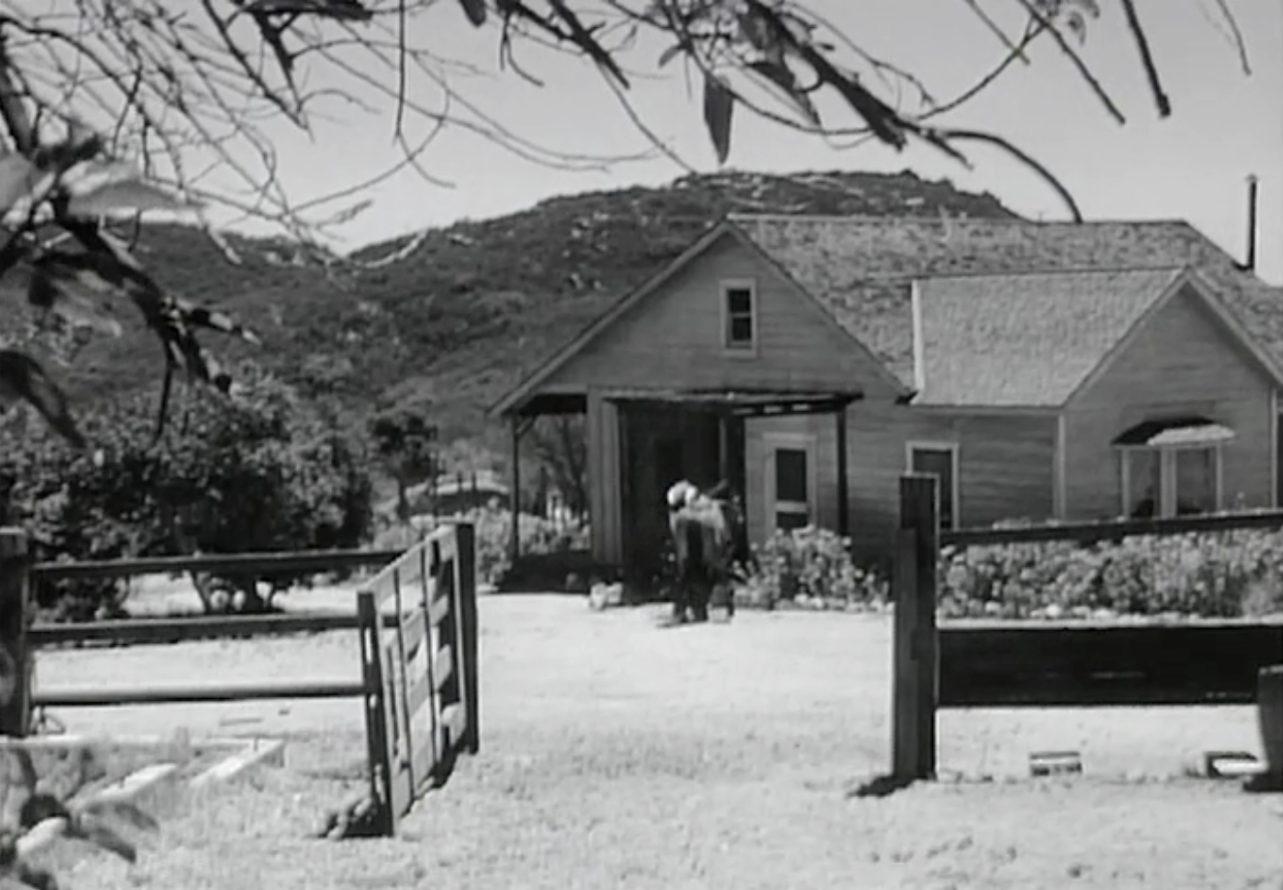
Why we love old movie locations — especially the Iverson Movie Ranch

For an introduction to this blog and to the growing interest in historic filming locations such as the Iverson Movie Ranch — the most widely filmed outdoor location in movie and TV history — please read the site's introductory post, found here.
• Your feedback is appreciated — please leave comments on any of the posts.
• To find specific rock features or look up movie titles, TV shows, actors and production people, see the "LABELS" section — the long alphabetical listing on the right side of the page, below.
• To join the MAILING LIST, send me an email at iversonfilmranch@aol.com and let me know you'd like to sign up.
• I've also begun a YouTube channel for Iverson Movie Ranch clips and other movie location videos, which you can get to by clicking here.
• Readers can email the webmaster at iversonfilmranch@aol.com
.

Showing posts with label anachronisms. Show all posts

Friday, July 25, 2014

Iverson Movie Ranch 101: Hidden gems in the opening
to the TV show "The Lone Ranger"

Clayton Moore and Silver: The Lone Ranger

"The Lone Ranger" remains one of the most popular TV Westerns of all time, and its famous opening sequence, with Rossini's "William Tell Overture" blaring its fanfare as Clayton Moore storms across the Iverson Movie Ranch on the back of his trusty steed Silver, has been hard-wired into our collective consciousness — to the point where many of us will never be able to hear the composition without thinking of the legendary Masked Man.

Gioachino Rossini, the "King of Opera" ... and composer of the "William Tell Overture"

A number of different versions exist of that iconic TV show opening, and a degree of confusion surrounds the sequence — especially when it comes to filming locations. Figuring out just what's going on in the various "Lone Ranger" openings is part of Fundamentals of the Iverson Movie Ranch, or "Iverson 101."

By the way, is it just me? ...

  John Goodman, above, and Gioachino Rossini are not the same guy

Return with us now to those thrilling days of yesteryear, as the Lone Ranger rides again ...

Below you will find several versions of the opening to the TV show. I will do my best to sort them out — and feel free to expand any of these video clips to full screen by first clicking on the red and white arrow, then clicking on the frame icon in the lower right corner, next to the YouTube logo ...


The 1954 opening to the "Lone Ranger" TV show, seen below, combines footage shot in 1954 — including the first 20 seconds or so of the video, along with the shot of Silver rearing up at Lone Ranger Rock — with original footage shot in 1949. This version debuted when Clayton Moore returned to the series in 1954 for the show's fourth season after sitting out season three. John Hart filled in for Moore during season three, but was never widely embraced by fans of the show. 


1954 version of the opening to "The Lone Ranger" — shot in part on the Iverson Movie Ranch

The opening seen above begins with a 20-second sequence that was shot in the desert north of Los Angeles in 1954. This sequence was once thought to be filmed in Lone Pine, Calif., but in 2018 we found the actual location near Lucerne Valley, Calif. For more about this location and the 1954 version of the opening, click here.

 
The Ranger's original ride toward Lone Ranger Rock (below), included in the 1949 and 1954 openings

After those first 20 seconds in the 1954 opening, the scene transitions to the Iverson Movie Ranch, where Clayton Moore, as the Lone Ranger, rides south through the Iverson Gorge as the cry of "Hi-yo Silver!" is heard and the familiar voiceover comes on, talking about "a fiery horse with the speed of light, a cloud of dust, and a hearty 'Hi-yo Silver!'" Most of this sequence was shot in 1949.

With the Lone Ranger in the saddle, Silver rears up next to Lone Ranger Rock in the Iverson Gorge, 
from the 1954 version of the opening to the TV show

The big moment starts about 31 seconds in, as Lone Ranger Rock comes into view and Silver rears up on his hind legs next to the popular landmark. Every version I've seen of the opening has a series of edits during the "rearing up" scene, and these edits hold clues to when the footage was shot. The sequence with the Lone Ranger riding toward the camera on his way to Lone Ranger Rock is from 1949, and appears to show Clayton Moore riding Silver. But it is believed that the original 1949 "rearing up" sequence was done by a stunt rider. When this version of the "rearing up" sequence was replaced in 1954, it was Clayton doing the rearing up on Silver, as seen above.

Lone Ranger Rock as it appears today

Lone Ranger Rock, which got its name from its appearance in the opening to the TV show, is still standing, on the former site of the Iverson Ranch in Chatsworth, Calif. You can see it from the car as you drive north on Redmesa Road, just north of Santa Susana Pass Road, and you can also get out and hike a short distance for a photo op with the rock — provided you're willing to put up with slippery terrain, poison oak and the possibility of rattlesnakes.

The Lone Ranger heads down the Gorge in the extended version of the original 1949 opening

As the clip continues, the Lone Ranger leaves Lone Ranger Rock and continues south through the Iverson Gorge. A version of this part of the ride appears in both the original 1949 opening and a 1956 reshoot, but the most commonly seen versions (from the 1956 reshoot) cut out before the point seen in the screen shot above. The original 1949 clip above contains one of the longer versions of the Ranger's ride into the Gorge.

A shot of Iverson's Upper Gorge from the original opening, just before the ascent to Lone Ranger Rock

The above shot, from the original 1949 opening, appears moments before the Lone Ranger makes a right turn to head up to Lone Ranger Rock. It's seen at about the 28-second mark in the clip above. The shot features a portion of the Iverson Gorge, including key rocks that are still in place today.
 
Sea Leopard, a key feature of the Ranger's ride toward Lone Ranger Rock

One rock that helps define the opening sequence is this one, which I call "Sea Leopard." Despite its relatively large size, Sea Leopard has been a difficult rock to see, as it has been hidden behind trees for decades.
 
Sea Leopard, still in place in the Iverson Gorge

But Sea Leopard is still there, and can be found if you're determined enough.

If you're inclined to try to follow in the hoofsteps of Silver and hike the path taken by the Lone Ranger, it can be done, although at times the thick brush makes it difficult. The trail where Clayton Moore and Silver rode through the Iverson Gorge has been preserved as public land, an unmarked section of Garden of the Gods Park on the east side of Redmesa Road in Chatsworth. As long as you stay below the condos, you should have only the rattlesnakes, poison oak, dense overgrowth and slippery slopes to worry about.


The 1956 reshoot, done when the show transitioned to color for its final season, is essentially new footage. However, a large portion of the new opening closely replicates footage from previous versions filmed in 1949 and 1954. The color version is often seen "retrofitted" to black and white, including for syndication and home video packages. Many viewers have probably watched the various versions of this footage countless times without realizing it's from several different shoots. 

This is the version of the opening that may be the most familiar to fans of the TV show:


1956 opening to "The Lone Ranger" — shot entirely on the Iverson Movie Ranch

Along with new video, this new 1956 version features a new arrangement of the "William Tell Overture" — although it's hard to tell them apart until about 12 seconds in, when the familiar "deedle-eet, deedle-eet, deedle-eet-deet-deet" part, now synonymous with the Lone Ranger, kicks in. (If you play the 1949 clip and pay attention to the music, you may be surprised to find that the "deedle-eet" section is missing from the first half of the clip — but it does come in around the 34-second mark, and accompanies the ride into the Lower Gorge.)

In the new video, Clayton Moore again guides Silver along the same trail through the Iverson Gorge that he traversed in 1949, and again the horse rears up next to Lone Ranger Rock.


Season 5 title shot — the fifth season was the only one shot in color

The backstory on this version is that the opening was completely reshot, in color, in 1956, for the fifth and, as it turned out, final season of the series — the only season of the show that aired in color. This new color version of the opening sequence, shot entirely on the Iverson Movie Ranch, was then "decolorized" for use on subsequent airings and repackages of seasons one through four of the TV show — in reruns, in syndication, on videotape, and eventually, on cable and DVD.

The Lone Ranger and Silver at Lone Ranger Rock, as seen in the clip from 1956

The climactic moment for most fans probably comes about halfway through the clip, soon after the familiar cry of "Hi-Yo Silver!" is heard, when Clayton Moore rides up to the rock we now know as Lone Ranger Rock and rears up on Silver. It is because of this sequence that the rock came to be known as Lone Ranger Rock, and it remains the most famous rock on the former site of the Iverson Movie Ranch.
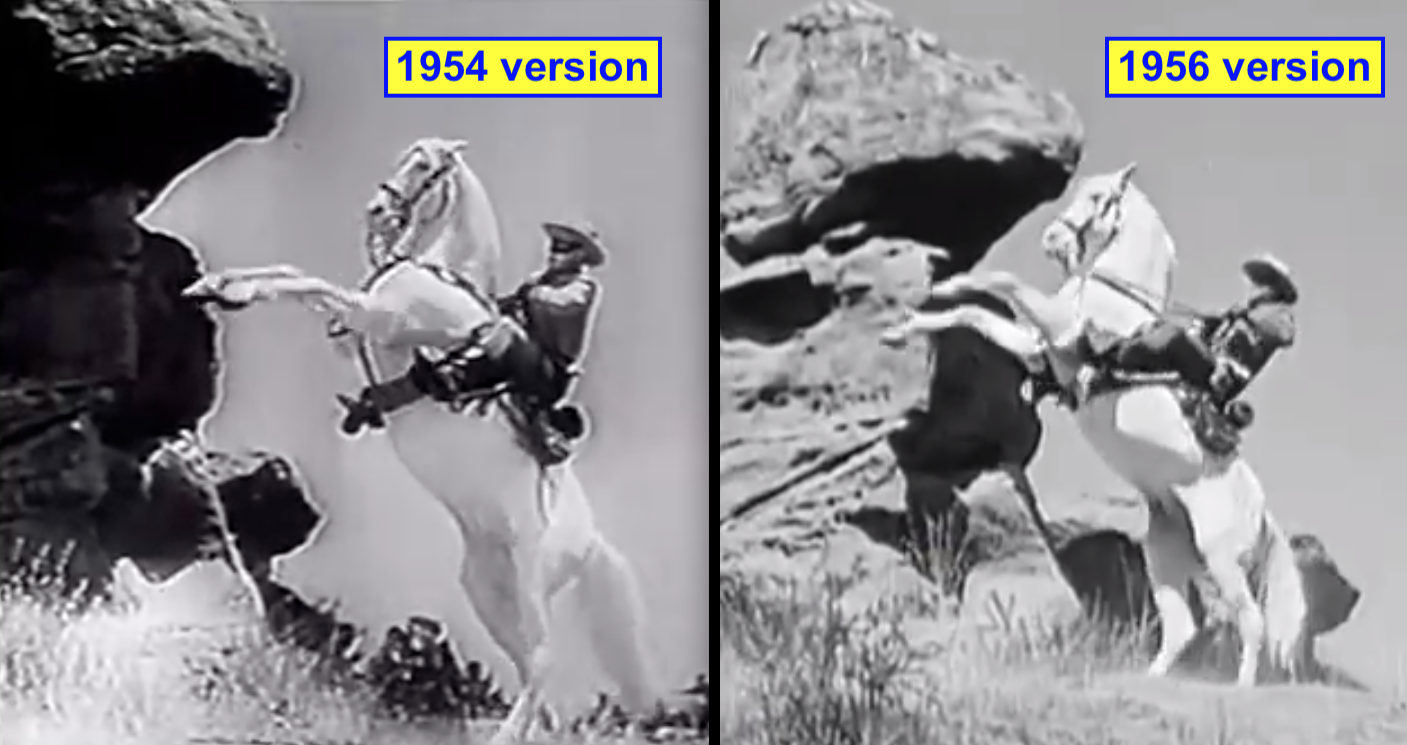
Here's a side-by-side view of two different "rearing up" sequences shot at Lone Ranger Rock — the 1954 version on the left and the 1956 reshoot on the right.

One quick way to tell the two shoots apart is by looking at the shadows on Lone Ranger Rock during the rearing-up sequence. In the 1954 footage, much of the rock is in shadow, while in the 1956 update, the rock is largely in sunlight.
 
The Lone Ranger and Tonto ride near Lone Ranger Rock in the early 1957
color episode "Breaking Point" (shot in 1956)

Even though Lone Ranger Rock was not yet known by that name, the people behind the TV show clearly understood the rock's importance — which explains why they made a point of shooting the opening multiple times in the exact same location, and why they shot scenes at the rock for the show's final season.

Frame from 1956 version of the "Lone Ranger" opening, with a white gate visible

One element distinguishing the 1956 opening — although it goes by quickly — is a white gate that appears briefly in the background at about the 17-second mark, immediately before the cry of "Hi-yo Silver!"

The gate, which was presumably not meant to show up in the shot, marked the boundary between the Upper Iverson and the Brandeis property to the west. In a later edit of the 1956 opening, which you can see below, the gate has been edited out and a few other minor changes have been made. In other edits of the opening sequence, the gate appears twice.

1956 version of the opening

Here's a shot of the Lone Ranger just before he arrives at Lone Ranger Rock, taken from the 1956 reshoot. This shot can be compared with a similar shot from the original 1949 shoot, which is posted higher up. The next three photos spotlight some of the details in the two shots.

This is the same 1956 shot with a few key details pointed out. Other than Sticky Bun, which was concealed behind foliage in the 1949 sequence, these same features are also seen in the 1949 version.

  1949 version

Here's another look at the comparable moment in the 1949 sequence. With Sea Leopard more visible today than it has been in the past, most of the features in the shot are now relatively easy to find — although finding famous rocks rarely turns out to be as easy as expected.

Here's a comparison of the Sea Leopard sightings in the 1949 and 1956 shots, focusing on one of the key differences between the two shots. Notice how much more foliage appears around and in front of Sea Leopard in the 1956 version, with the native vegetation having grown significantly in just seven years.


I'm including a bonus version here — It's the same footage seen above in the 1956 version, but a shorter edit, omitting the ride down the Gorge after the Lone Ranger leaves Lone Ranger Rock. This clip also happens to run too fast, but I'm including it because the picture quality is better than on the clip above.

Here's the speeded-up 1956 version, which provides a better look at the gate and other details:


1956 "bonus version" — runs fast, but the picture is better

While this clip runs a little too fast (or a lot too fast, depending on your tolerance level), it has the best picture quality I've been able to find for this version of the opening. It runs about 30 seconds and was filmed — and it was film, not video, in those days — entirely on the Iverson Movie Ranch, in 1956.


This next clip is one of a number of variations that have been created of the opening with minor edits. It represents a significant evolution from the first 1956 version in that it deletes the apparently unwanted (and initially overlooked) appearance of the white gate.


Edited 1956 version of the opening to "The Lone Ranger," eliminating the gate (shot entirely on the Iverson Movie Ranch)

This version contains a number of additional edits of the footage found in the first 1956 version, besides deleting the brief shot of the gate. One key difference is that in this version, after the cry of "Hi-yo Silver!," the Lone Ranger fires three shots before riding up to Lone Ranger Rock. That's edited down from the five shots he fires in the first 1956 version.


It should be noted that the various openings are not presented here in the chronological order in which they first appeared. But here's the 1956 reshoot as it was intended, in color:


The clip I've posted here is truncated, but it's the best I could find. It does not include any footage after the "rearing up" sequence at Lone Ranger Rock, so it excludes the ride down the Gorge. However, this clip matches the black-and-white 1956 version in that this original color clip also includes the brief glimpse of the white gate, and it also has the Lone Ranger firing five shots after the cry of "Hi-yo Silver!"

Here's the original appearance, in color, of that pesky white gate. This is part of the first segment of the reshot opening, which takes place on the Upper Iverson. In this color clip, the Upper Iverson segment lasts about 17 seconds, right up to the cry of "Hi-yo Silver!," where the scene shifts to the Lower Iverson for the ride past Sea Leopard, the ascent up to Lone Ranger Rock and — had it been included — the eventual ride down into the Lower Gorge.

Another screen shot from the portion of the color 1956 opening that was filmed on the Upper Iverson, this frame includes Pyramid Peak in the background, behind the Lone Ranger's head, along with the Line of Trees. The Line of Trees marked the western boundary of the Upper Iverson, with the neighboring Brandeis Estate on the other side of the trees.


Here's what the opening looks like — and more to the point, sounds like — in Spanish:


Spanish version of the opening to "The Lone Ranger": "El Llanero Solitario"

One of the most interesting things about this Spanish version is that it uses a completely different recording of the "William Tell Overture." I like this one better than any of the arrangements heard on U.S. versions, as the horns have a more dynamic sound — this one cries out to be cranked up. The video footage seen here is the same footage from 1956, shot entirely on the Iverson Movie Ranch. Here again, we see the white gate, and here we again have five shots ring out after the cry of "Hi-yo Silver!" Of course, we also have a completely different voiceover here, in Spanish, along with a "Spanish-sounding" guy yelling "Hi-yo Silver!"


The above examples are by no means an exhaustive collection of the many openings to the TV show. A virtually unlimited number of variations exist, but I tried to hit on the main differences here without going overboard. If you watch your own "Lone Ranger" episodes, you will undoubtedly discover other variations.
 
The General Mills flag, which kicks off the original opening to "The Lone Ranger"

The rarely seen original 1949 opening to "The Lone Ranger" begins with this shot of a flag promoting General Mills, the show's original sponsor. For more about this and other "Lone Ranger" openings, click here.
 

Shout-out to Michael Trotochaud of the Lone Ranger Fan Club for his help and tireless work sorting out the complicated history of the "Lone Ranger" opening sequence.

Sunday, May 25, 2014

Bigfoot Subdues Dracula: Pure whimsy ... or so I thought

"Thunder River Feud" (1942)

The image above, from Monogram's weirdly filmed, and not particularly well-preserved, Range Busters B-Western "Thunder River Feud," has haunted me since I first saw the movie back in 2008. It was one of the first movies in which I found features filmed on the Iverson Movie Ranch, as my fascination with the filming location was just beginning to blossom.

In part because of the poor quality of my version of the movie, in part due to my inherently whimsical nature — and, I still want to believe, in part because of some degree of perverse intent on the part of the filmmakers — I found something in the shot that I couldn't help thinking looked like a large Bigfoot lying on top of something I thought bore some resemblance to Dracula. I began referring to the image as "Bigfoot Subdues Dracula."

In case there's any doubt as to what I thought I was seeing here — and why wouldn't there be — I've labeled the two "protagonists" of the formation in the shot above. The screen shot became, initially, a focus of failed attempts to figure out just what I was seeing, and subsequently, a symbol for the unfindable oddities that lurk in the backgrounds in any number of old movies. I came to accept long ago that Bigfoot Subdues Dracula would never be seen again, and it became a running joke both when sifting through old movies and on expeditions to the former Iverson Movie Ranch, as I would remark about any remotely similar rock feature: "Look, there's Bigfoot Subdues Dracula ... ha ha!"

"Last of the Bad Men" (1957) (false lead)

It became apparent long ago that Bigfoot Subdues Dracula — or simply "Bigfoot," as I later came to call the feature — was unlikely to ever turn up in the real world, but I would occasionally see something in the movies that caused me to consider whether, by some miracle, I might be seeing the formation again. I went through a series of false leads, including the above shot from the Allied Artists Western "Last of the Bad Men," in which a potential Bigfoot, positioned with a similar "attitude" to the original, lurks meaningfully in the background. The sequence is shot on the Iverson Ranch, as are the bulk of the movie's outdoor sequences. But as it turns out, it's not Bigfoot.

"The Great Alaskan Mystery" (1944) (once again, NOT Bigfoot)

Another false lead, shown above, surfaced in the 1944 Universal serial "The Great Alaskan Mystery," starring Milburn Stone — who later became a TV icon playing Doc for 20 years on "Gunsmoke," and winning an Emmy in the process.

"Fighting Bill Fargo" (1942)

A clue surfaced a couple of years ago when I spotted the above formation in the Johnny Mack Brown B-Western "Fighting Bill Fargo." But by this time I was resigned to thinking of Bigfoot, and the elusive image of a Bigfoot overpowering a Dracula character, as nothing more than a trick of light — and an illusion that would never evolve into a "real" filming location sighting. As a result, I didn't give this sighting as much thought at the time as it may have deserved.

"Treasure of Ruby Hills" (Allied Artists, 1955)

Finally, it happened: Six years after the original sighting in "Thunder River Feud," the actual Bigfoot Subdues Dracula, no mistaking it this time, resurfaced, looking remarkably similar to what I thought all this time had been just an illusion. The formation turned up in this shot from the B-Western "Treasure of Ruby Hills," and while "Bigfoot" doesn't look nearly as "Bigfoot-y" here as it did in the original, far more grainy, "Thunder River Feud" shot, to my eye "Dracula" appears, if anything, even more Dracula-esque here than in the original.

In another piece of news to come out of this sighting, the approximate location for the rock feature is now known: Smooth Hill is recognizable in the background — it's the view of the hill from the northwest, from the general vicinity of the Middle Iverson Ranch Set.

"Two Guns and a Badge" (Allied Artists, 1954)

This shot from the Wayne Morris B-Western "Two Guns and a Badge" is extremely low-res, but it provides a similar view of Smooth Hill to the shot above from "Treasure of Ruby Hills" — and also contains the main house from the Middle Iverson Ranch Set. Bigfoot would be concealed behind the house in this shot.

Here's a comparison of the two above shots, highlighting a large split rock that helps establish that it's the same hill in both shots.

"Bells of Rosarita" (1945)

Smooth Hill, on the left, looms again behind the Middle Iverson Ranch Set in this scene from the Roy Rogers movie "Bells of Rosarita," in which Gabby Hayes is famously trapped in the trunk of an out-of-control old coupe.

North side of "Smooth Hill"

The hill appears much less smooth here than it does in "Treasure of Ruby Hills," illustrating how rocks, hills and other features can take on a vastly different appearance when the camera position shifts slightly. Smooth Hill was usually filmed from a different direction entirely — from the south, including frequent appearances in the background of shots of the Iverson Movie Ranch Western street, as seen below.

"Son of Paleface" (1952) — Smooth Hill from the other side

Smooth Hill, seen here from its more familiar southern side, is widely recognized as the hill in the background of shots of the Iverson Western street looking toward the north, including the example above from Bob Hope's Western comedy "Son of Paleface." The Western street, also known as El Paso Street, appears in the movie a ghost town — in other words, tumbleweeds were brought in and a few windows were boarded up. The bodies lying around are a separate issue.

"Rocky Mountain Rangers" (Three Mesquiteers, 1940)

Here's a nice view of Smooth Hill's southern side — looking characteristically smooth — from before the Western street was built, when Sheep Flats, the area seen in the foreground, was more wide-open. The shot comes from the Republic B-Western "Rocky Mountain Rangers," which I have in my pantheon of the greatest Iverson Ranch productions. The Western town set was built about four years later, in 1944, but would have been off to the left, out of the frame from this particular angle.

For a change the background is clear enough to spot a number of the telephone poles that were beginning to proliferate in the area by 1940. In some productions, such as those set in the earlier stages of the American West, the poles would have been an anachronism. But filmmakers typically shot without much apparent concern for them, and most of the time the backgrounds were so fuzzy it didn't matter.

Smooth Hill was later leveled, and a large apartment complex was built on top of it. Also seen here is the 118 Freeway, which was built in the mid-1960s, effectively bringing a halt to filming on the Lower Iverson. In the foreground is the Topanga onramp heading east.

"Cheyenne Takes Over" (PRC, 1947)

Back on the northern side of Smooth Hill, the story of Bigfoot continues to unfold. It turns out the rock was there all along in shots of the Middle Iverson Ranch Set, but it would have been pretty hard to find without knowing what we know now. You may or may not be able to pick it out in the above shot from the Lash LaRue movie "Cheyenne Takes Over."

Bigfoot is way in the background and really small in this screen shot, but once you know what the feature looks like and where it should be, you can tell that this is it.

"Captain Video, Master of the Stratosphere" (Columbia, 1951)

A wider shot of the Middle Iverson Ranch Set again includes both Smooth Hill and Bigfoot, as noted below. The shot comes from the "Captain Video" serial, which starred Judd Holdren and Larry Stewart.

The Chatsworth landmark Stoney Point can be spotted in the distance, and the shot also shows off the rarely seen back side of the Bunkhouse, part of the Middle Iverson Ranch Set.

"Treasure of Ruby Hills" (1955)

Back to "Treasure of Ruby Hills," and still another angle on Bigfoot. This shot displays the impressive span of the full rock feature in all its glory and includes the "Dracula" head popping out again, albeit slightly blurry.

"Treasure of Ruby Hills" also contains closeups of Bigfoot Subdues Dracula, such as this one showing mainly the "Bigfoot" portion. It's hard to tell from this angle (or any angle, really) how the "Dracula" image is formed, but presumably it's generated by the darker rocks at bottom left.

"The Life and Legend of Wyatt Earp" (1958)

The formation figures prominently in the background of this shot of Hugh O'Brian as Wyatt Earp in "The Bounty Killer," an episode of the "Wyatt Earp" TV show that first aired Sept. 30, 1958. "Dracula" can again be seen, but the figure transforms with each new angle. We may all be seeing something entirely different.

"The Roy Rogers Show" (1954)

This is what Bigfoot looks like from the other side — a lot like the first side. This shot comes from "Last of the Larrabee Kid," an episode of "The Roy Rogers Show" that premiered Oct. 17, 1954. In the background is the northeast face of the main house at Middle Iverson, which indicates we're looking more or less toward the west and viewing the southeastern face of the rock.

Recent shot of the Bigfoot area, now filled with condos

The story of Bigfoot does not have a happy ending. The rock formation was destroyed after the filming era wound down and that portion of the former Iverson Movie Ranch became a condo development. The photo above shows the approximate spot where Bigfoot once stood, looking toward the southeast.