Why we love old movie locations — especially the Iverson Movie Ranch

For an introduction to this blog and to the growing interest in historic filming locations such as the Iverson Movie Ranch — the most widely filmed outdoor location in movie and TV history — please read the site's introductory post, found here.
• Your feedback is appreciated — please leave comments on any of the posts.
• To find specific rock features or look up movie titles, TV shows, actors and production people, see the "LABELS" section — the long alphabetical listing on the right side of the page, below.
• To join the MAILING LIST, send me an email at iversonfilmranch@aol.com and let me know you'd like to sign up.
• I've also begun a YouTube channel for Iverson Movie Ranch clips and other movie location videos, which you can get to by clicking here.
• Readers can email the webmaster at iversonfilmranch@aol.com
.

Showing posts with label Devil's Pass. Show all posts

Sunday, January 4, 2015

Title sequence to the movie "Wells Fargo": Check out the credits "painted" on the giant sandstone boulders of the Iverson Movie Ranch (Here's the video)


Here's a video clip of the title sequence for the 1937 Paramount Western "Wells Fargo," starring Joel McCrea. The opening is kind of fun from an Iverson Movie Ranch standpoint — I think it's the only movie I've seen in which the credits are made to appear as though they're painted on rocks. And the rocks are all at Iverson, mainly in the heavily filmed area around Devil's Pass on the Lower Iverson.

"Wells Fargo" (1937) — opening credits "painted" on rocks

This is an example of what the credits look like. While they're meant to appear as though they're painted on the rocks, I don't think anyone is trying to pass them off as in fact being painted on. The effect appears to be the result of adding just the right amount of rippling and transparency to the type face,

This set of credits appears against the eastern side of Hangdog, shot from above Devil's Pass.

In this shot from "Wells Fargo," which appears between the two sets of credits shown above, the stage is traveling west through Devil's Pass, also known as Vultura's Pass. This was the first shot that I was able to positively ID — I recognized part of Bill Rock here, along with a corner of Hangdog.

"Buffalo Bill Rides Again" (1947)

Here's a shot from a different movie, taken from a similar angle. In this shot from the Richard Arlen-Jennifer Holt Western "Buffalo Bill Rides Again," the riders are entering Devil's Pass from the west and are about to head east through the pass. Bill Rock is the feature that definitively links the two shots.

This version of the "Buffalo Bill Rides Again" shot has the main features identified.

Back to "Wells Fargo," and the same features appearing in "Buffalo Bill Rides Again" are highlighted. I've blogged previously about all these features, and you can find them in the long index at the right of the page. For views of the complex rock feature Hangdog from a number of interesting angles, please click here.

You may have already noticed the "creases" that distinguish Bill Rock in both movies, forming a triangular pattern on the rock. You can see additional angles on Bill Rock in this earlier blog item.

This set of credits appears against the western side of Hangdog, and I was able to get a positive ID even though I had to compare shots of the rock from somewhat different angles.

This is what that same side of Hangdog looks like in recent times.

In this shot I've noted approximately where the credits appear in the "Wells Fargo" shot.

Here's a closer view of Hangdog, zeroing in on the area featured in the "Wells Fargo" shot.

Note the two distinctive rock areas, designated "A" and "B."

Here are the same areas as they appear in the credit shot from "Wells Fargo."


Director Frank Lloyd, who also produced "Wells Fargo," gets his own distinctive credit near the end of the title sequence. I have not been able to pinpoint this rock, but I have a feeling it's also somewhere around Devil's Pass.

Friday, April 11, 2014

Face to face with the Head of the Lion — and finally, the truth about the "Dark Side of the Wall"

Head of the Lion, Chatsworth, Calif.

If you have ever been to the Garden of the Gods Park in Chatsworth, Calif., chances are you walked right past the Head of the Lion. It's one of the hundreds of widely filmed movie rocks that still populate the area, from when the site was part of a bustling filming location known as the Iverson Movie Ranch. The face of the rock directly overlooks what is now the main trail into the park.


"Rocky Mountain Rangers" (1940)

The rock's position — and on occasion, its artistic use — can make it easy to miss. An example of the latter is the above shot from a movie that's a full-on Iverson spectacle, Republic's Three Mesquiteers B-Western "Rocky Mountain Rangers." In this shot, you may or may not notice the Head of the Lion at first. Only the snout area is visible, with the rock being used as a framing device for an overview of a portion of the Iverson Gorge. The lion's snout can be seen at the left edge of the frame. I'll highlight it in the next photo.

This is the same shot with Head of the Lion pointed out.

While we're at it, this is the same shot again, with a number of additional features of the Iverson Gorge spotlighted.

Another view of Head of the Lion in modern times

The Head of the Lion looks like this when it's viewed from the west, and if you've been following this blog in recent weeks you may already know where this is headed. This angle does not show the part of the rock that looks like a lion's head, and that fact contributed to some confusion recently in my research. I put up a blog post about seeing this rock in an old movie, the 1934 Beacon Productions B-Western "Cowboy Holiday." But at the time I thought it was something else entirely.

"Cowboy Holiday" (1934)

This is how Head of the Lion Looks in "Cowboy Holiday," and after momentarily losing consciousness because I was so excited over what I thought I was seeing, I wrote a blog entry making a big deal about spotting what I thought was the "Dark Side of The Wall." You can click here to read that post — I'm leaving it up as a reference, but I'm adding a big "mea culpa."

"Cowboy Holiday": Another shot of Head of the Lion

One problem with "Cowboy Holiday" — and one reason I got the sighting wrong — is the movie never does show the face of the lion. The above shot is about as close as it gets, with Head of the Lion being the main rock filling up the middle of the shot. If they would have moved the camera a short distance to the right, they could have captured a much more ... what's the right word, leonine? ... view of the rock.

"Adventures of Captain Marvel" (1941)

Another production in which Head of the Lion makes an appearance is the Republic serial "Adventures of Captain Marvel," as seen above. Here again, the rock is hard to see — and that may be one reason it wasn't filmed more often than it was. I'll highlight it in the next shot.

This is the same shot with the Head of the Lion pointed out. Even though the rock has a tendency to blend in with backgrounds, when you do see it here, its leonine — OK, lionlike — qualities are plainly evident.

"Rogue of the Rio Grande" (1930)

Above is what might be the first featured appearance on film by Head of the Lion, in the early sound B-Western "Rogue of the Rio Grande," from Monogram and Atlantic Pictures. The movie is said to be the first talking role for early cinema icon Myrna Loy. You should be able to spot the lion's face right in the middle of the shot.

"Blazing Across the Pecos" (1948)

Here's a shot from the Durango Kid movie "Blazing Across the Pecos," starring Charles Starrett, that shows not only part of the face of the lion, at far right, but also the rock's non-lion-head-like western profile.

Here's one more look at that western profile, and a last look at the rock in its contemporary setting, with Nyoka Cliff, across Iverson Gorge to the east, visible at far right.

Friday, May 17, 2013

Hangin' around Hangdog: Great Iverson Movie Ranch scene found in the 1941 Republic serial "Dick Tracy vs. Crime, Inc."

The 1941 production "Dick Tracy vs. Crime, Inc.," starring Ralph Byrd, is considered by many fans to be among the best serials ever made. It was the fourth and last of Republic's four Dick Tracy serials — a series that also included "Dick Tracy" (1937), "Dick Tracy Returns" (1938) and "Dick Tracy's G-Men" (1939). The last three installments all included sequences shot at Iverson.

I recently got my first look at "Dick Tracy vs. Crime, Inc." and ran across a particularly compelling Iverson sequence — including the above view of a dynamic rock I call Hangdog. The rock was at the center of a big shootout sequence, with one guy picking people off from on top of the rock and a bunch of other guys shooting at him from behind cars, as seen above. The shot really shows the scale of the rock, with a normal-sized man positioned atop Hangdog and dwarfed by the rock.

Hangdog is still intact, and looks like this today. Other views of the rock give a better idea of why it's called Hangdog. Click here to see a previous blog entry featuring additional shots of Hangdog.

 Stunt jump off Hangdog, Part 1

Stunt jump off Hangdog, Part 2

Stunt jump off Hangdog, Part 3

Stunt jump off Hangdog, Part 4

Included in the sequence is the above stunt jump off Hangdog — off a rock that looks to me like a shoulder — into the covered bed of a truck.

Here's what that same "shoulder" of Hangdog looks like today.

Scene from "Spy Smasher" (1942)

In a mildly amusing example of cross-promotion, the above shot from the 1942 Republic serial "Spy Smasher" includes a plug for "Dick Tracy vs. Crime, Inc." in the form of a set of posters on a gate.

Here's another shot of Hangdog in recent times, which I think shows the rock's two main "faces" — I tend to see it as a lion on the left and a Scooby-Doo-type dog on the right. Or another lion.

Ruh-roh! (Catch phrase often attributed to Scooby-Doo, 
above, but in fact originated by Astro on "The Jetsons")

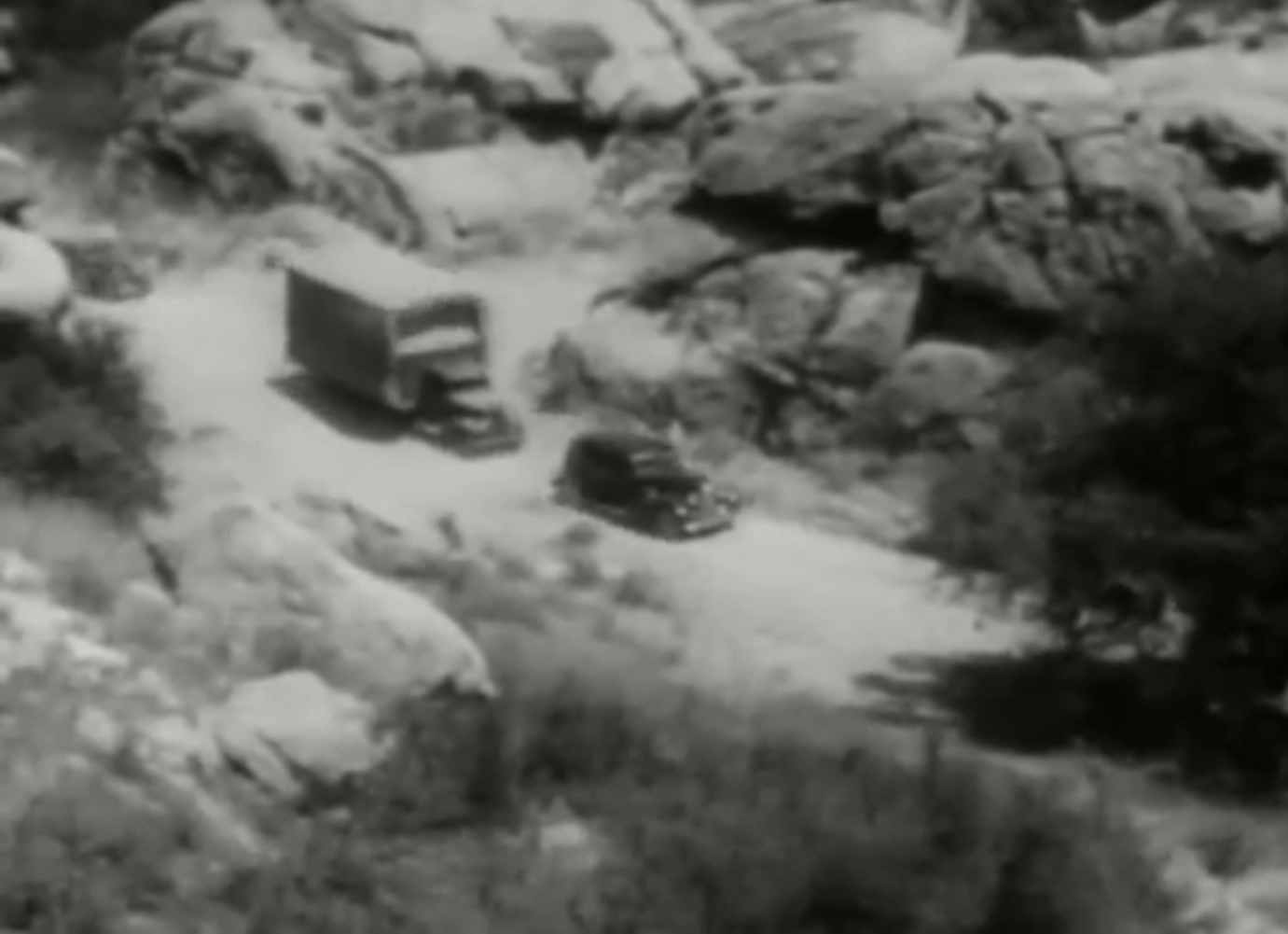
The thing that really elevates the "Dick Tracy vs. Crime, Inc." shootout sequence, in my opinion, is its bird's-eye views, including the above shot of a frequently filmed area known as Devil's Pass or Vultura's Pass. That's Hangdog again at top right, above the car, although the angle makes it hard to recognize. The pass itself starts to the right of the truck and continues east, behind Hangdog.

Vultura's Palace, in "Perils of Nyoka" (1942)

The same site turns up again the following year as the location of Vultura's Palace in the seminal Republic serial "Perils of Nyoka." That's a portion of Hangdog — including the shoulder, again — at the right in the above shot. You may notice the similarity between the rock directly above the palace entrance (at top center in the above shot) and the one seen in the "two-faced" shot of Hangdog a few shots up (above the Scooby-Doo cartoon), in the top-left corner. That's because it's the same rock in both shots. For more about this location, click here.

Another bird's-eye view from the "Dick Tracy vs. Crime, Inc." sequence, this one shows the guy posted atop Hangdog in the foreground, with an unusual angle on Bill Rock, the large rock at left center, near the car. The road where the vehicles are parked, which would pass by the front of Vultura's Palace the following year in "Perils of Nyoka," is sometimes called Vultura's Trail. Also visible here, in the background — and not in much detail — are the Devil's Doorway Cluster and Devil's Doorway Wall, in the top-left corner. The low, horizontal rock all the way in the corner is Devil's Doorway Wall.

This shot shows the same general area from a lower angle, with a portion of Bill Rock again seen at the left, the cars parked along Vultura's Trail, and Cactus Hill in the background. The flat area below Cactus Hill is where much of the Cal West Townhomes development now stands.

Reggie Lanning, at far right, operating the camera 
for the 1930 movie "The Big House"

The cinematographer on "Dick Tracy vs. Crime, Inc." was the great Reggie Lanning, a Republic stalwart who was responsible for some of the best camera work at Iverson from the late 1930s through the 1940s — not the least being the serials "Zorro's Fighting Legion" (1939), "Jungle Girl" (1941) and "Perils of Nyoka" (1942). He also did some nice work at Iverson for the Roy Rogers movies "Cowboy and the Senorita" (1944) and "Song of Arizona" (1946). For more about Lanning's incredible track record at Iverson, please read this blog entry. And please click here for more about the forgotten legacy of the great cinematographers of the B-movie era.

In the above promo still for the 1930 movie "The Big House," Lanning — who was uncredited on the production — works alongside cinematographer Harold Wenstrom shooting the film's star, Chester Morris. It's a rare glimpse of Lanning at work.


If you're interested in getting your own copy of "Dick Tracy vs. Crime, Inc." on DVD, you should be able to buy it off Amazon by clicking on the image above.

Thursday, March 14, 2013

Devil's Pass, Vultura's Pass and another look at everyone's favorite Wookiee from "Star Wars"


Chewbacca — rising above Devil's Pass (aka Vultura's Pass)

It's high time I update my blog entry from a few years ago on the Iverson rock I call Chewbacca.

Not everyone sees the resemblance between the rock and the beloved "Star Wars" Wookiee (often spelled Wookie), but it popped out at me the first time I saw the rock in person. Your mileage may vary, and I hope I get comments on whether readers see it or not.

"The Lone Ranger" TV show: episode "Devil's Pass" (1950)

The rock is located in a section of the former Lower Iverson I call Devil's Pass. The name comes from the title of an episode of the TV show "The Lone Ranger" that originally aired May 25, 1950. In the above screen shot from the episode "Devil's Pass," the Lone Ranger and Tonto are seen riding west through the pass.

Chewbacca is out of the picture, but would be up high on the right. Directly above Tonto's head is an often filmed rock known as Hangover Rock, which you may want to enlarge the photo (by clicking on it) to get a better look at. (You can find another shot of Hangover Rock at the bottom of this post.)

The same pass is also known as "Vultura's Pass," as it was the location of Vultura's Palace, seen above, in the seminal 1942 Republic serial "The Perils of Nyoka." The pass today remains on private property and is difficult to access other than looking at it over the brick wall that now separates this spot from the nearby condos. Some of the rocks in the above two shots are the same — you may be able to match up the rocks in the above photo that are just above the roof of the palace, near the center-top of the photo, with the same pair of rocks in the "Lone Ranger" shot, near the top-left corner. It's two rocks separated by a curved crack, and if I only had a dime for every time I've heard that expression.

Here's a shot of the evil Vultura, played by Adrian Booth — also known as Lorna Gray — posing for a publicity still for "The Perils of Nyoka" at the Iverson Movie Ranch, courtesy of Western movie expert Jerry England.

Another early shot of Lorna Gray/Adrian Booth, who apparently is still going strong at 95 — it wasn't that long ago, just a few years, that I went to an event in Hollywood to hear the longtime Republic Pictures star reminisce about the studio's Golden Age. Does she have stories!

"Buffalo Bill Rides Again" (1947)

Meanwhile, back at the Pass — Devil's or Vultura's — this is the view from a sniper's outpost up next to Chewbacca, looking west with the Upper Gorge in the background. The riders are entering the west end of the pass, arriving from the north, and will head roughly east. The screen shot comes from the Richard Arlen/Jennifer Holt B-Western "Buffalo Bill Rides Again."

Like most rocks, Chewbacca's appearance changes as it's viewed from different angles and in different light. Sadly, the thing has been hit with a little graffiti, something that has been a bit of a problem on the former Iverson Movie Ranch. It's most evident in the photo at the top of this post.

You might not think this prehistoric-looking thing is the same rock, but it is. Lighting makes a big difference, as illustrated by this shot of Chewie later in the day. Most of the character's "face" is in shade here.

This side of the rock reminds me of something out of the Broadway show "Cats."

There's that brick wall I mentioned, toward the right and down the hill. This is Devil's Pass in recent years, looking more or less southwest. On the other side of the wall are hundreds of condos.

Here's a better look at Hangover Rock, which is also seen in the third photo from the top, above. The precarious-looking feature marks the eastern end of Devil's Pass/Vultura's Pass. The African hut seen in this shot from the summer of 2008 was a set for the NBC TV series "Heroes." Partially visible in the background at the right is a non-movie house that was known as the "Old Folks' House," where Karl and Augusta Iverson, the founders of the Iverson Movie Ranch, lived in their later years. The house burned down just a few months after this photo was taken, in the 2008 Porter Ranch Fire.


NBC's series "Heroes" shot at Iverson for an Africa storyline that was a part of season three.