Why we love old movie locations — especially the Iverson Movie Ranch

For an introduction to this blog and to the growing interest in historic filming locations such as the Iverson Movie Ranch — the most widely filmed outdoor location in movie and TV history — please read the site's introductory post, found here.
• Your feedback is appreciated — please leave comments on any of the posts.
• To find specific rock features or look up movie titles, TV shows, actors and production people, see the "LABELS" section — the long alphabetical listing on the right side of the page, below.
• To join the MAILING LIST, send me an email at iversonfilmranch@aol.com and let me know you'd like to sign up.
• I've also begun a YouTube channel for Iverson Movie Ranch clips and other movie location videos, which you can get to by clicking here.
• Readers can email the webmaster at iversonfilmranch@aol.com
.

Showing posts with label flipping the shot. Show all posts

Tuesday, July 15, 2014

Chuck Connors and Dale Robertson do some male bonding

Chuck Connors, left, and Dale Robertson in "Tales of Wells Fargo" (1957)

A couple of years before he became famous as "The Rifleman," Chuck Connors helped launch another TV Western, "Tales of Wells Fargo." Connors appeared alongside series star Dale Robertson in the first episode of the show, "The Thin Rope," which premiered March 18, 1957.

"The Thin Rope," 1957: Premiere episode of "Tales of Wells Fargo"

Connors and Robertson shared a stagecoach ride spanning most of the episode, filmed on the Upper Iverson Movie Ranch. The trip gave the two men plenty of time for male bonding … not to mention time to think about whether they might end up trying to kill each other. From a filming location standpoint, the episode was a showcase for the Upper Iverson.

Chuck Connors and Dale Robertson — note the road in the background

The producers tried to get away with a little movie hocus-pocus on that stagecoach trip, through the magic of rear projection and the ability to reverse footage horizontally, or "flip the shot." The above screen shot includes a landmark in the background, Road Up the Hill, and because we've seen the same road in countless other productions, we can see that it appears here horizontally flipped.

This version of the screen shot points out the flipped road in the background, along with the properly oriented actors. Today the Road Up the Hill is part of a firebreak and hiking trail known as Johnson Motorway.

My own "fixed" version of the shot, showing Road Up the Hill in its proper orientation

In the above doctored version of the screen shot, I've flipped the photo to show how the road should look. Unfortunately, this also reverses the actors — in effect creating mirror images of them.

"Go West, Young Lady" (1941)

Here's an example of Road Up the Hill in another production. The road was seen hundreds of times in the backgrounds of movies and TV shows shot on the Upper Iverson. Here the road appears in a scene from the Columbia Western comedy/musical "Go West, Young Lady," which starred Glenn Ford, Penny Singleton, Ann Miller and Charlie Ruggles.

In this version of the shot from "Go West, Young Lady" the Road Up the Hill is pointed out. It's seen more clearly here than in the reverse-projection footage used in "Tales of Wells Fargo," but its distinctive shape leaves no doubt that it's the same road.

 "Tales of Wells Fargo" — Chuck and Dale approach the Reflecting Pool

Here we see the stagecoach negotiating an especially rocky stretch of road through Bobby's Bend. This rough piece of road, which I call the Floor, is ribbed with a series of large boulders, posing a formidable obstacle. While it seems nuts to even try to traverse this section of what could hardly be called a "road" in a rickety wooden stage, presumably this sort of thing was par for the course in the days of stagecoach travel — and here the stage does make it over the obstacle.

The photo contains a number of Upper Iverson features. You can learn more about these features by clicking on the following links: Wrench Rock, Smiling Lion, Two-Humper, the Aztec.

"The Tomb" (1986)

Here's one of the best views of the Floor that I've seen in any production. This view from high above Wrench Rock appears in the movie "The Tomb," a Fred Olen Ray film about an Egyptian curse with a cast that included John Carradine, Sybil Danning and Cameron Mitchell. It was one of the later films shot on this part of the Iverson Movie Ranch, and as you can see, the producers brought a couple of camels to the site for the shoot.
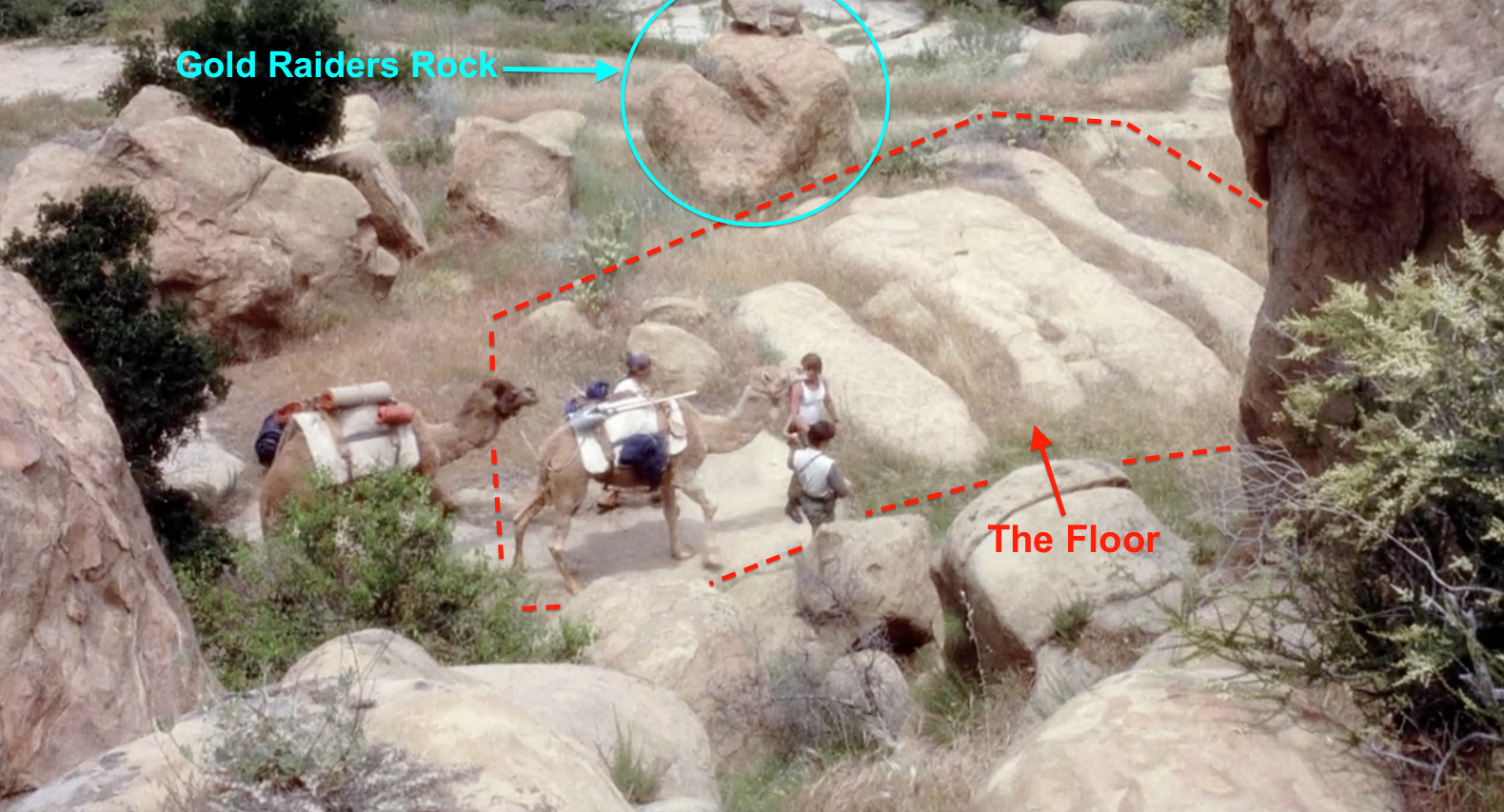
In this version of the photo from "The Tomb" I've identified the area I call the Floor, along with nearby Gold Raiders Rock, which is partially visible here. Please click here if you would like to see more photos from this unusual Upper Iverson shoot and learn more about "The Tomb" — including the Iverson location of the Tomb itself.

Back to that first "Tales of Wells Fargo" episode, this shot from the video clip above illustrates why the Reflecting Pool has that name, with the camera capturing a clear reflection of Wrench Rock in the pool.

The pool continues to be employed as a creative element as the sequence plays out. Here it conveys partial reflections of two of the bushwackers getting the drop on Chuck Connors. We also see Notch Rock directly above the head of one of the bad guys.

Chuck Connors in "Tales of Wells Fargo," with Wrench Rock in the background

The hat says "goofy Western sidekick" but the eyes say "bad intent." Connors plays an enigmatic character here — is he the naive rube Button Smith, or the notorious outlaw Pete Johnson? We get a tasty glimpse of both personas in his "Tales of Wells Fargo" appearance — and as anyone who ever saw "Nightmare in Badham County" can tell you, there was more to Chuck Connors than the upright citizen and loving dad he played on "The Rifleman."

Friday, March 23, 2012

Some cool Iverson Movie Ranch videos

Film historian Bill Sasser has been doing research for years on Western movie locations and has put up some terrific video clips on YouTube. Many of them feature the Iverson Movie Ranch, but Bill's prolific research encompasses a wide range of locations — from the other major filming sites, such as Lone Pine and Corriganville, to some of the less widely known ones, such as Beale's Cut and Walker Ranch.

I wanted to share some of Bill's videos and make sure my readers know about the work he has been doing. I'll start off with a few brief videos about Iverson ...


The above clip shows a corner of Iverson Village and spotlights a couple of the nearby rocks. (Click here for more posts about Iverson Village.) I don't know which movie this clip is from, but it includes some good stuff. The distinctive rock at the beginning of the clip, which appears right next to the wooden walkway in front of a building, is an interesting feature that is also seen during periods when the town didn't exist, often in the middle of a pond as the area flooded during the rainy season. I call it Pond Rock, but it is also commonly called Stacked Rocks. Sadly, Pond Rock was destroyed to make way for the Indian Hills Mobile Home Village — and presumably they cleared up that flooding problem before they moved the trailers in.

Also in the clip, starting around the 39-second mark, is Center Rock, which can be seen in the background, sticking out from under a big tree. I have an earlier blog post here that includes some background on Center Rock. Center Rock can still be seen today in the mobile home park. The tree is still there too, but it has been trimmed back considerably.


Here's a clip that compiles still shots of Iverson Village, aka the Western street, when it was flooded. I think most or all of these shots come from the episode of "The Roy Rogers Show" called "Ghost Town Gold," which first aired on May 25, 1952. It's one of only a couple of instances I know of where the town appeared in a production when it was flooded. The town was in hundreds of movies and TV episodes, even though it only existed for a relatively short time — from 1945 until about 1957.


This next clip features the Saddlehorn area on the Lower Iverson — and the video begs for ample use of the pause button. If you're quick you can catch the Sphinx in the background in the first three seconds. Right after Sphinx, still in the first three seconds, a stacked rock, presumably manmade, makes a brief appearance. Saddlehorn Rock surfaces at the 6-second mark, followed by a mysterious saddle-shaped rock at 10 seconds. (It's not the same rock as the Saddle, although that rock is located nearby.) The Saddlehorn Relay Station makes an appearance near the end, about 19 seconds in.

The relay station is long gone — none of the buildings from Iverson's filming era survived. As for the rocks seen in this video, the Sphinx and Saddlehorn Rock can still be seen today on a visit to the former Iverson Ranch. The Sphinx is in Garden of the Gods, which has been preserved as a park, and Saddlehorn Rock is just off a walkway through the condominium complex. The mysterious saddle-shaped rock, however, didn't survive, nor did the stacked rock.


Finally, here's a video of the opening sequence from the movie "Callaway Went Thataway" (1951), which features a romp through various parts of Iverson Ranch. The clip, which depicts a movie within the movie, flashes past too many famous movie rocks to try to name them, but it offers a good overview of the ranch. The sequence includes shots of Iverson horizontally flipped as well as properly oriented, and it blends Upper Iverson with Lower Iverson.

You can go directly to Bill's YouTube channel by clicking here. I plan to post more videos from Bill in future entries.

Tuesday, January 10, 2012

"Platypus Shack" and "Platypus Farm" — an oddity of the old Upper Iverson

This is a screen shot from the 1949 Paramount Western "El Paso," starring John Payne, Sterling Hayden, Gail Russell and Gabby Hayes, directed by Lewis R. Foster with cinematography by frequent Iverson shooter Ellis W. Carter. It shows a farm set I call "Platypus Farm," after the rock near the left of the shot, Platypus. (I call the rock in the center of the shot "Fish Head.") The farm set was probably built specifically for "El Paso," as the full set has not been spotted anywhere else. It has been suggested that the main house, on the right, may have been a false front or a mobile structure. Either way, by the end of the movie, it's gone.


The main building may have been destroyed in the production, as the house burns to the ground later in the movie. The above shot has the survivors burying two poor souls killed in an attack on the farm, and the charred remains of the house can be seen in the background, behind the rider on the right. It seems unlikely that they would have gone to the lengths of actually destroying a building to get the shot, but who knows? This shot seems to support the theory that the house was just a front and was perhaps designed to ultimately be destroyed on camera. Either way, at least part of the set — the shack, partially visible at the left of both of the above shots — survived and went on to appear in a number of productions, including episodes of the "Lone Ranger" TV show.


Here's "Platypus Shack" again, along with the rock Platypus, in the "Lone Ranger" episode "Barnaby Boggs, Esquire," which premiered Feb. 2, 1950, during the TV show's first season. The shot ran properly oriented in this episode, but in a different episode, the exact same footage was used — but flipped horizontally, as seen below:

This is how the shot ran in the "Man of the House" episode, which aired one week earlier, on Jan. 26, 1950. It may seem like shoddy production to run back-to-back episodes containing such an obvious shortcut — presumably just a way to save money by using the same footage twice. But that sort of thing was common in B-Westerns and carried over into early TV, where the producers were convinced, and probably rightly so, that no one was looking at this stuff very closely. Thankfully, we have DVDs and other digital media now and can really tear it down. (Click here for some additional posts about flipping shots.)


One more "Lone Ranger" shot, back to the "Barnaby Boggs, Esquire" episode, where Platypus Shack ran in its correct orientation. This shot offers a better look at the shack, with the Lone Ranger, played by Clayton Moore, circling around back. The shack stood from about 1949-1952 and appeared in a number of movies, including the Whip Wilson B-Westerns "Gunslingers" and "Silver Raiders" for Monogram (both 1950) and the Rocky Lane B-Western "Marshal of Cedar Rock" for Republic (released in early 1953 but filmed in 1952).

"Gun Belt" (1953) — "fancy" version of Platypus Shack

A fancier version of the shack, located a bit closer to the rock Platypus, can be seen in the 1953 movie "Gun Belt," which is discussed in a blog post here.


Here's another look at Platypus — the rock, minus the shack — in the slightly upscale Columbia B-Western "The Gun That Won the West" (1955).

And here's a real Platypus. Maybe you can see the resemblance in the bill, which gives the rock its name. I'll take the blame for it.

The 1957 George Montgomery Western "Gun Duel in Durango" provided this unusual shot of Fish Head, Platypus' neighbor to the east, with a couple of sentries on it — including one sitting on the rock's fish lips. As a footnote about Platypus and Fish Head, I believe both of these distinctive and heavily filmed rocks have survived, although I've never seen them in person. If they do still exist, they're "living" in someone's back yard on the former Upper Iverson Movie Ranch.

Monday, November 23, 2009

Flipping the shot in "Adventures of Kit Carson"

One of the tricks used to save money in the old movies and TV shows was flipping shots, apparently to get what looked like different footage but was in fact just the same footage mounted in reverse. In other words, left is right and right is left, like a mirror image. Here's an example from the TV show "Adventures of Kit Carson."

This shot is from about five minutes into the episode "Border Corsairs," which premiered Jan. 12, 1952. Kit, played by Bill Williams, is on the left and his sidekick El Toro, played by Don Diamond, is on the right. But this shot is in fact flipped.

Around the 10-minute mark of the same episode, this shot appears. The riders are now on opposite sides of each other. But if you look closely, you'll see that it's not just the riders who have switched sides — everything is reversed from the earlier shot. In the second shot, everything is correctly oriented. One of the better giveaways is that the curved white marking along the nose of Kit Carson's horse curves to the left in the first shot and to the right in the second.

The main feature in the background is Oat Mountain, the light-colored series of hills along the top of the shot. Another way to tell the shots are reversed is by looking at the dark triangle shape just above the riders — the Triangle Brand, as I call it, stamped on Oat Mountain. We know from seeing the orientation of the Triangle Brand in modern times — it's formed by a grove of trees on the side of the hill, and can still be easily spotted today — that this is the correct orientation for the shot.

Click here for another example of flipping the shot, from "The Roy Rogers Show."

Tuesday, August 11, 2009

What caused cowboy star Roy Rogers to "flip"?


"Ride in the Death Wagon" — episode of "The Roy Rogers Show," aired April 6, 1952

Sometimes what you see isn't what you get. This shot of Roy Rogers riding Trigger on the Upper Iverson, taken from a 1952 episode of "The Roy Rogers Show," is in fact printed backward. That is, left is right and right is left, like a mirror image. That's the way they ran this scene in the episode, because they wanted to have Roy riding from left to right, or west to east. It would have cost money to have a crew go out and shoot him riding, and they already had some perfectly good footage of him riding in the other direction, so they just flipped it and used the same footage twice.

Same episode, same cowboy ... opposite direction

Here's another shot from the same episode of the show, in which Roy is shown properly oriented, in virtually the same spot. You can see from the road going up the hill in the background that they didn't bother to shoot Roy riding in both directions, they just flipped the whole shot and ran the same footage twice. Flipping the shot was just one of the tricks used to stretch the budget, and in the days before DVD, Blu-ray, mp4 — heck, even before VHS — before we had freeze-frame and slow-motion, before viewers were able to take a close look at those backgrounds — and before people like me became obsessed with every little detail of the Iverson Movie Ranch — they could get away with it.

Click here to see another example of flipping the shot, from the TV show "Adventures of Kit Carson."