"Tell It to the Marines" (MGM, 1926): The Chinese bridge
I've had to slow down a little on my blogging in the past few
weeks, as I've been spending most of
my spare time trying to solve the complicated and fascinating conundrum of the Chinese bridge. I took a few errant swings at it, but I think I finally have a handle on the main elements of the mystery.
The bridge appears in the 1926 MGM silent feature "Tell It to the Marines," with the climactic bridge sequence filmed on the Iverson Movie Ranch.
"Tell It to the Marines": bridge spanning a steep gorge
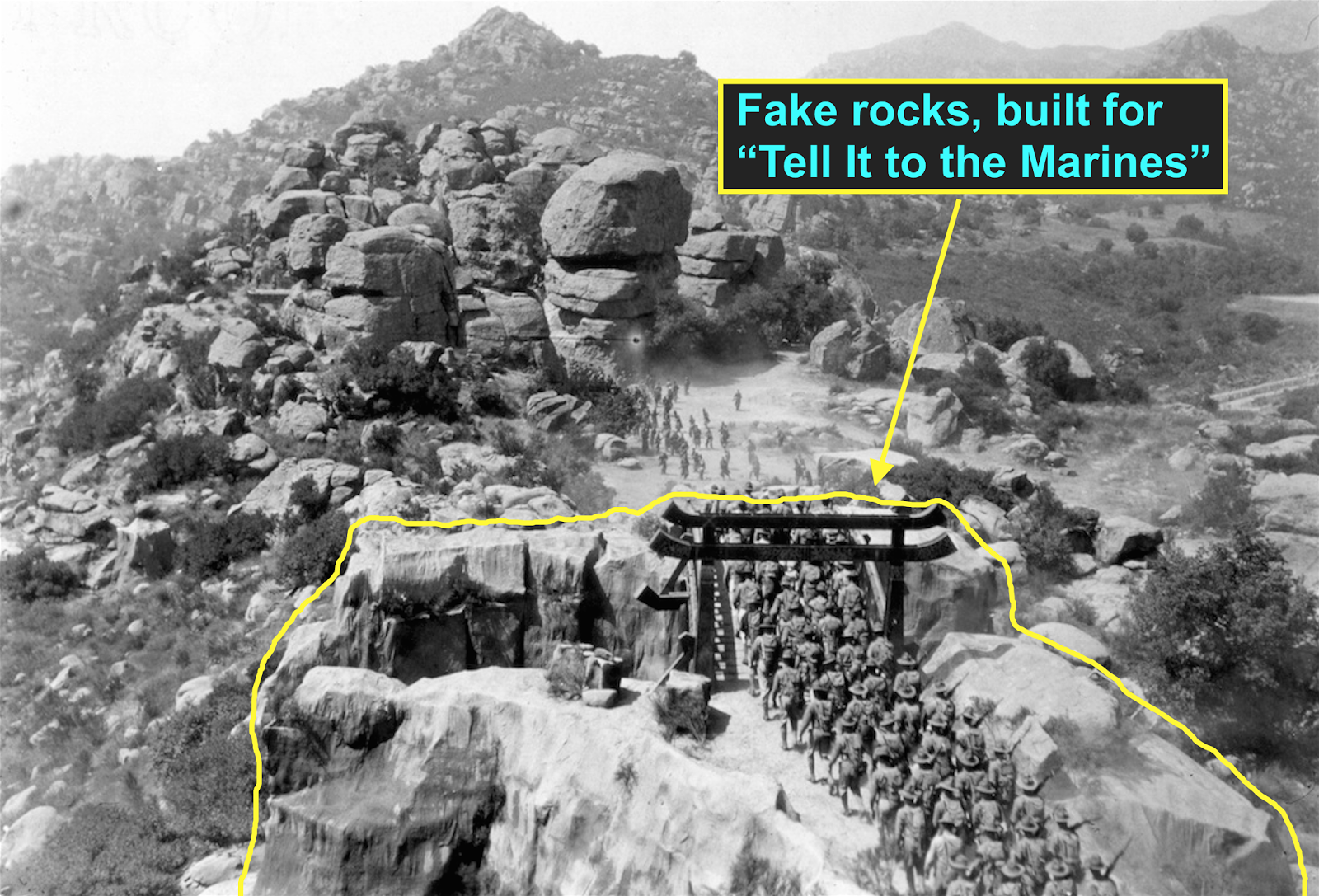
Production on the movie in 1926 included an ambitious shoot near the Garden of the Gods featuring one of the most unusual sets ever built on on the Chatsworth, Calif., location ranch — that Chinese arched bridge and its two elaborate banks of fake rocks.
The two banks of fake rocks are highlighted here. These "rocks" might be described by the seemingly self-contradicting term "actual fake rocks."
While the features seen in the lower two-thirds of the frame were
painted on glass, the "actual fake rocks" — and the Chinese bridge —
were real, and were filmed on location on the Iverson Ranch. The yellow line is a rough approximation of the division between the
location shoot at the top of the frame and the matte painting below.
The steep gorge never existed in the real world. When the scene was filmed, the
glass frame was placed in front of the camera and the fictional rocky gorge was superimposed over the live-action location
footage of Marines marching across the bridge at the top of the frame.
The arched bridge spanning the fake gorge, with its support structures of fake rock, was filmed more or less from the northwest in this shot, with the hill above Nyoka Cliff visible in the background, to the southeast.
The red highlighting in both of the above two shots showcases the same section of the hill above Nyoka Cliff. The black-and-white photo is the composite shot from the movie, filmed in 1926, and the color photo here was taken on a recent visit to the site.
A feature of the matte painting that I find intriguing is a large section of Nyoka Cliff that was used as the basis for the fake gorge. I believe by incorporating a representation of the actual cliff into the matte painting the filmmakers succeeded in making the gorge look more realistic than it otherwise might.
This shot highlights that same part of Nyoka Cliff as it appears today. You may be able to spot the same rock patterns in the above two shots.
The promo still for "Tell It to the Marines" offers a spectacular view of Garden of the Gods as the Marines march over the Chinese bridge. The scene sets up the climactic battle near the end of the movie, with the Iverson Ranch standing in for a section of "Hangchow, China" (more commonly referred to now as Hangzhou).
I initially thought the promo shot must be a composite, with the lower portion of the scene filmed separately from the upper portion. But once I got pointed toward the suggestion that it was done with fake rocks, I realized that this entire shot is filmed at Iverson. The whole project has an aura of old Hollywood and the "It's so crazy it just might work!" mentality. Leave it to MGM to pull off something like this.
Just a quick aside — the shot provides a glimpse of a fake cave house that was featured in the 1923 Buster Keaton movie "Three Ages." I posted an entry about the cave house recently —
check it out here.
The rocks in close proximity to the bridge and fake gorge complex help pinpoint where the set was built. Among the significant markers in the neighborhood is the cluster of relatively small rocks identified here.
I took this photo on a recent trip to Iverson, and it captures the same cluster of small rocks from a similar angle — minus the elevation of the promo shot, which would have required a camera tower to duplicate. Incidentally, you should be able to view any of these photos in a much larger format by clicking on them.
"Go West, Young Lady" (1941): Glenn Ford and Glenn Ford Rock
The cluster of small rocks includes one that I've been calling Glenn Ford Rock, based on a sequence in the Columbia musical comedy "Go West, Young Lady." I blogged not long ago about this sequence in
a post about the Footholds area, and you can find a number of photos from the sequence by clicking here.
Glenn Ford Rock as it appears today
This shot from 2009 captures Glenn Ford Rock from approximately the same angle seen in "Go West, Young Lady," and also shows a portion of the Low Wall — the much larger rock feature beneath Glenn Ford Rock.
The cluster of small rocks that includes Glenn Ford Rock is the same cluster highlighted a few shots up, both in the promo still for "Tell It to the Marines" and in a recent overview of Garden of the Gods.
1926 production photo from "Tell It to the Marines": the Chinese bridge
This production shot from "Tell It to the Marines" was recently unearthed by Iverson historian Ben Burtt. The behind-the-scenes photo contains some of the most important clues to the bridge shoot.
Some of the rock features in the production shot are fake, although most of them appear to be real. It's not always easy to tell which is which, but the column of fake rock to the right of the bridge is relatively easy to spot.
A portion of the same fake rock column is seen in the composite shot, as noted here.
The rock area noted here is the key to pinpointing the bridge location. I made a wrong guess or two before I finally nailed down this spot.
One problem is that the view today of the critical area beneath where the bridge once stood is blocked by a tree.
Fortunately, that pesky tree has a nearby rock that turned out to be a big help. I've had my eye on this rock for a few years, and a while back I nicknamed it Beached Whale.
Beached Whale, viewed from the west
The lengthwise view of Beached Whale, seen from the west, is the angle that's pertinent to determining the location of the Chinese bridge. Regrettably, this angle also offers another view of that pesky tree.
The west side of Beached Whale also appears in the production shot for "Tell It to the Marines."
My guess is that this is a young version of that tree that has since become such a pest. Its possible presence in 1926 isn't really significant to the research, but I thought it was a mildly interesting side note.
In case it bothers you that there's an unusually squared-off rock blocking the view of Beached Whale, it bothers me too. This rock is not found at the site today, and it has been a real head-scratcher to try to explain. The best theory I have is that it was a fake rock that had not yet been moved into place. But it looks realistic, and if it was a real rock then it must have later been removed for some reason.
Just above Beached Whale in the production shot is this triangular section of rock with a vertical crack running through it. I've zoomed in a little for this version of the production photo.
The same triangular rock wall can still be found at Iverson, as seen in this photo from a visit to the site in the past few weeks. This wall of rock lies hidden behind that pesky tree, a portion of which is visible at the right.
To the right of the triangular section of rock in the production shot is this rock area, which I would also describe as somewhat triangular.
This section of rock can also be found at the site. Again, because of the tree, it is impossible to shoot the rock from an angle that matches up more accurately with the production shot.
This rock also appears both in the production photo and at the site today. Note the small tree to its immediate right.
This is the same rock noted on the production shot, as seen on a recent visit to the site. Unfortunately, the rock is largely obscured today by branches of what is presumably the same tree seen in the 1926 photo — which is no longer small and cute but has grown large and bothersome.
This shot from a few years ago gives a little better idea of the lay of the land. The shot was taken before another "large and bothersome" tree — the pesky tree next to Beached Whale — got to be as big and pesky as it is today.
As usual, Beached Whale and the soon-to-be pesky tree are both in the picture.
The key players from the production shot are all here — I've labeled them Rocks A, B and C.
Here's the production shot again, with Rocks A, B and C labeled.
Two of the struts supporting the bridge — the south struts — appear to come together at a single point, behind Rock B.
Likely anchor point for the Chinese bridge's south struts, located in the Footholds area
As
it turns out, a rectangular indentation can be
found in the rocks at exactly the point where the two south struts would meet. I believe this carved area is where the struts were anchored. The rectangular anchor point is located in the Footholds area, directly behind Rock B.
I've designated this rectangular hole "Anchor Point G" — expanding on the alphabetical system already in place for the Footholds area (Foothold A, Foothold B, etc.) while acknowledging that this carving was clearly not designed to hold a human foot. I discussed the
Footholds discoveries in detail in a recent post, but this large indentation surfaced too late to make it into that original post.

In this shot taken from an angle similar to the one used in the original promo still (the photo at the very top of this blog post), we can see where Anchor Point G is positioned in the Footholds area. With a little imagination, we can picture its position beneath the Chinese bridge — below where the bridge meets the south bank of fake rocks.
The other struts under the bridge — the "North Struts" — would have their own anchor points. I believe I stumbled onto one of them on my most recent visit to the site.
Anchor Point H
This looks to me like the anchor point for the northwest strut. One troublesome note is that the supporting rock seems too small for the task. After some pondering it occurred to me that the support struts probably weren't bearing much weight, but may have been in place to add stability to the bridge structure.
I'm reasonably sure that the rock found at the site that bears the scar of Anchor Point H is the same rock noted here in the production shot, where it in fact appears to support the bridge's northwest strut.
While I wasn't able to get just the right angle, this shot of the Anchor Point H rock adds the context of its contemporary setting, and even from the wrong angle, the rocks in its immediate vicinity seem to me to match up nicely with the production shot.
Inevitably, Beached Whale and the pesky tree get singled out again. Kind of a fun angle on Beached Whale.
Closeup of Anchor Point H
Even as we bid farewell to Anchor Point H, the search continues for a possible "Anchor Point I" — a base for the Chinese bridge's northeast strut.
The above diagram approximates where the Chinese bridge and its two banks of fake rocks were situated during the shoot for "Tell It to the Marines." The bridge location is marked in red, with the south bank of fake rocks in green and the north bank in light blue. I originally had the bridge
placed a little farther south, but realized I needed to adjust my theory
after matching up a few additional rocks.
Shots from the movie tend to corroborate the bridge location. This screen shot looking toward the northeast includes a nice clue among the background hills.
First, note the position of the Chinese bridge and fake rocks.
Notice the distinctive group of background hills highlighted here.
These are the same hills in a recent photo taken from the Footholds area, near where the bridge once stood.
One noteworthy change in the landscape since 1926 is that this hill no longer exists. Smooth Hill, as I call it, was leveled around the time of construction of the 118 Freeway in the 1960s. The "stump" of the hill now is home to condominiums and a large apartment complex just north of the freeway.
A close shot of the bridge, again looking toward the northeast, includes a glimpse of a rock tower that stood just beyond the bridge, visible near the top center of this shot.
This tower is a rock feature that remains in place today. I call the rock "Minisub" in my research, based on its appearance from a different angle, as I will explain below.
This is Minisub today, from pretty much the same angle seen in "Tell It to the Marines." As you can see, not much of the rock is visible now from this angle.
Looking toward the west, Minisub takes on the appearance — to me, anyway — of a miniature submarine. I tossed around the idea of calling it the Yellow Submarine, but "Minisub" was more efficient — and the name has stuck.
Minisub can be identified in the aerial view, not far from where the bridge and fake rocks were located. It aligns somewhat with the eastern edge of the bridge.
A few of the other pertinent features of the area are noted in this version of the aerial photo.
Turning again to the matte shot, details can be found in the top left corner that yield further insights into the location shoot, including the position of the bridge and fake rocks.
This zoomed-in version of the matte shot reveals that Minisub, along with a distinctive tilted rock nearby, are in the frame. Both of these rocks can still be found on the grounds of the former Iverson Movie Ranch.
Minisub, photographed in 2011
It is impossible today to duplicate the angle seen in the matte shot, but this photo of Minisub from a similar angle should provide enough detail to match it up with the portion of the rock appearing in the matte shot.
The tilted rock (2009)
Similarly, a modern-day photo of the unnamed tilted rock, taken from a comparable but not exact angle, is an OK match for the matte shot. The terrain has changed greatly in the almost 90 years since the "Tell It to the Marines" shoot, and present-day efforts to match the old shots are hampered by foliage, condos, and possibly the biggest hurdle, the lack of access to a camera tower.
The tilted rock is a little hard to make out in this shot from 2009, as it's positioned directly in front of Minisub.
It appears to me that this part of the matte shot detail is made up of fake rocks built for "Tell It to the Marines."
The matte shot also reveals that the rear guard of the Marines, all the way at the left of the frame, is assembled below Minisub as the unit begins its advance toward the bridge.
The detachment of extras assembled for the filming of the Marines' assault on the bridge would have marched right between Minisub and the tilted rock on their way to the bridge.
The
best way to get to the location today is to enter Garden of the Gods through
the main gate, head up the trail, and at the top of the
trail, make a hard right turn. That will put you on the old movie road,
headed north. The bridge was positioned adjacent to and above the road,
where the road descends as it continues north.
Lon Chaney and Eleanor Boardman: Promo still for "Tell It to the Marines"
"Tell It to the Marines" stars Lon Chaney, a major figure in silent cinema and the
father of horror icon Lon Chaney Jr. Playing the love interest in the
movie is Eleanor Boardman.
William Haines and Lon Chaney
William Haines is on board as the brash
recruit who's the thorn in the side of Chaney's tough Marine drill
instructor. Conveniently, the three main players also form a love triangle.
Lon Chaney in "Tell It to the Marines" (1926)
Known
as "the Man of a Thousand Faces," the elder Lon Chaney launched the
family horror movie franchise with iconic performances in "The Hunchback
of Notre Dame" (1923) and "Phantom of the Opera" (1925), years before
son Lon Chaney Jr. would pick up the baton and become a horror icon in
his own right.
Lon Chaney Jr. menaces Evelyn Ankers in "The Wolf Man" (1941)
Chaney
Jr. wound up becoming an even more familiar face — at least to
modern-day audiences — with his performances as the Wolf Man, the Mummy,
Frankenstein's Monster and the Son of Dracula, among other monster
movie favorites.
Iverson's fascinating "Footholds" region
The story of the Chinese bridge is closely linked to "Footholds," an
area north of Garden of the Gods containing a high concentration of
manmade indentations in the rocks. The main part of Footholds is
situated just south of where the bridge stood, with the more recently discovered "Footholds North" containing the bulk of the artifacts from the bridge set.
A portion of the main Footholds area (2015)
The Chinese bridge accounts for
much of the rock carving in the area — but not all of it. In fact, the main part of Footholds appears to be largely unrelated to "Tell It to the Marines." This area remains essentially unexplained.
Clearly, however, a square indentation such as "Foothold A" would have been associated with set construction. In an earlier version of this post I tried to attribute Foothold A to "Tell It to the Marines," only to later determine that Foothold A was too far south to have much to do with the Chinese bridge.
Footholds Region (foreground), Iverson Movie Ranch
After
I posted about Footholds back in June, several readers came
forward with their own theories. Movie location aficionado Bob Chancey went so far as to suggest that some of the Footholds might be related
specifically to the bridge in "Tell It to the Marines." As it turns out,
Bob's suggestion was right on the mark.
With the wisdom of hindsight, I again invite readers to revisit the in-depth report I posted about three months ago on the Footholds area — keeping in mind that at the time, before the "Tell It to the Marines" connection was known,
Footholds was still thought of as just a bunch of footholds.
This post is part of a series of entries exploring silent movies filmed on the Iverson Movie Ranch.
We have previously reported on a number of the Iverson silent films, and
you can read those posts by clicking on the links below:
•
"Man-Woman-Marriage" (Dorothy Phillips, 1921): This post explores a large-scale battle sequence filmed near Garden of the Gods in 1920 that was billed at the time
as "so stupendous that it amazed even the film colony of Los Angeles."
• "Richard the Lion-Hearted" (Wallace Beery, 1923): Click here to see how a massive Medieval castle was created amid the huge rock features of Garden of the Gods.
• "Three Ages" (Buster Keaton, 1923) — Buster's "armory": This movie may be the best-known
of the silent-era Iverson shoots, and this post explores a rarely discussed set for the movie — an "armory" controlled by
Buster's caveman character, built high atop Rock Island in the Iverson
Gorge.
•
"Three Ages" (1923) — the fake cave house: Please click here to read about a fake cave house that
stood near Garden of the Gods for several years in the 1920s — and
possibly as far back as the 1910s — which had a prominent role in the
1923 Buster Keaton silent feature "Three Ages."
• "Ben-Hur: A Tale of the Christ" (Ramon Novarro, 1925): Click here to see some terrific behind-the-scenes photos provided by Jill Bergstrom, the granddaughter of the great Iverson cinematographer George B. Meehan Jr., who was part of the camera crew on "Ben-Hur." (Note that most of the material in this post is non-Iverson, even though parts of "Ben-Hur" were filmed on the location ranch.)
• Noah's Ark (Dolores Costello, 1928): Here's where the label for this series comes from (see above), in which Noah's Ark is "beached" on top of the sandstone giants
of Garden of the Gods. The movie is directed by Michael Curtiz, who later directed
"Casablanca" and who brought crews to the Iverson Movie Ranch on a
number of occasions.