Why we love old movie locations — especially the Iverson Movie Ranch

For an introduction to this blog and to the growing interest in historic filming locations such as the Iverson Movie Ranch — the most widely filmed outdoor location in movie and TV history — please read the site's introductory post, found here.
• Your feedback is appreciated — please leave comments on any of the posts.
• To find specific rock features or look up movie titles, TV shows, actors and production people, see the "LABELS" section — the long alphabetical listing on the right side of the page, below.
• To join the MAILING LIST, send me an email at iversonfilmranch@aol.com and let me know you'd like to sign up.
• I've also begun a YouTube channel for Iverson Movie Ranch clips and other movie location videos, which you can get to by clicking here.
• Readers can email the webmaster at iversonfilmranch@aol.com
.

Showing posts with label Gumdrop. Show all posts

Wednesday, March 11, 2015

The Iverson Movie Ranch Western street, one building at a time ... Part XIV: The Church/Schoolhouse

Eddie Dean stands his ground in "Check Your Guns" (1948)

The Church at the south end of town had one of the shortest lifespans of all of the buildings on the Iverson Movie Ranch Western street, standing for just two years, from 1947-1949.

But despite the brevity of its movie career — or maybe because of it — the Church has a lot of cachet among film location aficionados. I've blogged about it in the past, and would like to refer readers to an in-depth entry I did on the Church less than a year ago, which you can find by clicking here.

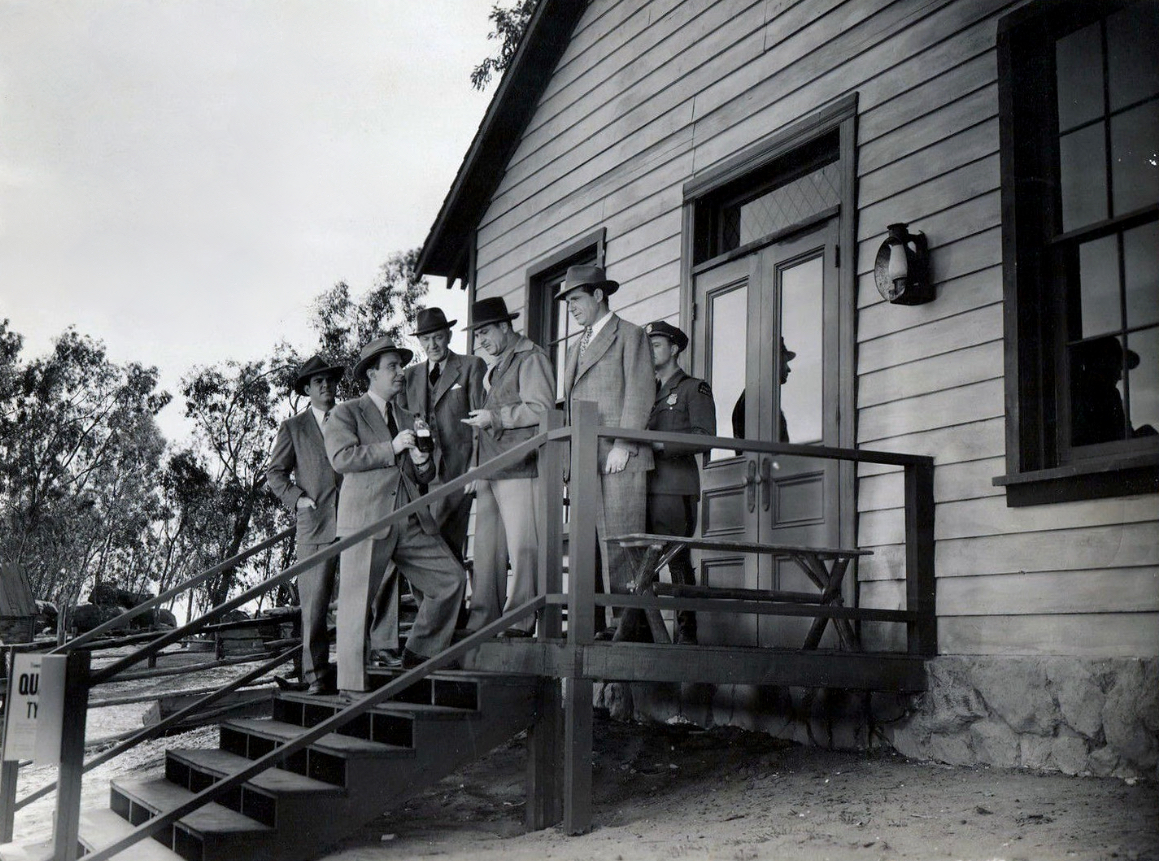
Promo still for "The Millerson Case" (1947): The Church debuts as a schoolhouse

It's not clear who built the Church, but it was probably originally put up as a set for either the Crime Doctor movie "The Millerson Case" or the Hopalong Cassidy movie "The Marauders."

"The Marauders" (1947): First appearance of the Church as a church

The two movies were released a month apart — "The Millerson Case" on May 29, 1947, followed by "The Marauders" on July 1 — and the Church/Schoolhouse was prominently featured in both productions.

1947 aerial photo, featuring the Western street — including the Church

One development since I last blogged about the Church almost a year ago was that a historic aerial photo of the area surfaced from 1947. Watermarks on the photo say 2011, but it only recently came into circulation.

This version of the 1947 aerial shot highlights the Church. The photo is not as clear as similar shots from other years, but you may be able to make out the Iverson Western street near the center of the frame.

2003 aerial photo: Indian Hills Mobile Home Village

Adapting the location of the Church from 1947 to a more recent aerial photo, we can see that the area where the Church was located is now occupied by the Indian Hills Mobile Home Village.

After a lot of time spent scouring old aerial photos and screen shots, I was able to determine that the tree noted here, in the 1947 aerial, was fake.

"The Marauders": Fake tree

Taking another look at the "Marauders" screen shot, I believe this is the fake tree. When I say "fake," I mean, it may have been a real tree, but it was brought in. It did not grow on that spot — and at some point around when the Church went away, so did the tree.

"Check Your Guns" (1948)

The fake tree appears in other productions as well, and from some angles appears almost perfectly round. Once you know to look for it, it does begin to look like a movie tree.

I believe this is the same fake tree seen in the 1947 aerial and in "The Marauders."

"Bat Masterson" TV series (footage from 1947, aired in 1961)

The fake tree appears to have been in place before the Church went up. It can be seen in the above shot filmed in 1947, just before the Church was built. The footage surfaced several years later in an episode of the TV series "Bat Masterson" titled "The Fatal Garment."

The fake tree is noted in this version of the "Bat Masterson" shot. I discussed other features of this shot in a recent entry on the Rainbow Mine Co. building, which you can see by clicking here.

"Check Your Guns" — west side of the Church

While many of the buildings on the Western street were fake fronts, it appears that the Church was a complete building with four sides and a roof, an observation that is corroborated by the 1947 aerial photo. The above shot from "Check Your Guns" provides a look at the west side of the building.

"The Marauders" — Hoppy & Co. outside the Church

We get another look at the same side of the building in "The Marauders," this time with a nice close view of that movie tree. It looks pretty realistic from this angle — but that's what movie trees are supposed to do.

1947: Schoolhouse turret vs. Church bell tower

I won't go into detail here about how the building transformed from a schoolhouse to a church, and back again. I covered that process in the earlier entry on the Church, which you can see by clicking here.

"The Hawk of Powder River" (Eddie Dean, 1948, from PRC)

Many of the Church's screen appearances were in low-budget B-Westerns from Producers Releasing Corp., which set up shop on the Iverson Western street for much of the 1940s. The Church is frequently seen in the background in PRC's Lash LaRue and Eddie Dean movies from 1947-1949.

This version of the "Hawk of Powder River" screen shot points out two nearby rocks that are closely associated with the Church: Gumdrop and Church Rock.

"Calamity Jane and Sam Bass" (Universal, 1949)

Taking a break from its duties as PRC background material, the Church had a featured role — and a rare color showcase — in "Calamity Jane and Sam Bass" in 1949. The Church appeared as a schoolhouse in the movie — note the rectangular tops on the windows, in contrast to other photos in this post.

"Oklahoma Justice" (1951)

Once the Church was gone, it was much easier to spot Gumdrop at the south end of the street. Church Rock, meanwhile, with its distinctive overhang, continued to hover up above.

Both Church Rock and Gumdrop remain in place today, just across the brick wall that runs along the southern boundary of the Indian Hills Mobile Home Village.


"The Iverson Movie Ranch Western street, one building at a time" is a series of posts on the movie and TV history of each of the major structures making up the Iverson Ranch's town set, which stood from 1944 to 1957 and appeared in hundreds of productions.


To see all of the posts in the series on the Iverson Western street, please click on the following links:

Part I: Casa Grande
Part II: The Livery Stable
Part III: The Saloon
Part IV: The Hotel
Part V: The General Store 
Part VI: The Barn
Part VII: The Sheriff's Office
Part VIII: The North and South Adobes
Part IX: The Lost Dutchman
Part X: The original north end of town
Part XI: The North and South Towers
Part XII: The Harness Maker
Part XIII: Rainbow Mine Co. 
Part XIV: The Church/Schoolhouse  
Part XV: The Corral Rocks Shack
Part XVI: The decline and fall of the Western street

Wednesday, April 16, 2014

The Two Towers of the old Iverson Church and Schoolhouse: A case for the Crime Doctor

I reported a few years back on the 1947 movie "The Millerson Case," part of a series of "Crime Doctor" movies from Poverty Row studio Larry Darmour Productions that starred Warner Baxter and were distributed to theaters by Columbia. Around that time, film historian Bill Sasser tipped me off that the movie had some interesting Iverson content, and wow, was he right.

"Crime Doctor" was originally a CBS radio program, airing from 1940-1947. The franchise expanded into feature films during that run, with 10 "Crime Doctor" movies released from 1943-1949.

Iverson Village as the town of Brook Falls in "The Millerson Case" (1947)

The "Crime Doctor" film series is set in the big city, and so it rarely ventures into rustic Iverson territory. But in "The Millerson Case" the lead character goes on a hunting trip and finds himself in a small country town called Brook Falls — with Iverson's Western street serving as the set for the town. The Iverson town set, often called El Paso Street or Iverson Village, was in place from 1945 until about 1957, appearing in hundreds of movies and early TV productions.

Here's another shot of Iverson Village from "The Millerson Case," which spends a lot of time in Brook Falls and offers a number of good shots of Iverson's Western street. This scene happens to feature a catfight in the middle of the street involving two of the ladies of Brook Falls. The stone building in the background is the Livery Stable.

Iverson Church, part of Iverson Village, as seen in "Check Your Guns" (1948)

This is the typical shot of Iverson Church, with this particular shot coming from the PRC B-Western "Check Your Guns." That's singing cowboy Eddie Dean riding into town on White Cloud. Iverson Church, at the south end of the street, had a much shorter lifespan than the town as a whole, standing only from about 1947-1949.

"The Millerson Case" (1947): Iverson Church in its original configuration, as a schoolhouse

"The Millerson Case" probably marks the earliest film appearance — by about a month — of the building that would become the Iverson Church, with the structure first surfacing here as a schoolhouse. Based on release dates and other details, it appears likely that the church — make that the schoolhouse — was built initially for "The Millerson Case," which came out in May 1947.

"The Marauders" (1947): The schoolhouse resurfaces as a church

One month after the release of "The Millerson Case" the structure appeared again in the Hopalong Cassidy feature "The Marauders," where it was reborn as a church. Both of these film appearances predate by a few months the first of what are probably the structure's most widely seen film roles, in a string of PRC-produced B-Westerns starring Eddie Dean and Lash LaRue.

The schoolhouse in "The Millerson Case"

Here's another shot of the schoolhouse in "The Millerson Case," showing the school building's original turret. The schoolhouse plays a central role in the plot of the movie — as headquarters for treating an outbreak of typhoid fever. The building is featured far more in "The Millerson Case" and "The Marauders" than in any other movie I've seen.

The church bell tower, in "The Marauders"

While the building ended up spending most of its brief movie career as a church, it appears it remained "convertible" — that is, it could be converted from church to schoolhouse, and back again, with only minor modifications.

You may or may not have noticed Hoppy sneaking up onto the roof in that last shot.

"The Marauders" (1947)

The building's conversion from schoolhouse to church involved mainly two cosmetic changes: adding or removing the arches above the two front windows — a procedure that included creating the illusion of stained glass — and reconfiguring the schoolhouse turret into the church steeple

Notice how the windows on the schoolhouse, left, become church windows with simple add-ons.

Here's a closer look at the conversion of the windows, as the process was handled in 1947 for "The Millerson Case," with the schoolhouse setup, and "The Marauders," with the fake arched church windows added. Also, the schoolhouse doors, which contain windows, have been replaced with what appears to be windowless doors for the church configuration.

It's hard to get a good look at the schoolhouse turret, which may have been used just once, in "The Millerson Case." It would have been a lot more trouble to change over the building's tower than it was to slap fake arches over the windows. For this reason I think the tower element of the conversion was done only once: when the building was finished being used as a schoolhouse for "The Millerson Case" and was converted into a church for "The Marauders," with the much taller church bell tower put in place.

"Calamity Jane and Sam Bass" (1949): back to the schoolhouse configuration — but not all the way back

When the building appears again as a schoolhouse two years later in "Calamity Jane and Sam Bass," the old window configuration has been revived but the building is still outfitted with the church's bell tower. It appears to me that this color B-Western from Universal, starring Howard Duff and Yvonne De Carlo, found a way around the costly conversion of the steeple back to a schoolhouse turret: Simply don't include much of the tower in the shot. (Even so, this shot includes enough of the turret that we can see it still includes the bell cutout from the church configuration.)

"The Westward Trail" (1948)

You may have already spotted Church Rock hovering over the building in some of the above shots. The above shot isn't the greatest picture quality, but the church and Church Rock are pointed out as they appear in PRC's Eddie Dean movie "The Westward Trail."

Here's another look at that schoolhouse shot from "Calamity Jane and Sam Bass," with Church Rock identified.

"Stage to Blue River" (1951)

By 1951 the church/schoolhouse was long gone — but of course Church Rock remained in place, as highlighted in the above promo still for the Whip Wilson B-Western "Stage to Blue River." Notice that the buildings of Iverson Village are mostly in pretty good shape here, although the roof of the Livery Stable, just above the shoulder of the stage driver, is showing some signs of wear.

This shot pinpoints the Livery Stable. 1951 and 1952 were peak years for Iverson Village, which began to deteriorate around this time. During the next five years it was seen increasingly as a ghost town.

"The Lone Ranger" TV show, "Ghost Town Fury" (first aired March 28, 1957) 

This image of a rundown Iverson Village was taken a few years later, in late 1956 or early 1957, when the town was soon to be dismantled. The shot comes from an episode of the TV show "The Lone Ranger" aired during the show's fifth and final season — the only season that was filmed in color. This view offers another look at Church Rock at the southwest end of town, along with its smaller neighbor, the important marker rock Gumdrop.

Here's the same shot from "The Lone Ranger," with some of the major features highlighted.

Church Rock in recent times

Church Rock continues to mark the spot today, although the spot now is filled largely with mobile homes. Nothing remains of the church itself, or of Iverson Village. In their place is the Indian Hills Mobile Home Village.

Gumdrop and Church Rock in recent times

Gumdrop can still be seen today too — at least the tip of it can. From this angle Gumdrop is to the left of Church Rock.


This blog entry is a new, hopefully improved version of a post I did back in 2010. If you're interested, you can click here to see my original post on "The Millerson Case" and the discovery that Iverson Church first appeared as a schoolhouse. You'll find that a little bit of the material I've covered here is duplicated in the 2010 post, and that original entry also includes some content that didn't make it into this update.

Below you will find links pointing you to Amazon pages where you can buy DVDs of some of the productions featured in this post.

Monday, July 19, 2010

The Church in Iverson Village


Here's a screen shot from "The Hawk of Powder River" (1948) showing the church at the southern end of Iverson Village, along with a large rock behind it (Church Rock, for lack of a better name) that has been helpful in determining where the village was located. The area where the town was built is now part of a trailer park off Topanga Canyon Boulevard, just south of the 118 freeway.

The Western town was built in 1945 for the Gary Cooper movie "Along Came Jones." It remained more or less intact and grew over the years, being used in a number of movies and TV shows through the 1960s. Inevitably, it met the fate that seems to befall all Western movie towns: It burned down. 

The church wasn't around in the very beginning but appeared early on. I've heard a theory that it was mobile and was put in place whenever the producers wanted a church in town. Personally I think it probably just existed for a certain period of time and if one were to track the movies in which it appears, one could approximate the years that made up its lifespan. (Update: New information has surfaced on the history of the church since this post. Check it out here.)

Trailers now occupy the former site of Iverson Village, but that same Church Rock can be seen still marking the spot. The slightly shorter rock to the left of it is Gumdrop, which is an even more reliable marker that appears in a lot of movies, identifying the southern end of town.

Monday, February 1, 2010

Iverson's Western street: The northern end of town ... and the demise of Smooth Hill


"The Hills of Utah" (1951) — Iverson Village looking north

I recently posted photos of the southern end of Iverson Village (you can click here to see that post), and this is what the rest of the town looked like. The shot above is from the Gene Autry B-Western "The Hills of Utah." Note the stone buildings on both sides of the street — the Saloon on the left and the Livery Stable on the right. Most Western movie towns were made of wood, so the buildings' stone appearance helps distinguish Iverson Village.

A number of the town's main structures are identified in this version of the shot, along with Smooth Hill, a landmark that sat just north of the town. The consensus for years among film historians was that the main street was oriented more or less north and south, although comparing the positions of Gumdrop and Church Rock, the marker rocks at the southern end of town seen in the earlier post, gave rise to the idea that the street would have had to be positioned at an angle, leaning a bit southwest to northeast.

Aerial photo of Sheep Flats, 1952

This idea was confirmed after the above aerial photo surfaced from 1952, when the Western town was still in place. The town was located on a sprawling flat area known as Sheep Flats, which is now occupied by the Indian Hills Mobile Home Village.

"Check Your Guns" (1948) — Smooth Hill (before Casa Grande was built)

I searched at Iverson Ranch for months for the hill at the north end of town, which I began calling Smooth Hill. It eventually became apparent, even though I had a hard time believing it at first, that the hill was gone. It turns out the thing was basically leveled when the 118 freeway went through in the 1960s. Chunks along the southern edge of the hill were blown away to put the freeway through, and while they were at it they lopped off the top of it.

The former site of Smooth Hill as it appears today, now occupied by apartments and condos

The destruction of Smooth Hill cleared the way for what is now a batch of condos and a couple of large apartment buildings sitting on that spot, overlooking the freeway just above the Topanga interchange.

"Rocky Mountain Rangers" (1940) — Smooth Hill, before the town was built

Smooth Hill was a presence in movies even before the Western street was built, as in the above example from Republic's Three Mesquiteers Western "Rocky Mountain Rangers." Not only was the hill a key marker identifying Iverson Village in the old movies, but it was also kind of famous in its own right — and its loss is felt.

"Calamity Jane and the Texan" (1950)

This shot from the Columbia Western "Calamity Jane and the Texan" shows more of the eastern side of the street, and provides a look at Oat Mountain to the north — the series of hills with streaks of white, in the background. One of the markers on Oat Mountain, the Triangle Brand, is also visible, at the top of the photo, toward the left, partially hidden behind a small hill (Notch Hill).

Here's the same screen shot with some of the key features highlighted. The town set is also called El Paso Street, after its role in the 1949 movie "El Paso." Once again, for a look at the southern end of the Western street, please click here.